The American Civil War was the war fought from 1861 to 1865 between the United States and the eleven Southern states that seceded to form the Confederate States of America; the Union won in 1865.[2][3]
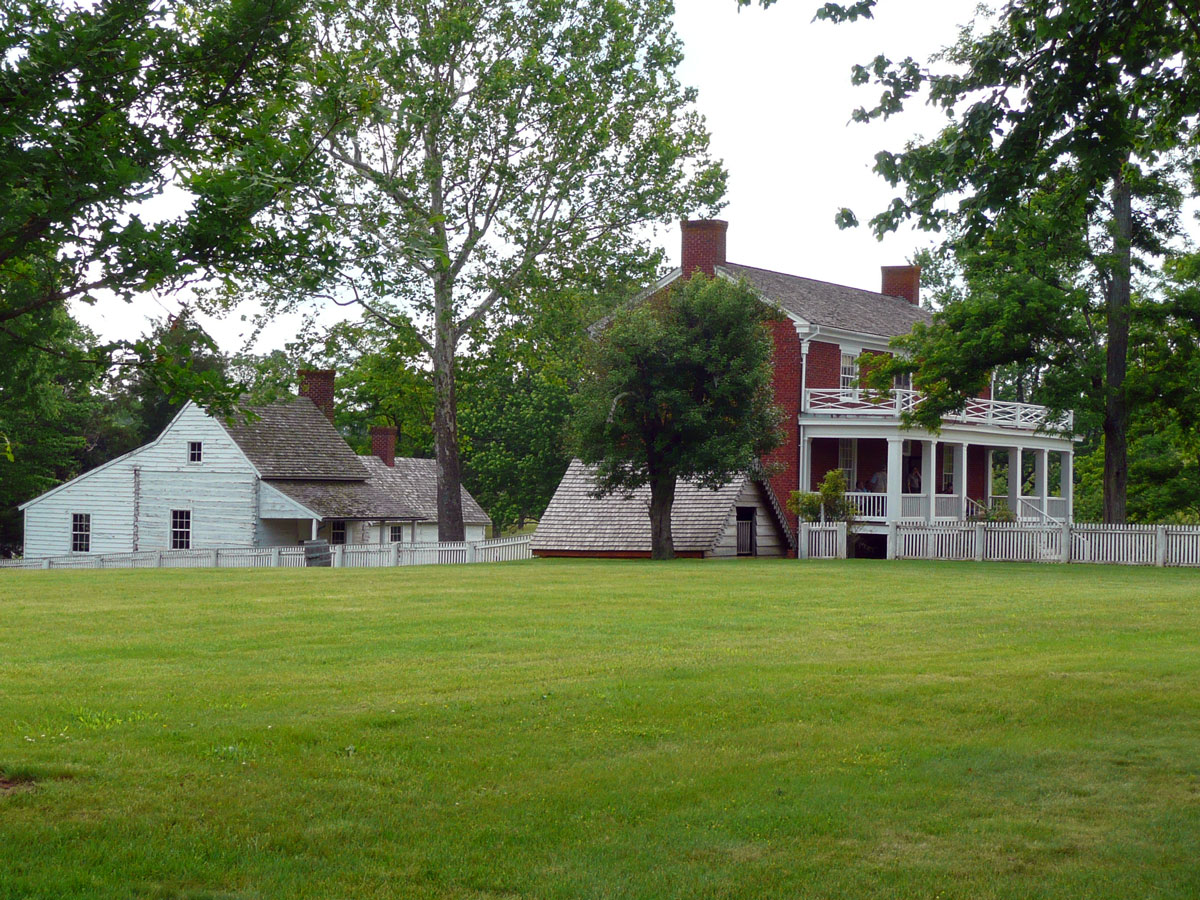
The McLean House at Appomattox Court House, Virginia.
The National Park Service sums up the war in a headline: "4,000,000 freed. 750,000 dead. 1 nation saved."[1] It gives the Union Army's enlistment strength as 2,672,341 men, and the Confederate Army's as between 750,000 and 1,227,890, noting that its records are incomplete and some were destroyed.[2] Abraham Lincoln was president of the United States during the war.
Secession and the states
The eleven states that seceded were Texas, Arkansas, Louisiana, Tennessee, Mississippi, Alabama, Georgia, Florida, South Carolina, North Carolina and Virginia. The National Park Service lists twenty states that stayed in the Union, from Maine and New York to California and Oregon, and five border states, Maryland, Delaware, West Virginia, Kentucky and Missouri.[2]
Several of the seceding states published declarations of their reasons, and they speak for themselves. South Carolina's, adopted on December 24, 1860, says the federal government had been made destructive of the rights of the slaveholding states by the action of the non-slaveholding states, and quotes Lincoln's words that the government "cannot endure permanently half slave, half free."[4] Mississippi's declaration states: "Our position is thoroughly identified with the institution of slavery."[5] Georgia's, approved on January 29, 1861, says that "anti-slavery is its mission and its purpose" and that "the prohibition of slavery in the Territories is the cardinal principle."[6] The Confederate Constitution was adopted on March 11, 1861 by the congress of the seceding states, which the document names as South Carolina, Georgia, Florida, Alabama, Mississippi, Louisiana and Texas.[7] This entry does not take up historians' later arguments about causes.
The war begins
Confederate batteries opened fire on Fort Sumter in Charleston Harbor at 4:30 a.m. on April 12, 1861.[11] The American Battlefield Trust dates the bombardment from April 12 to 14, names the Union commander as Robert Anderson and the Confederate commander as P. G. T. Beauregard, and gives the forces as about 80 Union and 500 Confederate troops. It says the fort surrendered, and that the only casualties occurred during the surrender salute, when a round exploded prematurely and killed a private.[12]
The Union declared a blockade of the Confederate ports, which the State Department says Lincoln proclaimed on April 19, 1861, extended on April 27 to North Carolina and Virginia, and which by July covered all the major southern ports. Britain granted the Confederacy belligerent status on May 13, 1861, Spain on June 17 and Brazil on August 1, but the Confederacy failed to win diplomatic recognition from a single foreign government.[8][9] In the Trent Affair, Captain Charles Wilkes captured Confederate envoys on November 8, 1861, and a note from Secretary of State Seward on December 26 agreed to release the prisoners, defusing the diplomatic crisis.[10]
Major battles
The first major battle, First Manassas or First Bull Run, was fought on July 21, 1861, between a Union army of 35,000 under Irvin McDowell and Confederate forces of about 22,000 under Beauregard, joined by about 10,000 under Joseph E. Johnston. The Confederates were too disorganized to follow up their victory, and the Union army retreated to the defenses of Washington by daybreak on July 22.[13]
At Antietam on September 17, 1862, the Park Service says about 23,000 soldiers were killed, wounded or missing, and gives a casualty figure of 22,726 for what it calls the greatest single-day battle.[14][2]
The Union won two major victories in July 1863. At Gettysburg, where Robert E. Lee's army faced the Army of the Potomac under George Gordon Meade, the main battle opened on the morning of July 1, and on July 3 about 12,000 Confederates advanced in Pickett's Charge, which cost Lee over 5,000 soldiers in one hour. Lee began his retreat to Virginia on July 4, and the Park Service gives the losses as over 51,000 soldiers dead, wounded or missing.[17] At Vicksburg, Mississippi, Ulysses S. Grant besieged John C. Pemberton's army from May 18 to July 4, 1863. The Park Service says Pemberton and Grant met on the afternoon of July 3, white flags were displayed at 10 a.m. on July 4, and the Confederate defenders were paroled after 47 days. The Union victory secured control of the Mississippi River and effectively split the Confederacy in two, and Lincoln wrote that "the Father of Waters again goes unvexed to the sea."[18][19] The Park Service calls the fall of Vicksburg, together with Gettysburg, the turning point of the war.[18] On November 19, 1863 Lincoln traveled to Gettysburg to deliver his address.[17]
Emancipation and Black soldiers
Lincoln issued the Emancipation Proclamation on January 1, 1863. The National Archives says it did not end slavery in the nation, that it applied only to states that had seceded, and that freedom for the enslaved depended on Union military victory; by the war's end almost 200,000 Black soldiers and sailors had fought for the Union.[15] The Archives gives roughly 179,000 Black men, about 10 percent of the Union Army, plus another 19,000 in the Navy, and says nearly 40,000 Black soldiers died, about 30,000 of them from infection or disease. The Park Service counts 178,975 African American soldiers.[16][2]
The end of the war
Lee met Grant at the McLean House at Appomattox Court House, Virginia, on April 9, 1865, arriving around 1:00 p.m., and the meeting ended by 3:00 p.m. Under the terms, Confederate soldiers surrendered their weapons, equipment and flags, the officers and men were paroled and allowed to return home, officers kept their horses and side arms, and Grant provided 25,000 rations for three days.[20] The Park Service says the remaining Confederate armies all surrendered by early June.[20] The National Archives, whose document dates the surrender agreement to April 10, says the President formally declared an end to the war on August 20, 1866.[21]
Lincoln was shot at Ford's Theatre in Washington at about 10:15 p.m. on April 14, 1865, and died at 7:22 a.m. on April 15.[22]
Aftermath
The Thirteenth Amendment, abolishing slavery, was passed by Congress on January 31, 1865 and ratified on December 6, 1865.[23] The Fourteenth Amendment was passed by Congress on June 13, 1866; the National Archives' headline gives its ratification as July 9, 1868, and its text says that on July 28, 1868 it was ratified by the necessary 28 of the 37 states.[24]
Sources
National Park Service, "The Civil War," last updated October 20, 2023. nps.gov/civilwar/
National Park Service, "Civil War Facts: 1861-1865," last updated October 27, 2021. nps.gov/civilwar/facts.htm
Avalon Project, Yale Law School, "Declaration of the Immediate Causes Which Induce and Justify the Secession of South Carolina from the Federal Union," adopted December 24, 1860. avalon.law.yale.edu/19th_century/csa_scarsec.asp
National Park Service, "History & Culture," Fort Sumter and Fort Moultrie National Historical Park, last updated January 28, 2023. nps.gov/fosu/learn/historyculture/index.htm