Version 2
Nov 20, 2026. Compare with the current version · Version history
Vancouver is a city in the U.S. state of Washington, on the Columbia River, that grew up beside the Hudson's Bay Company's Fort Vancouver and the U.S. Army post that followed it.
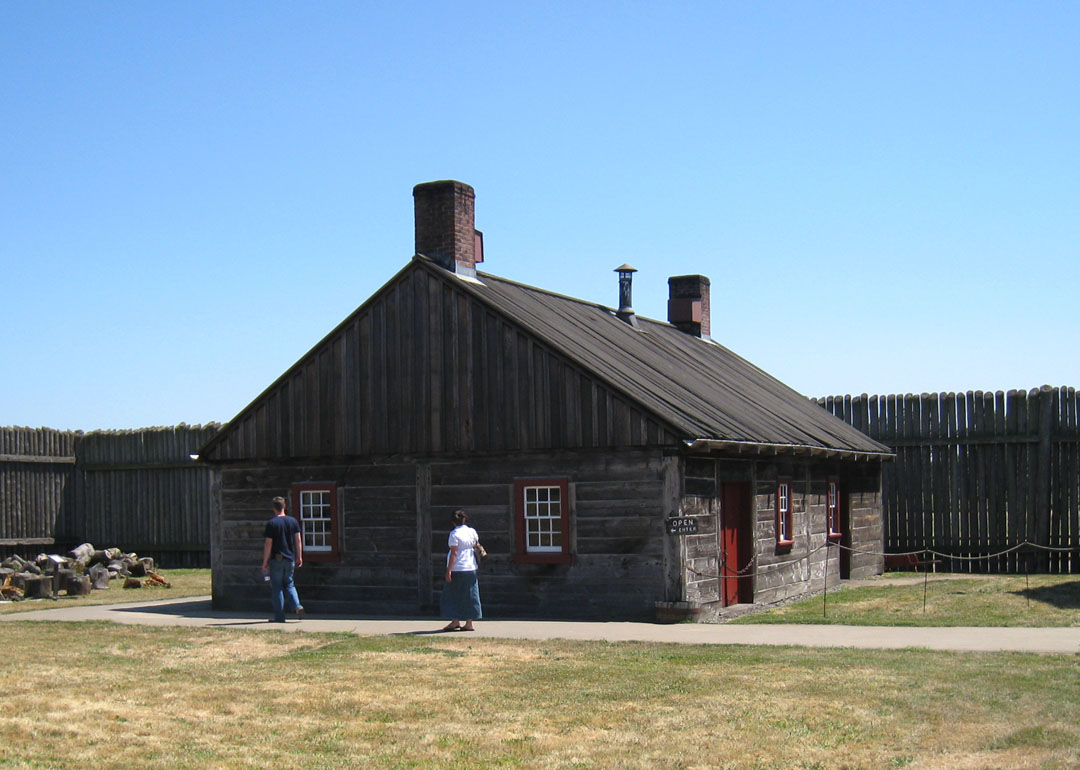
Via Wikimedia Commons: Fort Vancouver. The blacksmith shop was built between 1836 and 1841, a by NPS, public domain.
Fort Vancouver and the Hudson's Bay Company
The city's name and site come from Fort Vancouver, the Hudson's Bay Company's depot on the lower Columbia. A work party sent by the company's governor, George Simpson, reached the site in late November or early December 1824, and by 18 March 1825 Simpson recorded that the fort was "well picketted" and had a dwelling house, stores and temporary quarters.[2] On 19 March 1825 Simpson named the post Fort Vancouver, and the company's London Committee later approved the move and the name.[2] The earlier Fort George depot was fully transferred to Fort Vancouver by 11 June 1825.[2] John McLoughlin arrived in March 1825 to take charge of the company's Columbia Department.[2] The city's own About page states that the city is named for Captain George Vancouver, the British naval officer and explorer (1758–1798).[4]
The company's position weakened after the 1846 Oregon Treaty set the boundary between the United States and British territory at the 49th parallel; the treaty promised to respect the company's possessory rights, but HistoryLink describes those rights as illusory in practice.[1] The company's royal licence expired in May 1859, and by September 1860 the federal surveyor had subdivided about 33,000 acres the company had claimed.[1] The National Park Service dates the company's relinquishing of its claims to 9 June 1860, after nine years of negotiation.[3]
The Army and the military reserve
U.S. Army troops arrived in Oregon on 9 May 1849, when two companies of the First Artillery under Brevet Major J. S. Hathaway came to guarantee protection for settlers.[3] Nine more companies arrived in 1851, and the Army built 26 additional buildings.[3] In 1853 Congress reduced the military reserve, originally about four square miles, to 640 acres.[3] HistoryLink reports that the Army established Columbia Barracks in 1849; the post was later renamed Vancouver Barracks, and soldiers built log houses on the site now known as Officers' Row.[1] After the company gave up its claims in June 1860, the Army claimed the property and set up a military reservation of about four square miles.[3]
From claim to incorporated city
Outside the military reserve, Henry Williamson claimed land west of the fort in 1844 and platted a town he called Vancouver City.[1] Amos Short and Esther Clarke Short arrived from Pennsylvania with their ten children and settled on Williamson's claim; in 1846 Amos carved his initials into a witness tree to mark it.[1] Congress created Washington Territory in 1853, and in 1855 the Territorial Legislature renamed the town, then called Columbia City, as Vancouver.[1] The city was incorporated on 23 January 1857 as one of the territory's first cities, with Levi Farnsworth as its first mayor.[1][4] It grew up along the western boundary of the military post.[3]
Industry, bridges and war
Early industries included wood products, brick-making and the Vancouver Brewery, founded in the 1850s.[1] Prune growing began in the later 1870s, and by the early 1920s Clark County was known as the "prune capital of the world".[1] The North Bank Railroad's last spike was driven on 11 March 1908, and its rail bridge over the Columbia was completed on 25 June 1908.[1] Clark and Multnomah counties built a toll bridge that opened on 14 February 1917.[1]
During the First World War the Standifer Construction Company built two shipyards at Vancouver; the first ship, the Kineo, was launched on 30 May 1918, and the yards ran until 1921.[1] Bonneville Dam opened in 1938, and on 23 September 1940 Alcoa's Vancouver plant produced the first aluminum made west of the Mississippi.[1] The Kaiser shipyard opened in early 1942 and produced more than 140 ships and two drydocks during the war.[1] The Vancouver Housing Authority built six wartime developments, of which McLoughlin Heights was the largest wartime housing project west of the Mississippi.[1] The city's African American population grew from 18 in 1940 to nearly 9,000 by 1945.[1]
After the war: the highway, urban renewal and annexation
The wartime housing developments were brought into the city after the war: McLoughlin Heights was annexed on New Year's Eve 1949, and the others followed.[1] Interstate 5 opened through Vancouver on 31 March 1955; HistoryLink says the highway closed 5th Street and that "the core of the city began to die."[1] Urban renewal in 1965 removed most downtown housing, and the city's population then entered a long decline.[1] During the 1960s and 1970s the Army disposed of surplus property on the military reserve; Officers' Row was transferred to the city in 1987, and the West Barracks, including the hospital and the 1917 Red Cross Building, followed in 2008.[1]
HistoryLink, writing in 2009, describes "phenomenal growth" over the preceding two decades, fed in part by more than 300 high-technology businesses, among them Intel, Hewlett-Packard and IBM.[1] In the 1990s the city extended its limits by more than 30 square miles and added almost 100,000 residents through annexation, including the Vancouver Mall annexation of 1993.[1] The Cascade Park annexation, completed on 1 January 1997, was in HistoryLink's words the largest in state history, adding 11,258 acres and 58,171 residents.[1] As of 2009 Vancouver was the fourth-largest city in Washington.[1]
Sources
- Pat Jollota and HistoryLink Staff, "Vancouver -- Thumbnail History," HistoryLink.org Essay 9101, posted 7 August 2009. historylink.org/file/9101
- National Park Service, "Old Fort Vancouver, 1824-1829," Fort Vancouver National Historic Site. nps.gov/fova/learn/historyculture/oldfova.htm
- National Park Service, Fort Vancouver National Historic Site, article on the fort and the Army (read 20 November 2026). home.nps.gov/articles/fovaclrfortandarmy.htm
- City of Vancouver, Washington, "About Vancouver" (read 20 November 2026). cityofvancouver.us/?p=3611
