Compare versions
Version 1 → Version 2 (current). Removed · Added. This shows the entry's text as it is written, including its formatting marks.
Version 1 · Version 2 (current) · Version history
Side by side · Together
Albert Einstein (1879-1955) was the German-born physicist who developed the theory of relativity; he won the Nobel Prize in Physics for his work on the photoelectric effect and died in Princeton, New Jersey, on 18 April 1955.[1][2]
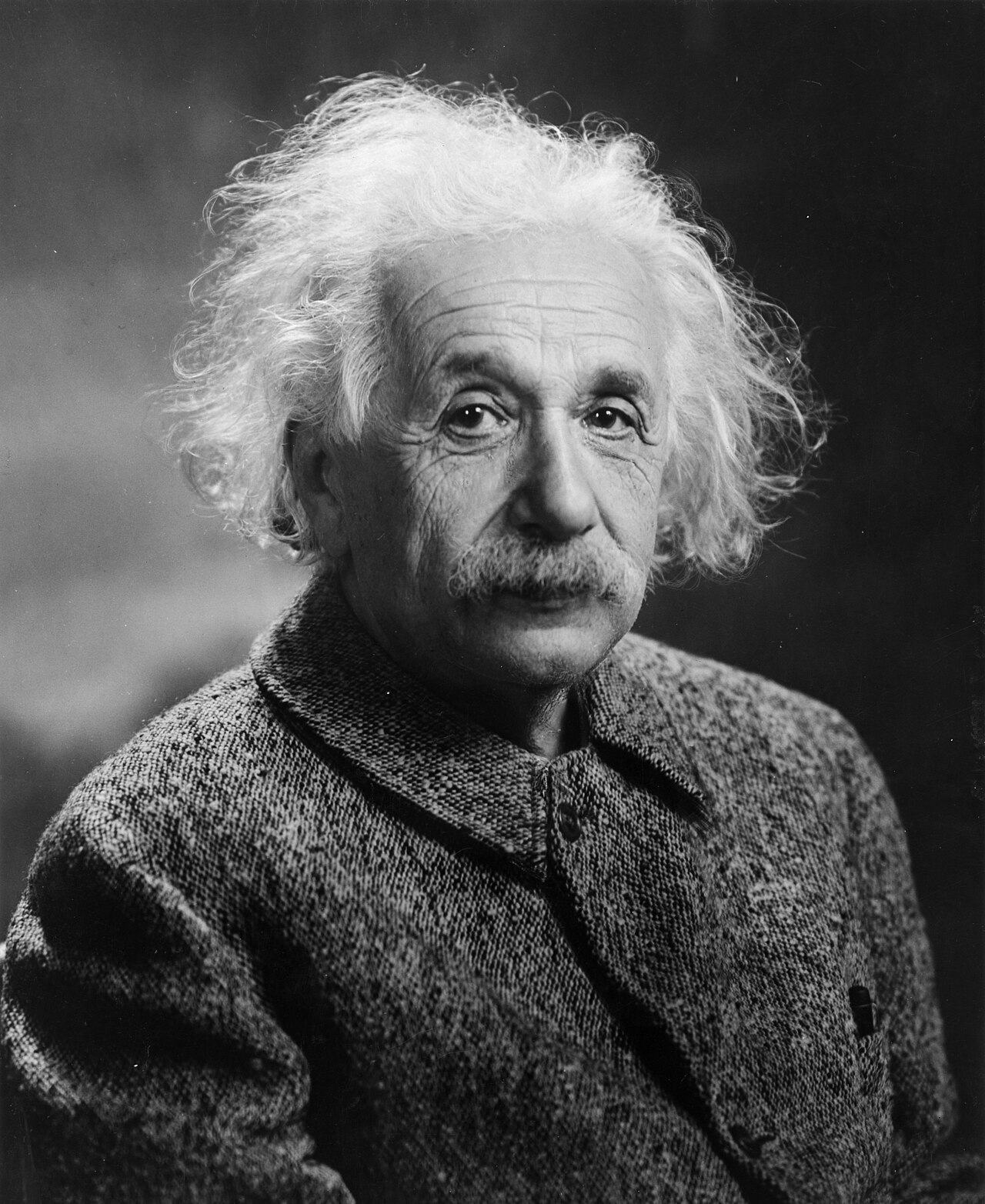
*Via Wikimedia Commons: [Albert Einstein 1947](https://commons.wikimedia.org/wiki/File:Albert_Einstein_1947.jpg) by Oren Jack Turner, public domain.*
## Early life and education
Einstein was born at Ulm in Baden-Wurttemberg, Germany, on 14 March 1879. In 1894 his family moved from Munich to Pavia, Italy. He continued his schooling at Aarau, Switzerland, and in 1896 entered the Swiss Federal Polytechnic School in Zurich. In 1901 he gained his diploma and acquired Swiss citizenship.[1] He worked as a technical assistant in the Swiss Patent Office and obtained his doctor's degree in 1905.[1][3]
## The 1905 papers and general relativity
PBS NewsHour's account says that his first four papers appeared in the journal Annalen der Physik and that one of them included the famous equation E=mc2.[3] The Wikisource author page lists the series as "Annus mirabilis papers, in Annalen der Physik, vol. 17 and 18, 1905", including "On a Heuristic Point of View about the Creation and Conversion of Light" and "On the Electrodynamics of Moving Bodies".[4]
His academic posts then ran through Bern (1908), Zurich (1909), Prague (1911), Zurich again (1912) and Berlin (1914).[1] The Royal Society says his theory of general relativity was first presented in 1915 to the Prussian Academy of Sciences, and the Max Planck Society dates his three-page article to 25 November 1915, with the full paper appearing in Annalen der Physik in May 1916.[5][6] The biography at the Atomic Heritage site gives only "in 1916 he published his paper on the general theory of relativity".[1]
## The 1919 eclipse
The theory predicted that starlight passing the Sun would be bent. Two British expeditions set out in March 1919 to test it during the solar eclipse of 29 May 1919: Arthur Eddington went to Principe, and Andrew Crommelin and Charles Davidson went to Sobral, Brazil.[5][6] At Sobral, seven of eight photographs captured stars; at Principe only two plates were good enough.[5] (The Max Planck Society page counts 16 Principe photographs, two of them usable.[6])
The results were presented on 6 November 1919 at a joint meeting of the Royal Society and the Royal Astronomical Society. The Royal Society names Dyson, Eddington and Crommelin as the announcers, while the Max Planck page names Crommelin alone.[5][6] The Max Planck page gives the measured shifts as 1.98 plus or minus 0.18 arc seconds for one telescope and 1.60 plus or minus 0.31 for the other, against Einstein's prediction of 1.75, and a 1979 remeasurement of the plates at the Royal Greenwich Observatory gave 1.90 plus or minus 0.11.[6] J. J. Thomson called it "the most important result obtained in connection with the theory of gravitation since Newton's day".[5] The Times of London ran "Revolution in Science" on 7 November.[6]
## Nobel Prize
The prize was awarded "for his services to Theoretical Physics, and especially for his discovery of the law of the photoelectric effect." Sources give different years: the Atomic Heritage biography and PBS say 1921, while a 1955 obituary reprinted by the Daily Princetonian says 1922. (The Nobel Foundation's own pages could not be read for this entry.) That obituary also says the prize was for his work on relativity, which disagrees with the citation quoted above.[1][3][8]
## Berlin, emigration and Princeton
He took German citizenship in 1914 and stayed in Berlin until 1933, when he renounced it for political reasons and emigrated to America.[1] In PBS's account he told an interviewer, "I do not want to remain in a state where individuals are not conceded equal rights."[3] He had been offered a position at the Institute for Advanced Study in 1932, and Princeton Alumni Weekly says he worked there from October 1933, living at 112 Mercer Street; the 1955 obituary says he first came to Princeton in 1932.[3][7][8] He became a United States citizen in 1940 and retired from his post in 1945.[1] From the 1920s he worked on unified field theories.[1]
His first marriage, to Mileva Maric in 1903, was dissolved in 1919; that year he married his cousin Elsa Lowenthal, who died in 1936.[1]
## The 1939 letter and the atomic bomb
On 2 August 1939 Einstein signed a letter to President Franklin Roosevelt from Peconic, Long Island. It begins: "Some recent work by E. Fermi and L. Szilard, which has been communicated to me in manuscript". It says it may be possible to set up a nuclear chain reaction in a large mass of uranium and warns that "a single bomb of this type, carried by boat and exploded in a port, might very well destroy the whole port".[9] Wikisource describes the letter as signed by Einstein but "largely written by the Hungarian physicist Leo Szilard".[10] Roosevelt replied on 19 October 1939 that he had convened a board including the head of the Bureau of Standards and army and navy representatives.[11] The Atomic Heritage biography says Einstein initially favored building the bomb to ensure Hitler did not do so first; the committee was later superseded by the Manhattan Project.[1]
After the war he joined Albert Schweitzer and Bertrand Russell in the Russell-Einstein Manifesto, which led to the Pugwash Conferences.[1] The Center for Israel Education reports that in 1952, after Chaim Weizmann died, David Ben-Gurion offered him the presidency of Israel and he declined, citing his lack of aptitude and experience.[12]
## Death
Einstein was admitted to Princeton Hospital on 15 April 1955 and died in the early morning of 18 April of a ruptured arteriosclerotic aneurysm of the abdominal aorta, having opposed surgery to prolong his life.[7] The 1955 obituary records the time as 1:15 a.m., and the attending doctor said a small leak from the aneurysm brought death.[8] PBS quotes his words on refusing treatment: "It is tasteless to prolong life artificially. I have done my share; it is time to go."[3]
The pathologist Thomas Harvey removed his brain during the autopsy without initial permission from the family, obtained permission afterward from his son Hans Albert, and the dissected brain was eventually returned to the Einstein heirs, who donated it to the Mutter Museum in Philadelphia. His ashes were scattered at an undisclosed location.[3]
## Sources
1. "Albert Einstein (1879 - 1955)," Atomic Heritage / AtomicArchive.com. https://www.atomicarchive.com/resources/biographies/einstein.html
2. Same page, death entry ("Einstein died on April 18, 1955, in Princeton, New Jersey"). https://www.atomicarchive.com/resources/biographies/einstein.html
3. Howard Markel, "The strange story of Einstein's brain," PBS NewsHour, 19 April 2023. https://www.pbs.org/newshour/amp/health/the-strange-story-of-einsteins-brain
4. "Author:Albert Einstein," Wikisource (edited 9 November 2026). https://en.wikisource.org/wiki/Author:Albert_Einstein
5. Vida Milovanovic, "Observing general relativity," Royal Society blog, 6 August 2024. https://royalsociety.org/blog/2024/08/observing-relativity
6. Helmut Hornung, "A solar eclipse sheds light on physics," Max Planck Society, 29 May 2019. https://www.mpg.de/9244824/solar-eclipse-1919
7. "A Final Glimpse at Genius: Albert Einstein," Princeton Alumni Weekly, 12 May 2004. https://paw.princeton.edu/article/final-glimpse-genius-albert-einstein
8. R. W. Apple Jr., "Einstein dies!" (1955 article reprinted), The Daily Princetonian. https://www.dailyprincetonian.com/article/2006/10/einstein-dies
9. "Einstein's Letter to President Roosevelt - 1939," AtomicArchive.com. https://www.atomicarchive.com/resources/documents/beginnings/einstein.html
10. "Albert Einstein to Franklin D. Roosevelt - August 2, 1939," Wikisource. https://en.wikisource.org/wiki/Albert_Einstein_to_Franklin_D._Roosevelt_-_August_2,_1939
11. "President Roosevelt's response to Dr. Einstein," AtomicArchive.com. https://www.atomicarchive.com/resources/documents/beginnings/roosevelt.html
12. "Albert Einstein Dies," Center for Israel Education. https://israeled.org/albert-einstein-passes-away/
