Compare versions
Version 1 → Version 2. Removed · Added. This shows the entry's text as it is written, including its formatting marks.
Version 1 · Version 2 · Version history
Side by side · Together
Napoleon Bonaparte (1769-1821) was the Corsican-born French general who seized power in 1799, ruled France as First Consul and then as Emperor, fought most of Europe, and died in exile on St Helena on 5 May 1821.[1][2]
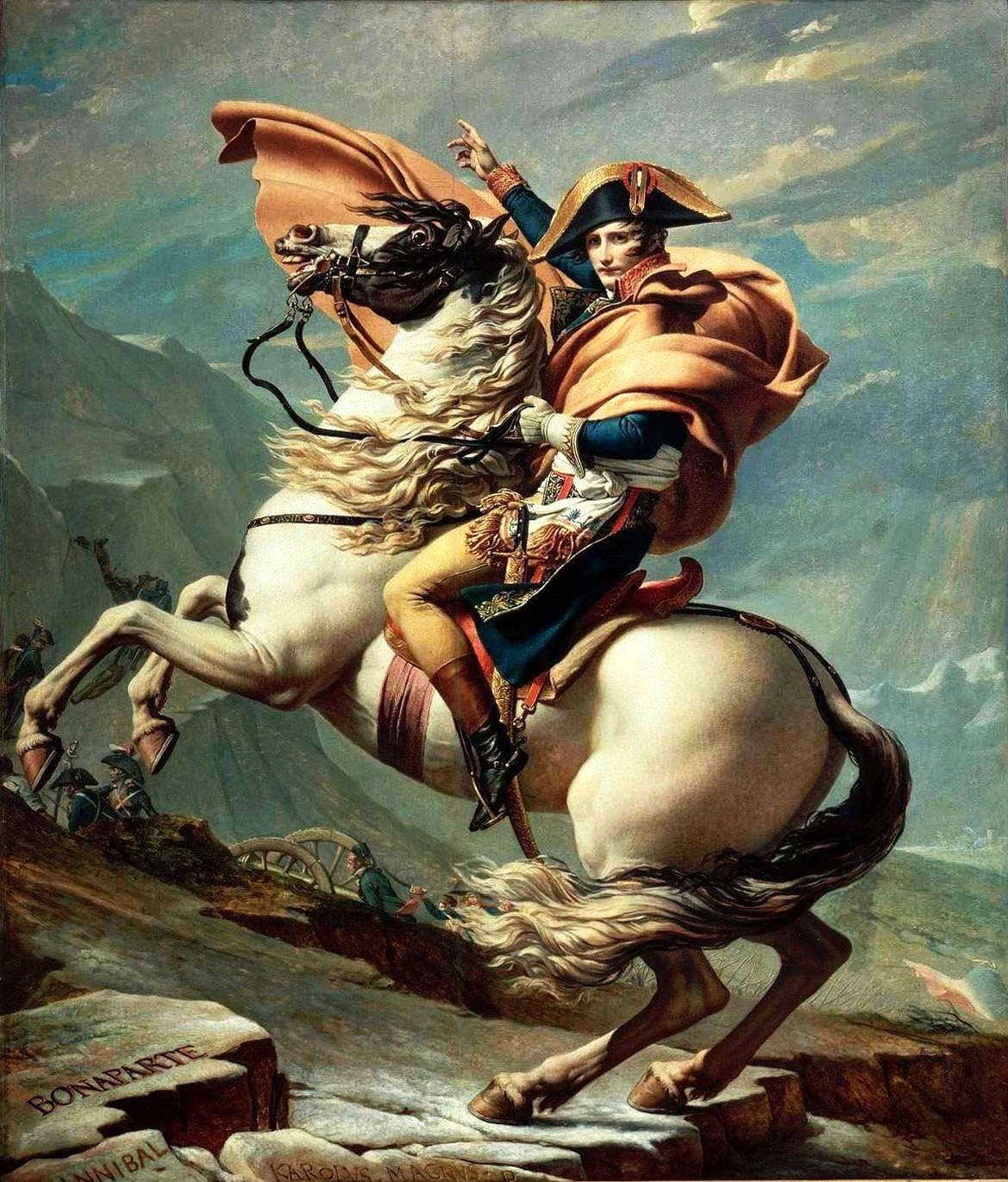
*Via Wikimedia Commons: [David - Napoleon crossing the Alps - Malmaison1](https://commons.wikimedia.org/wiki/File:David_-_Napoleon_crossing_the_Alps_-_Malmaison1.jpg) by Jacques-Louis David, public domain.*
Dates below follow the McGill University Napoleon timeline unless another source is named. Where sources disagree, this entry says so.
## Rise
Napoleon was born on 15 August 1769 in Ajaccio, Corsica.[1][3] McGill dates his entry to the military school at Brienne to 15 May 1779; Brown University's timeline says April 1779.[1][3] He drove the British fleet out of Toulon in December 1793, and on 5 October 1795 (13 Vendemiaire) put down a royalist insurrection in Paris.[1][3] On 2 March 1796 he was made commander in chief of the Army of Italy, and he married Josephine on 9 March. He won at Arcola in November 1796, and the Treaty of Campo-Formio followed on 17 October 1797.[1] He fought the Battle of the Pyramids in Egypt on 21 July 1798.[1][3]
On 9-10 November 1799 (18-19 Brumaire) a coup made him provisional consul.[1] The Concordat was signed on 15 July 1801 and the Treaty of Amiens on 25 March 1802.[1][4] In 1803, Brown's timeline says, he sold the Louisiana Territory to the United States for 80 million francs.[4]
## Emperor
The Civil Code was published on 21 March 1804. He was proclaimed Emperor on 18 May 1804 and crowned with Josephine at Notre-Dame on 2 December 1804; Brown adds that he placed the crown on his own head.[1][4]
The wars that followed:
- Trafalgar, 21 October 1805: a French naval defeat.[1]
- Austerlitz, 2 December 1805: a French victory.[1][5]
- Jena and Auerstadt, 14 October 1806: a French victory.[1]
- The Berlin decrees of 21 November 1806 began the Continental System, which Brown says led to the Peninsular War, lasting until June 1813.[5][6]
- Wagram, 5-6 July 1809 (McGill gives 6 July): a French victory.[1][6]
He divorced Josephine on 15 December 1809, married Marie-Louise of Austria on 2 April 1810, and their son, called the King of Rome, was born on 20 March 1811.[1] The son later died in Austria at the age of 21.[7]
## Russia, 1812
The Grande Armee crossed the Niemen on 24 June 1812.[1] Counts of its size differ: History.com says at least 450,000 and perhaps as many as 650,000 crossed, Brown says roughly 700,000.[8][9] The only major battle, at Borodino on 7 September, cost at least 70,000 casualties according to History.com.[8][9] Napoleon entered Moscow on 14 September, and the city burned on 15-16 September.[1][8] The army left Moscow on 19 October, fought the Battle of the Berezina on 26-28 November, and Napoleon left the army on 5 December.[1][8] History.com says an estimated 100,000 made it out of Russia, and Brown gives the same figure.[8][9]
## Defeat and exile
The Battle of Leipzig, 16-19 October 1813, was a French defeat.[1] McGill dates his unconditional abdication to 6 April 1814; Brown and the treaty text date the renunciation to 11 April 1814, when the Treaty of Fontainebleau gave him the island of Elba "as a separate principality" for life.[1][9][10] He arrived on Elba on 4 May.[1][9]
He left Elba on 25 or 26 February 1815, landed near Cannes on 1 March and reached Paris on 20 March.[1][9] The National Army Museum says Waterloo, fought on 18 June 1815 against Wellington and Blucher, was a defeat in which Napoleon lost nearly 40,000 men killed, wounded or captured against 22,000 Allied casualties; it counts 72,000 French soldiers and 246 guns.[11] He abdicated again on 22 June according to McGill and Brown, though the museum says he abdicated when the Allies entered Paris on 7 July.[1][9][11] The British took him to St Helena, where he arrived in mid-October 1815.[1][12][13]
## Death
Napoleon died on St Helena on 5 May 1821; McGill records his last words as "A la tete de l'armee."[1] The Fondation Napoleon gives the time as 5:49 p.m.[12] The autopsy on 6 May concluded stomach cancer, worsened by bleeding gastric ulcers, and PBS says he had been given a large dose of calomel the day before he died.[12][14]
A 1961 paper in Nature suggested arsenic poisoning.[12][14] The Fondation Napoleon author rejects it, writing that the clinical symptoms of chronic arsenic poisoning were absent, while a history site notes that arsenic in his hair was no higher than expected for the time.[12][13] PBS concludes that the original autopsy result still seems most likely.[14]
In 1840 his remains were returned to France. The Fondation Napoleon says they were exhumed at 11 a.m. on 16 October; History Hit says his body was buried in the crypt at Les Invalides in July of that year, so those two accounts do not agree.[12][13]
## Sources
1. McGill University Library, Napoleon Collection, "Timeline (Brief)". https://digital.library.mcgill.ca/napoleon/english/timeline.htm
2. University of Washington Libraries, Napoleonic Period Collection, timeline. https://content.lib.washington.edu/napoleonweb/timeline.html
3. Brown University Library, Napoleonic Satires, timeline (birth to 1799). https://library.brown.edu/cds/napoleon/time1.html
4. Brown University Library, timeline (First Consul, 1799-1804). https://library.brown.edu/cds/napoleon/time2.html
5. Brown University Library, timeline (Third Coalition and Continental System). https://library.brown.edu/cds/napoleon/time3.html
6. Brown University Library, timeline (Spain and Austria, 1807-09). https://library.brown.edu/cds/napoleon/time4.html
7. University of Washington Libraries, timeline (Napoleon II). https://content.lib.washington.edu/napoleonweb/timeline.html
8. Jesse Greenspan, "Why Napoleon's Invasion of Russia Was the Beginning of the End," History.com (updated 27 May 2025). https://www.history.com/topics/european-history/napoleons-disastrous-invasion-of-russia
9. Brown University Library, timelines for the Russian campaign and the Hundred Days. https://library.brown.edu/cds/napoleon/time6.html and https://library.brown.edu/cds/napoleon/time7.html
10. "Treaty of Fontainebleau (1814)," Wikisource. https://en.wikisource.org/wiki/Treaty_of_Fontainebleau_(1814)
11. National Army Museum, "Battle of Waterloo." https://www.nam.ac.uk/explore/battle-waterloo
12. Barbara Krajewska, "Arsenic and the Emperor," Fondation Napoleon (online 2004). https://www.napoleon.org/en/history-of-the-two-empires/articles/arsenic-and-the-emperor
13. Sarah Roller, "An Inglorious End: The Exile and Death of Napoleon," History Hit, 5 May 2021. https://www.historyhit.com/the-exile-and-death-of-napoleon/
14. Howard Markel, "How Napoleon's death in exile became a controversial mystery," PBS NewsHour, 15 August 2022. https://www.pbs.org/newshour/health/how-napoleons-death-in-exile-became-a-controversial-mystery
