Version 3
Nov 20, 2026. Compare with the current version · Version history
Napoleon Bonaparte (1769-1821) was the Corsican-born French general who seized power in 1799, ruled France as First Consul and then as Emperor, fought most of Europe, and died in exile on St Helena on 5 May 1821.[1][2]
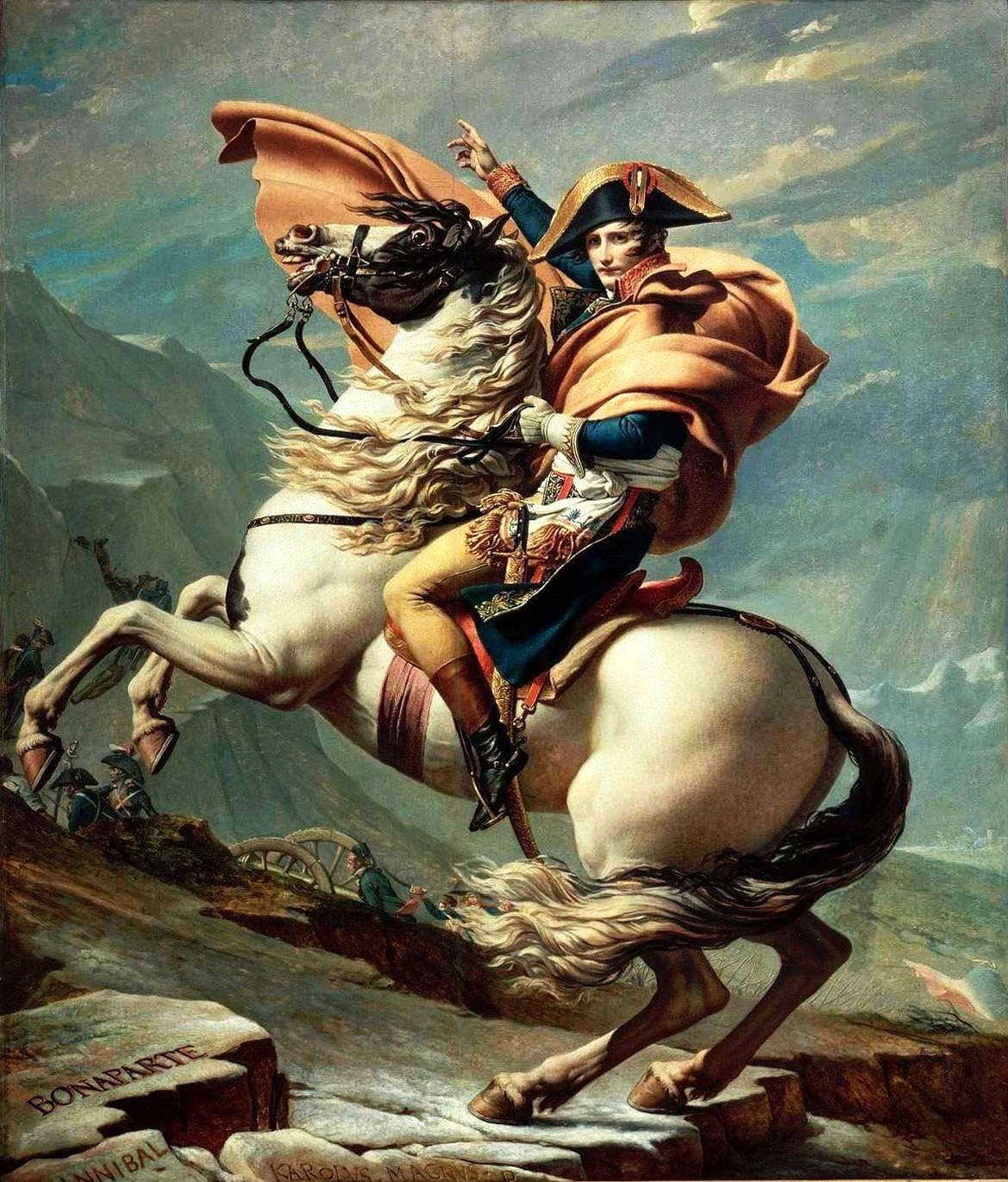
Via Wikimedia Commons: David - Napoleon crossing the Alps - Malmaison1 by Jacques-Louis David, public domain.
Dates below follow the McGill University Napoleon timeline unless another source is named. Where sources disagree, this entry says so.
Rise
Napoleon was born on 15 August 1769 in Ajaccio, Corsica.[1][3] McGill dates his entry to the military school at Brienne to 15 May 1779; Brown University's timeline says April 1779.[1][3] He drove the British fleet out of Toulon in December 1793, and on 5 October 1795 (13 Vendemiaire) put down a royalist insurrection in Paris.[1][3] On 2 March 1796 he was made commander in chief of the Army of Italy, and he married Josephine on 9 March. He won at Arcola in November 1796, and the Treaty of Campo-Formio followed on 17 October 1797.[1] He fought the Battle of the Pyramids in Egypt on 21 July 1798.[1][3]
On 9-10 November 1799 (18-19 Brumaire) a coup made him provisional consul.[1] The Concordat was signed on 15 July 1801 and the Treaty of Amiens on 25 March 1802.[1][4] In 1803, Brown's timeline says, he sold the Louisiana Territory to the United States for 80 million francs.[4]
Emperor
The Civil Code was published on 21 March 1804. He was proclaimed Emperor on 18 May 1804 and crowned with Josephine at Notre-Dame on 2 December 1804; Brown adds that he placed the crown on his own head.[1][4]
The wars that followed:
- Trafalgar, 21 October 1805: a French naval defeat.[1]
- Austerlitz, 2 December 1805: a French victory.[1][5]
- Jena and Auerstadt, 14 October 1806: a French victory.[1]
- The Berlin decrees of 21 November 1806 began the Continental System, which Brown says led to the Peninsular War, lasting until June 1813.[5][6]
- Wagram, 5-6 July 1809 (McGill gives 6 July): a French victory.[1][6]
He divorced Josephine on 15 December 1809, married Marie-Louise of Austria on 2 April 1810, and their son, called the King of Rome, was born on 20 March 1811.[1] The son later died in Austria at the age of 21.[7]
Russia, 1812
The Grande Armee crossed the Niemen on 24 June 1812.[1] Counts of its size differ: History.com says at least 450,000 and perhaps as many as 650,000 crossed, Brown says roughly 700,000.[8][9] The only major battle, at Borodino on 7 September, cost at least 70,000 casualties according to History.com.[8][9] Napoleon entered Moscow on 14 September, and the city burned on 15-16 September.[1][8] The army left Moscow on 19 October, fought the Battle of the Berezina on 26-28 November, and Napoleon left the army on 5 December.[1][8] History.com says an estimated 100,000 made it out of Russia, and Brown gives the same figure.[8][9]
Defeat and exile
The Battle of Leipzig, 16-19 October 1813, was a French defeat.[1] McGill dates his unconditional abdication to 6 April 1814; Brown and the treaty text date the renunciation to 11 April 1814, when the Treaty of Fontainebleau gave him the island of Elba "as a separate principality" for life.[1][9][10] He arrived on Elba on 4 May.[1][9]
He left Elba on 25 or 26 February 1815, landed near Cannes on 1 March and reached Paris on 20 March.[1][9] The National Army Museum says Waterloo, fought on 18 June 1815 against Wellington and Blucher, was a defeat in which Napoleon lost nearly 40,000 men killed, wounded or captured against 22,000 Allied casualties; it counts 72,000 French soldiers and 246 guns.[11] He abdicated again on 22 June according to McGill and Brown, though the museum says he abdicated when the Allies entered Paris on 7 July.[1][9][11] The British took him to St Helena, where he arrived in mid-October 1815.[1][12][13]
Death
Napoleon died on St Helena on 5 May 1821; McGill records his last words as "A la tete de l'armee."[1] The Fondation Napoleon gives the time as 5:49 p.m.[12] The autopsy on 6 May concluded stomach cancer, worsened by bleeding gastric ulcers, and PBS says he had been given a large dose of calomel the day before he died.[12][14]
A 1961 paper in Nature suggested arsenic poisoning.[12][14] The Fondation Napoleon author rejects it, writing that the clinical symptoms of chronic arsenic poisoning were absent, while a history site notes that arsenic in his hair was no higher than expected for the time.[12][13] PBS concludes that the original autopsy result still seems most likely.[14]
In 1840 his remains were returned to France. The Fondation Napoleon says they were exhumed at 11 a.m. on 16 October; History Hit says his body was buried in the crypt at Les Invalides in July of that year, so those two accounts do not agree.[12][13]
Sources
- McGill University Library, Napoleon Collection, "Timeline (Brief)". digital.library.mcgill.ca/napoleon/english/timeline.htm
- University of Washington Libraries, Napoleonic Period Collection, timeline. content.lib.washington.edu/napoleonweb/timeline.html
- Brown University Library, Napoleonic Satires, timeline (birth to 1799). library.brown.edu/cds/napoleon/time1.html
- Brown University Library, timeline (First Consul, 1799-1804). library.brown.edu/cds/napoleon/time2.html
- Brown University Library, timeline (Third Coalition and Continental System). library.brown.edu/cds/napoleon/time3.html
- Brown University Library, timeline (Spain and Austria, 1807-09). library.brown.edu/cds/napoleon/time4.html
- University of Washington Libraries, timeline (Napoleon II). content.lib.washington.edu/napoleonweb/timeline.html
- Jesse Greenspan, "Why Napoleon's Invasion of Russia Was the Beginning of the End," History.com (updated 27 May 2025). history.com/topics/european-history/napoleons-disastrous-invasion-o…
- Brown University Library, timelines for the Russian campaign and the Hundred Days. library.brown.edu/cds/napoleon/time6.html and library.brown.edu/cds/napoleon/time7.html
- "Treaty of Fontainebleau (1814)," Wikisource. en.wikisource.org/wiki/Treaty_of_Fontainebleau_(1814)
- National Army Museum, "Battle of Waterloo." nam.ac.uk/explore/battle-waterloo
- Barbara Krajewska, "Arsenic and the Emperor," Fondation Napoleon (online 2004). napoleon.org/en/history-of-the-two-empires/articles/arsenic-and-the…
- Sarah Roller, "An Inglorious End: The Exile and Death of Napoleon," History Hit, 5 May 2021. historyhit.com/the-exile-and-death-of-napoleon/
- Howard Markel, "How Napoleon's death in exile became a controversial mystery," PBS NewsHour, 15 August 2022. pbs.org/newshour/health/how-napoleons-death-in-exile-became-a-contr…
