Compare versions
Version 2 → Version 3 (current). Removed · Added. This shows the entry's text as it is written, including its formatting marks.
Version 2 · Version 3 (current) · Version history
Side by side · Together
Version 2Version 3 (current)
Winston Churchill (1874-1965) was the British statesman who served as Prime Minister from 1940 to 1945 and again from 1951 to 1955, led Britain through the Second World War, and won the Nobel Prize in Literature in 1953.[1][2]
Winston Churchill (1874-1965) was the British statesman who served as Prime Minister from 1940 to 1945 and again from 1951 to 1955, led Britain through the Second World War, and won the Nobel Prize in Literature in 1953.[1][2]
17 unchanged paragraphs
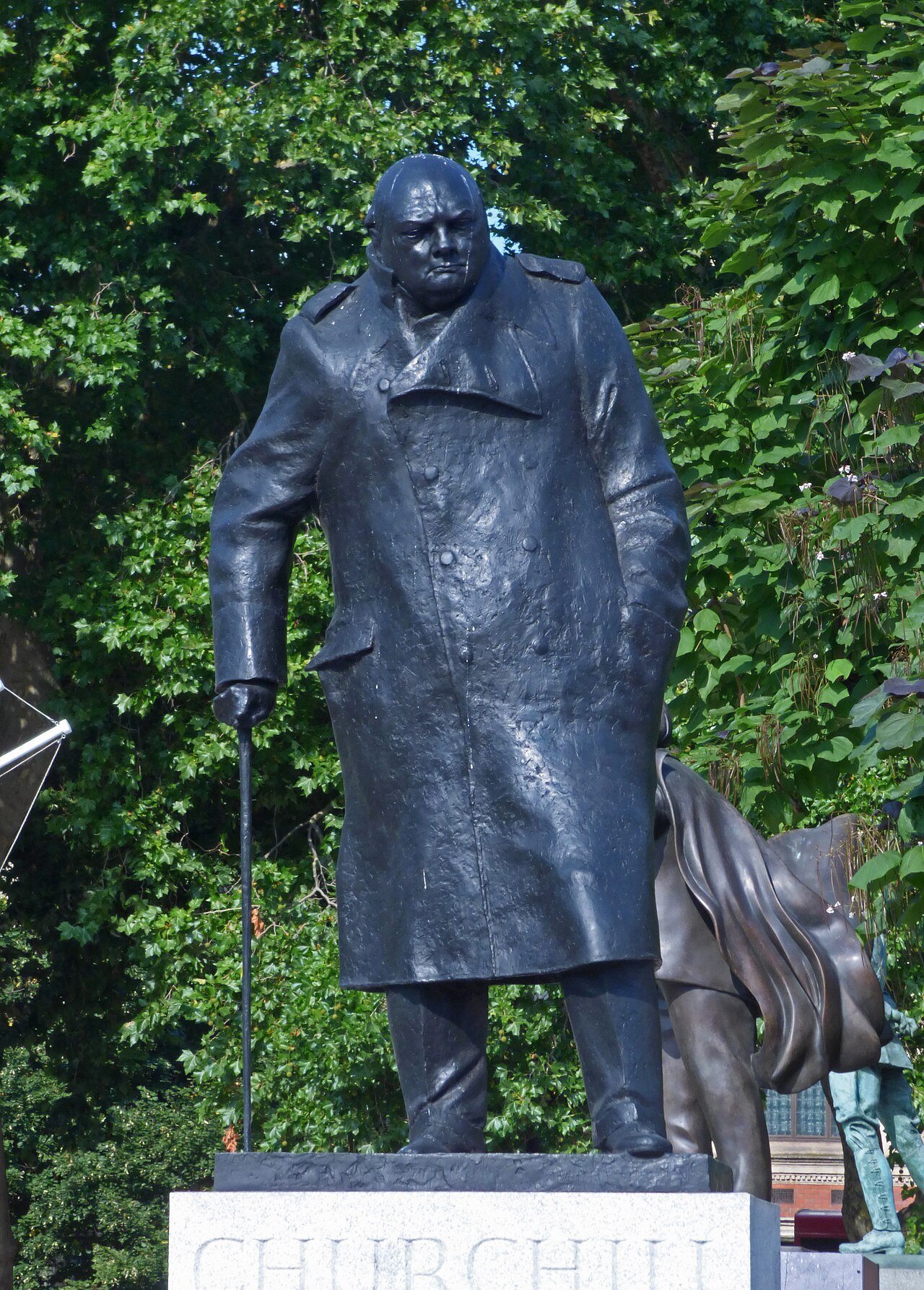
*Via Wikimedia Commons: [Winston Churchill statue, Parliament Square - 2025-08-06](https://commons.wikimedia.org/wiki/File:Winston_Churchill_statue,_Parliament_Square_-_2025-08-06.jpg) by Jeremy Oakley, [CC BY 4.0](https://creativecommons.org/licenses/by/4.0).*
*Via Wikimedia Commons: [Winston Churchill statue, Parliament Square - 2025-08-06](https://commons.wikimedia.org/wiki/File:Winston_Churchill_statue,_Parliament_Square_-_2025-08-06.jpg) by Jeremy Oakley, [CC BY 4.0](https://creativecommons.org/licenses/by/4.0).*
## Early life and career
## Early life and career
Churchill was born on 30 November 1874 at Blenheim Palace in Oxfordshire.[1] History.com gives approximate years for his early career: Sandhurst in 1893, India in 1896, capture in the Boer War in 1899, election to Parliament in 1900, a switch to the Liberals in 1904, First Lord of the Admiralty in 1911, and a return to the Conservatives in 1924.[2] It says the Gallipoli campaign ended after nine months and 250,000 casualties.[2] History.com also says that out of office from 1929 to 1939, Churchill issued unheeded warnings of the threat of Nazi and Japanese aggression.[2]
Churchill was born on 30 November 1874 at Blenheim Palace in Oxfordshire.[1] History.com gives approximate years for his early career: Sandhurst in 1893, India in 1896, capture in the Boer War in 1899, election to Parliament in 1900, a switch to the Liberals in 1904, First Lord of the Admiralty in 1911, and a return to the Conservatives in 1924.[2] It says the Gallipoli campaign ended after nine months and 250,000 casualties.[2] History.com also says that out of office from 1929 to 1939, Churchill issued unheeded warnings of the threat of Nazi and Japanese aggression.[2]
## Prime Minister, 1940
## Prime Minister, 1940
Churchill became Prime Minister in May 1940. In his first speech to the House of Commons, on 13 May, he said: "I have nothing to offer but blood, toil, tears and sweat." Asked what the policy was, he answered: "It is to wage war, by sea, land and air, with all our might," and the aim was "victory, victory at all costs."[3]
Churchill became Prime Minister in May 1940. In his first speech to the House of Commons, on 13 May, he said: "I have nothing to offer but blood, toil, tears and sweat." Asked what the policy was, he answered: "It is to wage war, by sea, land and air, with all our might," and the aim was "victory, victory at all costs."[3]
On 4 June he reported on the evacuation from Dunkirk. He said "Wars are not won by evacuations," that the rescue had carried over 335,000 men "out of the jaws of death and shame," and that British losses exceeded 30,000 killed, wounded and missing. Of the ships, he said 220 light warships and 650 other vessels were engaged, and also spoke of nearly 1,000 ships of all kinds in the Navy's effort. He ended: "We shall fight on the beaches ... we shall never surrender."[4] On 18 June he told the Commons: "I expect that the battle of Britain is about to begin," and that men would say of it "This was their finest hour."[5]
On 4 June he reported on the evacuation from Dunkirk. He said "Wars are not won by evacuations," that the rescue had carried over 335,000 men "out of the jaws of death and shame," and that British losses exceeded 30,000 killed, wounded and missing. Of the ships, he said 220 light warships and 650 other vessels were engaged, and also spoke of nearly 1,000 ships of all kinds in the Navy's effort. He ended: "We shall fight on the beaches ... we shall never surrender."[4] On 18 June he told the Commons: "I expect that the battle of Britain is about to begin," and that men would say of it "This was their finest hour."[5]
## 1945 and the iron curtain
## 1945 and the iron curtain
The 1945 election result was announced on 26 July. Historyhit says Labour won 393 seats to the Conservatives' 197, and the Churchill Archive describes a Labour landslide with a majority of 146; these are different measures of the same result.[7][10] History.com says Churchill was forced to resign as Prime Minister and that Clement Attlee, the Labour leader, was sworn in the same day.[9]
The 1945 election result was announced on 26 July. Historyhit says Labour won 393 seats to the Conservatives' 197, and the Churchill Archive describes a Labour landslide with a majority of 146; these are different measures of the same result.[7][10] History.com says Churchill was forced to resign as Prime Minister and that Clement Attlee, the Labour leader, was sworn in the same day.[9]
Out of office, Churchill spoke at Westminster College in Fulton, Missouri, on 5 March 1946, with President Truman on the platform.[6] The government history blog quotes the passage: "From Stettin in the Baltic to Trieste in the Adriatic, an iron curtain has descended across the Continent." The National Churchill Museum prints the same words with slightly different punctuation.[6][8] The Churchill Archive records Churchill's remark that he had no official mission or status and spoke only for himself; it says Truman quickly distanced himself, and that Stalin attacked Churchill in Pravda.[7]
Out of office, Churchill spoke at Westminster College in Fulton, Missouri, on 5 March 1946, with President Truman on the platform.[6] The government history blog quotes the passage: "From Stettin in the Baltic to Trieste in the Adriatic, an iron curtain has descended across the Continent." The National Churchill Museum prints the same words with slightly different punctuation.[6][8] The Churchill Archive records Churchill's remark that he had no official mission or status and spoke only for himself; it says Truman quickly distanced himself, and that Stalin attacked Churchill in Pravda.[7]
## Later years and death
## Later years and death
History.com says Churchill was elected Prime Minister again in 1951 and retired in 1955, remaining in Parliament until 1964.[2][9] The Nobel Prize in Literature came in 1953, with a citation, quoted by the National Churchill Museum, "for his mastery of historical and biographical description as well as for brilliant oratory in defending exalted human values."[8][11]
History.com says Churchill was elected Prime Minister again in 1951 and retired in 1955, remaining in Parliament until 1964.[2][9] The Nobel Prize in Literature came in 1953, with a citation, quoted by the National Churchill Museum, "for his mastery of historical and biographical description as well as for brilliant oratory in defending exalted human values."[8][11]
Churchill died in London on 24 January 1965, aged 90.[1][11] History.com says his body lay in state for three days in Westminster Hall, and that the funeral procession on 30 January 1965 ended at St Paul's Cathedral, with dignitaries from 112 countries; it calls the funeral the largest in history at that time. He was buried in a private ceremony in the churchyard at Bladon.[12]
Churchill died in London on 24 January 1965, aged 90.[1][11] History.com says his body lay in state for three days in Westminster Hall, and that the funeral procession on 30 January 1965 ended at St Paul's Cathedral, with dignitaries from 112 countries; it calls the funeral the largest in history at that time. He was buried in a private ceremony in the churchyard at Bladon.[12]
## Still needs a source
## Still needs a source
Churchill's record is disputed, and this entry covers only the points we could source. Not yet checked against a page we could read, so no claims are made about them:
Churchill's record is disputed, and this entry covers only the points we could source. Not yet checked against a page we could read, so no claims are made about them:
- His views on India and the British Empire, and the 1943 Bengal famine.
- The 1924-29 Chancellorship and the return to the gold standard in 1925.
- The Atlantic Charter of August 1941 and the wartime conferences.
- His honorary United States citizenship in 1963.
- The exact date of his retirement in 1955.
## Sources
## Sources
1. UK Government, "Winston Churchill," past prime ministers. https://www.gov.uk/government/history/past-prime-ministers/winston-churchill
2. History.com Editors, "Winston Churchill," published 27 October 2009, updated 28 May 2025. https://www.history.com/topics/world-war-ii/winston-churchill
3. House of Commons Hansard, 13 May 1940, "His Majesty's Government." https://api.parliament.uk/historic-hansard/commons/1940/may/13/his-majestys-government-1
4. House of Commons Hansard, 4 June 1940, "War Situation." https://api.parliament.uk/historic-hansard/commons/1940/jun/04/war-situation
5. House of Commons Hansard, 18 June 1940, "War Situation." https://api.parliament.uk/historic-hansard/commons/1940/jun/18/war-situation
6. Gill Bennett, "What's the context? Winston Churchill's Sinews of Peace speech," UK Government history blog, 5 March 2021. https://history.blog.gov.uk/2021/03/05/whats-the-context-winston-churchills-sinews-of-peace-speech-fulton-5-march-1946
7. Allen Packwood, "Churchill and the Iron Curtain: Introduction," Churchill Archive. https://www.churchillarchive.com/churchill-and-the-iron-curtain-introduction
8. National Churchill Museum, "Sinews of Peace: Power of Prose" exhibit. https://www.nationalchurchillmuseum.org/sinews-of-peace-power-of-prose-exhibit.html
9. History.com Editors, "Winston Churchill resigns," updated 24 July 2025. https://www.history.com/this-day-in-history/winston-churchill-resigns-2
10. "Why Did Labour Defeat Winston Churchill's Conservative Party in 1945?" History Hit, 26 July 2017. https://www.historyhit.com/1945-churchill-defeated-labour-party/
11. History.com Editors, "Winston Churchill dies," updated 31 January 2025. https://www.history.com/this-day-in-history/winston-churchill-dies
12. Christopher Klein, "Winston Churchill's Funeral, 50 Years Ago," History.com, updated 28 May 2025. https://www.history.com/articles/winston-churchills-funeral-50-years-ago
