Compare versions
Version 1 → Version 5 (current). Removed · Added. This shows the entry's text as it is written, including its formatting marks.
Version 1 · Version 5 (current) · Version history
Side by side · Together
Version 1Version 5 (current)
Mohandas Karamchand Gandhi (1869-1948), known as Mahatma, was the Indian lawyer and political leader who led campaigns of nonviolent civil disobedience, called satyagraha, in South Africa and then in India, where he became the leading figure in the movement for independence from British rule; he was assassinated in Delhi on 30 January 1948.[1][2]
Mohandas Karamchand Gandhi (1869-1948), known as Mahatma, was the Indian lawyer and political leader who led campaigns of nonviolent civil disobedience, called satyagraha, in South Africa and then in India, where he became the leading figure in the movement for independence from British rule; he was assassinated in Delhi on 30 January 1948.[1][2]
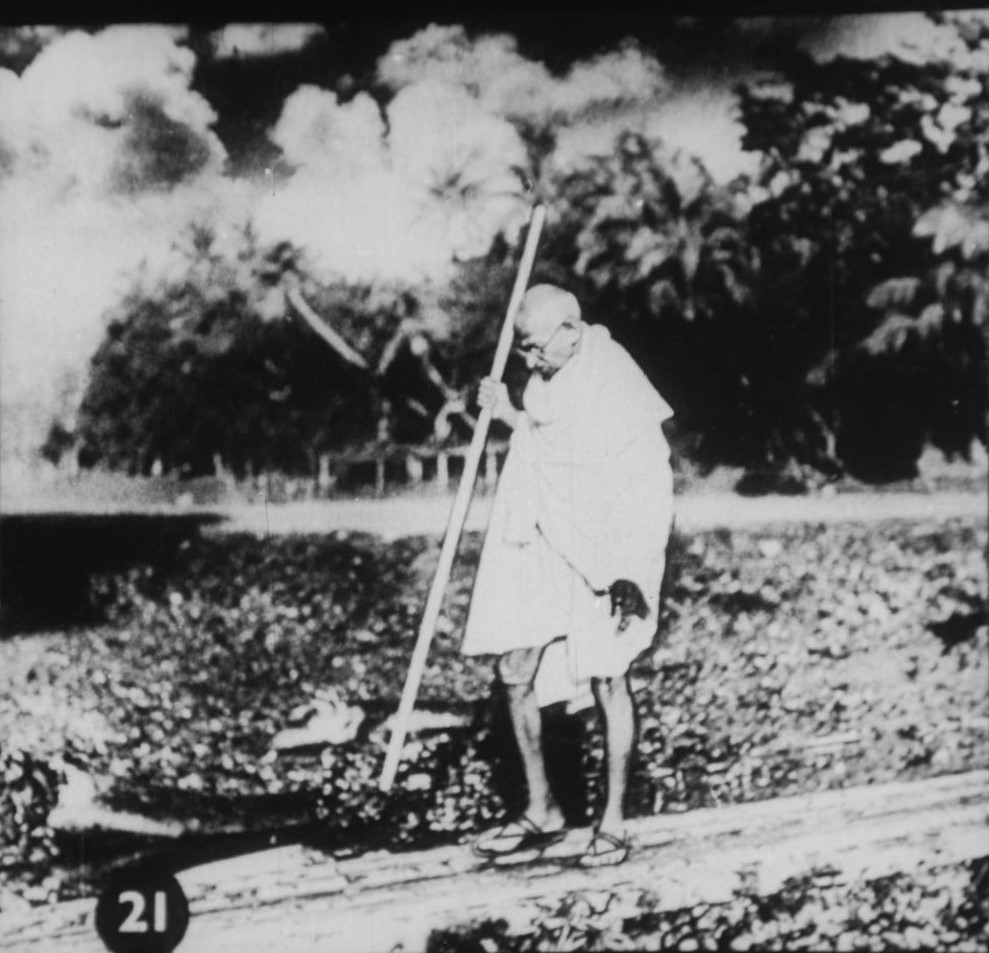
*Via Wikimedia Commons: [Gandhi in Noakhali, 1946 cropped](https://commons.wikimedia.org/wiki/File:Gandhi_in_Noakhali,_1946_cropped.jpg) by Unknown author Unknown author, public domain.*
19 unchanged paragraphs
## Early life and South Africa
## Early life and South Africa
The Government of India's Gandhi Smriti chronology says Gandhi was born on 2 October 1869 at Porbandar, Kathiawad, the son of Karamchand and Putlibai Gandhi, and married Kasturba in 1883.[1] He sailed for England in 1891 to study law; History.com says he studied at the Inner Temple in London and returned to India in mid-1891 to set up a law practice in Bombay.[1][2] In 1893 he sailed for South Africa to work as a lawyer for an Indian firm and, the chronology says, found himself subjected to all kinds of colour discrimination.[1] History.com adds that on a train voyage to Pretoria he was thrown out of a first-class compartment, and calls it a turning point; the HistoryWorld timeline dates that incident to 1893 at Pietermaritzburg.[2][3]
The Government of India's Gandhi Smriti chronology says Gandhi was born on 2 October 1869 at Porbandar, Kathiawad, the son of Karamchand and Putlibai Gandhi, and married Kasturba in 1883.[1] He sailed for England in 1891 to study law; History.com says he studied at the Inner Temple in London and returned to India in mid-1891 to set up a law practice in Bombay.[1][2] In 1893 he sailed for South Africa to work as a lawyer for an Indian firm and, the chronology says, found himself subjected to all kinds of colour discrimination.[1] History.com adds that on a train voyage to Pretoria he was thrown out of a first-class compartment, and calls it a turning point; the HistoryWorld timeline dates that incident to 1893 at Pietermaritzburg.[2][3]
He organised the Natal Indian Congress in 1894 and founded the weekly Indian Opinion in 1904.[1] The first satyagraha campaign began in 1906 with a meeting in Johannesburg against a proposed Asiatic Ordinance, and in 1907 he organised satyagraha against compulsory registration of Asians; he was imprisoned for the first time in 1908.[1] He wrote Hind Swaraj in 1909 and set up Tolstoy Farm near Johannesburg in 1910.[1] History.com says the South African government eventually accepted a compromise negotiated by Gandhi and General Jan Christian Smuts, including recognition of Indian marriages and abolition of the poll tax for Indians.[2] He left South Africa for good in 1914.[1]
He organised the Natal Indian Congress in 1894 and founded the weekly Indian Opinion in 1904.[1] The first satyagraha campaign began in 1906 with a meeting in Johannesburg against a proposed Asiatic Ordinance, and in 1907 he organised satyagraha against compulsory registration of Asians; he was imprisoned for the first time in 1908.[1] He wrote Hind Swaraj in 1909 and set up Tolstoy Farm near Johannesburg in 1910.[1] History.com says the South African government eventually accepted a compromise negotiated by Gandhi and General Jan Christian Smuts, including recognition of Indian marriages and abolition of the poll tax for Indians.[2] He left South Africa for good in 1914.[1]
## India: from Champaran to the Salt March
## India: from Champaran to the Salt March
After returning in 1915 he established the Satyagraha Ashram near Ahmedabad.[1] The chronology records his first satyagraha in India in 1917, a mill-workers' strike at Ahmedabad in 1918, and a nationwide hartal against the Rowlatt Bills in 1919.[1] History.com says he backed off after violence broke out, including the massacre of some 400 Indians at Amritsar by British-led soldiers.[2] He was elected president of the All-India Home Rule League in 1920, and in 1921 he took to wearing only a loincloth, in devotion to homespun cotton.[1] He suspended mass disobedience in 1922 because of violence at Chauri Chaura and was sentenced that year to six years in prison; History.com says he was released in 1924 after an appendicitis operation.[1][2]
After returning in 1915 he established the Satyagraha Ashram near Ahmedabad.[1] The chronology records his first satyagraha in India in 1917, a mill-workers' strike at Ahmedabad in 1918, and a nationwide hartal against the Rowlatt Bills in 1919.[1] History.com says he backed off after violence broke out, including the massacre of some 400 Indians at Amritsar by British-led soldiers.[2] He was elected president of the All-India Home Rule League in 1920, and in 1921 he took to wearing only a loincloth, in devotion to homespun cotton.[1] He suspended mass disobedience in 1922 because of violence at Chauri Chaura and was sentenced that year to six years in prison; History.com says he was released in 1924 after an appendicitis operation.[1][2]
In 1930 he set out from Sabarmati with 79 volunteers on the salt march to the sea at Dandi, and broke the salt law by picking up salt on the shore; the chronology says he was arrested at Karadi and imprisoned without trial, and that one hundred thousand people were arrested.[1] History.com says the march began on 12 March 1930, covered 241 miles in 24 days with a small group that swelled to thousands, and ended on 6 April, and that some 60,000 people were arrested overall; it quotes Gandhi's words on the beach: "With this, I am shaking the foundations of the British Empire." It also dates his own arrest to 5 May. The sources differ on the distance and on the number of arrests.[1][4] The UN also names the Salt March of 1930 as a historic example of his mass civil disobedience.[5]
In 1930 he set out from Sabarmati with 79 volunteers on the salt march to the sea at Dandi, and broke the salt law by picking up salt on the shore; the chronology says he was arrested at Karadi and imprisoned without trial, and that one hundred thousand people were arrested.[1] History.com says the march began on 12 March 1930, covered 241 miles in 24 days with a small group that swelled to thousands, and ended on 6 April, and that some 60,000 people were arrested overall; it quotes Gandhi's words on the beach: "With this, I am shaking the foundations of the British Empire." It also dates his own arrest to 5 May. The sources differ on the distance and on the number of arrests.[1][4] The UN also names the Salt March of 1930 as a historic example of his mass civil disobedience.[5]
## 1931 to 1942
## 1931 to 1942
The chronology says the Gandhi-Irwin Pact of 1931 ended civil disobedience, and that he went to London for the second Round Table Conference, staying at Kingsley Hall in the East End.[1] In 1932 he concluded what the chronology calls an "epic fast" after the British accepted the "Yeravada Pact."[1] History.com says he fasted over the treatment of the so-called untouchables, whom he renamed Harijans, and that some in the Congress, notably Mohammed Ali Jinnah, grew frustrated with his methods.[2] The chronology records a tour of every province against untouchability in 1933 and the founding of the All-India Village Industries Association in 1934.[1]
The chronology says the Gandhi-Irwin Pact of 1931 ended civil disobedience, and that he went to London for the second Round Table Conference, staying at Kingsley Hall in the East End.[1] In 1932 he concluded what the chronology calls an "epic fast" after the British accepted the "Yeravada Pact."[1] History.com says he fasted over the treatment of the so-called untouchables, whom he renamed Harijans, and that some in the Congress, notably Mohammed Ali Jinnah, grew frustrated with his methods.[2] The chronology records a tour of every province against untouchability in 1933 and the founding of the All-India Village Industries Association in 1934.[1]
In 1942 the chronology says he called Sir Stafford Cripps's proposals "a post-dated cheque," and that the Congress passed the "Quit India" resolution, "the final nation-wide satyagraha campaign," with Gandhi as leader. He was arrested, and his secretary Mahadev Desai died in the Aga Khan Palace; Gandhi began a 21-day fast there in 1943, and Kasturba died in detention in 1944.[1] The HistoryWorld timeline says nearly all Congress leaders were arrested and remained in prison until the end of the war.[3]
In 1942 the chronology says he called Sir Stafford Cripps's proposals "a post-dated cheque," and that the Congress passed the "Quit India" resolution, "the final nation-wide satyagraha campaign," with Gandhi as leader. He was arrested, and his secretary Mahadev Desai died in the Aga Khan Palace; Gandhi began a 21-day fast there in 1943, and Kasturba died in detention in 1944.[1] The HistoryWorld timeline says nearly all Congress leaders were arrested and remained in prison until the end of the war.[3]
## Partition and death
## Partition and death
In 1946 he conferred with the British Cabinet Mission and toured 49 villages in East Bengal to quell communal rioting; in 1947 he toured Bihar, met the Viceroy, Lord Mountbatten, and Jinnah in New Delhi, "opposed decision to accept division," and fasted and prayed to combat riots in Calcutta as India was partitioned and granted independence.[1] History.com says he strongly opposed Partition but agreed to it in the hope that Hindus and Muslims could then live in peace.[2]
In 1946 he conferred with the British Cabinet Mission and toured 49 villages in East Bengal to quell communal rioting; in 1947 he toured Bihar, met the Viceroy, Lord Mountbatten, and Jinnah in New Delhi, "opposed decision to accept division," and fasted and prayed to combat riots in Calcutta as India was partitioned and granted independence.[1] History.com says he strongly opposed Partition but agreed to it in the hope that Hindus and Muslims could then live in peace.[2]
In January 1948 he fasted for five days in Delhi for communal unity. On 20 January a bomb exploded at his prayer meeting at Birla House, and on 30 January he was assassinated there by Nathuram Vinayak Godse.[1] History.com says Godse was a Hindu fanatic enraged by Gandhi's efforts to negotiate with Jinnah and other Muslims, and that about a million people followed the procession the next day, when his body was cremated on the banks of the Jumna River.[2]
In January 1948 he fasted for five days in Delhi for communal unity. On 20 January a bomb exploded at his prayer meeting at Birla House, and on 30 January he was assassinated there by Nathuram Vinayak Godse.[1] History.com says Godse was a Hindu fanatic enraged by Gandhi's efforts to negotiate with Jinnah and other Muslims, and that about a million people followed the procession the next day, when his body was cremated on the banks of the Jumna River.[2]
## Name and legacy
## Name and legacy
History.com says his followers called him Mahatma, "the great-souled one."[2] The United Nations observes 2 October, his birthday, as the International Day of Non-Violence under General Assembly resolution A/RES/61/271 of 15 June 2007, introduced on behalf of 140 co-sponsors; the UN page describes him as the leader of the Indian independence movement and "pioneer of the philosophy and strategy of non-violence."[5]
History.com says his followers called him Mahatma, "the great-souled one."[2] The United Nations observes 2 October, his birthday, as the International Day of Non-Violence under General Assembly resolution A/RES/61/271 of 15 June 2007, introduced on behalf of 140 co-sponsors; the UN page describes him as the leader of the Indian independence movement and "pioneer of the philosophy and strategy of non-violence."[5]
## Still needs a source
## Still needs a source
These points have not been checked against a page we could read, so the entry makes no claims about them:
These points have not been checked against a page we could read, so the entry makes no claims about them:
- The exact date of the Quit India resolution (August 1942) and of Indian independence and Partition (August 1947).
- Criticism of Gandhi, including his early writings about Africans in South Africa and his debates over caste with B. R. Ambedkar, and the Poona Pact of 1932 in detail.
- Who first called him Mahatma, and his Nobel Peace Prize nominations.
- The Champaran campaign of 1917 and the Non-Cooperation movement in detail.
## Sources
## Sources
1. Gandhi Smriti and Darshan Samiti, Government of India, "Chronology of Mahatma Gandhi" (last updated 14 September 2018). https://gandhismriti.gov.in/more/chronology-mahatma-gandhi
2. HISTORY.com Editors, "Mahatma Gandhi," published 30 July 2010, updated 11 March 2026. https://www.history.com/topics/india/mahatma-gandhi
3. HistoryWorld, "Mahatma Gandhi timeline." https://historyworld.net/featured-timelines/people/mahatma-gandhi
4. Evan Andrews, "When Gandhi's Salt March Rattled British Colonial Rule," History.com, published 12 March 2015, updated 28 May 2025. https://www.history.com/.amp/news/gandhi-salt-march-india-british-colonial-rule
5. United Nations, "International Day of Non-Violence." https://www.un.org/en/observances/non-violence-day
