Compare versions
Version 9 → Version 10 (current). Removed · Added. This shows the entry's text as it is written, including its formatting marks.
Version 9 · Version 10 (current) · Version history
Side by side · Together
California is a state of the United States, admitted to the Union as the 31st state on 9 September 1850, with Sacramento as its capital.[3][6]
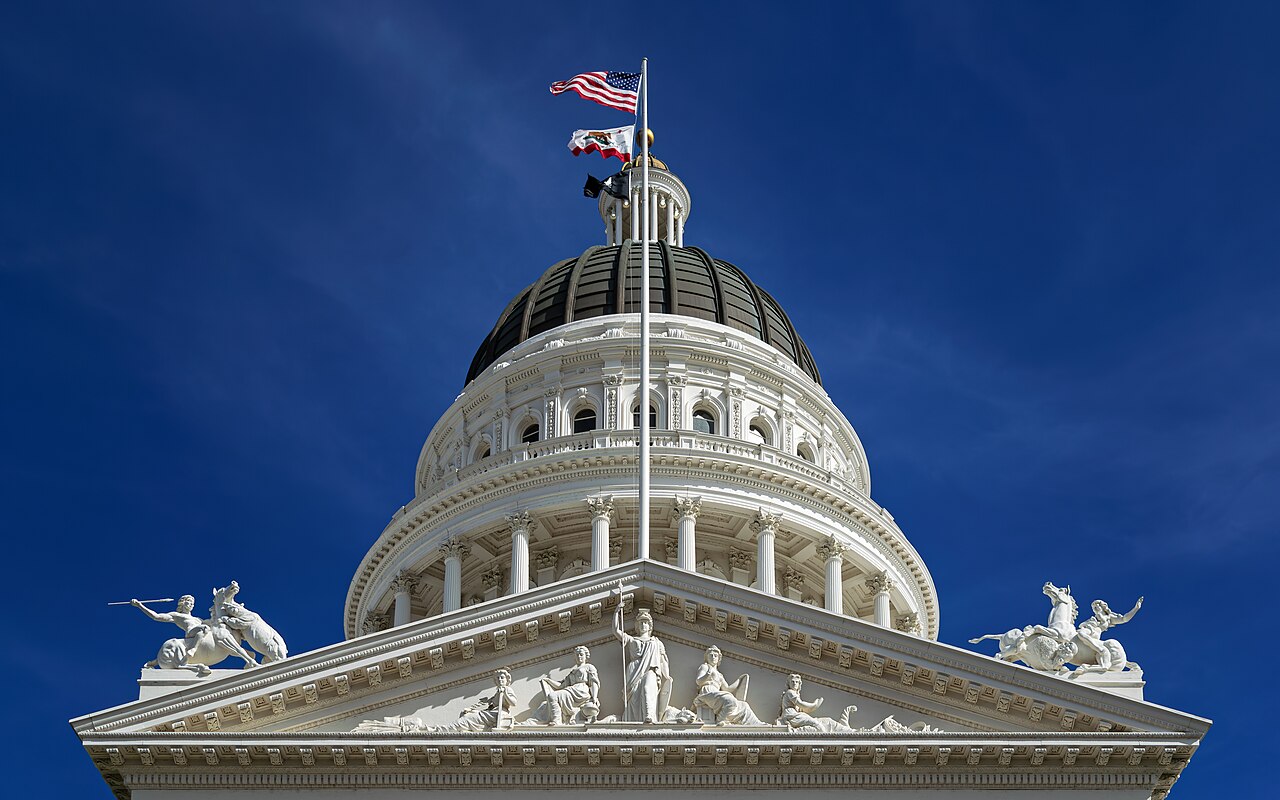
*Via Wikimedia Commons: [California State Capitol (top), NW view up](https://commons.wikimedia.org/wiki/File:California_State_Capitol_(top),_NW_view_up.jpg) by Photograph: Radomianin, public domain.*
## Indigenous peoples, Spain and Mexico
Before European colonization, the area that became California was home to many Native peoples. Scholars have conservatively estimated about 300,000 people speaking seventy-eight mutually unintelligible languages, though others, using different data and methods, have proposed more than one hundred languages and up to one million residents.[16] The linguistic diversity was among the highest anywhere in the world.[16]
Juan Rodríguez Cabrillo left the port of Navidad, Mexico, on 27 June 1542 and led the first European expedition to explore what is now the west coast of the United States.[15] He claimed California for the King of Spain, but for more than two further centuries direct encounters remained fleeting.[16]
Spain moved to occupy Alta California (the northern part of its Californias, and the area of the present state) in 1769, provoked by threats of Russian and English expansion in the Pacific Northwest that endangered its holdings in northern Mexico.[16] New Spain was short of funds, and Franciscan missionaries offered an inexpensive way to claim the territory through occupation.[16] The first Alta California mission was founded at San Diego in 1769, and twenty-one missions were eventually established.[16]
Mexico won independence from Spain in 1821 and gained government control of California.[16] The emancipation of Native people from the missions began in 1826 and formal secularization of the missions began in 1833-1834, but the process moved slowly and unevenly across regions.[16]
## The Bear Flag and the American takeover
In 1846, before the treaty, the Bear Flag Party raised a flag at Sonoma on 14 June and declared California free from Mexican rule, according to the California Office of Historic Preservation's record of the Bear Flag Monument.[17] On 7 July 1846, Commodore John Drake Sloat raised the American flag at Monterey.[17] Two days later, on 9 July 1846, the Bear Flag was taken down at Sonoma, where Lieutenant Joseph W. Revere replaced it with the American flag; Revere had been sent from San Francisco by Commander John B. Montgomery of the sloop-of-war Portsmouth.[17]
## From Mexican territory to statehood
On 24 January 1848, the carpenter James W. Marshall found gold in the American River while working at John Sutter's sawmill near Coloma, California.[2] Nine days later, on 2 February 1848, the United States and Mexico signed the [Treaty of Guadalupe Hidalgo](https://www.archives.gov/milestone-documents/treaty-of-guadalupe-hidalgo). Under it Mexico ceded about 55 percent of its territory, including present-day California, and the United States agreed to pay $15 million.[1]
The Census Bureau describes the discovery as the start of "the first of several large-scale westward migrations in American history", with thousands of miners, entrepreneurs and families travelling to California by land and sea between 1849 and 1855.[2] The 1850 census counted 92,597 people in the state, and the population rose by more than 300 percent between 1850 and 1860.[2]
Californians sought statehood in 1849.[3] After heated debate over slavery, Congress accepted California as a free-labor state under the Compromise of 1850, and it became the 31st state on 9 September 1850.[3][4]
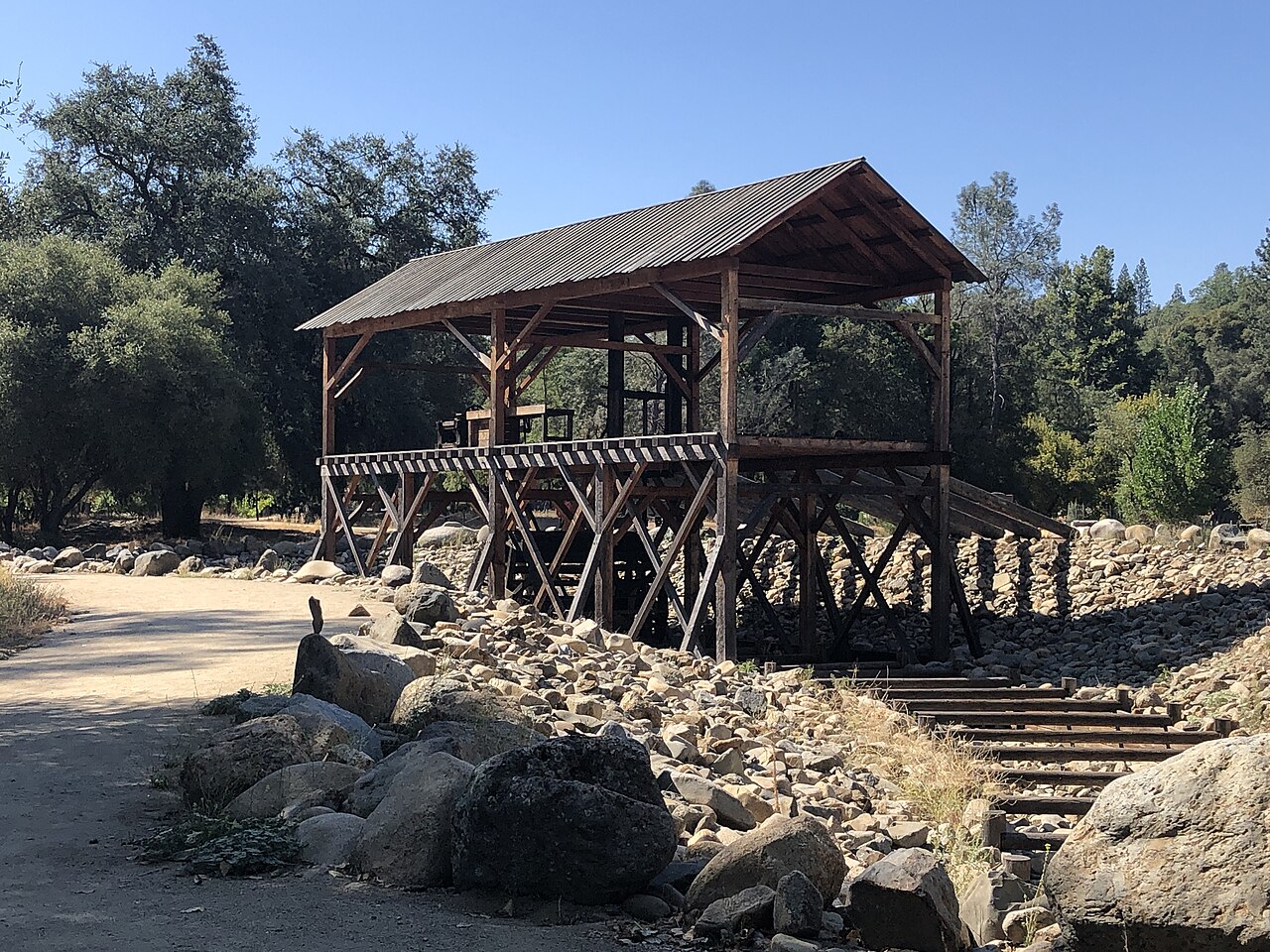
*Via Wikimedia Commons: [Marshall Gold Discovery State Historic Park - Aug 2019 - Stierch 11](https://commons.wikimedia.org/wiki/File:Marshall_Gold_Discovery_State_Historic_Park_-_Aug_2019_-_Stierch_11.jpg) by Missvain, [CC BY 4.0](https://creativecommons.org/licenses/by/4.0).*
## The 1849 constitution
Military Governor Bennet Riley recommended on 3 June 1849 that Californians form a state constitution or a plan for a territorial government, and his proclamation provided for a convention of 37 delegates.[20] Delegates were elected on 1 August 1849, and the convention opened on 1 September at Colton Hall in Monterey.[20] It admitted 48 delegates, eleven more than the proclamation had contemplated.[20] The California State Archives reports that most came from states east of the Mississippi, with the largest group (ten) from New York, that six of the 48 were born in California, that nineteen had lived in the area for under three years, and that their ages ranged from 25 to 53.[21] The State Parks landmark record names Robert Semple as chairman and William G. March as secretary.[22]
The delegates adopted the engrossed text on 10 and 11 October and signed the enrolled parchment copy on 13 October 1849.[21][23] The State Archives says much of the document was based heavily on the constitution of Iowa and, to a lesser degree, that of New York.[21] Electors ratified it by 12,061 votes to 811 about a month later; the State Military Museum dates the ratification election to 13 November 1849.[20][21] The first legislature met in San Jose on 15 December 1849 and petitioned Congress to admit California to the Union.[21]
The convention's translator was W. E. P. Hartnell, and a Spanish translation of the constitution was prepared under his supervision.[23] Article XI, Section 21 required all laws to be published in both Spanish and English, which the State Archives says made California a bilingual state for its first thirty years; the 1879 Constitution did not repeat the provision.[21] The 1849 constitution was amended only three times in thirty years, in 1856, 1862 and 1871.[21]
## The capital
According to California State Parks, San Jose was the first capital, but it lacked suitable facilities, and the wet winter of 1850-1851 left its roads muddy. The legislature met in Vallejo for one week in 1852 and for a month in 1853, then moved to Benicia, where a brick statehouse was built but the site proved too small to expand. The capital moved to Sacramento in 1854.[3]
## Population
The 2020 Census counted 39,538,223 residents in California as of 1 April 2020, up 6.1 percent from 37,253,956 in 2010.[5] The state's number of seats in the U.S. House of Representatives fell from 53 to 52 on the 2020 apportionment, which the Census Bureau released on 26 April 2021.[5]
## Area
As of the 2010 Census, California's land area was 155,779.2 square miles, the third largest of any state.[6]
## The Legislature
California's Legislature has two chambers. The Assembly has 80 members and the Senate has 40, and each Assembly or Senate district chooses one member.[7] Under Article IV, Section 2 of the state constitution, as reproduced by FindLaw with a currency note of 1 January 2026, Senators serve four-year terms, with half elected every two years, and Assembly members serve two-year terms.[8] The same section limits a person to 12 years of service in the Senate, the Assembly, or both, for members first elected after the limit took effect.[8] Because FindLaw warns that its copy may not reflect the latest law, these provisions should be checked against the legislature's own text.[8]
## The Governor
Under Article V, Section 2 of the state constitution, as reproduced by FindLaw with a currency note of 1 January 2026, the Governor is elected every fourth year at the same time and places as members of the Assembly, and holds office from the Monday after 1 January following the election until a successor qualifies.[9] The same section provides that no Governor may serve more than two terms.[9]
## Direct democracy
California voters approved two constitutional amendments on 10 October 1911: Proposition 7, which created the initiative and referendum process, with 76.4 percent in favour, and Proposition 8, which created a process to recall state and local elected officials, with 76.8 percent.[18] Ballotpedia counts California as the twelfth state to establish an initiative and referendum process.[18] Governor Hiram Johnson, a Republican who served from 1911 to 1917, had asked the Legislature in his inaugural address of 3 January 1911 to adopt "the initiative, the referendum, and the recall", while saying they were not a cure-all for political problems.[19] The same address called the Southern Pacific Company "the former political master of this State".[19] Ballotpedia credits Johnson with working with legislators affiliated with the Lincoln/Roosevelt League to place the propositions on the ballot, and records that the National Referendum League and the Lincoln/Roosevelt League backed them.[18]
## The courts
California's state courts have three levels. The California Supreme Court, which the Judicial Branch's overview describes as headed by a Chief Justice and six associate justices, has discretion to review decisions of the Courts of Appeal in order to settle important questions of law, and it must review the appeal in any case in which a trial court has imposed a judgment of death.[10] Below it, the Legislature has divided the state geographically into six appellate districts, which together have 19 divisions and which the Judicial Branch lists as having 106 authorized justices.[10][11] The Courts of Appeal review most appealable rulings from the trial courts, and death penalty cases go directly to the Supreme Court instead.[11] The trial courts are the superior courts, 58 in all, one in each county.[10]
## Counties
The Assembly's Office of the Chief Clerk lists the total number of counties in California as 58.[13] The California State Association of Counties says that counties are the primary service provider of many state services, such as public health and foster care.[14]
## Nickname and motto
California's nickname is "the Golden State", and its motto is "Eureka", a Greek word meaning "I have found it!", according to the Assembly's Office of the Chief Clerk.[13] The Chief Clerk's page does not say why they were chosen. The gold discovery of 1848 is described in [From Mexican territory to statehood](#from-mexican-territory-to-statehood).
## Landforms
The U.S. Geological Survey's Landsat page on California gives the elevation of Mount Whitney in the Sierra Nevada as 14,494 feet above sea level, the highest peak in the conterminous United States, and describes Badwater Basin, in Death Valley, as the lowest point in the United States at 282 feet below sea level.[24] The same page gives the state's Pacific shoreline as 1,100 miles and says 26 million of its 39 million residents lived near the coast, as of its June 2021 date.[24]
## Climate
NOAA's State Climate Summaries describe a climate shaped by California's long north-south extent and several mountain ranges.[25] The Pacific Ocean moderates coastal temperatures, while inland areas have a wider range; the southern deserts are among the hottest and driest areas in the nation, and some high-elevation sites can receive more than 400 inches of snow a year.[25] Summers are generally dry and winters wet, with more than half of annual precipitation falling from December through February; annual totals range from under 8 inches in southern valleys and deserts to over 50 inches on the western slopes of the Sierra Nevada, the Cascade Range and the Northern Coast Ranges.[25]
The same summary reports that annual average temperatures in California rose almost 3°F from the start of the 20th century (observations for 1900-2024), that 2015-2024 was the warmest decade on record, and that sea levels rose by about 3 inches between 1970 and 2020.[25] It also names atmospheric rivers, wildfire, drought and variable snowpack among the state's climate-related threats.[25]
## The economy
As of the Bureau of Economic Analysis (BEA) data that the Federal Reserve Bank of St. Louis republishes in its FRED database, last updated on 30 September 2026, California's gross domestic product (GDP) was about $4.30 trillion in 2025 (4,297,449.8 million current dollars), against 4,054,078.0 million in 2024.[12] Those two figures imply nominal growth of about 6.0 percent.[12] They are in current dollars, so the change includes price increases.
## Sources
1. [Treaty of Guadalupe Hidalgo (1848)](https://www.archives.gov/milestone-documents/treaty-of-guadalupe-hidalgo), Milestone Documents, U.S. National Archives.
2. [History and the Census: The 1848 California Gold Rush](https://www.census.gov/about/history/stories/monthly/2018/january-2018.html), U.S. Census Bureau, January 2018.
3. [California statehood and capital history](https://www.parks.ca.gov/?page_id=23856), California State Parks.
4. [California becomes the 31st state in record time](https://www.history.com/this-day-in-history/september-9/california-becomes-the-31st-state-in-record-time), HISTORY.
5. [2020 Census demographics](http://dof.ca.gov/forecasting/demographics/2020-census-demographics/), California Department of Finance, with the Census Bureau's 2020 apportionment counts released 26 April 2021.
6. [California state and local geography guide, 2010](https://www.census.gov/geographies/reference-files/2010/geo/state-local-geo-guides-2010/california.html), U.S. Census Bureau.
7. [Assembly & Senate](https://capitolmuseum.ca.gov/learn/history-and-government/assembly-and-senate), California State Capitol Museum.
8. [California Constitution, Article IV, Section 2](https://codes.findlaw.com/ca/constitution-of-the-state-of-california-1879/ca-const-art-iv-sect-2/), FindLaw, current as of 1 January 2026.
9. [California Constitution, Article V, Section 2](https://codes.findlaw.com/ca/constitution-of-the-state-of-california-1879/ca-const-art-v-sect-2/), FindLaw, current as of 1 January 2026.
10. [California courts overview](https://supreme.courts.ca.gov/about-court/court-and-judicial-branch/california-courts-overview), California Supreme Court and Judicial Branch of California.
11. [Courts of Appeal](https://newsroom.courts.ca.gov/branch-facts/courts-appeal), Branch Facts, Judicial Branch of California.
12. [Gross Domestic Product: All Industry Total in California (CANGSP)](https://fred.stlouisfed.org/series/CANGSP), U.S. Bureau of Economic Analysis via FRED, Federal Reserve Bank of St. Louis, last updated 30 September 2026.
13. [Vital Statistics](https://clerk.assembly.ca.gov/vital-statistics), Office of the Chief Clerk, California State Assembly, undated, read November 2026.
14. [California State Association of Counties](http://www.counties.org/), home page, read November 2026.
15. [Juan Rodriguez Cabrillo](https://www.nps.gov/cabr/learn/historyculture/juan-rodriguez-cabrillo.htm), Cabrillo National Monument, U.S. National Park Service.
16. [Native Americans and the California Mission System, 1769-1848](https://ohp.parks.ca.gov/pages/1054/files/CA_Multiple_Native%20Americans%20and%20CA%20Mission%20System%20MPDF.pdf), National Register of Historic Places Multiple Property Documentation Form, prepared by Far Western Anthropological Research Group for the California Office of Historic Preservation, January 2023 (revised May 2023).
17. [Bear Flag Monument](https://ohp.parks.ca.gov/ListedResources/Detail/7), California Historical Landmark listing, California Office of Historic Preservation, read November 2026.
18. [On this date 114 years ago, California became the twelfth state to adopt the initiative and referendum process](https://news.ballotpedia.org/2025/10/10/on-this-date-114-years-ago-california-became-the-twelfth-state-to-adopt-the-initiative-and-referendum-process/), Ballotpedia News, 10 October 2025.
19. [Hiram Johnson, first inaugural address, 3 January 1911](https://governors.library.ca.gov/addresses/23-hjohnson01.html), California State Library, Governors' addresses.
20. [Early California: the Constitution of 1849](https://www.militarymuseum.org/Constitution.html), California State Military Museum, read November 2026.
21. [1849 California Constitution Fact Sheet](https://archives.cdn.sos.ca.gov/pdf/1849_Constitution_Facts.pdf), California State Archives, California Secretary of State.
22. [Colton Hall](https://ohp.parks.ca.gov/ListedResources/Detail/126), California Historical Landmark listing, California Office of Historic Preservation, read November 2026.
23. [Constitutional Convention of 1849](https://www.sos.ca.gov/archives/collections/constitutions/1849), California State Archives, California Secretary of State, read November 2026.
24. [California and Landsat](https://www.usgs.gov/node/59709), U.S. Geological Survey, 16 June 2021.
25. [California](https://statesummaries.ncics.org/chapter/ca/), State Climate Summaries 2025, NOAA National Centers for Environmental Information and North Carolina Institute for Climate Studies, read November 2026.
