Version 2
Nov 22, 2026. Compare with the current version · Version history
The James Webb Space Telescope (JWST, or Webb) is a space observatory built by NASA with the European Space Agency (ESA) and the Canadian Space Agency (CSA) to observe the universe in infrared light.[1][2] It launched on 25 December 2021 and works from a solar orbit about 1.5 million kilometres from Earth.[1][3]
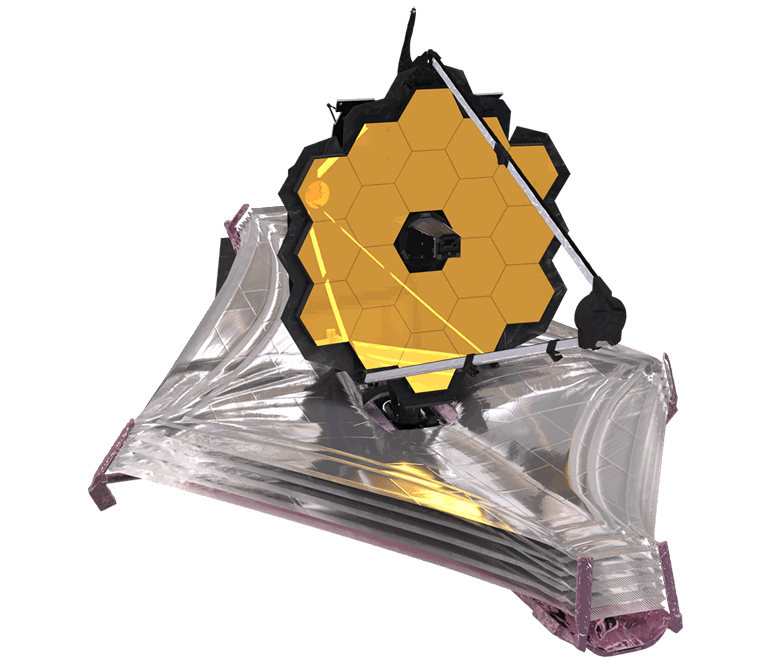
Via Wikimedia Commons: JWST spacecraft model 3 by NASA, public domain.
Name and partnership
Webb is a joint project of NASA, ESA and CSA.[4] It is named for James E. Webb, NASA's second administrator, who led the agency during much of the Apollo era (February 1961 to October 1968, according to ESA).[4] Before 2002 the project was called the Next Generation Space Telescope; it was renamed in his honour on 10 September 2002.[5]
Europe's four main contributions were the NIRSpec instrument, the optical bench of the MIRI instrument, the Ariane 5 launch, and staff to support operations. In return, European scientists receive a minimum share of 15% of the observing time.[4]
Origins and construction
In September 1989 the Space Telescope Science Institute and NASA held a workshop on a successor to the Hubble Space Telescope, bringing together more than 130 astronomers and engineers.[2] In 1996 a committee led by astronomer Alan Dressler recommended an infrared telescope with a mirror more than four metres across, operating far beyond the Moon's orbit.[2] NASA funded further studies in 1997 and chose instrument teams in 2002.[2] Construction of the mirror segments and science instruments began in 2004, and in 2005 NASA approved the European Ariane 5 rocket as the launch vehicle.[2]
All 18 mirror segments were finished and tested by 2011.[2] Between 2012 and 2013 the instruments and mirror segments arrived at NASA's Goddard Space Flight Center in Maryland, and from late 2015 to early 2016 the segments were mounted on the telescope's backplane.[2] In 2017 the mirror and instruments were tested at cryogenic temperatures in a giant vacuum chamber at NASA's Johnson Space Center, and in 2018 they were delivered to Northrop Grumman in California. The two halves of the observatory were joined there in 2019, and in 2020 Webb was fully folded for the first time and passed its final environmental tests.[2] Unlike Hubble, Webb cannot be visited by astronauts. NASA states that early studies of servicing Webb, by crewed or robotic missions, concluded that the benefits did not outweigh the added mission complexity, mass and cost.[5]
The mirror and optics
Webb's primary mirror is 6.5 metres across and is the largest ever launched into space.[6] It is made of 18 hexagonal segments, each 1.32 metres across flat to flat, built from beryllium, which is strong for its weight and holds its shape over a range of temperatures.[6] Each segment carries a gold coating 100 nanometres thick, which reflects infrared light well.[6] The mirror's collecting area is about 25 square metres,[1] almost six times Hubble's, whose mirror is 2.4 metres across.[6][4]
The mirror is larger than the rocket's fairing, so the two outer wings, each holding three segments, fold back for launch.[6][7] Light that the primary mirror gathers goes to a round secondary mirror on a boom, then to a tertiary mirror and a flat fine steering mirror, and on to the instruments.[6] Actuators on the back of each segment adjust its position and shape. After launch the segments were aligned so that together they act as one mirror, to about one ten-thousandth of the thickness of a human hair.[6]
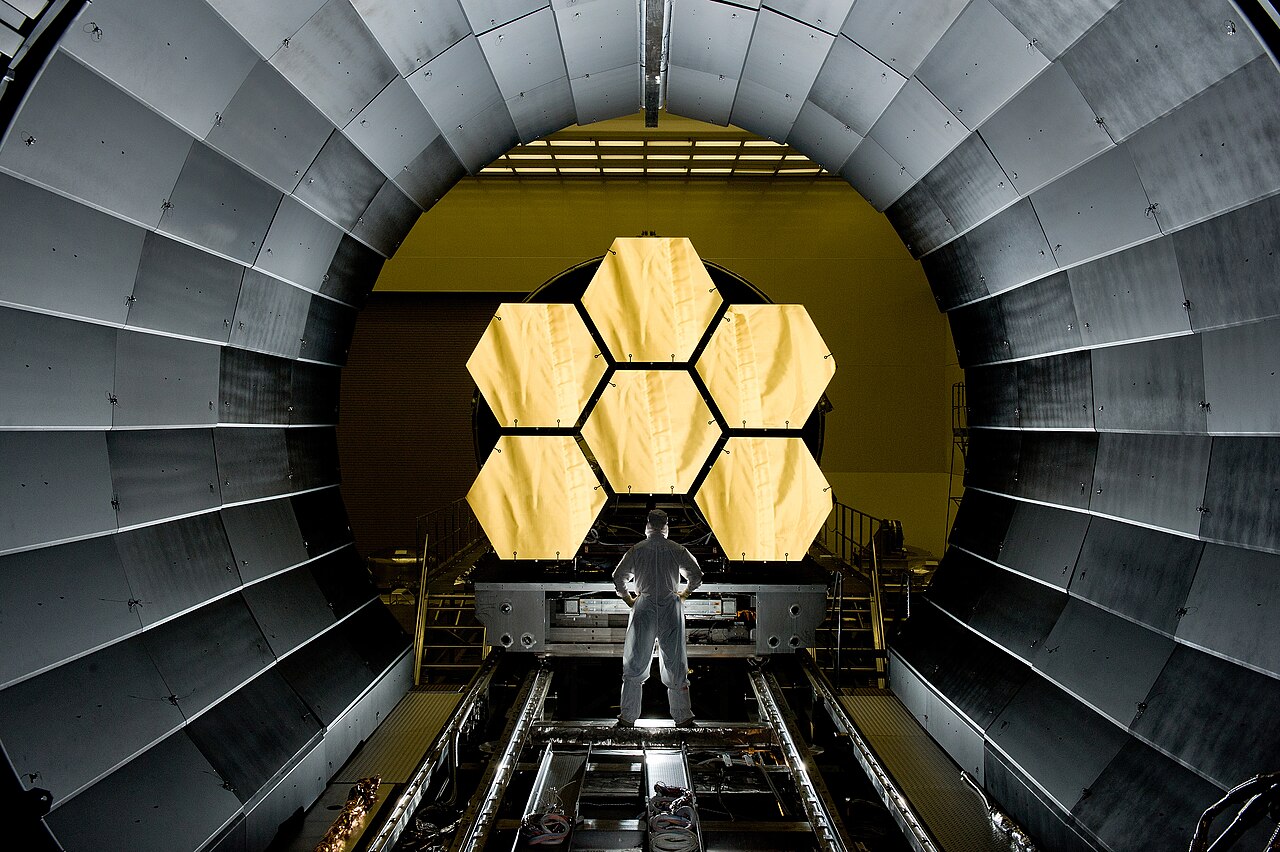
Via Wikimedia Commons: James Webb Primary Mirror by NASA/MSFC/David Higginbotham, public domain.
Why infrared, and why the cold
Webb's instruments cover wavelengths of about 0.6 to 28 micrometres, from visible red to the mid-infrared. Hubble observes from 0.1 to 2.5 micrometres, ultraviolet to near-infrared.[4] Infrared lets Webb see into dust clouds where stars and planets form.[5] It also lets Webb see very distant galaxies: according to NASA's Webb FAQ, light that early galaxies emitted in the ultraviolet is stretched by the expansion of the universe and reaches Earth as infrared.[5]
Because infrared light is essentially heat, the telescope has to be very cold, or its own warmth would swamp the faint signals it is looking for.[8] Webb's sunshield has five layers of Kapton, a tough plastic coated with reflective metal, each thinner than a human hair.[8] It measures 21.197 by 14.162 metres, about the size of a tennis court, and cuts the temperature between its hot and cold sides by about 299 °C.[8] ESA puts the telescope's operating temperature at about −233 °C.[4] The mid-infrared instrument, MIRI, needs detectors colder than 7 kelvin, which passive cooling cannot reach, so Webb carries a dedicated cryocooler for it.[1]
The four instruments
Webb carries four science instruments:
- NIRCam (Near Infrared Camera) is the primary imager for light from 0.6 to 5 micrometres. It has coronagraphs, which block a bright star's light to reveal faint objects near it, and it senses the mirror's alignment.[9]
- NIRSpec (Near Infrared Spectrograph) splits light into spectra and can observe more than 100 objects at once, using tiny shutters (microshutters) invented at Goddard. Each shutter is about 100 by 200 micrometres.[1][10]
- MIRI (Mid-Infrared Instrument) is a camera and spectrograph for 5 to 28 micrometres. NASA calls it the only mid-infrared instrument on Webb, and it was developed by a consortium of European institutes with NASA's Jet Propulsion Laboratory.[11]
- FGS/NIRISS (Fine Guidance Sensor and Near Infrared Imager and Slitless Spectrograph) combines the guider that locks onto stars to keep Webb pointed precisely with an imager and spectrograph. NIRISS is the only Webb instrument capable of aperture mask interferometry.[12]
Launch, deployment and orbit
Webb launched at 7:20 a.m. EST (12:20 UTC) on 25 December 2021 on an Ariane 5 ECA rocket from Europe's Spaceport in Kourou, French Guiana.[1][2] NASA's timeline says the rocket separated from the observatory 27 minutes into the flight,[2] and its deployment page says roughly 26 minutes.[7] The solar array unfolded about 30 minutes after launch.[2] The Ariane launch was so accurate that very little course correction was needed, which saved fuel.[7]
Webb's fully deployed form, about 21 by 14 by 8 metres, was far too big for any rocket, so it folded to fit the 5.4-metre fairing.[7] Unfolding involved more than 50 major deployments with 178 release mechanisms, and NASA counted over 300 possible single points of failure.[7] In the first week the sunshield was deployed and tensioned. In the second week the secondary mirror was extended and the two mirror wings were latched into place. The telescope then cooled over several weeks, and the remaining five months of commissioning went to aligning the optics and calibrating the instruments.[7]
Webb orbits the Sun, not the Earth, near the second Sun–Earth Lagrange point (L2), where the combined pull of the Sun and Earth lets a spacecraft keep pace with Earth as it circles the Sun.[3] The trip took about 30 days, and it reached the orbit on 24 January 2022.[3][13] Webb circles L2 in a loop that takes about six months, which keeps it out of the shadows of Earth and the Moon, so it can observe all the time.[3] Hubble, by contrast, orbits about 560 kilometres above Earth.[13]
First images and science
On the evening of 11 July 2022 President Joe Biden unveiled the first full-colour image, of the galaxy cluster SMACS 0723. Four more targets followed the next morning.[2] NASA's set of first images and data comprised the SMACS 0723 deep field, a spectrum of the hot gas-giant exoplanet WASP-96 b showing water vapour, the Southern Ring Nebula, Stephan's Quintet, and the "Cosmic Cliffs" in the Carina Nebula.[14] NASA says the deep field covers a patch of sky about the size of a grain of sand held at arm's length.[14]
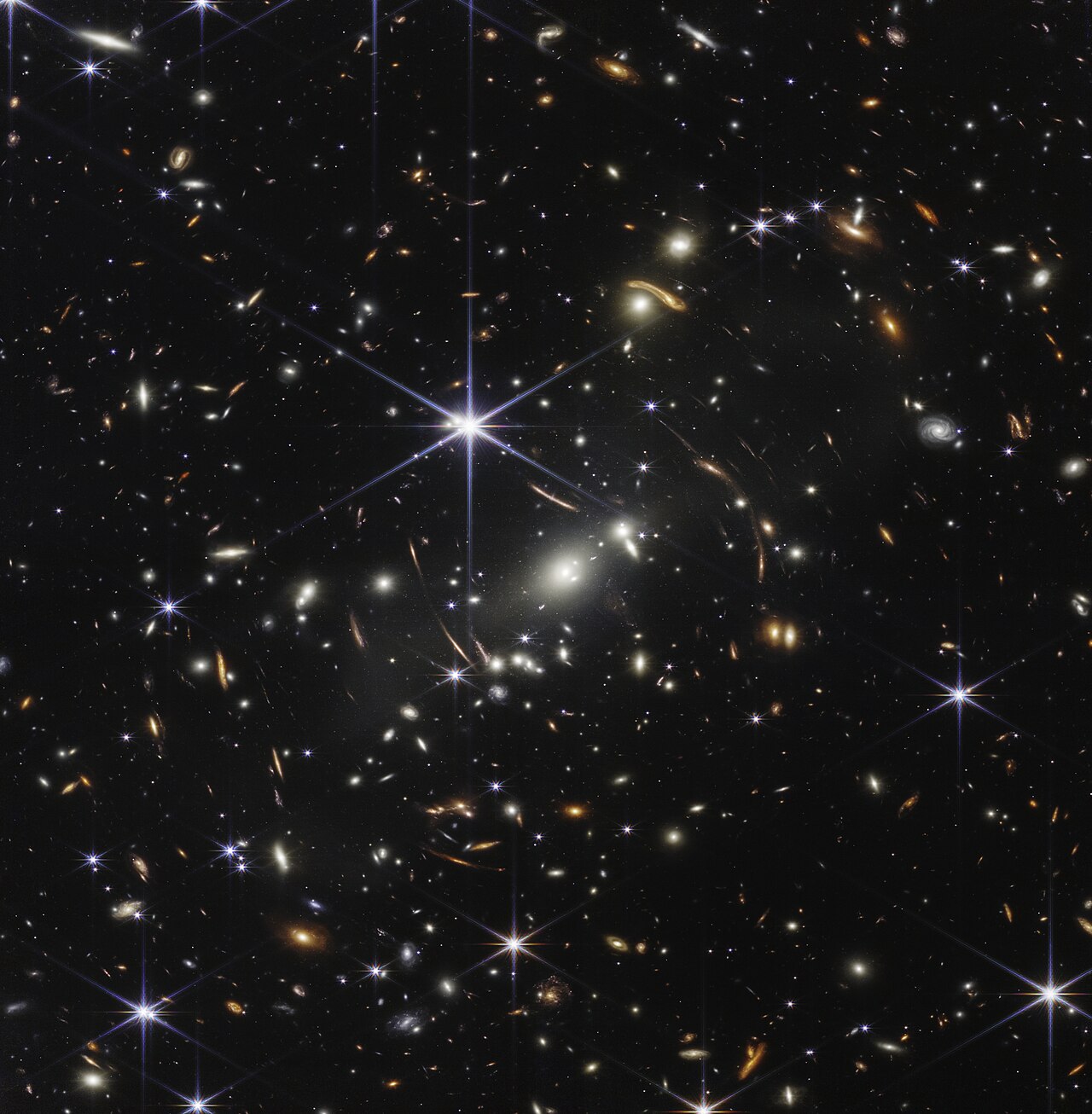
Via Wikimedia Commons: Webb's First Deep Field by NASA, ESA, CSA, and STScI, public domain.
NASA organises Webb's science under four themes: the early universe, galaxies over time, the life cycle of stars, and other worlds, including exoplanets and objects in the Solar System.[15] For the first, NASA describes "Cosmic Dawn", roughly 50 million to one billion years after the Big Bang.[15] In May 2024 ESA reported that Webb had found the galaxy JADES-GS-z14-0 at a redshift of 14.32 (+0.08/−0.20), only about 290 million years after the Big Bang, which was then the most distant galaxy known.[16] Webb has also observed the Andromeda galaxy: NASA says that observations in December 2025 gave the final evidence needed to reconstruct the merger of a binary star system nicknamed Bao there.[13]
Lifetime and where it stands
Webb was designed to work for at least five years, with a goal of ten. After launch and commissioning, the team found that the propellant on board should support science operations for more than 20 years, though NASA notes that other factors, such as hardware wearing out in space, could limit the mission.[5] NASA's FAQ reports that, as of January 2023, Webb's mirror had recorded 21 measurable micrometeoroid impacts, all but one consistent with pre-launch predictions. The exception, a larger-than-expected strike, was judged a statistically rare event, and NASA says the telescope still exceeds all mission requirements.[5] As of November 2026, NASA lists Webb as an active mission.[13]
Sources
- NASA Science. "James Webb Space Telescope: Fact Sheet." science.nasa.gov/mission/webb/fact-sheet/ (read 22 November 2026)
- NASA Science. "Webb Mission Timeline." science.nasa.gov/mission/webb/webb-mission-timeline/ (read 22 November 2026)
- NASA Science. "Webb's Orbit." science.nasa.gov/mission/webb/orbit/ (read 22 November 2026)
- European Space Agency. "Webb factsheet." esa.int/Science_Exploration/Space_Science/Webb/Webb_factsheet (read 22 November 2026)
- NASA Science. "Webb FAQ." science.nasa.gov/mission/webb/faqs-full/ (read 22 November 2026)
- NASA Science. "Webb's Mirrors." science.nasa.gov/mission/webb/webbs-mirrors/ (read 22 November 2026)
- NASA Science. "Webb's Deployment." science.nasa.gov/mission/webb/deployment/ (read 22 November 2026)
- NASA Science. "Webb's Sunshield." science.nasa.gov/mission/webb/webbs-sunshield/ (read 22 November 2026)
- NASA Science. "Near Infrared Camera (NIRCam)." science.nasa.gov/mission/webb/nircam/ (read 22 November 2026)
- NASA Science. "Near InfraRed Spectrograph (NIRSpec)." science.nasa.gov/mission/webb/nirspec/ (read 22 November 2026)
- NASA Science. "Mid-Infrared Instrument (MIRI)." science.nasa.gov/mission/webb/mid-infrared-instrument-miri/ (read 22 November 2026)
- NASA Science. "FGS/NIRISS." science.nasa.gov/mission/webb/fine-guidance-sensor-near-infrared-im… (read 22 November 2026)
- NASA Science. "James Webb Space Telescope" (mission page). science.nasa.gov/mission/webb/ (read 22 November 2026)
- NASA Science. "Webb's First Images." science.nasa.gov/mission/webb/webbs-first-images/ (read 22 November 2026)
- NASA Science. "Webb Science Overview." science.nasa.gov/mission/webb/science-overview/ (read 22 November 2026)
- European Space Agency. "Webb finds most distant known galaxy." May 2024. esa.int/ESA_Multimedia/Images/2024/05/Webb_finds_most_distant_known… (read 22 November 2026)
