Version 2 (current)
Nov 22, 2026. Version history
The Andromeda Galaxy (Messier 31, or M31) is a large spiral galaxy about 2.5 million light-years from Earth and the nearest major galaxy to the Milky Way.[1] It lies in the constellation Andromeda and is visible to the naked eye as a faint smudge.[1]
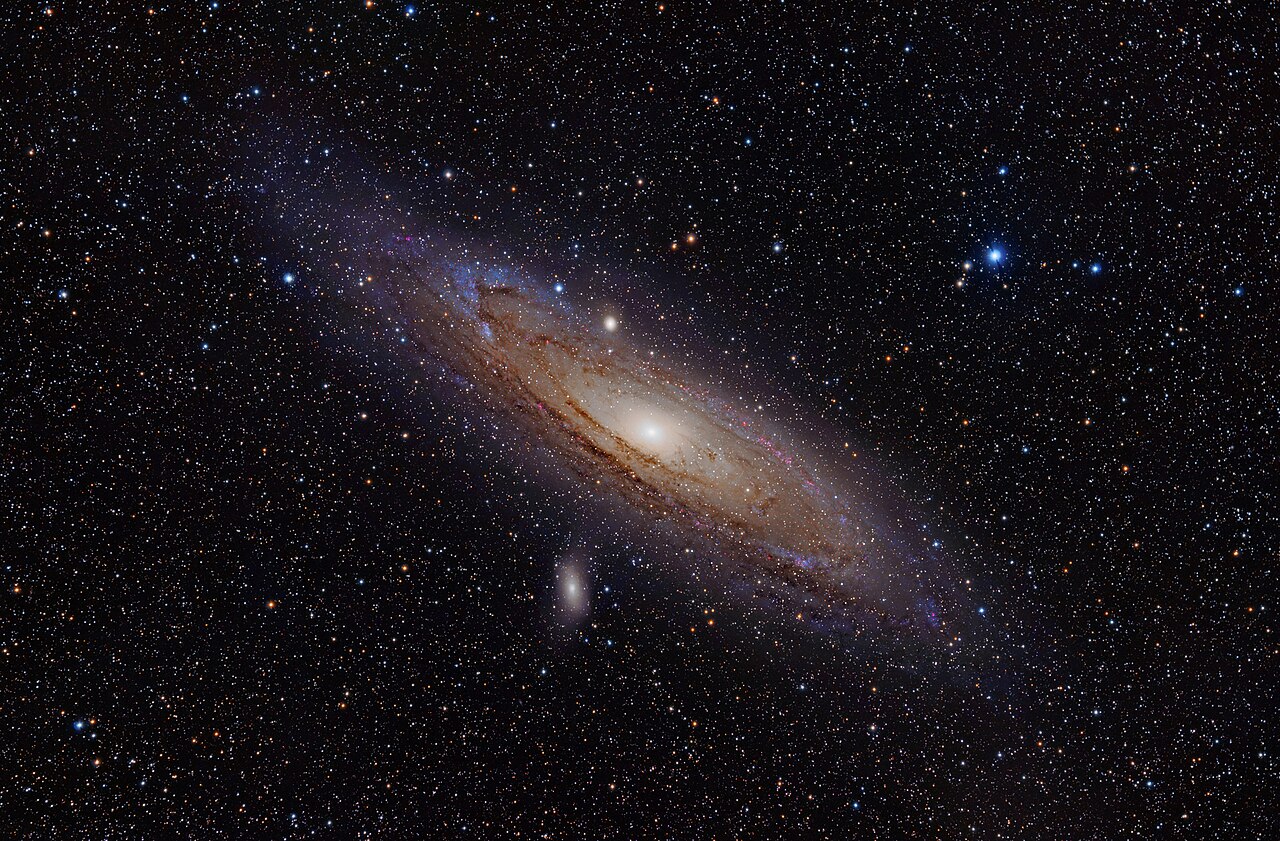
Via Wikimedia Commons: Andromeda Galaxy (with h-alpha) by Adam Evans, CC BY 2.0.
Where it is and how it looks
M31 has an apparent magnitude of 3.1, bright enough to see without a telescope even from places with moderate light pollution, and it is best observed in November.[1] On a clear autumn night it looks like a faint, cigar-shaped patch of roughly the Moon's apparent width, according to NASA.[7] Its full diameter on the night sky is about six times that of the full Moon.[6] The disc is seen almost edge-on, tilted 77 degrees from our line of sight.[7]
Distance figures differ slightly between NASA pages. NASA's Hubble pages give 2.5 million light-years for the galaxy as a whole.[1][4] NASA's January 2025 account of the star V1 puts that star, which lies inside Andromeda, at 2.2 million light-years.[3] NASA's ultraviolet imaging page gives the galaxy's extent as 260,000 light-years across.[8]
Discovery and the "island universe" debate
Because Andromeda is so easy to see, NASA's Hubble catalogue notes that no one can say who discovered it. The earliest known report is in the Book of Fixed Stars by the Persian astronomer Abd al-Rahman al-Sufi, from the year 964.[1]
In the early 1900s most astronomers considered the Milky Way a single "island universe" of stars with nothing beyond it, and Andromeda was catalogued as one of many faint "spiral nebulae".[2] Whether these nebulae belonged to the Milky Way or were independent systems far outside it was an open question; the astronomer Harlow Shapley believed they were part of the Milky Way.[2][3]
In 1923 Edwin Hubble, using the 100-inch Hooker Telescope at Mount Wilson Observatory in California, found a star in Andromeda that brightened and faded in a regular pattern. It was a Cepheid variable, a type of star whose pulsation period is tied to its true brightness, a relationship discovered by Henrietta Swan Leavitt, so that it can serve as a distance marker.[2][3] The star, named V1, was at a distance far greater than anything in the Milky Way, which showed that Andromeda was a separate galaxy.[3] NASA reports that when Hubble told Shapley, Shapley remarked, "Here is the letter that destroyed my universe."[3]
Size and contents
Andromeda is estimated to contain about one trillion stars.[7] Hubble Space Telescope surveys cannot resolve all of them: the 2025 mosaic resolves about 200 million stars, those brighter than the Sun, which NASA describes as a fraction of the galaxy's population.[7]
Structure and history
Observations in ultraviolet light by NASA's Galaxy Evolution Explorer showed bright blue-white rings of hot, young, massive stars, with cooler dust lanes between them and a central ball of older stars. In visible light the rings look more like spiral arms.[8] Astronomers using NASA's Spitzer Space Telescope read this ring structure as evidence that Andromeda had a direct collision with its neighbour M32 more than 200 million years ago.[8]
Hubble results published in 2025 describe a galaxy whose history differs from the Milky Way's. According to NASA, Andromeda has more young stars and unusual features such as coherent streams of stars, which suggests more recent star formation and interaction. One researcher, Daniel Weisz of the University of California, Berkeley, called it "a train wreck" that formed many stars and then largely shut down, and described it as a transitional galaxy between a star-forming spiral and an elliptical dominated by aging red stars.[7] A possible culprit is the compact satellite galaxy M32, which resembles the stripped-down core of a once-spiral galaxy that may have interacted with Andromeda.[7]
Hubble's mosaics
In January 2015 Hubble released what was then its largest image, covering a section of Andromeda's disc. It assembled 411 images into a 1.5-billion-pixel view that shows over 100 million stars and thousands of star clusters.[6] ESA says this section stretched over 40,000 light-years of the disc;[6] NASA's version of the same release says 61,000 light-years.[9] The program behind it, the Panchromatic Hubble Andromeda Treasury (PHAT), covered the northern half of the galaxy.[7]
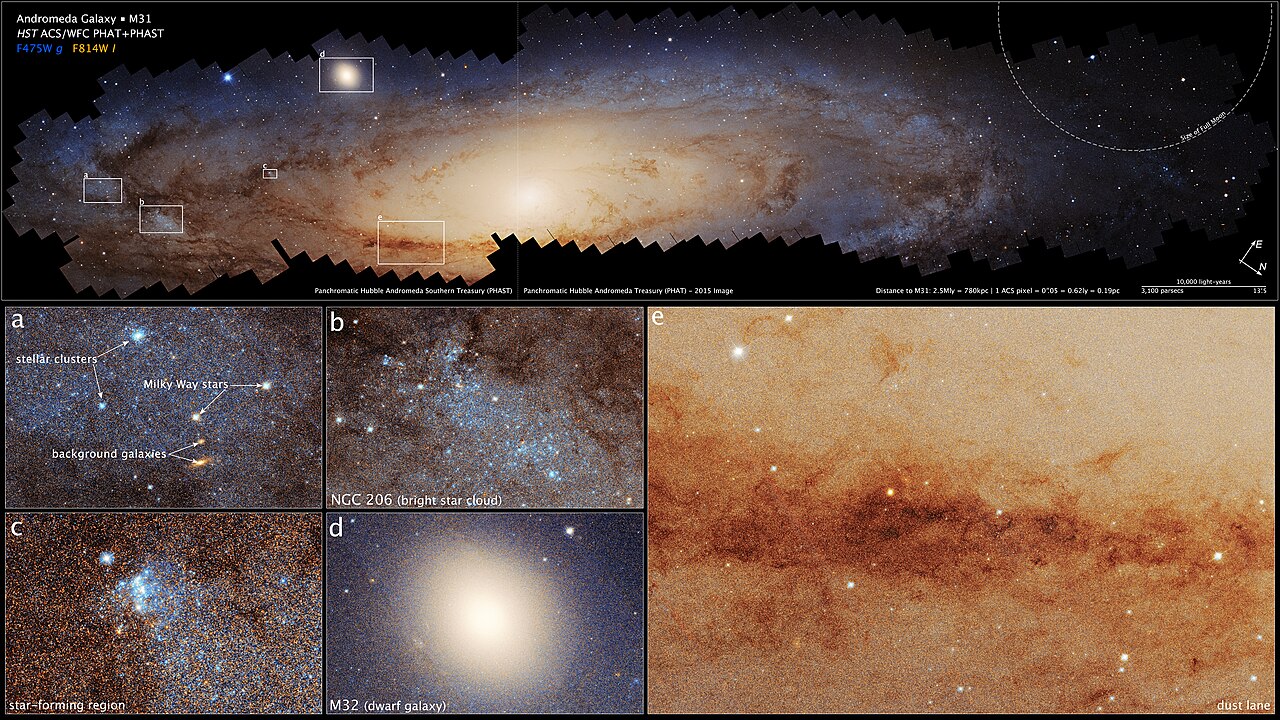
Via Wikimedia Commons: Hubble’s panoramic view of the Andromeda Galaxy (annotated) (heic2501b by NASA, ESA, B. Williams (U. of Washington), CC BY 4.0.
A follow-up program, the Panchromatic Hubble Andromeda Southern Treasury (PHAST), added about 100 million stars in the southern half. In January 2025 the combined data produced a mosaic of about 600 fields and at least 2.5 billion pixels, which NASA calls the largest photomosaic ever assembled from Hubble observations, requiring more than 1,000 Hubble orbits spanning more than a decade.[7] NASA states that the survey data on stellar ages, heavy-element content and masses will help distinguish between competing scenarios in which Andromeda merged with one or more galaxies.[7]
Motion and the predicted collision
Astronomers realised as far back as 1912 that Andromeda was moving toward us.[5] NASA gives its approach speed as about 250,000 miles per hour, measured from the Doppler shift of its starlight, but whether the encounter would be a miss, a glancing blow or a head-on collision depended on Andromeda's sideways motion across the sky, which could not be measured for more than a century.[4]
In May 2012 NASA announced that Hubble observations, repeated over five to seven years, had measured that sideways motion and were statistically consistent with a head-on collision. The team predicted the galaxies would collide in about four billion years and merge into a single elliptical galaxy about two billion years after that. NASA said the Sun and Earth would not be destroyed, because the stars within each galaxy are so far apart that they would not collide with each other, though the solar system would probably be thrown farther from the galactic centre. The 2012 release added that Andromeda's companion, the Triangulum Galaxy (M33), would likely join the collision, with a small chance of striking the Milky Way first.[4]
In June 2025 a team led by Till Sawala of the University of Helsinki published a new analysis in Nature Astronomy using Hubble and Gaia data. ESA describes the earlier prediction as a collision in about 4.5 billion years. The new study folded in 22 variables with their uncertainties and ran 100,000 simulations out to 10 billion years, and found only a 50-50 chance of the two galaxies colliding within the next 10 billion years. It also found that the gravity of the Milky Way's satellite, the Large Magellanic Cloud, tends to pull the Milky Way off Andromeda's path, while M33 pulls the Milky Way slightly toward it. Sawala emphasised that the long-term future of the Local Group is highly uncertain.[5] ESA's release says the fate of the Milky Way remains an open question.[5]
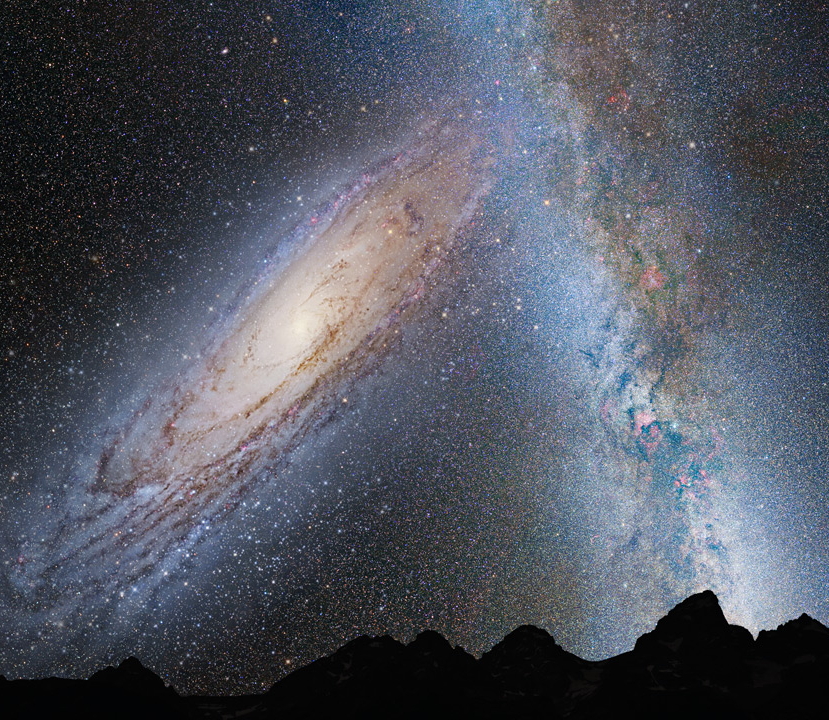
Via Wikimedia Commons: Milky Way-Andromeda Collision close-up by NASA; Z. Levay and R. van der Marel, STScI; T. Hallas; and A, public domain.
Andromeda and the James Webb Space Telescope
The James Webb Space Telescope has also observed Andromeda. NASA's Webb mission page reports that observations in December 2025 gave the final evidence needed to reconstruct a merger of a binary star system, nicknamed Bao, in the galaxy.[10]
Sources
- NASA Science. "Messier 31 (The Andromeda Galaxy)," Hubble's Messier Catalog. science.nasa.gov/mission/hubble/science/explore-the-night-sky/hubbl… (read 22 November 2026)
- NASA Hubble Mission Team. "Hubble Views the Star that Changed the Universe." 23 May 2011. science.nasa.gov/missions/hubble/hubble-views-the-star-that-changed… (read 22 November 2026)
- NASA Hubble Mission Team. "NASA Celebrates Edwin Hubble's Discovery of a New Universe." 15 January 2025. science.nasa.gov/missions/hubble/nasa-celebrates-edwin-hubbles-disc… (read 22 November 2026)
- NASA Hubble Mission Team. "NASA's Hubble Shows Milky Way is Destined for Head-On Collision." 31 May 2012. science.nasa.gov/missions/hubble/nasas-hubble-shows-milky-way-is-de… (read 22 November 2026)
- ESA/Hubble. "Hubble casts doubt on certainty of galactic collision" (heic2508). 2 June 2025. esahubble.org/news/heic2508/ (read 22 November 2026)
- ESA/Hubble. "Andromeda in HD: Hubble captures the sharpest ever view of neighbouring spiral Galaxy" (heic1502). 5 January 2015. esahubble.org/news/heic1502/ (read 22 November 2026)
- NASA Hubble Mission Team. "NASA's Hubble Traces Hidden History of Andromeda Galaxy." January 2025. science.nasa.gov/missions/hubble/nasas-hubble-traces-hidden-history… (read 22 November 2026)
- NASA/JPL-Caltech. "Andromeda" (PIA15416), Galaxy Evolution Explorer. 16 May 2012. science.nasa.gov/photojournal/andromeda/ (read 22 November 2026)
- NASA Hubble Mission Team. "Hubble's High-Definition Panoramic View of the Andromeda Galaxy." 5 January 2015. hubblesite.org/contents/news-releases/2015/news-2015-02 (read 22 November 2026)
- NASA Science. "James Webb Space Telescope" (mission page). science.nasa.gov/mission/webb/ (read 22 November 2026)
