Version 2 (current)
Nov 22, 2026. Version history
Mercury is the smallest planet in the Solar System and the closest to the Sun, only slightly larger than Earth's Moon. It has no moons or rings and almost no atmosphere.[1]
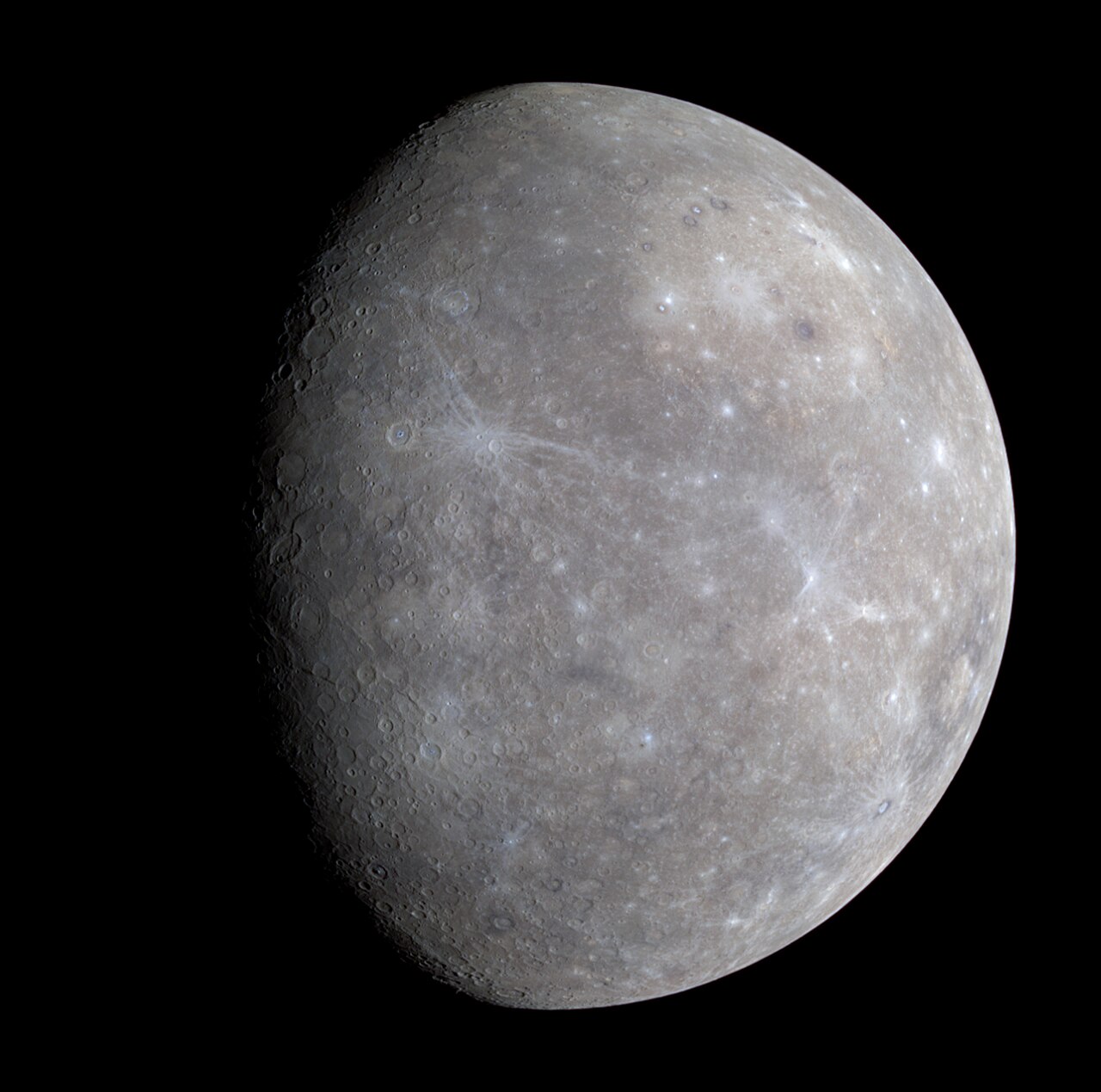
Via Wikimedia Commons: Mercury in color - Prockter07 centered by NASA / Johns Hopkins University Applied Physics Laboratory /, public domain.
Size, distance and orbit
Mercury's radius is 2,440 kilometres, a little more than a third of Earth's width.[1] It orbits the Sun at an average distance of about 58 million kilometres (0.4 astronomical units). Its orbit is highly eccentric, ranging from about 47 million to 70 million kilometres from the Sun.[1] It travels at nearly 47 kilometres per second, faster than any other planet, and completes an orbit every 88 Earth days.[1]
Mercury spins slowly, once every 59 Earth days, so it rotates three times for every two orbits of the Sun.[1][3] Because of the way its spin and orbit combine, one full day-night cycle (one Mercury solar day) lasts 176 Earth days, just over two Mercury years.[1] When Mercury is closest to the Sun and moving fastest, the Sun appears from some places on the surface to rise, briefly set and rise again.[1] The planet's axis is tilted only 2 degrees, so it has no real seasons.[1] From the surface, NASA says, the Sun would look more than three times as large as it does from Earth, with sunlight up to seven times brighter.[1]
Temperature
Daytime surface temperatures can reach about 430 °C, and with no atmosphere to retain heat, nights can fall to about −180 °C.[1] Despite being closest to the Sun, Mercury is not the hottest planet: Venus is, because of its dense atmosphere.[1] ESA likewise notes that Mercury has a lower average temperature than Venus.[3]
Interior and structure
Mercury is the second densest planet after Earth. It has a large metallic core with a radius of about 2,074 kilometres, about 85% of the planet's radius, and there is evidence that the core is partly molten. The rocky shell outside it, comparable to Earth's mantle and crust together, is only about 400 kilometres thick.[1] NASA says Mercury formed about 4.5 billion years ago.[1]
Surface
The surface resembles the Moon's, scarred by impact craters from meteoroids and comets.[1] ESA calls Mercury the most cratered planet in the Solar System.[3] Craters are named after famous deceased artists, musicians and authors; NASA mentions Dr. Seuss and Alvin Ailey among them.[1] The largest basins, formed by asteroid impacts early in the Solar System's history, include the Caloris basin, 1,550 kilometres across, and the Rachmaninoff basin, 306 kilometres across.[1] The surface also has cliffs hundreds of miles long and up to a mile high, which NASA says formed as the interior cooled and contracted over billions of years.[1] Bright streaks called crater rays are made of crushed rock thrown out by impacts, and the space environment darkens them over time.[1] NASA's MESSENGER mission also found evidence of past volcanic activity on the surface.[2]
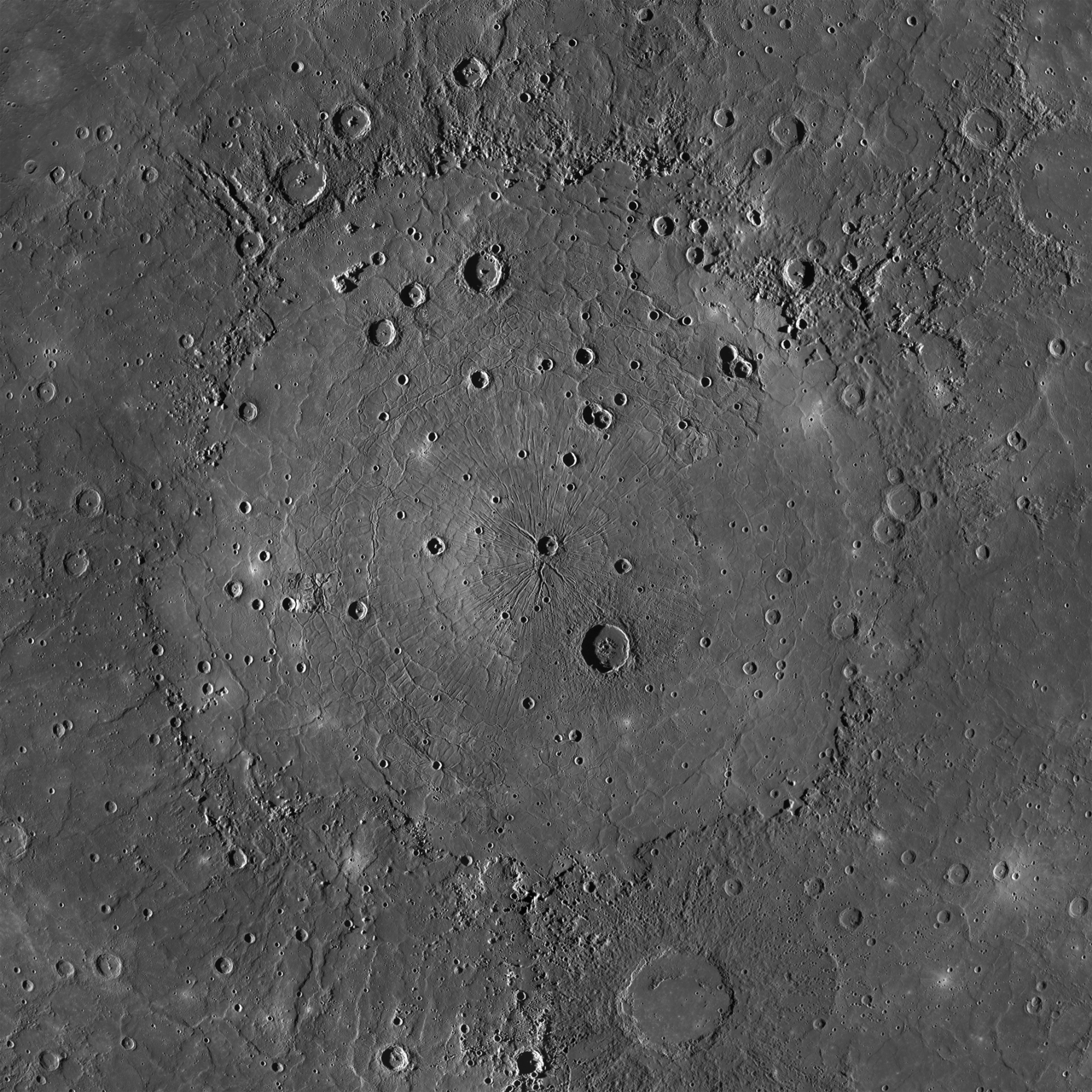
Via Wikimedia Commons: MESSENGER mosaic of the Caloris basin by NASA/Johns Hopkins University Applied Physics Laboratory/Car, public domain.
Ice at the poles
Mercury's axis is almost upright, so some deep craters near the poles never see sunlight. NASA's MESSENGER mission found evidence of water ice frozen in such places,[2] and NASA says the mission verified that the polar deposits are dominantly water ice.[2] NASA's Mercury facts page words this more cautiously, saying only that Mercury "may" have water ice in permanently shadowed regions.[1] ESA states that Mercury has ice in its permanently shadowed craters.[3]
Exosphere and magnetic field
Mercury has no real atmosphere but a thin exosphere of atoms knocked off the surface by the solar wind and meteoroid impacts, made up mostly of oxygen, sodium, hydrogen, helium and potassium.[1] Its magnetic field is offset from the planet's equator, and MESSENGER found a significant northward offset from the planet's center.[1][2] At the surface the field has about 1% of Earth's strength, but it interacts with the solar wind in ways that can create "magnetic tornadoes" that funnel solar wind plasma to the surface.[1]
Exploration
Only two spacecraft had visited Mercury before the current mission: NASA's Mariner 10, which flew past three times in 1974 and 1975, and NASA's MESSENGER.[3][5]
MESSENGER. The spacecraft launched on 3 August 2004 (UT) and made one Earth flyby, two Venus flybys and three Mercury flybys (January 2008, October 2008 and September 2009) to slow down for orbit. It became the first spacecraft to orbit Mercury in March 2011, nearly seven years after launch. (NASA's page gives 18 March 2011 in its text and 11 March in its key-dates list.)[2] It completed its primary yearlong mission in March 2012 after nearly 100,000 images, and by February 2014 had taken its 200,000th. The mission ended on 30 April 2015 when MESSENGER, out of propellant, struck the surface at about 14,080 kilometres per hour.[2] NASA credits it with determining Mercury's surface composition, revealing its geological history, and detailing its internal magnetic field.[2]
BepiColombo. BepiColombo is a joint mission of the European Space Agency (ESA) and the Japan Aerospace Exploration Agency (JAXA), named for the Italian mathematician and engineer Giuseppe (Bepi) Colombo (1920–84).[3] It launched on 20 October 2018 on an Ariane 5 and carries two orbiters, ESA's Mercury Planetary Orbiter (MPO) and JAXA's Mercury Magnetospheric Orbiter (Mio).[3][5] It made six Mercury flybys between October 2021 and January 2025.[3] ESA says that placing a spacecraft in a stable orbit around Mercury takes even more energy than sending one to Pluto, because of the Sun's gravity.[3]
ESA's arrival-updates page, last updated on 29 October 2026, says the transfer module separated on 3 September 2026. It schedules the spacecraft stack to enter orbit around Mercury on 21 November 2026 and MPO and Mio to separate on 9–10 December 2026, with the science phase to begin in April 2027.[4] None of the sources read for this entry reports the outcome of the 21 November orbit insertion. BepiColombo is planned to be the first mission to orbit Mercury with two spacecraft at once.[4]
Name
NASA says Mercury is named for the swiftest of the ancient Roman gods,[1] and ESA for the messenger of the gods.[3] This entry is about the planet. For the chemical element of the same name, see Mercury.
Sources
- NASA Science. "Mercury: Facts." science.nasa.gov/mercury/facts/ (read 22 November 2026)
- NASA Science. "MESSENGER." science.nasa.gov/mission/messenger/ (read 22 November 2026)
- European Space Agency. "BepiColombo factsheet." esa.int/Science_Exploration/Space_Science/BepiColombo/BepiColombo_f… (read 22 November 2026)
- European Space Agency. "Latest updates: BepiColombo's arrival at Mercury." 29 October 2026. esa.int/Science_Exploration/Space_Science/BepiColombo/Latest_update… (read 22 November 2026)
- NASA Science. "BepiColombo." science.nasa.gov/mission/bepicolombo/ (read 22 November 2026)
