Version 2
Nov 22, 2026. Compare with the current version · Version history
Venus is the second planet from the Sun and Earth's closest planetary neighbour, nearly Earth's size but wrapped in a thick carbon dioxide atmosphere that makes it the hottest planet in the Solar System.[1]
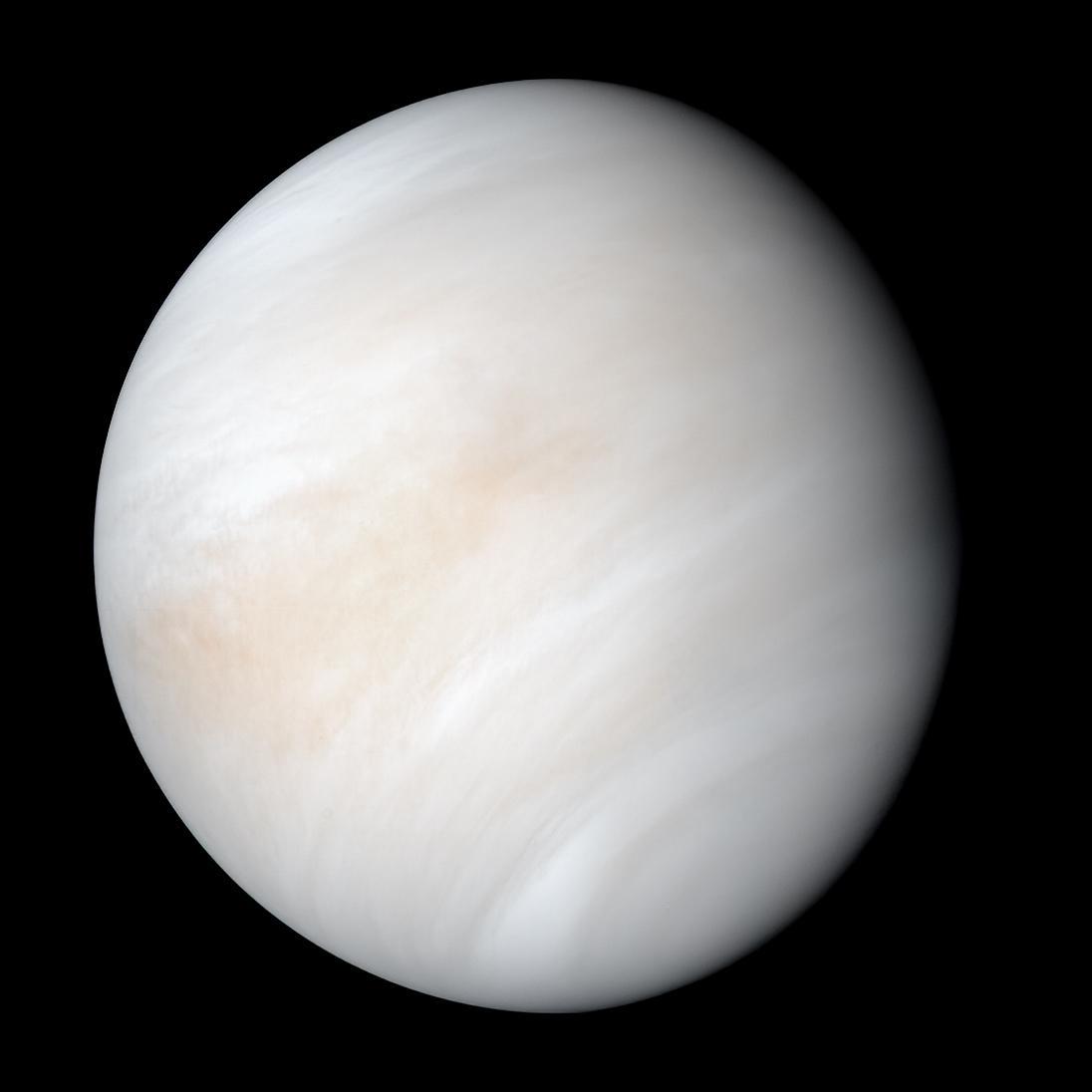
Via Wikimedia Commons: PIA23791-Venus-RealAndEnhancedContrastViews-20200608 (cropped) by NASA/JPL-Caltech, public domain.
Size, distance and appearance
Venus orbits the Sun at an average distance of about 108 million kilometres, or 0.72 astronomical units, and sunlight takes about six minutes to reach it.[1] Its equatorial diameter is about 12,104 kilometres, against 12,756 kilometres for Earth.[1] At its closest, Venus is about 38 million kilometres from Earth, and at its farthest about 261 million kilometres. NASA notes that Mercury actually spends more time near Earth than Venus does.[1]
After the Sun and Moon, Venus is the brightest object in the sky.[1] Because its orbit lies inside Earth's, it never strays far from the Sun in the sky, and ancient observers took the morning and evening appearances for two objects.[1] Through a telescope Venus shows phases like the Moon's, cycling from new to full over 584 days, and NASA says Galileo's observation of these phases provided key scientific evidence for the Sun-centred model of the Solar System.[1]
Day, year and rotation
A Venus day lasts 243 Earth days, longer than its year of 225 Earth days. Sunrise to sunset takes about 117 Earth days. Venus spins backward compared with Earth, so the Sun would rise in the west and set in the east. Its axis is tilted only 3 degrees, too little to produce noticeable seasons.[1] ESA reports that Venus Express found surface features were not quite where expected, evidence that Venus spins slightly more slowly than previously measured.[3]
No moons, but a companion
Venus has no moons and no rings.[1] It does have a quasi-satellite, an asteroid that orbits the Sun while staying near a planet. It was discovered on 11 November 2002 by Brian Skiff at the Lowell Observatory Near-Earth-Object Search, was provisionally named 2002 VE68, and was officially named Zoozve in February 2024. NASA estimates it is 200 to 500 metres across. According to the International Astronomical Union, it is the first-identified quasi-satellite of a major planet.[1]
Interior and magnetism
NASA says Venus has an iron core, a hot-rock mantle and a thin crust, remarkably similar in structure to Earth's.[1] Even so, Venus has no internally generated magnetic field. It has a weak induced magnetic field, created when the solar wind carrying the Sun's magnetic field interacts with the planet's ionosphere, and shaped like a comet's tail.[1]
Atmosphere and temperature
The atmosphere is mostly carbon dioxide, with dense clouds of sulfuric acid.[1] A runaway greenhouse effect heats the surface to about 467 °C, hot enough to melt lead, and surface pressure is about 93 times that at sea level on Earth.[1] NASA's Magellan page gives slightly different figures of 475 °C and 92 atmospheres.[2] About 50 kilometres above the surface, NASA says, temperatures are between 30 and 70 °C and pressure is similar to Earth's surface.[1] At the cloud tops, winds reach up to 360 kilometres per hour, and dark streaks there that absorb ultraviolet light remain unexplained.[1] NASA lists fine particles, ice crystals and iron chloride as the likeliest explanations, mentions microbial life only as a much less likely possibility, and states that none of the findings gives compelling evidence of life in the clouds.[1]
ESA's Venus Express, which studied the atmosphere from orbit, found among other things that high-altitude winds had become faster over time, that a very cold region high in the atmosphere may be cold enough for carbon dioxide to freeze, and that a thin layer of ozone exists. It also confirmed that a large quantity of water has been lost into space over billions of years.[3]
Surface
Venus has valleys, high mountains and thousands of volcanoes. Two large highland regions are Ishtar Terra, about the size of Australia, near the north pole, and the even larger Aphrodite Terra, near the equator. One mountain rises 11 kilometres, higher than Mount Everest.[1] Features include "pancake" domes up to 62 kilometres wide, likely formed by thick lava, "tick" domes with radiating spurs, and tesserae, terrain of intricate ridges and grooves.[1]
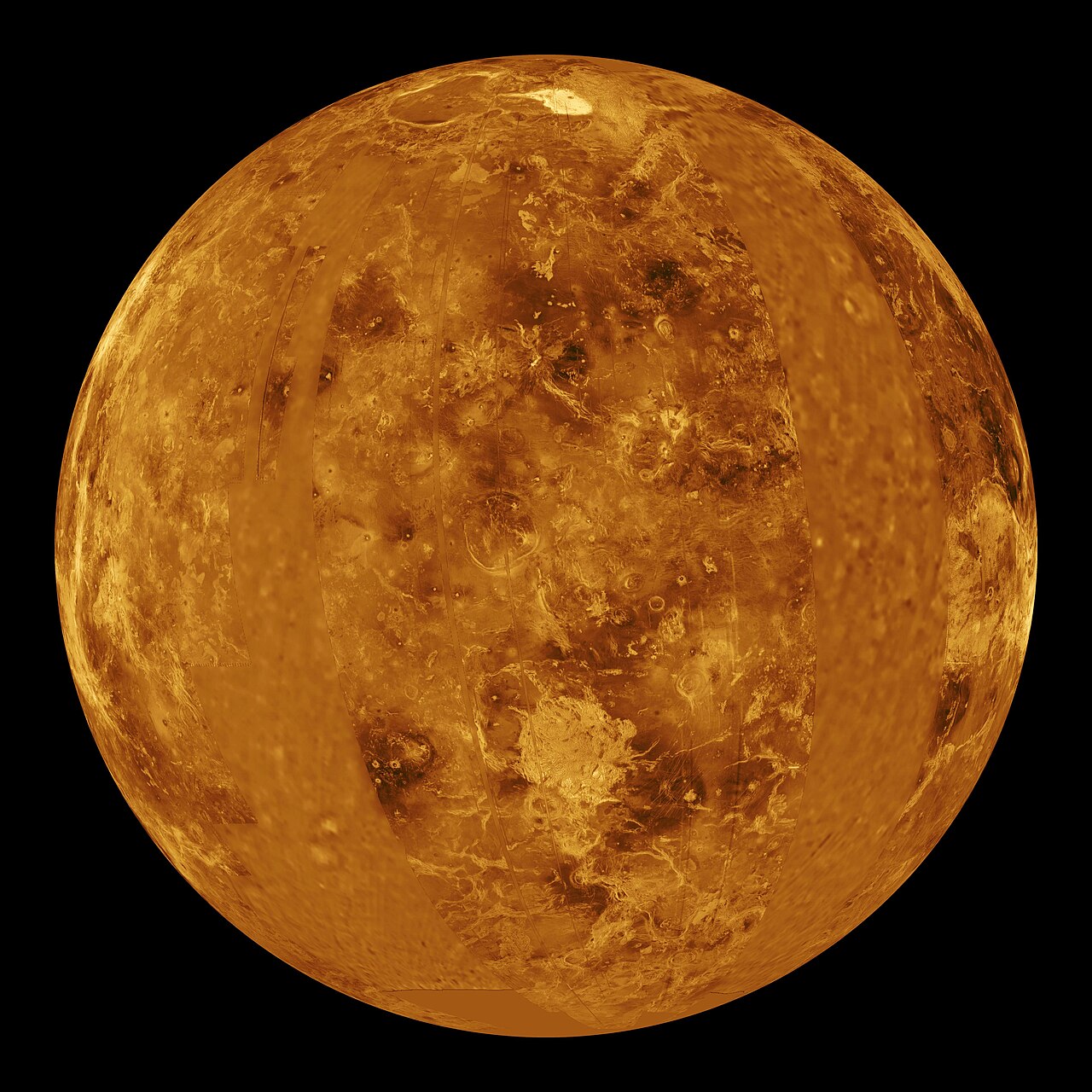
Via Wikimedia Commons: PIA00257 Venus (Computer Simulated Global View Centered at 0 Degrees E by NASA/JPL, public domain.
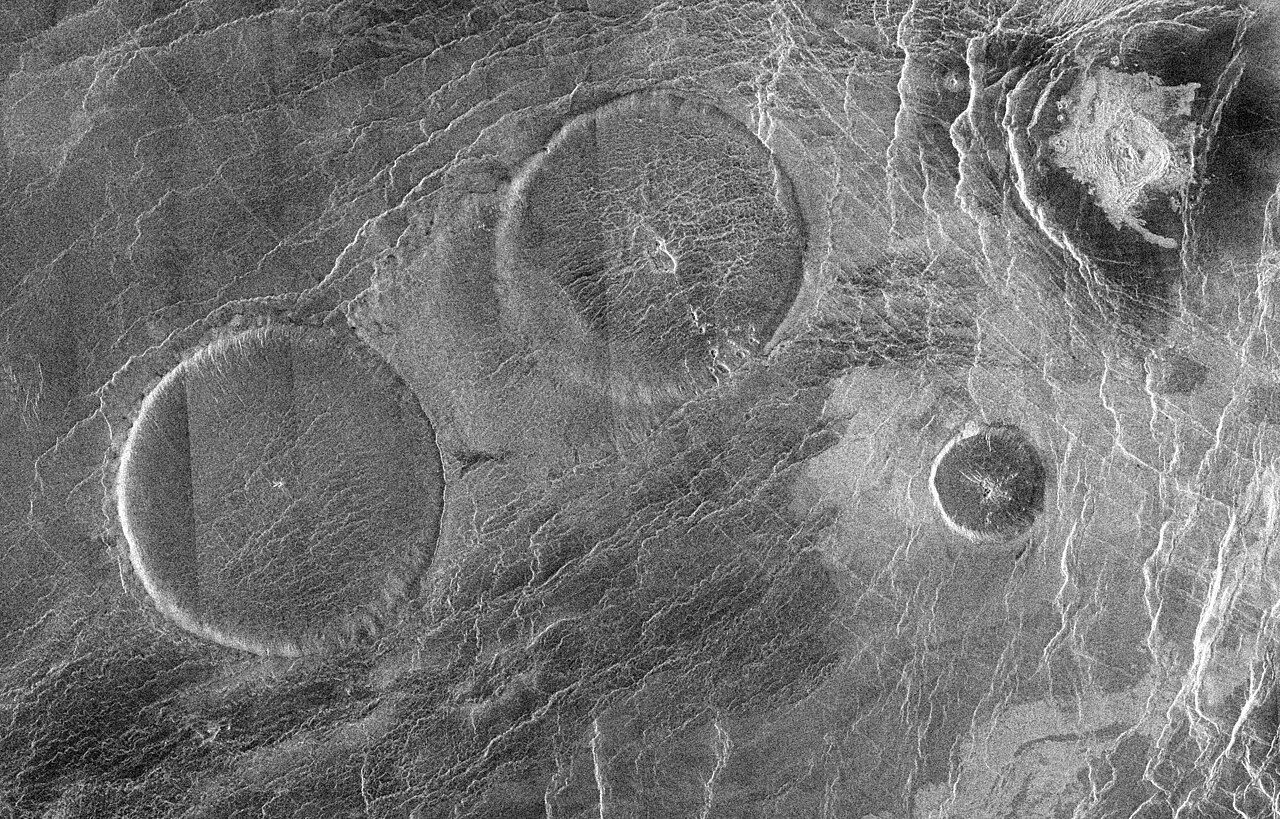
Via Wikimedia Commons: PIA00084 Eistla region pancake volcanoes by NASA/Jet Propulsion Laboratory, public domain.
Except for Earth, Venus has by far the fewest impact craters of any rocky planet, and volcanism and tectonic forces appear to have erased most traces of its early surface. NASA says the average age of surface features could be as young as 150 million years.[1] NASA's Magellan mission found that at least 85% of the surface is covered in volcanic flows. With no water, erosion is very slow, so surface features can persist for hundreds of millions of years, and continental drift is not evident.[2] Most features are named after women, and Venus is the only planet named for a female god.[1]
Exploration
The Soviet Union sent a series of Venera probes between 1961 and 1984, according to NASA's Venus page; ten reached the surface, and the longest survivor lasted two hours and the shortest 23 minutes.[1] (NASA's mission list dates the Venera program 1961–1983.)[6] Their photographs show a barren, dim, rocky landscape.[1]
NASA's Magellan spacecraft was launched on 4 May 1989 from the Space Shuttle Atlantis, the first deep space probe launched by a shuttle, and entered orbit around Venus on 10 August 1990.[2] It used radar to see through the clouds. NASA calls it the first spacecraft to image the entire surface of Venus, with mapping coverage reaching 98% by September 1992.[2] It returned 1,200 gigabits of data, more than all earlier NASA planetary missions combined at that time.[2] Magellan was commanded to plunge into the atmosphere in October 1994, and contact was lost on 13 October.[2]
ESA's Venus Express, launched on 9 November 2005, was ESA's first spacecraft to visit Venus, and its mission concluded in 2014.[3]
NASA's DAVINCI and VERITAS missions will be the first American spacecraft to explore Venus since the 1990s.[4][5] VERITAS is an orbiter that will map the surface in much greater detail than Magellan and seek answers to whether Venus has plate tectonics and continuous volcanism.[4] DAVINCI will make flybys and release a probe that samples the atmosphere on the way down to the highland region Alpha Regio.[5] NASA's mission list shows DAVINCI at 2029, VERITAS at 2031 and ESA's EnVision orbiter at 2031; these dates were as listed when the page was read on 22 November 2026.[6]
Name
Venus is named for the Roman goddess of love and beauty, known to the Greeks as Aphrodite.[1]
Sources
- NASA Science. "Venus Facts." science.nasa.gov/venus/facts/ (read 22 November 2026)
- NASA Science. "Magellan." science.nasa.gov/mission/magellan/ (read 22 November 2026)
- European Space Agency. "Venus Express science highlights." 1 June 2014. esa.int/Science_Exploration/Space_Science/Venus_Express/Venus_Expre… (read 22 November 2026)
- NASA Science. "VERITAS." science.nasa.gov/mission/veritas/ (read 22 November 2026)
- NASA Science. "DAVINCI." science.nasa.gov/mission/davinci/ (read 22 November 2026)
- NASA NSSDCA. "Venus." nssdc.gsfc.nasa.gov/planetary/planets/venuspage.html (read 22 November 2026)
