Compare versions
Version 1 → Version 2 (current). Removed · Added. This shows the entry's text as it is written, including its formatting marks.
Version 1 · Version 2 (current) · Version history
Side by side · Together
Version 1Version 2 (current)
10 unchanged paragraphs
Earth is the third planet from the Sun and the fifth largest in the Solar System, and the only place known to host life. NASA also notes that it is the only planet in the Solar System with liquid water on its surface.[1]
Earth is the third planet from the Sun and the fifth largest in the Solar System, and the only place known to host life. NASA also notes that it is the only planet in the Solar System with liquid water on its surface.[1]
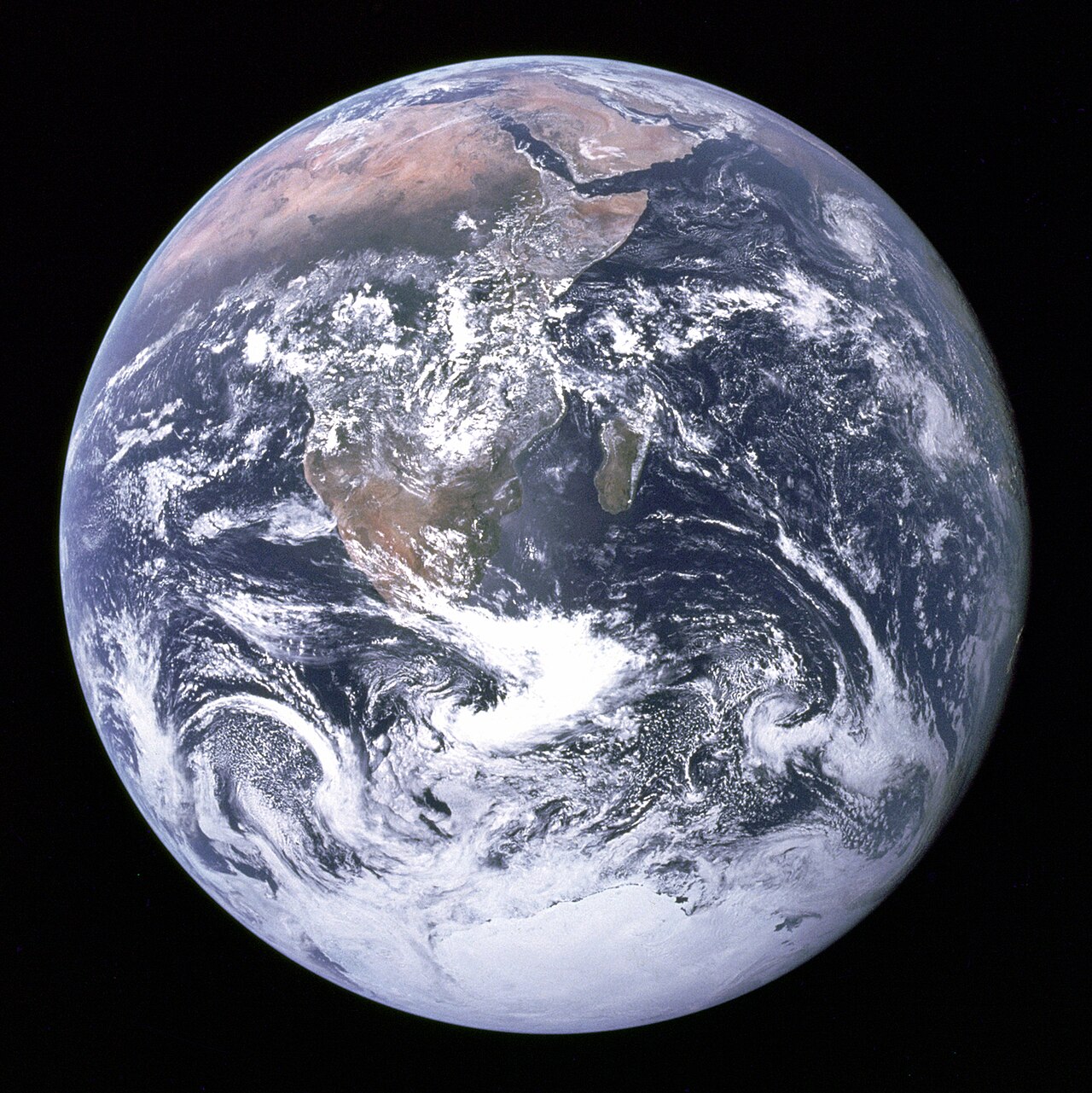

*Via Wikimedia Commons: [The Earth seen from Apollo 17](https://commons.wikimedia.org/wiki/File:The_Earth_seen_from_Apollo_17.jpg) by NASA/Apollo 17 crew; taken by either Harrison Schmitt or Ron, public domain.*
*Via Wikimedia Commons: [The Earth seen from Apollo 17](https://commons.wikimedia.org/wiki/File:The_Earth_seen_from_Apollo_17.jpg) by NASA/Apollo 17 crew; taken by either Harrison Schmitt or Ron, public domain.*
## Size, orbit and rotation
## Size, orbit and rotation
Earth has an equatorial diameter of 12,756 kilometres, making it the largest of the four rocky planets.[1] It orbits the Sun at an average distance of about 150 million kilometres, which defines one astronomical unit, and sunlight takes about eight minutes to reach it.[1] A day (one rotation) takes 23.9 hours and a year 365.25 days. The extra quarter day is why a leap day is added every four years.[1]
Earth has an equatorial diameter of 12,756 kilometres, making it the largest of the four rocky planets.[1] It orbits the Sun at an average distance of about 150 million kilometres, which defines one astronomical unit, and sunlight takes about eight minutes to reach it.[1] A day (one rotation) takes 23.9 hours and a year 365.25 days. The extra quarter day is why a leap day is added every four years.[1]
Earth's axis is tilted 23.4 degrees to the plane of its orbit, which causes the seasons: the hemisphere tilted toward the Sun receives more direct sunlight and has summer, while the other has winter.[1]
Earth's axis is tilted 23.4 degrees to the plane of its orbit, which causes the seasons: the hemisphere tilted toward the Sun receives more direct sunlight and has summer, while the other has winter.[1]
## Age and formation
## Age and formation
NASA says Earth formed about 4.5 billion years ago, when gravity pulled swirling gas and dust into a planet as the Solar System settled into its present layout.[1] The U.S. Geological Survey (USGS) explains that Earth's age cannot be read directly from its rocks, because the oldest rocks have been recycled by plate tectonics. Scientists instead assume Earth formed at the same time as the other solid bodies in the Solar System and date meteorites using radioactive decay, giving a best estimate of 4.54 billion years, based on lead isotopes in the Canyon Diablo iron meteorite.[3] According to USGS, the oldest rocks found so far are the Acasta Gneisses in northwestern Canada at about 4.03 billion years, and zircon crystals in Western Australia have ages of up to 4.3 billion years, the oldest materials found on Earth.[3]
NASA says Earth formed about 4.5 billion years ago, when gravity pulled swirling gas and dust into a planet as the Solar System settled into its present layout.[1] The U.S. Geological Survey (USGS) explains that Earth's age cannot be read directly from its rocks, because the oldest rocks have been recycled by plate tectonics. Scientists instead assume Earth formed at the same time as the other solid bodies in the Solar System and date meteorites using radioactive decay, giving a best estimate of 4.54 billion years, based on lead isotopes in the Canyon Diablo iron meteorite.[3] According to USGS, the oldest rocks found so far are the Acasta Gneisses in northwestern Canada at about 4.03 billion years, and zircon crystals in Western Australia have ages of up to 4.3 billion years, the oldest materials found on Earth.[3]
## Interior
## Interior
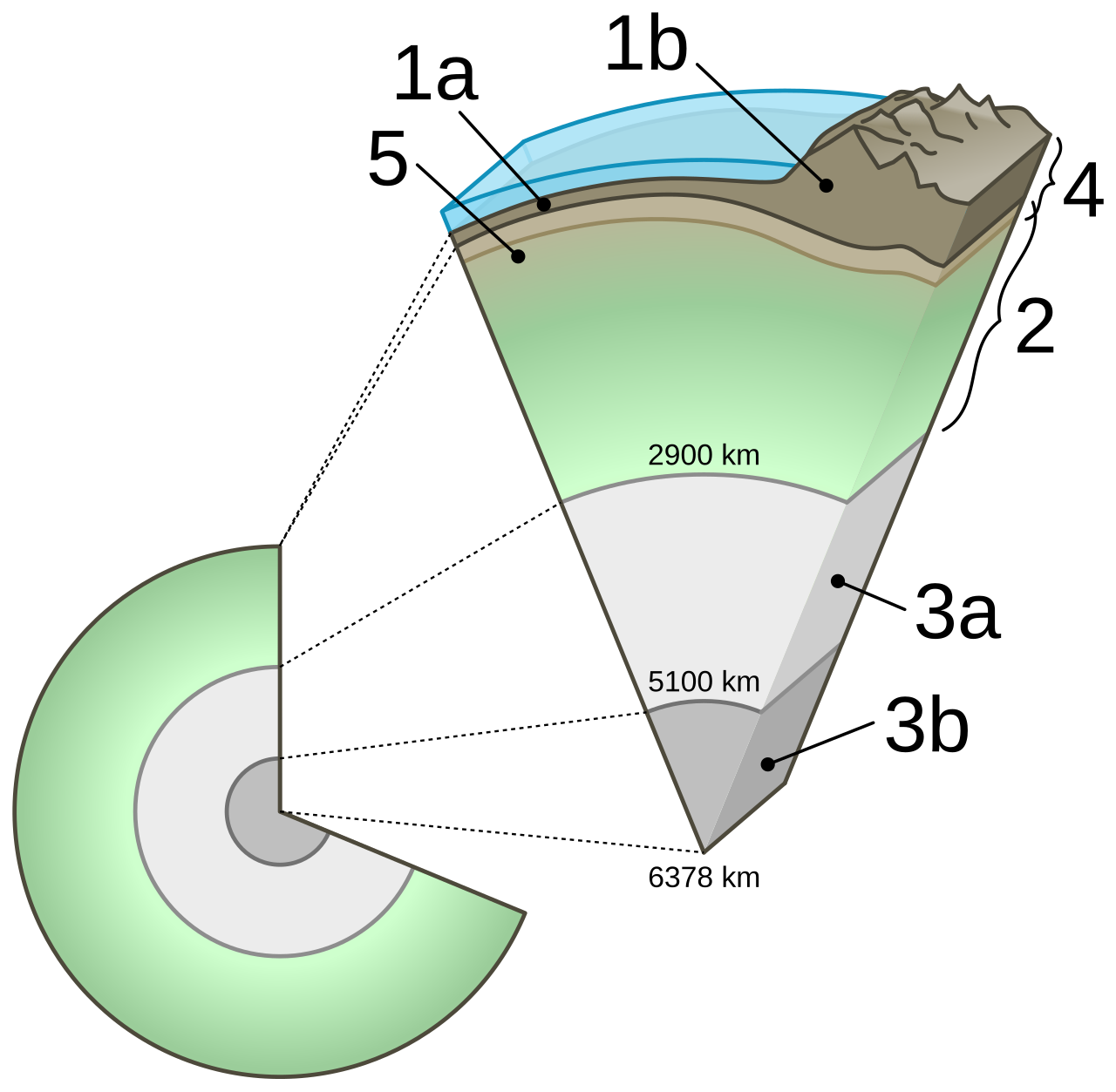
NASA describes four layers. The solid inner core, of iron and nickel, has a radius of about 1,221 kilometres and temperatures as high as about 5,400 °C. The liquid outer core is about 2,300 kilometres thick. The mantle, a hot, viscous mixture of molten rock described as having the consistency of caramel, is about 2,900 kilometres thick. The crust averages about 30 kilometres in depth on land and about 5 kilometres under the ocean.[1] USGS gives slightly different dimensions for the core (a 2,200-kilometre liquid outer core and a 1,250-kilometre solid inner core) and notes that continental crust can reach 100 kilometres under large mountain ranges such as the Alps.[2]
NASA describes four layers. The solid inner core, of iron and nickel, has a radius of about 1,221 kilometres and temperatures as high as about 5,400 °C. The liquid outer core is about 2,300 kilometres thick. The mantle, a hot, viscous mixture of molten rock described as having the consistency of caramel, is about 2,900 kilometres thick. The crust averages about 30 kilometres in depth on land and about 5 kilometres under the ocean.[1] USGS gives slightly different dimensions for the core (a 2,200-kilometre liquid outer core and a 1,250-kilometre solid inner core) and notes that continental crust can reach 100 kilometres under large mountain ranges such as the Alps.[2]

21 unchanged paragraphs
*Via Wikimedia Commons: [Earth cutaway schematic numbered (green)](https://commons.wikimedia.org/wiki/File:Earth_cutaway_schematic_numbered_(green).svg) by USGS - Anasofiapaixao - Bibar, [CC0](http://creativecommons.org/publicdomain/zero/1.0/deed.en).*
*Via Wikimedia Commons: [Earth cutaway schematic numbered (green)](https://commons.wikimedia.org/wiki/File:Earth_cutaway_schematic_numbered_(green).svg) by USGS - Anasofiapaixao - Bibar, [CC0](http://creativecommons.org/publicdomain/zero/1.0/deed.en).*
As the Earth rotates, USGS says, the liquid outer core spins and creates the magnetic field.[2] NASA says the field is distorted by the solar wind into a teardrop shape, and that charged particles trapped in it make the air glow as auroras near the poles. It adds that the magnetic field reverses polarity at irregular intervals, on average about every 300,000 years.[1]
As the Earth rotates, USGS says, the liquid outer core spins and creates the magnetic field.[2] NASA says the field is distorted by the solar wind into a teardrop shape, and that charged particles trapped in it make the air glow as auroras near the poles. It adds that the magnetic field reverses polarity at irregular intervals, on average about every 300,000 years.[1]
## Plate tectonics
## Plate tectonics
Earth's lithosphere, the rigid crust together with the upper mantle, is broken into huge plates that are constantly moving.[1] USGS says the lithosphere averages at least 80 kilometres in thickness over much of the Earth and rests on a softer, mobile zone called the asthenosphere.[2] The theory of plate tectonics says the outer layer is fragmented into a dozen or more large and small plates moving relative to one another, and USGS says it explains why earthquakes and volcanic eruptions occur in specific places and how mountain ranges like the Alps and Himalayas formed.[4] NASA says earthquakes occur when plates grind past one another, ride over one another, collide to make mountains, or split apart, and that the North American plate moves west at about the rate fingernails grow.[1]
Earth's lithosphere, the rigid crust together with the upper mantle, is broken into huge plates that are constantly moving.[1] USGS says the lithosphere averages at least 80 kilometres in thickness over much of the Earth and rests on a softer, mobile zone called the asthenosphere.[2] The theory of plate tectonics says the outer layer is fragmented into a dozen or more large and small plates moving relative to one another, and USGS says it explains why earthquakes and volcanic eruptions occur in specific places and how mountain ranges like the Alps and Himalayas formed.[4] NASA says earthquakes occur when plates grind past one another, ride over one another, collide to make mountains, or split apart, and that the North American plate moves west at about the rate fingernails grow.[1]
USGS traces the idea back to continental drift, in which the supercontinent Pangaea began to break up about 225 to 200 million years ago and fragmented into today's continents.[4] It also notes that for much of history many Europeans believed in catastrophism, a flood-driven view of the Earth's surface, until the 1785 uniformitarian principle of the Scottish geologist James Hutton, "the present is the key to the past", became the basis of modern geology.[4]
USGS traces the idea back to continental drift, in which the supercontinent Pangaea began to break up about 225 to 200 million years ago and fragmented into today's continents.[4] It also notes that for much of history many Europeans believed in catastrophism, a flood-driven view of the Earth's surface, until the 1785 uniformitarian principle of the Scottish geologist James Hutton, "the present is the key to the past", became the basis of modern geology.[4]
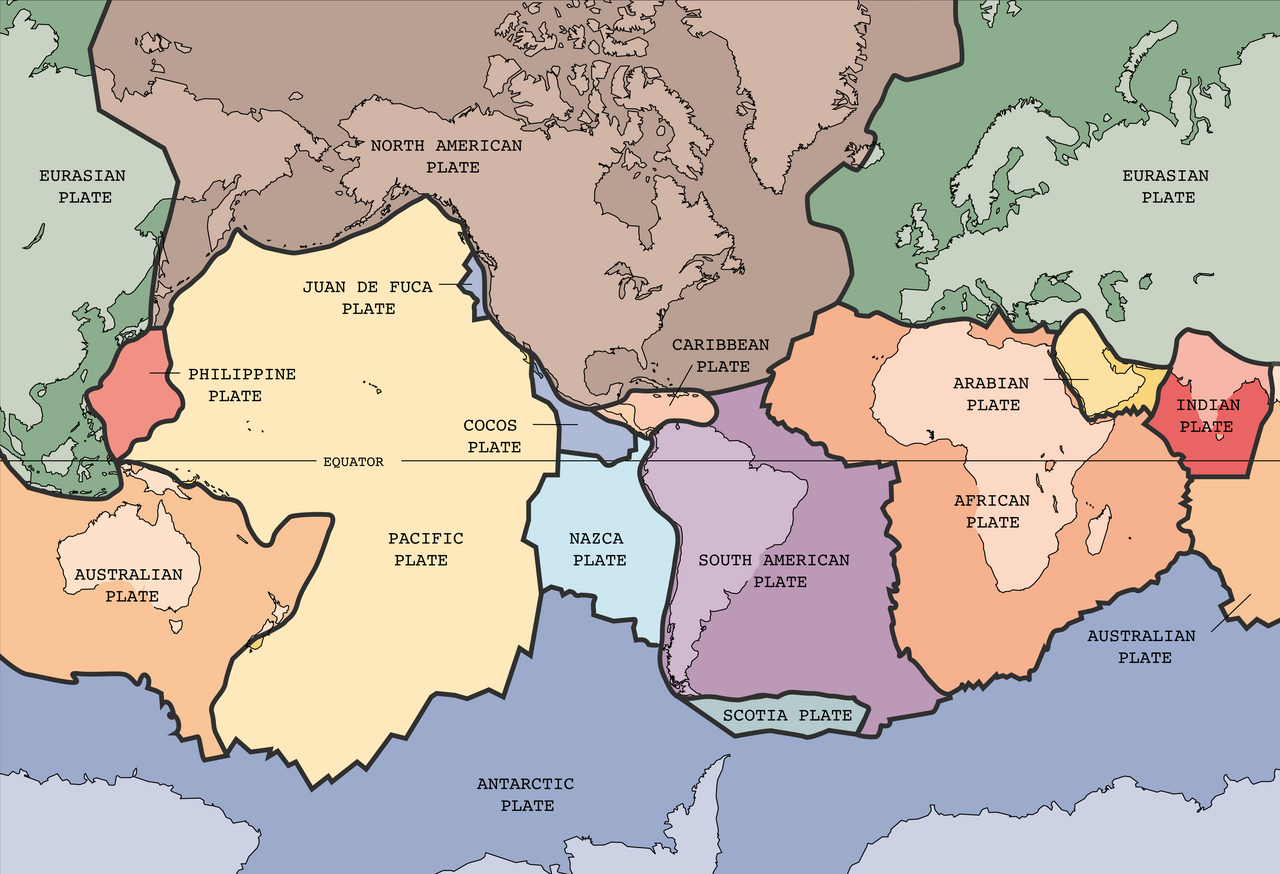

*Via Wikimedia Commons: [Tectonic plates](https://commons.wikimedia.org/wiki/File:Tectonic_plates.png) by Map: USGS Description: Muriel Gottrop~commonswiki, public domain.*
*Via Wikimedia Commons: [Tectonic plates](https://commons.wikimedia.org/wiki/File:Tectonic_plates.png) by Map: USGS Description: Muriel Gottrop~commonswiki, public domain.*
## Oceans and surface
## Oceans and surface
NASA says the global ocean covers about 71% of the surface, averages about 3.6 kilometres deep, and holds 97% of Earth's water. Almost all of Earth's volcanoes lie beneath it, and the planet's longest mountain range, four times the length of the Andes, Rockies and Himalayas combined, is underwater.[1] NOAA's National Ocean Service gives about 70% for the ocean's share of the surface, a surface area of about 360 million square kilometres and an average depth of 3,682 metres, and calls it the largest livable space on Earth.[5]
NASA says the global ocean covers about 71% of the surface, averages about 3.6 kilometres deep, and holds 97% of Earth's water. Almost all of Earth's volcanoes lie beneath it, and the planet's longest mountain range, four times the length of the Andes, Rockies and Himalayas combined, is underwater.[1] NOAA's National Ocean Service gives about 70% for the ocean's share of the surface, a surface area of about 360 million square kilometres and an average depth of 3,682 metres, and calls it the largest livable space on Earth.[5]
NOAA reports that, as of April 2026, 28.7% of the global seafloor had been mapped with modern high-resolution sonar, and that explorers had seen less than 0.001% of the deep seafloor.[5]
NOAA reports that, as of April 2026, 28.7% of the global seafloor had been mapped with modern high-resolution sonar, and that explorers had seen less than 0.001% of the deep seafloor.[5]
## Atmosphere
## Atmosphere
Near the surface the atmosphere is 78% nitrogen, 21% oxygen and 1% other gases such as argon, carbon dioxide and neon. NASA says it shapes long-term climate and local weather, shields the surface from much of the Sun's harmful radiation, and causes most meteoroids to burn up as meteors before they reach the ground.[1]
Near the surface the atmosphere is 78% nitrogen, 21% oxygen and 1% other gases such as argon, carbon dioxide and neon. NASA says it shapes long-term climate and local weather, shields the surface from much of the Sun's harmful radiation, and causes most meteoroids to burn up as meteors before they reach the ground.[1]
NASA's Earth Indicator page says carbon dioxide is an important greenhouse gas: without any greenhouse gases Earth would be too cold to support life, and increases in carbon dioxide warm the planet. It says the gas comes from sources including fossil-fuel burning, wildfires and volcanic eruptions, and that atmospheric carbon dioxide has risen sharply over the past 100 years.[7] NOAA's Global Monitoring Laboratory reports a monthly average at Mauna Loa Observatory in Hawaii of 426.69 parts per million in October 2026, against 424.87 parts per million in October 2025. The record there began in March 1958 with measurements by C. David Keeling.[6] NASA says some of the features that make Earth good for life are changing because of climate change.[1]
NASA's Earth Indicator page says carbon dioxide is an important greenhouse gas: without any greenhouse gases Earth would be too cold to support life, and increases in carbon dioxide warm the planet. It says the gas comes from sources including fossil-fuel burning, wildfires and volcanic eruptions, and that atmospheric carbon dioxide has risen sharply over the past 100 years.[7] NOAA's Global Monitoring Laboratory reports a monthly average at Mauna Loa Observatory in Hawaii of 426.69 parts per million in October 2026, against 424.87 parts per million in October 2025. The record there began in March 1958 with measurements by C. David Keeling.[6] NASA says some of the features that make Earth good for life are changing because of climate change.[1]
## Life
## Life
NASA says Earth's temperature and chemistry are hospitable to life and that its vast oceans provided a place for life to begin about 3.8 billion years ago.[1] Earth is the only place known to be inhabited by living things.[1]
NASA says Earth's temperature and chemistry are hospitable to life and that its vast oceans provided a place for life to begin about 3.8 billion years ago.[1] Earth is the only place known to be inhabited by living things.[1]
## The Moon
## The Moon
Earth has one moon, the only planet in the Solar System with exactly one. NASA says the Moon is likely the result of a collision billions of years ago, when a large body smashed into the young Earth and the debris clumped together. The Moon's radius is 1,738 kilometres, its average distance from Earth is 384,400 kilometres, and NASA says it stabilizes Earth's wobble, making the climate less variable.[1] Earth also temporarily hosts small asteroids that are trapped by its gravity for months or years.[1]
Earth has one moon, the only planet in the Solar System with exactly one. NASA says the Moon is likely the result of a collision billions of years ago, when a large body smashed into the young Earth and the debris clumped together. The Moon's radius is 1,738 kilometres, its average distance from Earth is 384,400 kilometres, and NASA says it stabilizes Earth's wobble, making the climate less variable.[1] Earth also temporarily hosts small asteroids that are trapped by its gravity for months or years.[1]
## Name
## Name
NASA says the name Earth is about 1,000 years old and comes from an Old English and Germanic word meaning "the ground". It is the only planet whose English name does not come from Greek or Roman mythology.[1]
NASA says the name Earth is about 1,000 years old and comes from an Old English and Germanic word meaning "the ground". It is the only planet whose English name does not come from Greek or Roman mythology.[1]
## Sources
## Sources
1. NASA Science. "Earth." https://science.nasa.gov/earth/facts/ (read 22 November 2026)
2. U.S. Geological Survey. "Inside the Earth," This Dynamic Earth. https://pubs.usgs.gov/gip/dynamic/inside.html (read 22 November 2026)
3. U.S. Geological Survey. "Age of the Earth," Geologic Time. https://pubs.usgs.gov/gip/geotime/age.html (read 22 November 2026)
4. U.S. Geological Survey. "Historical perspective," This Dynamic Earth. https://pubs.usgs.gov/gip/dynamic/historical.html (read 22 November 2026)
5. NOAA National Ocean Service. "How much of the ocean has been explored?" https://oceanservice.noaa.gov/facts/exploration.html (read 22 November 2026)
6. NOAA Global Monitoring Laboratory. "Trends in Atmospheric Carbon Dioxide." https://gml.noaa.gov/ccgg/trends/ (read 22 November 2026)
7. NASA Science. "Carbon Dioxide - Earth Indicator." https://climate.nasa.gov/vital-signs/carbon-dioxide/ (read 22 November 2026)
