The Moon is Earth's only natural satellite, a rocky body about 384,400 kilometres away that is less than a third of Earth's width. It is the only world beyond Earth that humans have visited.[1]
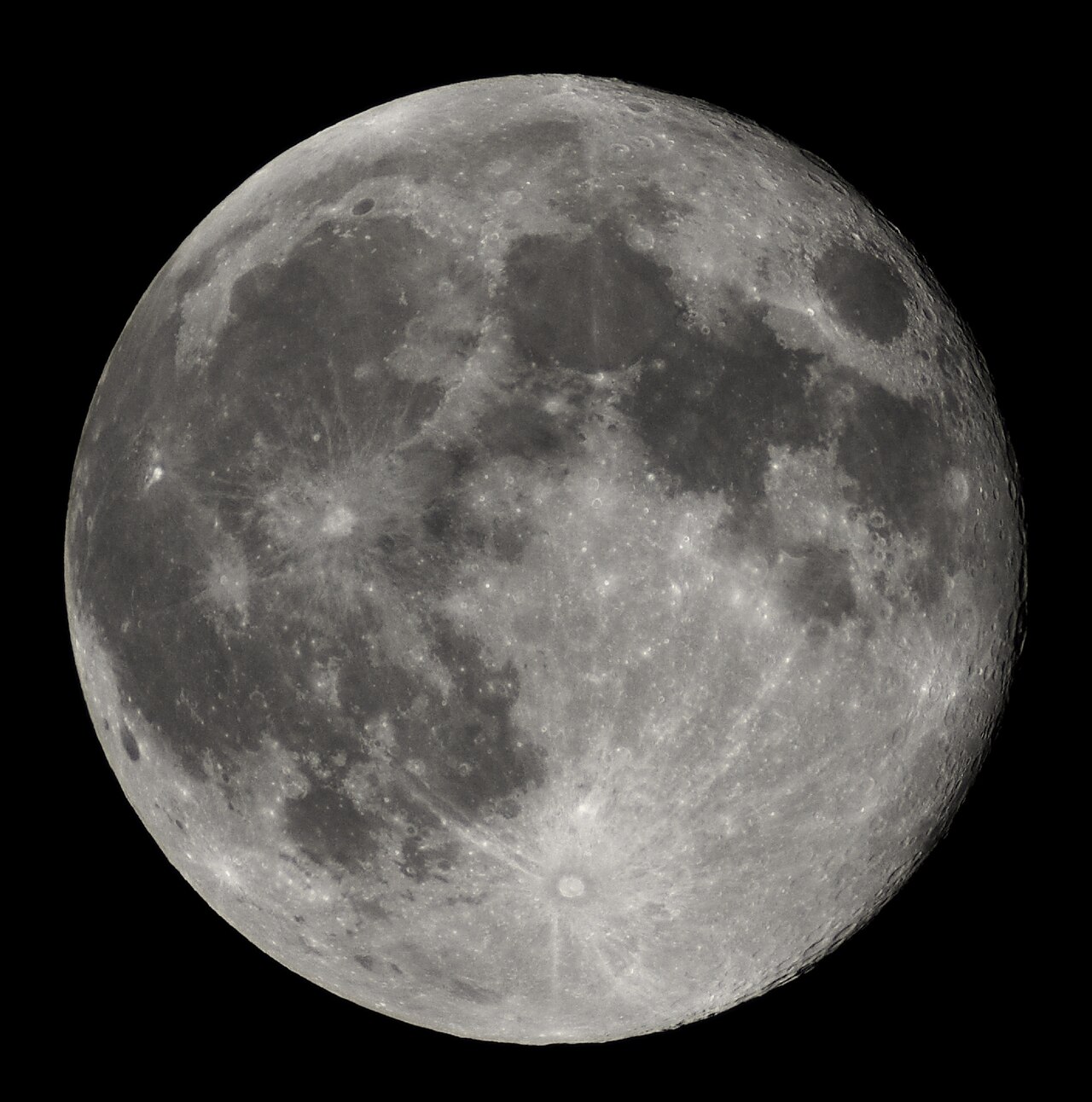
The full Moon, showing its light highlands and dark lava-filled maria.
The Moon's radius is about 1,740 kilometres, and it orbits at an average distance of 384,400 kilometres, far enough that 30 Earth-sized planets would fit between the two.[1] It is slowly moving away from Earth, by about an inch (2.5 centimetres) a year.[1] The Moon completes an orbit in about 27 Earth days and spins at the same rate, so the same hemisphere always faces Earth, a state called synchronous or tidal locking. Because Earth is also moving around the Sun, the Moon seems from Earth to circle us about every 29 days.[1] Humans first saw the far side when a Soviet spacecraft flew past in 1959.[1] NASA calls "dark side" a misleading name for it, since every part of the Moon is in sunlight at some point.[1]
Phases
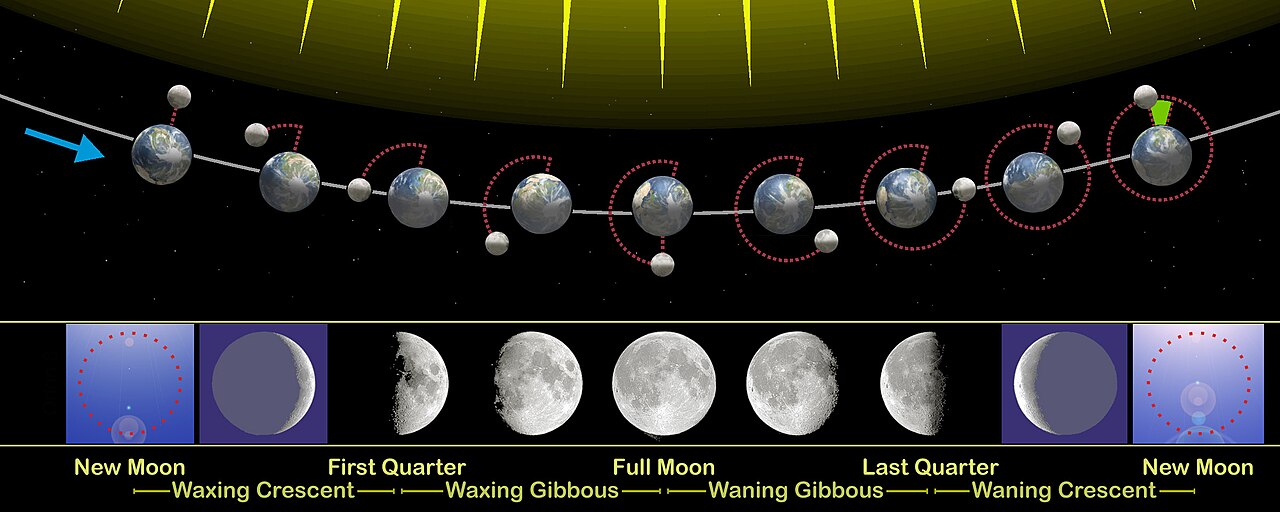
The Moon makes no light of its own; moonlight is reflected sunlight. The Sun always lights half of the Moon, and the phases are the changing amount of that lit half visible from Earth.[3] NASA lists eight phases, from new Moon through first quarter, full Moon and last quarter, repeating about every 29.5 days.[3]
A diagram of the Moon's phases through its orbit around Earth.
NOAA says tides are caused by the gravitational pull of the Moon and the Sun, which sets very long-period waves moving through the ocean, so that the sea surface rises and falls on a regular schedule along the coasts.[5]
Eclipses happen when Earth, Moon and Sun line up. The Moon's orbit is tilted relative to Earth's orbit around the Sun, which is why eclipses do not occur every month. In a lunar eclipse, which happens at full Moon, Earth's shadow falls on the Moon, which can turn red because sunlight filtered through Earth's atmosphere still reaches it. In a solar eclipse, which happens at new Moon, the Moon blocks the Sun.[4]
Formation
NASA says that near the time the Solar System formed, about 4.5 billion years ago, something, perhaps a single Mars-sized object, struck the young Earth and flung enough molten and vaporized debris into space to form the Moon.[2] The impactor is named Theia in the leading version of this theory.[2] Earlier ideas that the Moon was captured by Earth's gravity, or formed alongside Earth from the same debris, fell out of favor after Apollo returned 842 pounds (382 kilograms) of lunar samples. NASA reports that the sample ages indicate the Moon formed about 60 million years after the Solar System began, and that the samples show the Moon was molten at first.[2] NASA says the molten surface, a global "magma ocean", had mostly crystallized within about 100 million years, with lighter rocks floating up to form the crust.[1]
Structure and surface
The Moon has a core, mantle and crust. NASA describes a solid, iron-rich inner core with a radius of about 240 kilometres, surrounded by a liquid iron shell about 90 kilometres thick and a partially molten layer. The crust is about 40 kilometres thick on the near side and up to about 60 kilometres on the far side.[1] The Moon had active volcanoes long ago, but all are dormant.[1]
With almost no atmosphere to slow them, asteroids, meteoroids and comets have cratered the surface. Tycho Crater is more than 85 kilometres wide. Nearly the whole Moon is covered by the lunar regolith, a charcoal-gray rubble of dust and rock.[1] The light areas are the highlands. The dark areas are the maria (Latin for "seas"), impact basins filled with lava between 4.2 and 1.2 billion years ago.[1] Surface gravity is one-sixth of Earth's, and temperatures range from about 127 °C in full Sun to about −173 °C in darkness.[1] The Moon has only a very thin exosphere, which is not breathable and does not shield the surface from radiation or meteoroids.[1]
Water
Early analysis of Apollo and Luna samples suggested the Moon was dry. NASA says the first definitive discovery of water was made in 2008 by India's Chandrayaan-1, which detected hydroxyl molecules across the surface, concentrated at the poles. Later missions including Lunar Prospector, LCROSS and the Lunar Reconnaissance Orbiter showed global hydration and high concentrations of water ice in permanently shadowed regions at the poles. In October 2020 NASA's SOFIA airborne observatory confirmed water on the sunlit surface, in Clavius Crater.[1]
Exploration
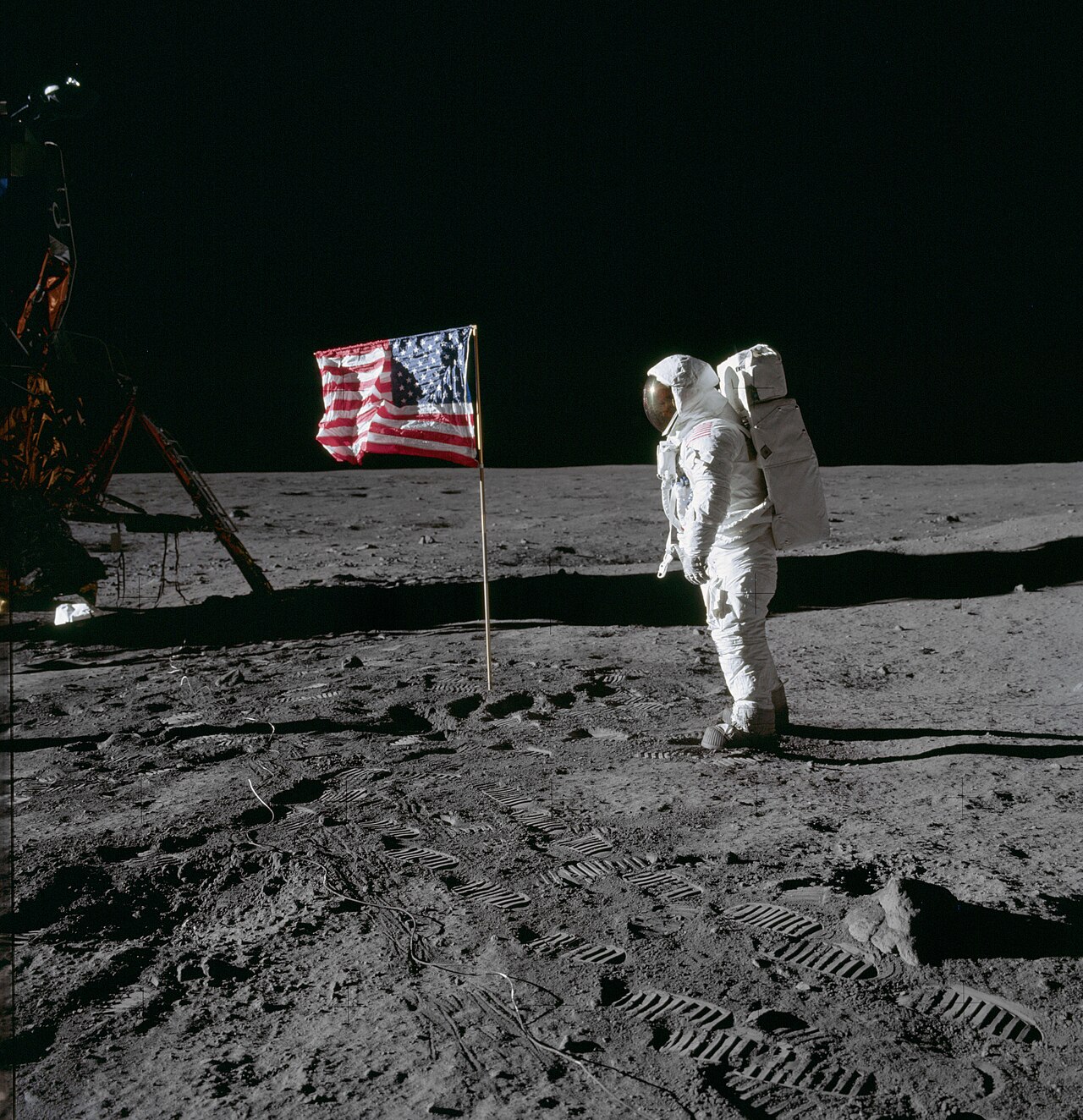
NASA says more than 105 robotic spacecraft have been launched to explore the Moon.[1] The Apollo program ran from 1962 to 1972, with 11 crewed missions and six lunar landings.[6] Apollo 11's primary objective was to fulfil President John F. Kennedy's 25 May 1961 goal of a crewed lunar landing and return. It launched on 16 July 1969 and Neil Armstrong became the first human to set foot on the Moon.[7]
An Apollo 11 astronaut standing on the Moon beside the U.S. flag in July 1969.
NASA's Artemis program is the current effort. Artemis I, an uncrewed test of the Space Launch System rocket and Orion spacecraft, flew in November 2022. Artemis II, with four astronauts (three from NASA and one from the Canadian Space Agency), launched on 1 April 2026 and made a roughly 10-day flight around the Moon, traveling 252,756 miles from Earth, a record distance for humans.[8][9] According to NASA's Artemis page, read on 22 November 2026, Artemis III is planned for 2027 as a low Earth orbit test of docking with commercial landers, and the first crewed landing, Artemis IV, for 2028.[8]
Name
The Moon shares its name with all other moons because no one knew other moons existed until Galileo Galilei discovered four moons orbiting Jupiter in 1610. Its Latin name, Luna, is the root of "lunar".[1]