Version 2
Nov 22, 2026. Compare with the current version · Version history
Deimos is the smaller and outer of Mars's two moons, a lumpy, heavily cratered body about 15 by 12 by 11 kilometres across that orbits Mars every 30 hours.[1]
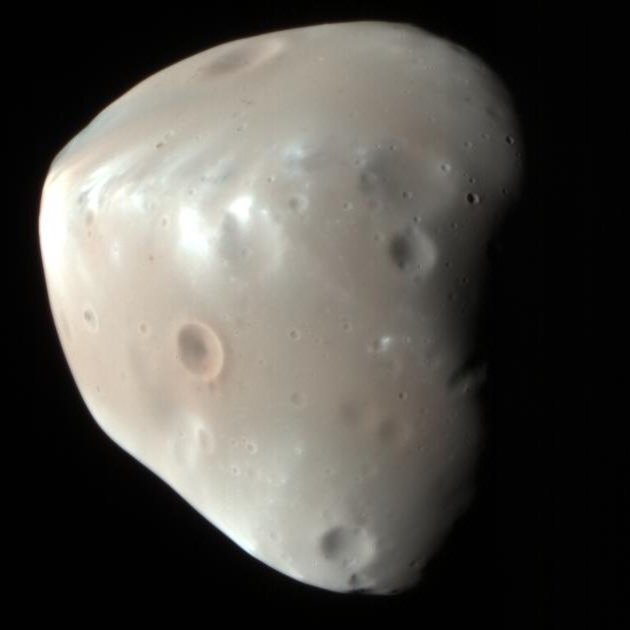
Via Wikimedia Commons: NASA-Deimos-MarsMoon-20090221 by NASA/JPL/University of Arizona, public domain.
Size and orbit
NASA gives Deimos's dimensions as 15 by 12 by 11 kilometres and its orbital period as 30 hours.[1] It is about half as big as Phobos and orbits two and a half times farther from Mars.[2] NASA calls it less irregular in shape than Phobos.[1]
Surface
Deimos is heavily cratered, but its craters are generally smaller than 2.5 kilometres across, and it lacks the grooves and ridges seen on Phobos. Its largest crater, about 2.3 kilometres in diameter, is about a fifth the size of the largest on Phobos.[1] It looks smoother than Phobos because loose dirt partly fills some of its craters.[1]
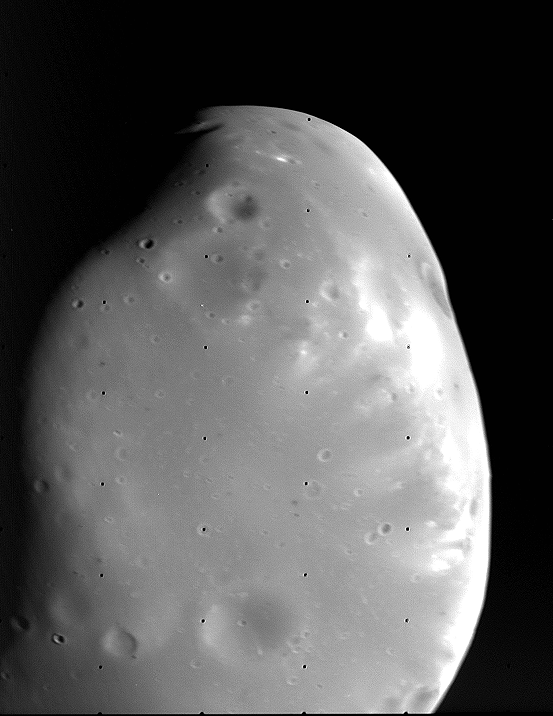
Via Wikimedia Commons: Deimos from Viking 2 by NASA, public domain.
NASA explains the dirt this way. When something strikes Deimos, dust and debris leave the surface because the moon's gravity is too weak to hold them. Mars's gravity keeps that debris in a ring-like cloud around the planet in roughly the region where Deimos orbits, and as the moon revolves it sweeps the debris up again, redepositing it as a dusty layer. NASA says Deimos has a thick regolith, perhaps as deep as 100 metres, formed as meteorites pulverized the surface.[1]
Composition
Deimos is a dark body that appears to be made of C-type material, similar to that of asteroids found in the outer asteroid belt.[1]
Discovery and name
Asaph Hall discovered Deimos on 11 August 1877, the same month in which he found Phobos. He named Mars's moons for the mythological sons of Ares, the Greek counterpart of the Roman god Mars. Deimos means "dread" and is the brother of Phobos.[1]
Origin
Scientists have long debated where Mars's moons came from. NASA says one idea is that Phobos and Deimos are the remains of a massive impact on Mars that sent material into orbit, and another is that they are ancient asteroids captured by Mars's gravity billions of years ago.[4] A NASA-led study published in November 2024 proposed a third path, in which a passing asteroid was torn apart by Mars's gravity and its fragments settled into a disk that formed the moons. The article notes that Deimos in particular sits far from the planet and probably formed out there, which is easier to explain under that model.[3] It calls Phobos and Deimos the only moons in the Solar System that orbit a rocky planet other than Earth's.[3]
Exploration
NASA's page shows an enhanced-color image of it taken on 21 February 2009 by the HiRISE camera on the Mars Reconnaissance Orbiter.[1] Japan's Martian Moons eXploration (MMX) spacecraft, launched in October 2026 and focused on Phobos, will also observe Deimos from a distance and plans to attempt a flyby of it.[4][5] Observations of both moons are meant to help answer the question of their origin.[4][5]
Sources
- NASA Science. "Deimos." science.nasa.gov/mars/moons/deimos/ (read 22 November 2026)
- NASA Science. "Mars Facts." science.nasa.gov/mars/facts/ (read 22 November 2026)
- Tabor, Abby. "Making Mars' Moons: Supercomputers Offer 'Disruptive' New Explanation." NASA, 20 November 2024. nasa.gov/solar-system/planets/mars/making-mars-moons-supercomputers… (read 22 November 2026)
- Talbert, Patricia. "NASA to Help Unlock Mysteries of Mars' Moons in Upcoming Mission." NASA, 15 October 2026. science.nasa.gov/directorates/smd/planetary-science-division/nasa-t… (read 22 November 2026)
- JAXA. "MMX Mission." mmx.jaxa.jp/en/mission/ (read 22 November 2026)
