Compare versions
Version 2 → Version 3 (current). Removed · Added. This shows the entry's text as it is written, including its formatting marks.
Version 2 · Version 3 (current) · Version history
Side by side · Together
Jupiter is the fifth planet from the Sun and the largest in the Solar System, a gas giant made mostly of hydrogen and helium holding more than twice the combined material of all the other bodies in the Solar System.[1]
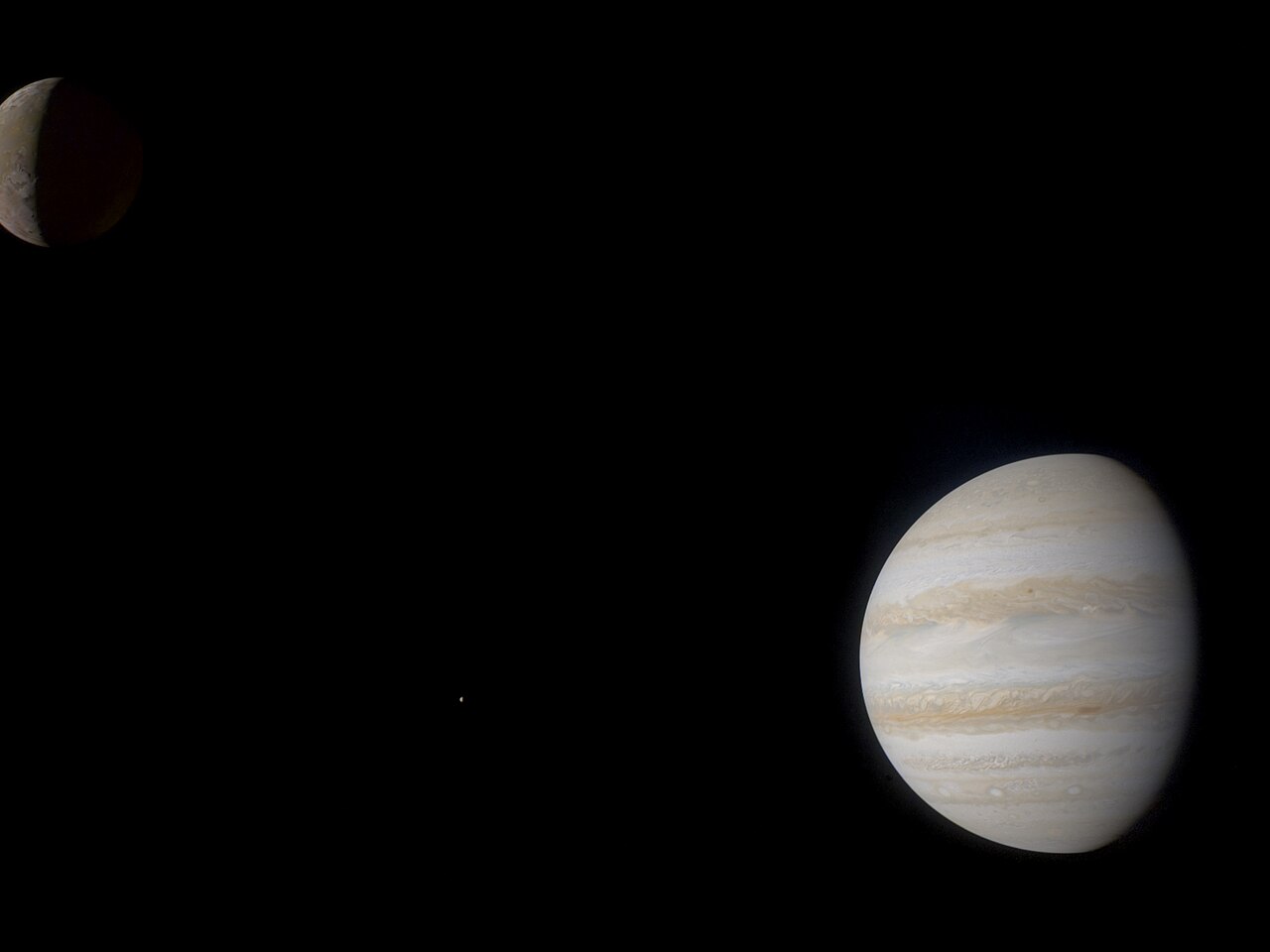true-color image processed from Juno spacecraft data.](/m/2026/11/-buwpjqx0dgaQ3A2.jpg)
*Via Wikimedia Commons: [Io, Europa and Jupiter - PJ58 - true colors (53517414766)](https://commons.wikimedia.org/wiki/File:Io,_Europa_and_Jupiter_-_PJ58_-_true_colors_(53517414766).jpg) by semeion.photo, [CC BY 2.0](https://creativecommons.org/licenses/by/2.0).*
## Size, orbit and rotation
NASA says Jupiter's radius is about 69,911 kilometres, 11 times Earth's, and that 1,000 Earths could fit inside it if it were a hollow shell.[1] It orbits the Sun at an average distance of about 778 million kilometres (5.2 astronomical units), taking about 12 Earth years to go around, and sunlight needs about 43 minutes to reach it.[1] It has the shortest day of any planet, about 9.9 hours.[1] Its equator is tilted only 3 degrees to its orbit, so it spins nearly upright and has no extreme seasons.[1]
## Formation
NASA says Jupiter formed about 4.6 billion years ago from the dust and gas left over from the Sun's formation, which makes it the oldest planet, and that it settled into its present position in the outer Solar System about 4 billion years ago.[1] It took most of the mass left after the Sun formed, ending up with more than twice the combined material of all the other bodies in the Solar System. NASA notes that it has the same ingredients as a star but did not grow massive enough to ignite.[1]
## Interior
Jupiter is made mostly of hydrogen and helium, like the Sun.[1] Deep in the atmosphere, NASA says, pressure and temperature rise until the hydrogen becomes liquid, giving Jupiter the Solar System's largest ocean, one made of hydrogen rather than water. At depths perhaps halfway to the center, the pressure strips electrons from the hydrogen and the liquid conducts electricity like a metal. Jupiter's fast rotation is thought to drive electrical currents in this layer that generate the planet's powerful magnetic field.[1]
Scientists once expected a small, solid core. NASA reports that data from its Juno spacecraft suggest the core is much larger than expected and not solid: it is partially dissolved, with no clear boundary with the metallic hydrogen around it, and researchers describe it as "dilute" or "fuzzy".[1] Jupiter has no true surface, and a spacecraft that flew deep inside would be crushed, melted and vaporized.[1]
## Atmosphere and the Great Red Spot
Jupiter's stripes and swirls are clouds of ammonia and water in an atmosphere of hydrogen and helium. The dark orange bands are called belts and the lighter ones zones, and they flow east and west in opposite directions.[1] NASA says the planet probably has three cloud layers spanning about 71 kilometres, with ammonia ice on top, ammonium hydrosulfide crystals in the middle and water ice and vapor below. Winds reach up to 539 kilometres per hour at the equator.[1]
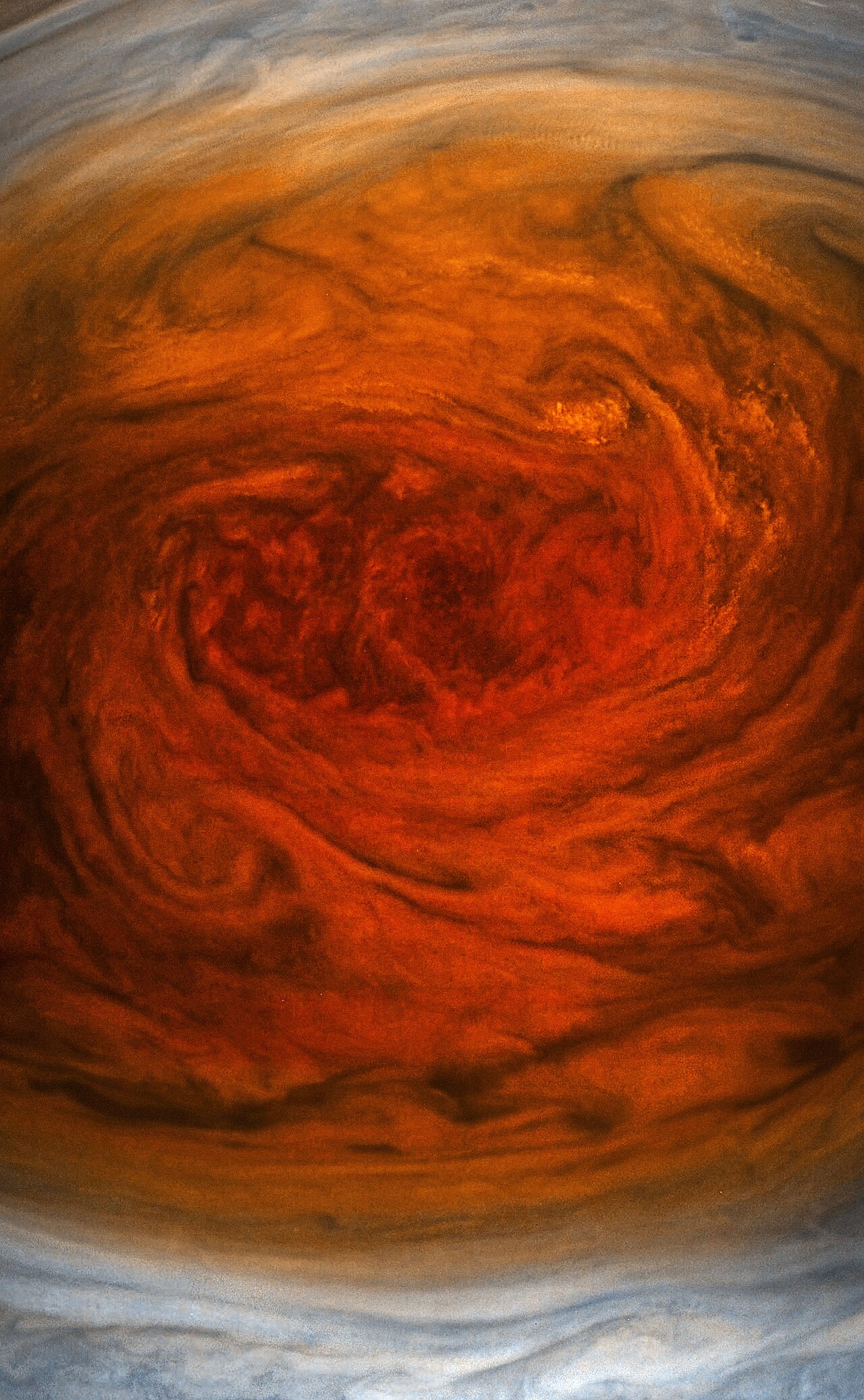
*Via Wikimedia Commons: [Great red spot juno 20170712](https://commons.wikimedia.org/wiki/File:Great_red_spot_juno_20170712.jpg) by NASA / SwRI / MSSS / Gerald Eichstädt / Seán Doran, public domain.*
The Great Red Spot is a swirling oval of cloud about twice as wide as Earth that has been observed for more than 300 years.[1] Juno gravity data constrained its depth to about 500 kilometres below the cloud tops.[1] More recently three smaller ovals merged to form the Little Red Spot, about half the size of the Great Red Spot.[1] Juno also found polygonal arrangements of giant cyclones at both poles: eight in an octagon at the north and five in a pentagon at the south.[1]
## Rings
Jupiter's rings were discovered in 1979 by NASA's Voyager 1, a surprise. They are made of small, dark particles that are hard to see except when backlit by the Sun, and data from the Galileo spacecraft indicate they may be dust kicked up when meteoroids hit the planet's small inner moons.[1]
## Moons
The International Astronomical Union recognizes 115 moons of Jupiter, and the planet also has thousands of smaller objects in orbit.[2] The four largest, Io, Europa, Ganymede and Callisto, were first observed by Galileo Galilei in 1610 with an early telescope and are called the Galilean satellites.[2]
- **Io** is the most volcanically active body in the Solar System.[2]
- **Europa**, about 90% the size of Earth's Moon, may hide a liquid-water ocean with ingredients for life beneath its frozen crust.[2]
- **Ganymede** is the largest moon in the Solar System, bigger than the planet Mercury.[2]
- **Callisto** has very few small craters, which NASA says indicates a small degree of current surface activity.[2]
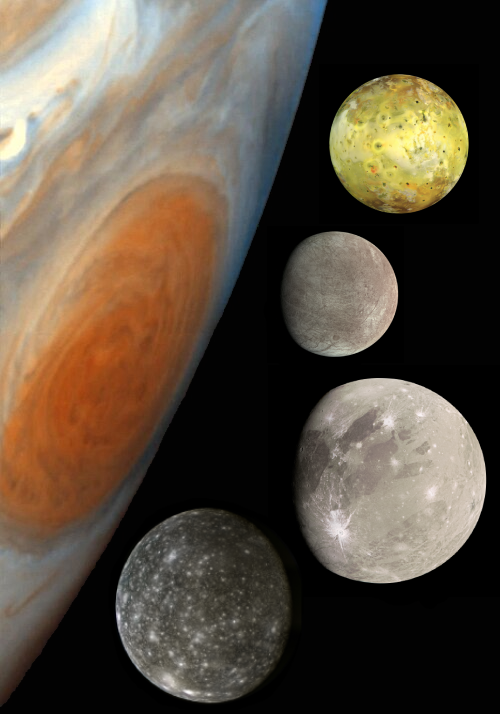
*Via Wikimedia Commons: [Jupiter and the Galilean Satellites (True Color)](https://commons.wikimedia.org/wiki/File:Jupiter_and_the_Galilean_Satellites_(True_Color).png) by WhatADrag07, [CC BY-SA 4.0](https://creativecommons.org/licenses/by-sa/4.0).*
NASA calls Europa one of the likeliest places to find life elsewhere in the Solar System, because of evidence of a vast ocean beneath its icy crust, while saying Jupiter itself is probably not conducive to life.[1]
## Exploration
NASA's Pioneer 10, launched on 2 March 1972, was the first spacecraft to fly past Jupiter.[5] NASA's Voyager 1 discovered the rings in 1979.[1]
NASA's Galileo spacecraft was launched from the Space Shuttle Atlantis on 18 October 1989 and released its atmospheric probe on 12 July 1995. It began orbiting Jupiter in December 1995, orbited 34 times, and was deliberately sent into Jupiter's atmosphere on 21 September 2003 to protect a possible ocean beneath the ice of Europa.[4]
NASA's Juno launched on 5 August 2011 and entered orbit around Jupiter on 4 July 2016.[3] It was the first NASA spacecraft designed to operate on solar power so far from the Sun. Its findings include polar cyclone networks and active volcanoes on Io.[3] NASA's mission page says the extended mission was to continue through September 2025. The page still lists Juno as an active mission, but I found no NASA statement on its status after that date.[3]
Two more missions are on their way. NASA's Europa Clipper launched on 14 October 2024 to explore Europa.[6] NASA's Juno page says it is scheduled to enter orbit around Jupiter in April 2030.[3] The European Space Agency's Juice (Jupiter Icy Moons Explorer) launched on 14 April 2023, is due to reach Jupiter in July 2031, and will study Ganymede, Europa and Callisto, ending with an orbital tour of Ganymede.[7]
## Name
Jupiter is named for the king of the gods in Roman mythology, and most of its moons are named for characters associated with Jupiter or his Greek counterpart Zeus.[1]
## Sources
1. NASA Science. "Jupiter Facts." https://science.nasa.gov/jupiter/facts/ (read 22 November 2026)
2. NASA Science. "Jupiter Moons." https://science.nasa.gov/jupiter/moons/ (read 22 November 2026)
3. NASA Science. "Juno." https://science.nasa.gov/mission/juno/ (read 22 November 2026)
4. NASA Science. "Galileo." https://science.nasa.gov/mission/galileo/ (read 22 November 2026)
5. NASA Science. "Pioneer 10." https://science.nasa.gov/mission/pioneer-10/ (read 22 November 2026)
6. NASA Science. "Europa Clipper." https://science.nasa.gov/mission/europa-clipper/ (read 22 November 2026)
7. European Space Agency. "Juice factsheet." https://www.esa.int/Science_Exploration/Space_Science/Juice/Juice_factsheet (read 22 November 2026)
