Compare versions
Version 1 → Version 2. Removed · Added. This shows the entry's text as it is written, including its formatting marks.
Version 1 · Version 2 · Version history
Side by side · Together
Version 1Version 2
Io is the innermost of Jupiter's four large Galilean moons and the most volcanically active world in the Solar System, with hundreds of volcanoes and lava lakes on a surface slightly larger than Earth's Moon.[1][2]
Io is the innermost of Jupiter's four large Galilean moons and the most volcanically active world in the Solar System, with hundreds of volcanoes and lava lakes on a surface slightly larger than Earth's Moon.[1][2][4]
13 unchanged paragraphs
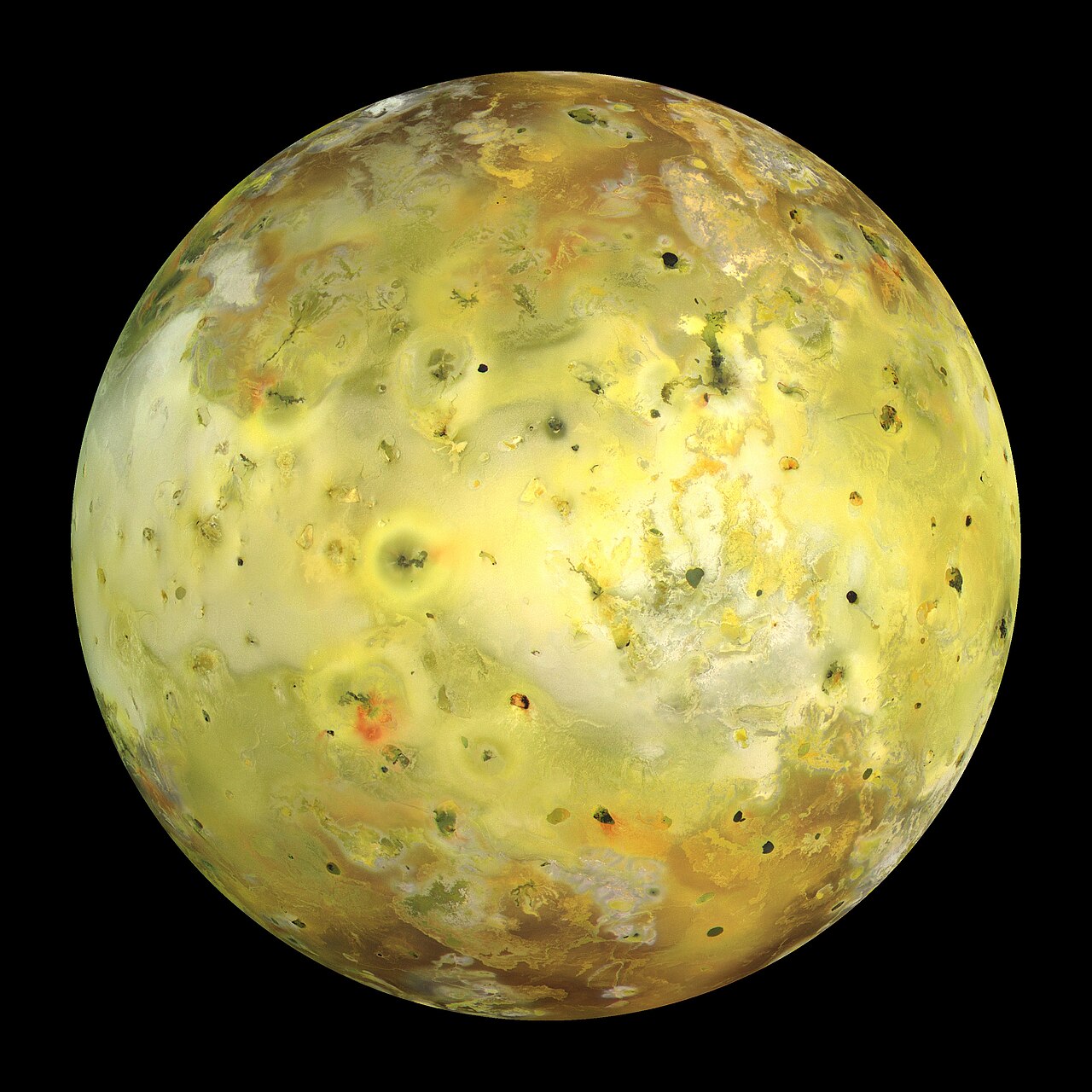

*Via Wikimedia Commons: [Io highest resolution true color](https://commons.wikimedia.org/wiki/File:Io_highest_resolution_true_color.jpg) by NASA / JPL / University of Arizona, public domain.*
*Via Wikimedia Commons: [Io highest resolution true color](https://commons.wikimedia.org/wiki/File:Io_highest_resolution_true_color.jpg) by NASA / JPL / University of Arizona, public domain.*
## Size and orbit
## Size and orbit
Io's radius is about 1,821.5 kilometres and its mean density 3,530 kilograms per cubic metre, according to NASA's Jovian satellite fact sheet, which lists the highest density of the four Galilean moons.[4] NASA describes it as a bit larger than Earth's Moon and about one-quarter the diameter of Earth, the third largest of Jupiter's moons and the fifth in distance from the planet.[1][2] It orbits Jupiter at an average distance of about 422,000 kilometres in 1.77 days, and its rotation is synchronous, so it always shows the same face to Jupiter.[1][4]
Io's radius is about 1,821.5 kilometres and its mean density 3,530 kilograms per cubic metre, according to NASA's Jovian satellite fact sheet, which lists the highest density of the four Galilean moons.[4] NASA describes it as a bit larger than Earth's Moon and about one-quarter the diameter of Earth, the third largest of Jupiter's moons and the fifth in distance from the planet.[1][2] It orbits Jupiter at an average distance of about 422,000 kilometres in 1.77 days, and its rotation is synchronous, so it always shows the same face to Jupiter.[1][4]
## Why it erupts
## Why it erupts
NASA says Io's activity comes from a tug-of-war between Jupiter's powerful gravity and smaller, precisely timed pulls from the two neighboring moons that orbit farther out, Europa and Ganymede. These pulls make Io's orbit slightly elliptical, so its distance from Jupiter varies, and the changing tidal forces make its solid surface bulge up and down by as much as 100 metres. By comparison, NASA says, the greatest difference between high and low tide on Earth's oceans is about 18 metres.[1] The tidal forces generate a tremendous amount of heat inside Io and keep much of its subsurface crust liquid, searching for an escape route to the surface.[1]
NASA says Io's activity comes from a tug-of-war between Jupiter's powerful gravity and smaller, precisely timed pulls from the two neighboring moons that orbit farther out, Europa and Ganymede. These pulls make Io's orbit slightly elliptical, so its distance from Jupiter varies, and the changing tidal forces make its solid surface bulge up and down by as much as 100 metres. By comparison, NASA says, the greatest difference between high and low tide on Earth's oceans is about 18 metres.[1] The tidal forces generate a tremendous amount of heat inside Io and keep much of its subsurface crust liquid, searching for an escape route to the surface.[1]
## Surface
## Surface
Io has hundreds of volcanoes, some of which erupt lava fountains dozens of kilometres high. Some eruptions are powerful enough to be seen with large telescopes on Earth, and Io has lakes of molten silicate lava on its surface.[2] NASA says the volcanism resurfaces Io with new deposits faster than comets and asteroids can mark it with large craters.[2] NASA says the composition of the erupted material is not yet entirely clear. Theories suggest it is largely molten sulfur and sulfur compounds, which would account for Io's varied colors, or silicate rock, which would better fit the high temperatures measured, which may be too hot for sulfur.[1] Data from the Galileo spacecraft showed that Io's volcanic activity may be 100 times greater than Earth's.[5]
Io has hundreds of volcanoes, some of which erupt lava fountains dozens of kilometres high. Some eruptions are powerful enough to be seen with large telescopes on Earth, and Io has lakes of molten silicate lava on its surface.[2] NASA says the volcanism resurfaces Io with new deposits faster than comets and asteroids can mark it with large craters.[2] NASA says the composition of the erupted material is not yet entirely clear. Theories suggest it is largely molten sulfur and sulfur compounds, which would account for Io's varied colors, or silicate rock, which would better fit the high temperatures measured, which may be too hot for sulfur.[1] Data from the Galileo spacecraft showed that Io's volcanic activity may be 100 times greater than Earth's.[5]
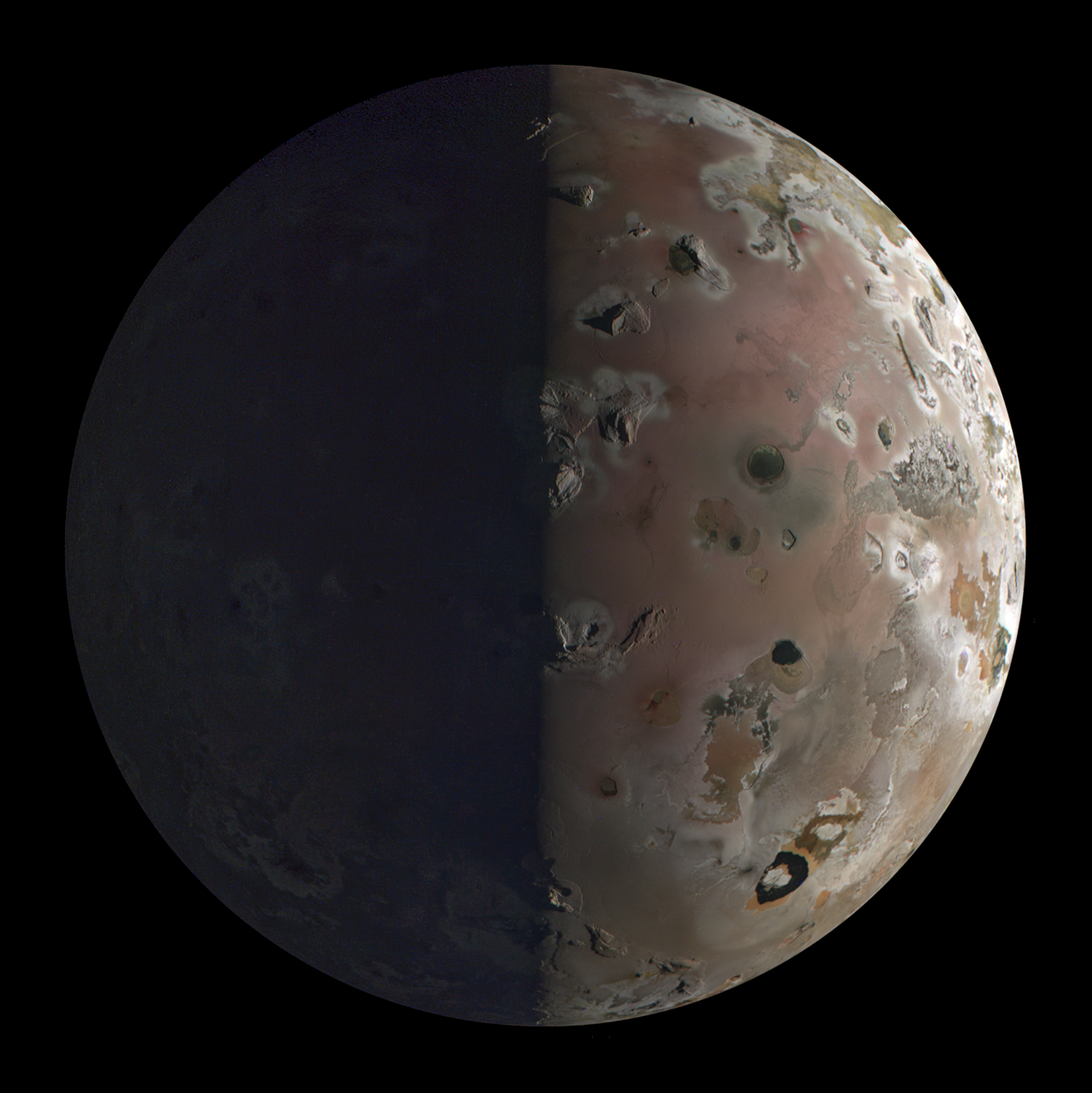

*Via Wikimedia Commons: [Io imaged by Juno spacecraft](https://commons.wikimedia.org/wiki/File:Io_imaged_by_Juno_spacecraft.png) by NASA/JPL-Caltech/SwRI/MSSS/Kevin M. Gill, public domain.*
*Via Wikimedia Commons: [Io imaged by Juno spacecraft](https://commons.wikimedia.org/wiki/File:Io_imaged_by_Juno_spacecraft.png) by NASA/JPL-Caltech/SwRI/MSSS/Kevin M. Gill, public domain.*
## Atmosphere and magnetic environment
## Atmosphere and magnetic environment
Sulfur dioxide is the main constituent of Io's thin atmosphere, and Io has no water to speak of.[1] As Jupiter rotates, its magnetic field sweeps past Io and strips off about 1,000 kilograms of Io's material every second. The material becomes ionized and forms a doughnut-shaped cloud of radiation called a plasma torus, and NASA says ions escaping from this torus inflate Jupiter's magnetosphere to more than twice the size otherwise expected.[1] Io's orbit across Jupiter's magnetic field lines makes it behave like an electric generator, developing about 400,000 volts and driving a current of 3 million amperes toward Jupiter, which creates lightning in Jupiter's upper atmosphere.[1] NASA says Galileo data suggest an iron core, which could give Io its own magnetic field.[1]
Sulfur dioxide is the main constituent of Io's thin atmosphere, and Io has no water to speak of.[1] As Jupiter rotates, its magnetic field sweeps past Io and strips off about 1,000 kilograms of Io's material every second. The material becomes ionized and forms a doughnut-shaped cloud of radiation called a plasma torus, and NASA says ions escaping from this torus inflate Jupiter's magnetosphere to more than twice the size otherwise expected.[1] Io's orbit across Jupiter's magnetic field lines makes it behave like an electric generator, developing about 400,000 volts and driving a current of 3 million amperes toward Jupiter, which creates lightning in Jupiter's upper atmosphere.[1] NASA says Galileo data suggest an iron core, which could give Io its own magnetic field.[1]
## Discovery and name
## Discovery and name
Galileo Galilei discovered Io on 8 January 1610, together with three other Jovian moons, the first time a moon had been found orbiting a planet other than Earth. NASA says he apparently saw it on 7 January but could not tell Io from Europa until the next night.[1] He called the four moons the Medicean planets and referred to them by Roman numerals, and the individual names were officially adopted only in the mid-1800s.[1] In mythology, Io is a mortal woman whom Zeus (Jupiter in Roman mythology) turned into a cow, and NASA says the Juno mission is named for Zeus's wife, the goddess.[1]
Galileo Galilei discovered Io on 8 January 1610, together with three other Jovian moons, the first time a moon had been found orbiting a planet other than Earth. NASA says he apparently saw it on 7 January but could not tell Io from Europa until the next night.[1] He called the four moons the Medicean planets and referred to them by Roman numerals, and the individual names were officially adopted only in the mid-1800s.[1] In mythology, Io is a mortal woman transformed into a cow during a quarrel between Zeus (Jupiter in Roman mythology) and his wife, and NASA says the Juno mission is named for Zeus's wife, the goddess.[1]
7 unchanged paragraphs
## Exploration
## Exploration
NASA says Pioneer 10 and Pioneer 11 made the first close-up measurements of Io in 1973 and 1974, and in March 1979 Voyager 1 caught a volcanic eruption in the act during its Jupiter flyby, the first sign of Io's powerful volcanism.[3] Voyager 2 took additional images in July 1979.[3] Most of what is known about Io comes from the Galileo spacecraft, which made seven encounters with it.[3][5] On arrival day, 7 December 1995, Galileo passed within about 900 kilometres of Io.[5] The Ulysses and Cassini spacecraft and New Horizons (in 2007) also observed it.[3]
NASA says Pioneer 10 and Pioneer 11 made the first close-up measurements of Io in 1973 and 1974, and in March 1979 Voyager 1 caught a volcanic eruption in the act during its Jupiter flyby, the first sign of Io's powerful volcanism.[3] Voyager 2 took additional images in July 1979.[3] Most of what is known about Io comes from the Galileo spacecraft, which made seven encounters with it.[3][5] On arrival day, 7 December 1995, Galileo passed within about 900 kilometres of Io.[5] The Ulysses and Cassini spacecraft and New Horizons (in 2007) also observed it.[3]
NASA's Juno spacecraft has been observing Io since April 2022. Its images appear to show fresh lava fields in areas last seen by Galileo and New Horizons, and its closest passes came in December 2023 and February 2024.[6] NASA reports that Juno's infrared instrument was used to study heat sources on Io, including a possible active volcano at Loki Patera, the largest volcanic depression on Io, about 202 kilometres wide.[3] NASA's Juno mission page says Juno's extended mission was scheduled to end in September 2025, and I found no later NASA statement on its status.[6] Europe's Juice mission, which launched in April 2023 and will reach Jupiter in July 2031, will also study Io as part of the wider Jupiter system, although its main targets are Ganymede, Europa and Callisto.[7]
NASA's Juno spacecraft has been observing Io since April 2022. Its images appear to show fresh lava fields in areas last seen by Galileo and New Horizons, and its closest passes came in December 2023 and February 2024.[6] NASA reports that Juno's infrared instrument was used to study heat sources on Io, including a possible active volcano at Loki Patera, the largest volcanic depression on Io, about 202 kilometres wide.[3] NASA's Juno mission page says Juno's extended mission was scheduled to end in September 2025, and I found no later NASA statement on its status.[6] Europe's Juice mission, which launched in April 2023 and will reach Jupiter in July 2031, will also study Io as part of the wider Jupiter system, although its main targets are Ganymede, Europa and Callisto.[7]
## Potential for life
## Potential for life
NASA says constant volcanism and intense radiation make life as we know it unlikely on Io.[1]
NASA says constant volcanism and intense radiation make life as we know it unlikely on Io.[1]
## Sources
## Sources
1. NASA Science. "Io: Facts." https://science.nasa.gov/jupiter/jupiter-moons/io/facts/ (read 22 November 2026)
2. NASA Science. "Io." https://science.nasa.gov/jupiter/moons/io/ (read 22 November 2026)
3. NASA Science. "Io: Exploration." https://science.nasa.gov/jupiter/jupiter-moons/io/exploration/ (read 22 November 2026)
4. NASA NSSDCA. "Jovian Satellite Fact Sheet." https://nssdc.gsfc.nasa.gov/planetary/factsheet/joviansatfact.html (read 22 November 2026)
5. NASA Science. "Galileo." https://science.nasa.gov/mission/galileo/ (read 22 November 2026)
6. NASA Science. "Juno." https://science.nasa.gov/mission/juno/ (read 22 November 2026)
7. European Space Agency. "Juice factsheet." https://www.esa.int/Science_Exploration/Space_Science/Juice/Juice_factsheet (read 22 November 2026)
