Version 1
Nov 22, 2026. Compare with the current version · Version history
Amalthea is the largest of Jupiter's four small inner moons, an irregularly shaped body that orbits Jupiter inside the orbit of Io once every 0.498 Earth days.[1]
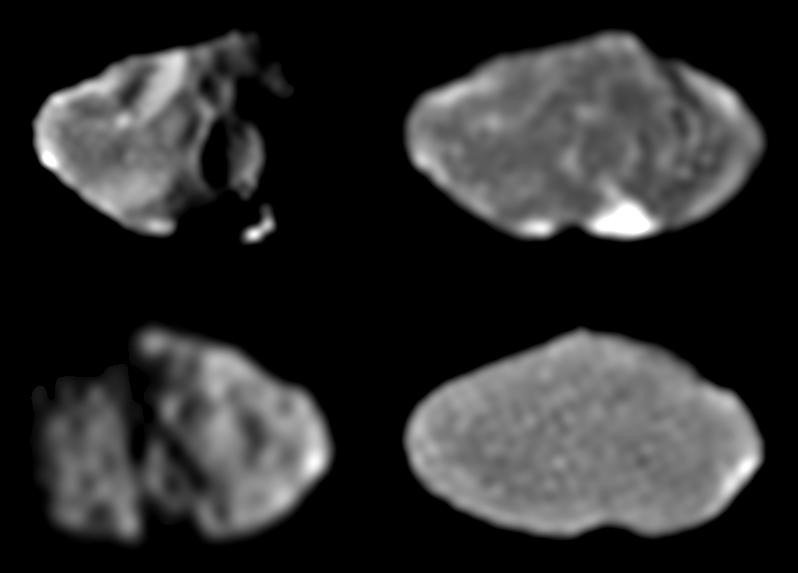
Via Wikimedia Commons: Jupiter's moon Amalthea photographed by Galileo by NASA, public domain.
Size, shape and orbit
NASA gives Amalthea a mean radius of about 83.5 kilometres, with an orbit 181,400 kilometres from Jupiter.[1] NASA's Jovian satellite fact sheet lists its dimensions as roughly 125 by 73 by 64 kilometres and its mass as about 7.5 × 10¹⁸ kilograms.[2] It is one of four small moons inside the orbit of Io, with Metis, Adrastea and Thebe, and NASA says all of them are oddly shaped because they lack the mass or fluidity to pull themselves into a roughly spherical shape.[1] Amalthea and Thebe rotate once for each orbit around Jupiter, always keeping the same side facing the planet.[1]
NASA says Io's distance from Jupiter subjects it to extreme tidal flexing, and that Amalthea, being closer still, is relatively immune to such forces because it is so small: its diameter is about one-nineteenth of Io's. NASA also says that because Amalthea is so close to its parent planet, its orbit will eventually decay and it will fall into Jupiter.[1]
Surface and heat
NASA says images from the Galileo spacecraft have revealed surface features on the inner moons including impact craters, hills and valleys. Pictures of Thebe, Amalthea and Metis taken in January 2000 by Galileo are the highest-resolution images obtained of these small satellites.[1] Galileo made one close encounter with Amalthea during its mission.[3]
NASA's Amalthea page describes it as the reddest object in the Solar System and says it appears to give out more heat than it receives from the Sun. It offers two possible explanations: electric currents induced in the moon's core as it moves through Jupiter's strong magnetic field, or heating from tidal stresses.[1]
The Gossamer ring
NASA says Amalthea and Thebe provide the material for Jupiter's Gossamer ring.[1]
Discovery and name
Edward Emerson Barnard discovered Amalthea on 9 September 1892.[1] It was originally designated Jupiter V. The name was suggested by Camille Flammarion, and it comes from a naiad, a water nymph, who nursed the newborn Jupiter and is often depicted with a goat whose milk is said to have fed the infant god.[1]
Sources
- NASA Science. "Amalthea." science.nasa.gov/jupiter/jupiter-moons/amalthea/ (read 22 November 2026)
- NASA NSSDCA. "Jovian Satellite Fact Sheet." nssdc.gsfc.nasa.gov/planetary/factsheet/joviansatfact.html (read 22 November 2026)
- NASA Science. "Galileo." science.nasa.gov/mission/galileo/ (read 22 November 2026)
