Compare versions
Version 1 → Version 2 (current). Removed · Added. This shows the entry's text as it is written, including its formatting marks.
Version 1 · Version 2 (current) · Version history
Side by side · Together
Elara is a small outer moon of Jupiter, the eighth largest of its moons and the second largest of the Himalia group, with a mean radius of about 43 kilometres.[1] It was discovered on 5 January 1905 by Charles Dillon Perrine at Lick Observatory in California.[1]
## Size and orbit
NASA gives Elara a mean radius of 43 kilometres (26.7 miles), assuming an albedo of 0.04, which makes it only about 2 percent the size of Europa and about half as big as Himalia.[1] NASA's Jovian Satellite Fact Sheet lists a radius of 40 kilometres, a mass of about 0.008 × 10²⁰ kilograms and an albedo of 0.03, so the two NASA sources differ slightly on both radius and albedo.[2]
Elara orbits Jupiter at a mean distance of about 11.7 million kilometres (7.3 million miles), taking nearly 260 Earth days to complete one orbit.[1] The fact sheet gives a semi-major axis of 11,741 thousand kilometres (164.2 Jovian radii), an orbital period of 259.65 days, an inclination of 26.63 degrees to Jupiter's equator, an eccentricity of 0.217 and a rotation period of 0.5 days.[2] The orbit is prograde, in the same direction as Jupiter's rotation.[1]
## The Himalia group
NASA says Elara belongs to the Himalia group, a family of Jovian moons with similar orbits and appearance that are therefore thought to share a common origin.[1] Its members are Himalia (the largest), Elara, Lysithea and Leda.[1] Because Elara reflects only about 4 percent of the light it receives, NASA suggests it may be a chunk of a C- or D-class asteroid that was broken apart in a collision, either before or after Jupiter's gravity captured it, with the other pieces becoming the other moons of the group.[1]
NASA adds that a fifth candidate, S/2000 J11, with a radius of about 2 kilometres, was lost before its orbit could be determined, and may have crashed into Himalia.[1] The fact sheet, however, now lists an object named Dia (S/2000 J11) with a radius of 2 kilometres, so the two NASA pages differ on whether that moon is still tracked.[2]
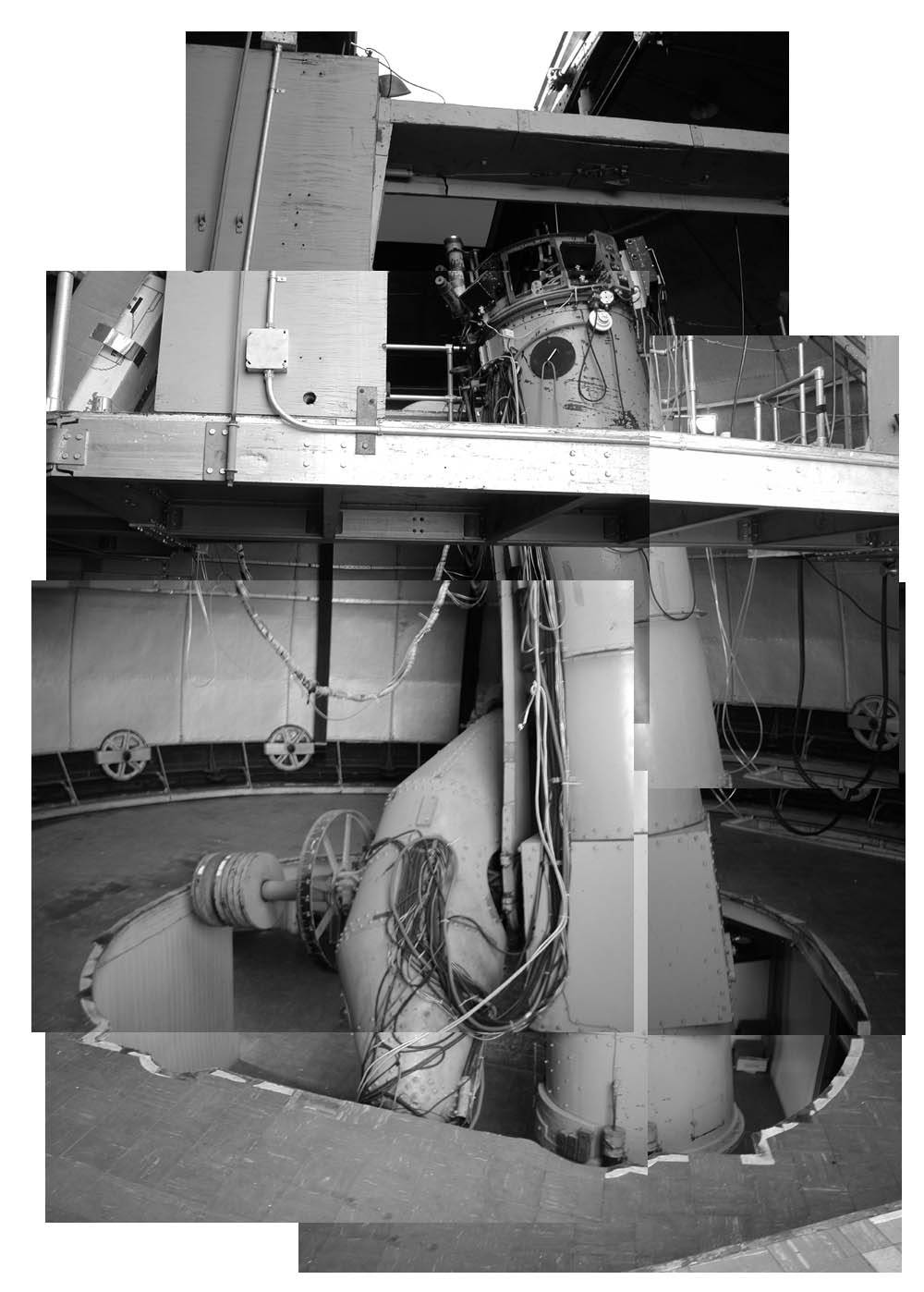Observatory; the image source was not checked against the instrument.](/m/2026/11/sqcJIQeMn1mw2o8P.jpg)
*Via Wikimedia Commons: [Crossley composite](https://commons.wikimedia.org/wiki/File:Crossley_composite.jpg) by Gatohaus at English Wikipedia, public domain.*
## Discovery and name
Perrine found Elara in photographs taken with the 36-inch (0.9-metre) Crossley reflector at Lick Observatory on Mount Hamilton.[1] The discovery listing of NASA's Jet Propulsion Laboratory gives the same year and discoverer.[3]
Elara is named for one of the lovers of Zeus, the Greek equivalent of the Roman god Jupiter. In Greek mythology Zeus hid her from his wife, Hera, beneath the Earth, where she gave birth to their son, a giant called Tityas.[1] A name ending in "a" follows the International Astronomical Union's policy for Jupiter's prograde outer moons.[1]
## Sources
1. NASA Science. "Elara." https://science.nasa.gov/jupiter/jupiter-moons/elara/ (read 22 November 2026)
2. NASA NSSDCA. "Jovian Satellite Fact Sheet." https://nssdc.gsfc.nasa.gov/planetary/factsheet/joviansatfact.html (read 22 November 2026)
3. NASA JPL Solar System Dynamics. "Planetary Satellite Discovery Circumstances." https://ssd.jpl.nasa.gov/sats/discovery.html (read 22 November 2026)
