Compare versions
Version 7 → Version 8. Removed · Added. This shows the entry's text as it is written, including its formatting marks.
Version 7 · Version 8 · Version history
Side by side · Together
Massachusetts is a state of the United States whose 2020 census count was 7,029,917 residents.[1]
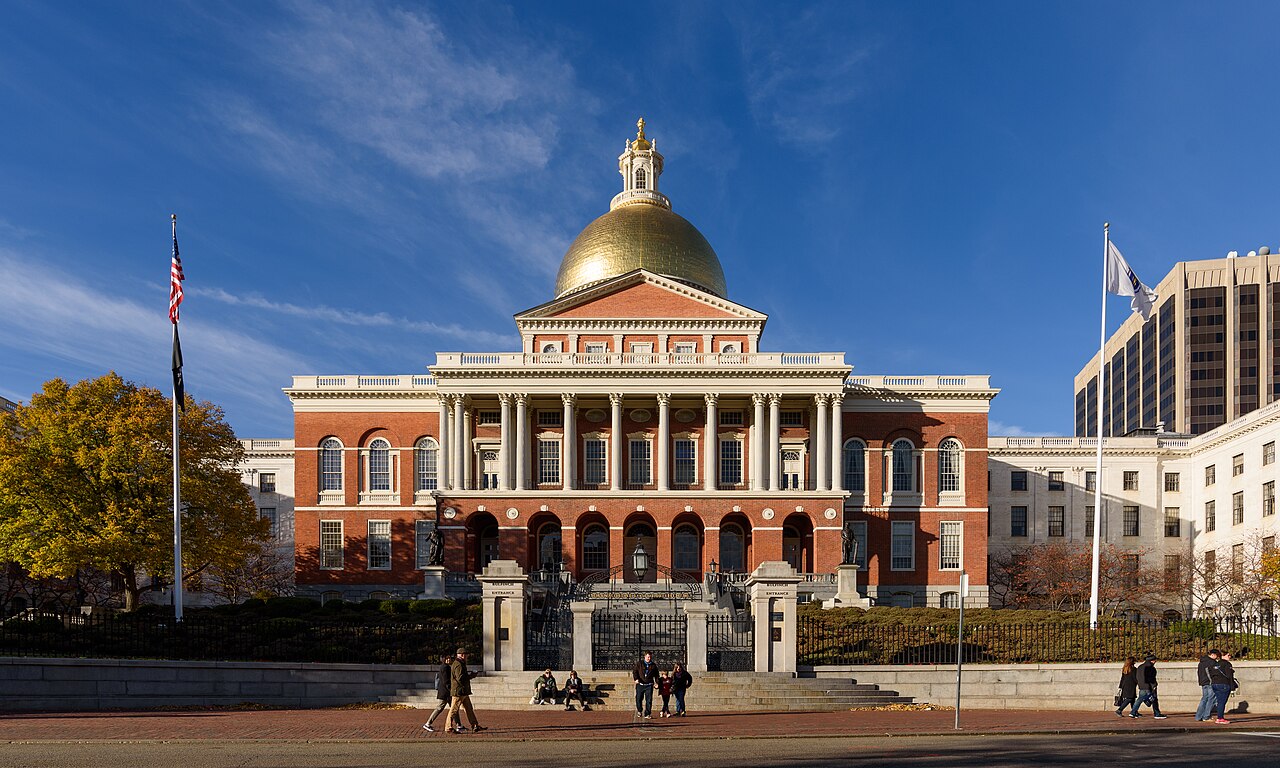
*Via Wikimedia Commons: [Massachusetts State House Boston November 2016](https://commons.wikimedia.org/wiki/File:Massachusetts_State_House_Boston_November_2016.jpg) by King of Hearts, [CC BY-SA 4.0](https://creativecommons.org/licenses/by-sa/4.0).*
## Early English settlement
In November 1620, the settlers who had sailed to the New World aboard the Mayflower signed an agreement, now called the Mayflower Compact, dated "the eleventh of November" and signed at Cape Cod. In it they described their voyage as undertaken for the glory of God and the advancement of the Christian faith, said they meant to plant the first colony in the northern parts of Virginia, and agreed to form a civil body politic and make just and equal laws for the colony's general good.[2]
A larger movement followed a decade later. The ship Arbella anchored in Salem Harbor on 14 June 1630 after leaving England on 8 April, which one New England historical society marks as the start of the Massachusetts Bay Colony. It was the flagship of a fleet of 11 ships carrying about 1,000 people, the first wave of the Great Migration of 1630 to 1642.[3] Its chief passenger, John Winthrop, then 41, led the settlers and carried the charter of the Massachusetts Bay Company.[3] The group stayed in Salem only a few weeks before moving to Charlestown, and then, in September, to Boston.[3]
## Schools and the college
Harvard College was founded on 28 October 1636, when the Great and General Court of the Massachusetts Bay Colony voted to establish it; it is named for John Harvard, its first major benefactor, who gave half his estate and a library of more than 400 books.[12] Boston Latin School dates from 1635 and is described as North America's first secondary school, preparing pupils for Harvard with a course of mainly Greek and Latin.[13]
A colony law of 1647 required every township reaching 50 households to appoint a teacher of reading and writing, whose wages could be paid by parents, masters or the town. A township reaching 100 families or householders had to set up a grammar school whose master could prepare students for university, and a town that neglected this for more than a year owed 5 pounds to the next school until it complied.[14] Its preamble gave the aim of keeping people from being kept from the knowledge of the Scriptures.[14] The law is often called the "Old Deluder Satan" act, and it followed a 1642 law that let selectmen take children from parents who failed to teach them.[13] A historical society account records that in 1675 a Braintree man, William Scant, was brought before the court for breaking the 1647 act.[13]
## The Salem witch trials, 1692
In January 1692 Samuel Parris's daughter Elizabeth, aged 9, and his niece Abigail Williams, aged 11, began having "fits". On 29 February, under pressure from magistrates, the girls accused three women, Tituba, Sarah Good and Sarah Osborne, and questioning began on 1 March.[15]
Governor William Phips set up a Court of Oyer and Terminer, a special court for hearing and judging serious cases, on 27 May 1692, with Lieutenant Governor William Stoughton at its head.[16] Stoughton allowed spectral evidence, which the New England Historical Society defines as acts "carried out by demons that only an accuser can see".[16] The American Bar Association's journal describes it as testimony about paranormal phenomena, and notes that the court kept accepting it even though it could impose the death penalty.[17]
More than 200 people were accused and 20 were executed: 19 men and women were hanged, and Giles Corey, aged 71, was pressed to death with heavy stones in September after refusing to stand trial. At least five of the accused died in jail.[15] In early October Increase Mather, a Puritan minister, published a tract urging "sober cautions against the over-hasty suspecting or too precipitant judging of persons".[17] On 29 October 1692 Phips disbanded the Court of Oyer and Terminer,[15][17] and a Superior Court of Judicature took its place.[15] By May 1693 Phips had pardoned all those still imprisoned on witchcraft charges.[15]
The colony's later reckoning came in stages. In 1702 the court declared the trials unlawful. In 1711 the colony restored the rights and good names of many of the accused and granted 600 pounds in restitution to their heirs. The Commonwealth formally apologised in 1957, and in July 2022 Elizabeth Johnson Jr., the last convicted person whose name had not been cleared, was officially exonerated.[15]
## The Constitution of 1780
A convention in September 1779 named a subcommittee of John Adams, Samuel Adams and James Bowdoin to draft a constitution for the state; Bowdoin and Samuel Adams left the drafting to John Adams, who completed it in October 1779.[4] It was then put to the voters, which one legal analysis describes as an innovation credited to Adams, and was adopted in 1780 by a two-thirds majority of the eligible voters.[4]
The original text had no amendment procedure, so changes came through conventions called by the legislature until 1918, when Article XLVIII set the present process.[4] As of the source's writing, the constitution had been amended more than 120 times while its core provisions remained intact.[4] Its Declaration of Rights has 30 articles and opens by declaring that "all people are born free and equal and have certain natural, essential and unalienable rights." In 1976 the Declaration was amended to refer to "all people" instead of "all men" and to add an equality-of-law guarantee regardless of sex.[4]
## The end of slavery
Slavery in Massachusetts ended through its state constitution in the 1780s.[5] In the cases of Quock Walker, an enslaved man from Worcester County who fled his owner Nathaniel Jennison and sued, a jury found for Walker, freed him and awarded him £50 in damages; Jennison was convicted of assault and battery in 1783, where Chief Justice William Cushing told the jury that the constitution's inalienable-rights clause disallowed slavery in the state.[4] The Massachusetts Historical Society names Walker as one of two people in landmark cases that helped bring slavery to an end in the state.[5]
## Population
The 2020 census counted 7,029,917 residents, up 482,288 (7.4%) from 6,547,629 in 2010. Earlier decades grew 3.1% (2000 to 2010) and 5.5% (1990 to 2000). Middlesex County was the largest at 1,632,002, ahead of Worcester County (862,111) and Essex County (809,829). The largest cities were Boston (675,647), Worcester (206,518) and Springfield (155,929).[1]
## Area
The Census Bureau's 2010 state-area table, with boundaries as of 1 January 2010, gives Massachusetts a total area of 10,554 square miles, made up of 7,800 square miles of land and 2,754 square miles of water.[22] Other reference works round or define land area differently, so figures from other sources can differ from these by a few hundred square miles.
## The road to the Revolution, 1773 to 1775
In December 1773 Bostonians staged a dramatic protest that destroyed the cargo of tea belonging to the East India Company, an episode now called the Boston Tea Party.[6] Parliament answered in the spring of 1774 with the Coercive Acts, which singled out Massachusetts and Boston for punishment.[6] The first of them, the Boston Port Act of 31 March 1774, banned the loading and unloading of goods at Boston's town and harbour from 1 June 1774. Its preamble blamed "dangerous commotions and insurrections" fomented in the town, tied them to the destruction of the tea, and allowed the Crown to reopen the port only after compensation was paid for the tea and for losses in the riots.[7] The confrontations at Lexington and Concord on 19 April 1775 followed.[6]
## Shays' Rebellion, 1786 to 1787
Shays' Rebellion was an armed protest by farmers in western Massachusetts over debt and taxes in 1786 and 1787. Under the Articles of Confederation the national government could ask the states for money but could not tax citizens directly, and Massachusetts raised taxes to pay its creditors; farmers in the west, who had little hard currency, were hit hardest, and many were veterans who had received little or no pay during the war.[10] The National Park Service likewise describes Daniel Shays, a Revolutionary War veteran, as one of those burdened by taxes and fees levied to pay the state's war debt.[11]
In August 1786 the state legislature adjourned without considering petitions for debt relief, and over 1,000 farmers marched on Northampton and prevented the court from sitting. In September armed farmers led in part by Shays forced the Springfield court to adjourn without hearing foreclosure cases.[10]
On 25 January 1787 Shays led about 1,500 men against the federal arsenal at Springfield, which was defended by 1,200 state militia under Major General William Shepard. After warning shots failed, Shepard ordered grapeshot fired; four of the attackers were killed and 20 wounded, and the rest retreated north.[10] In early February, militia under Benjamin Lincoln marched at night through a snowstorm and surprised the rebel camp, capturing many and scattering the rest, and Shays fled to New Hampshire or Vermont. He was pardoned in 1788 and returned to Massachusetts.[10] The Park Service says the episode left a lasting impression of how close the country had come to anarchy and helped bring about a stronger central government and a national constitution.[11] The Battlefields Trust adds that the unrest raised calls for reform that contributed to the Philadelphia Convention of 1787, where delegates wrote a new Constitution rather than only amending the Articles.[10]
## Ratification of the United States Constitution
A state convention in Boston ratified the federal Constitution in February 1788. Its instrument of ratification is dated 6 February 1788, with the signing and sealing clause dated 7 February; it states that the convention "assent to & ratify" the Constitution on behalf of the people of Massachusetts, and was signed by John Hancock as president and William Cushing as vice president.[8] Along with ratifying, the convention recommended nine alterations. They included reserving to the states all powers not expressly delegated, limiting Congress's use of its power over election rules, restricting direct taxes until other revenue had proved insufficient, and requiring a grand jury indictment before trial for a crime carrying an infamous punishment or loss of life, except in military cases.[9]
## Textile mills and the workers of Lowell
Massachusetts became an early centre of American cotton manufacturing. The National Park Service traces the Lowell Machine Shop to the machine shop of the Boston Manufacturing Company at Waltham, which operated from 1814 to 1824. Paul Moody, who had helped Francis Cabot Lowell develop the power loom at Waltham, led that shop and later headed the one at Lowell.[19] The Park Service calls the machine-making skills built up in such early textile shops a crucial step in the American Industrial Revolution, and says the Lowell shop later built a first locomotive in 1835, turned to hydraulic turbines under James B. Francis from 1837, and became an independent company in 1845.[19]
The mills of Lowell drew their labour largely from "mill girls", a term used in antebellum newspapers for young Yankee women, generally 15 to 30 years old, who worked in the large cotton factories; they were also called "female operatives".[18] The corporations recruited the daughters of New England farmers with monthly cash wages and room and board, and large-scale arrivals began in 1823, when Lowell's first factory opened.[18] Most worked 12 to 14 hours a day, plus half a day on Saturdays, and most lived in corporation-owned boardinghouses, usually sharing a room with three other women.[18]
Women in the mills struck twice in the 1830s, and in the 1840s female labor reformers campaigned for a ten-hour day against strong corporate opposition. Sarah Bagley, who came to Lowell in 1836, promoted the ten-hour day and edited the labor newspaper *The Voice of Industry*.[18] The legislation for a ten-hour day failed, but the textile corporations reduced the workday to 11 hours.[18] The Park Service adds that the number of Irish workers in the mills rose dramatically in the 1840s.[18]
## Same-sex marriage and the Goodridge decision, 2003 to 2004
On 18 November 2003 the Supreme Judicial Court, the state's highest court, decided *Goodridge v. Department of Public Health*, a case begun in the Superior Court on 11 April 2001 and argued before the seven justices on 4 March 2003.[20] Chief Justice Margaret Marshall wrote for the majority that the Commonwealth may not deny "the protections, benefits, and obligations conferred by civil marriage to two individuals of the same sex who wish to marry".[20] The court construed civil marriage to mean "the voluntary union of two persons as spouses, to the exclusion of all others", and declared that barring a person from civil marriage solely because that person would marry someone of the same sex violates the Massachusetts Constitution.[20] It stayed entry of judgment for 180 days "to permit the Legislature to take such action as it may deem appropriate".[20]
The ruling was 4 to 3.[21] Justices Spina, Sosman and Cordy dissented.[20] Spina's dissent argued that the case concerned "the power of the Legislature to effectuate social change without interference from the courts", that the power to regulate marriage lies with the Legislature rather than the judiciary, and that the court had turned its role as protector of individual rights into that of creator of rights.[20] A research summary reports that on 17 May 2004 same-gender marriage became legal in Massachusetts.[21]
## Sources
1. University of Massachusetts Amherst Donahue Institute, news release on 2020 census results for Massachusetts, 17 August 2021. https://www.umass.edu/news/article/massachusetts-keeps-pace-us-growth-island-counties-show-big-gains-and-cape-cod
2. "The Mayflower Compact, 1620", Avalon Project, Yale Law School. https://avalon.law.yale.edu/17th_century/mayflower.asp
3. "June 14, 1630: Arbella comes to anchor in Salem Harbor", New England Historical Society. https://newenglandhistoricalsociety.com/june-14-1630-arbella-comes-anchor-salem-harbor/
4. "The Massachusetts Constitution: Oldest in the United States, and Often Ahead of its Time", State Court Report. https://statecourtreport.org/index.php/our-work/analysis-opinion/massachusetts-constitution-oldest-united-states-and-often-ahead-its-time
5. "The End of Slavery in Massachusetts", Massachusetts Historical Society. https://www.masshist.org/features/endofslavery/
6. "Coming of the American Revolution", Massachusetts Historical Society. https://www.masshist.org/revolution/
7. "Boston Port Act; March 31, 1774", Avalon Project, Yale Law School. https://avalon.law.yale.edu/18th_century/boston_port_act.asp
8. "Massachusetts Ratification of the Constitution, February 6, 1788", Avalon Project, Yale Law School. https://avalon.law.yale.edu/18th_century/ratma.asp
9. "Massachusetts Ratifying Convention Concludes Meeting, February 6, 1788", Teaching American History. https://teachingamericanhistory.org/library/document/massachusettes-ratifying-convention-concludes-meeting/
10. "Shays' Rebellion", American Battlefield Trust. https://www.battlefields.org/learn/articles/shays-rebellion
11. "Rebellion at the Springfield Arsenal", National Park Service, Springfield Armory National Historic Site (archived page, last updated 2015). https://www.nps.gov/spar/learn/news/rebellion-at-the-springfield-arsenal.htm
12. "History", Harvard University. https://www.harvard.edu/about/history/
13. "How the Old Deluder Satan Act Made Sure Puritan Children Got Educated", New England Historical Society. https://newenglandhistoricalsociety.com/old-deluder-satan-act-made-sure-puritan-children-got-educated/
14. "The Old Deluder Act (1647)", from Records of the Governor and Company of the Massachusetts Bay in New England, vol. II (1853), constitution.org. https://constitution.org/primarysources/deluder.html
15. "A Brief History of the Salem Witch Trials", Smithsonian Magazine. https://www.smithsonianmag.com/history-archaeology/brief-salem.html
16. "The Deadly Rules of Massachusetts' Court of Oyer and Terminer", New England Historical Society. https://newenglandhistoricalsociety.com/rules-massachusetts-court-of-oyer-and-terminer/
17. "Special witch trials dissolved", ABA Journal. https://abajournal.com/magazine/article/special_witch_trials_dissolved
18. "The Mill Girls of Lowell", National Park Service, Lowell National Historical Park. https://www.nps.gov/lowe/learn/historyculture/the-mill-girls-of-lowell.htm
19. "Lowell Machine Shop", National Park Service, Lowell National Historical Park. https://home.nps.gov/lowe/learn/photosmultimedia/machine_shop.htm
20. *Goodridge v. Department of Public Health*, SJC-08860, Massachusetts Supreme Judicial Court, 18 November 2003 (opinion text, Stanford Law School copy). https://web.stanford.edu/~mrosenfe/Goodridge_v_Dept_Public_Health_MA_2003.pdf
21. "Massachusetts Court Rules for Same-Gender Marriage", EBSCO Research Starters. https://www.ebsco.com/research-starters/social-sciences-and-humanities/massachusetts-court-rules-same-gender-marriage21. "Massachusetts Court Rules for Same-Gender Marriage", EBSCO Research Starters. https://www.ebsco.com/research-starters/social-sciences-and-humanities/massachusetts-court-rules-same-gender-marriage
22. "State Area Measurements and Internal Point Coordinates", U.S. Census Bureau, 2010 (boundaries as of 1 January 2010). https://www.census.gov/geographies/reference-files/2010/geo/state-area.html
