Version 1
Nov 23, 2026. Compare with the current version · Version history
Thebe is a small inner moon of Jupiter, the seventh largest of its moons, with a mean radius of about 49 kilometres.[1] It was found in images taken by the Voyager 1 spacecraft and is one of the four small moons that orbit closer to Jupiter than the four large Galilean moons.[1]
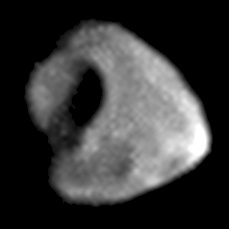
Via Wikimedia Commons: Thebe by NASA/JPL, public domain.
Size and orbit
NASA gives Thebe a mean radius of about 49 kilometres.[1] NASA's Jovian Satellite Fact Sheet describes it as an elongated body measuring 58 × 49 × 42 kilometres, with a mass of about 0.008 × 10²⁰ kilograms and an albedo of 0.05.[2]
Thebe orbits Jupiter at a distance of about 222 thousand kilometres (138 thousand miles) and circles the planet in a little over 16 hours.[1] The fact sheet gives a semi-major axis of 221.9 thousand kilometres (3.11 Jovian radii), a period of 0.6745 days, an inclination of 1.08 degrees to Jupiter's equator and an eccentricity of 0.018, and marks its rotation as synchronous, which means it keeps the same face toward Jupiter.[2]
A regular moon
NASA says Thebe is one of eight "regular" Jovian satellites, the four Galilean moons and the four small moons closer in. Regular moons orbit Jupiter in the same direction as the planet's rotation, in nearly circular orbits that lie in the plane of Jupiter's equator.[1] This sets Thebe apart from the many small outer moons, such as Himalia and Pasiphae, whose orbits are eccentric and highly inclined. Its sister inner moons include Amalthea, and NASA names Metis as the other moon exempted from the naming rule described below.[1]
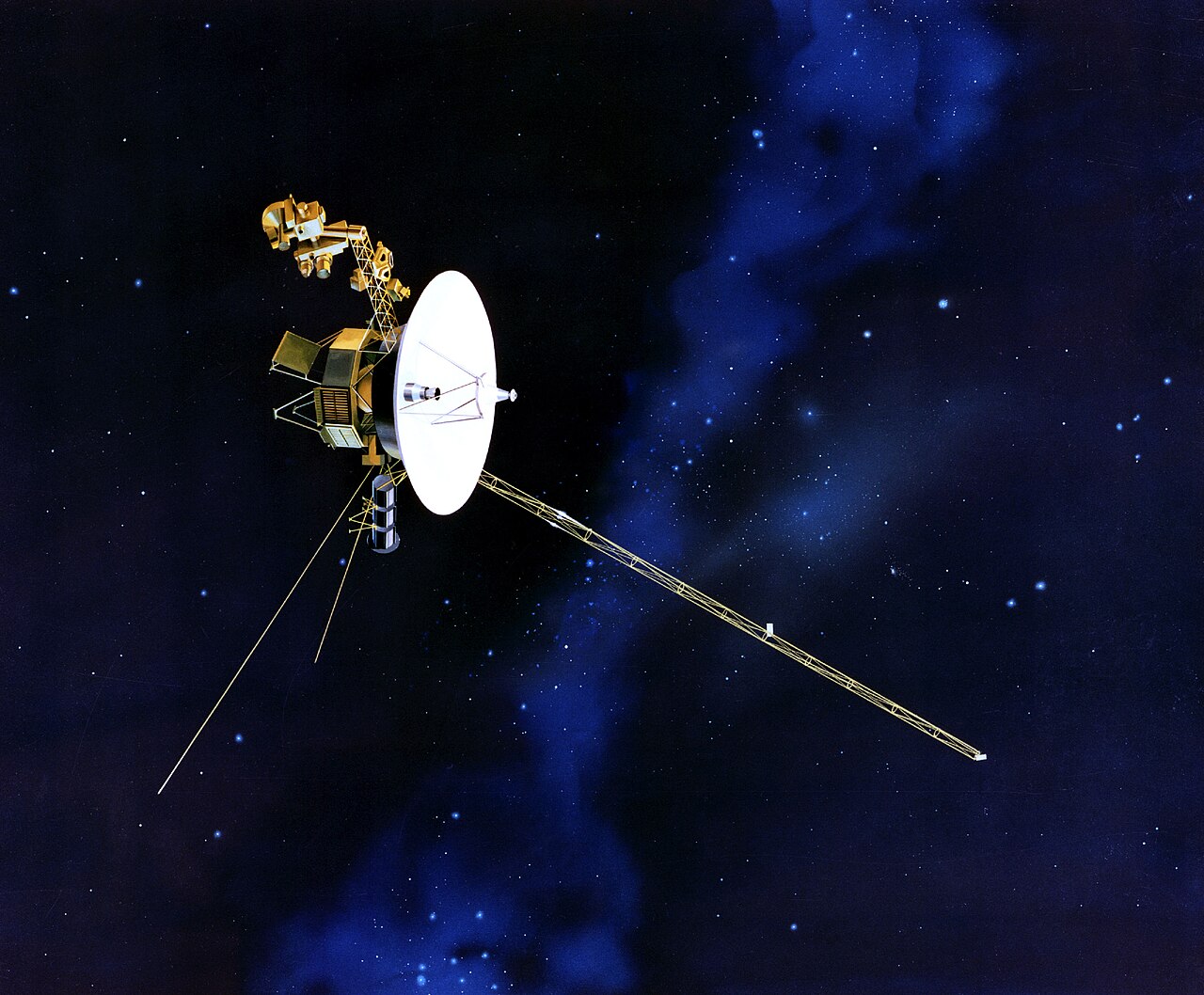
Via Wikimedia Commons: Voyager spacecraft by NASA/JPL, public domain.
Discovery and name
NASA says Thebe was discovered in 1980 by the Voyager science team from images taken by Voyager 1, and that it was originally called S/1979 J2.[1] The discovery listing of NASA's Jet Propulsion Laboratory gives the year of discovery as 1979, so the two NASA sources differ by a year, which may reflect the date of the images against the date of the announcement; the sources do not say, and the entry does not decide.[3]
The moon was ultimately named Thebe, a name linked to Jupiter, or his Greek equivalent Zeus, in several myths. In one, Thebe was a nymph and a lover of Zeus; in another she was an Egyptian king's daughter and a lover of Jupiter.[1] NASA says Thebe and Metis were exempted from the International Astronomical Union's requirement that prograde moons, apart from the Galilean moons, receive names ending in "a".[1]
Sources
- NASA Science. "Thebe." science.nasa.gov/jupiter/jupiter-moons/thebe/ (read 22 November 2026)
- NASA NSSDCA. "Jovian Satellite Fact Sheet." nssdc.gsfc.nasa.gov/planetary/factsheet/joviansatfact.html (read 22 November 2026)
- NASA JPL Solar System Dynamics. "Planetary Satellite Discovery Circumstances." ssd.jpl.nasa.gov/sats/discovery.html (read 22 November 2026)
