Compare versions
Version 2 → Version 3 (current). Removed · Added. This shows the entry's text as it is written, including its formatting marks.
Version 2 · Version 3 (current) · Version history
Side by side · Together
Version 2Version 3 (current)
Adrastea is the smallest of the four inner moons of Jupiter, with a mean radius of about 8 kilometres, and orbits so close to the planet that it circles Jupiter in about seven hours.[1] It was discovered in July 1979 by the Voyager science team.[1]
Adrastea is the smallest of the four inner moons of Jupiter, with a mean radius of about 8 kilometres, and orbits so close to the planet that it circles Jupiter in about seven hours.[1] It was discovered in July 1979 by the Voyager science team.[1]
## Size and orbit
## Size and orbit
NASA gives Adrastea a mean radius of about 8.2 ± 2.0 kilometres and calls it the smallest of the group.[1] NASA's Jovian Satellite Fact Sheet lists an elongated shape of 10 × 8 × 7 kilometres, a mass of about 0.0002 × 10²⁰ kilograms and an albedo of 0.10.[2]
NASA gives Adrastea a mean radius of about 8.2 ± 2.0 kilometres and calls it the smallest of the group.[1] NASA's Jovian Satellite Fact Sheet lists radii along three axes of 10 × 8 × 7 kilometres, an elongated shape, a mass of about 0.0002 × 10²⁰ kilograms and an albedo of 0.10.[2]
14 unchanged paragraphs
Adrastea orbits about 129,000 kilometres from Jupiter and takes 0.298 Earth days, about 7 hours, to complete an orbit.[1][2] The fact sheet gives an inclination of 0.05 degrees and an eccentricity of 0.002, so the orbit is almost circular and lies in Jupiter's equatorial plane.[2] NASA's page says the rotation period is not known, whereas the fact sheet marks the rotation as synchronous, so the two NASA sources differ on this point.[1][2]
Adrastea orbits about 129,000 kilometres from Jupiter and takes 0.298 Earth days, about 7 hours, to complete an orbit.[1][2] The fact sheet gives an inclination of 0.05 degrees and an eccentricity of 0.002, so the orbit is almost circular and lies in Jupiter's equatorial plane.[2] NASA's page says the rotation period is not known, whereas the fact sheet marks the rotation as synchronous, so the two NASA sources differ on this point.[1][2]
NASA says that Adrastea and Metis are the two moons that orbit inside what is called Jupiter's synchronous orbit radius, so Adrastea orbits faster than Jupiter rotates. NASA states that at this distance Adrastea's orbit will eventually decay and it will fall into the planet.[1]
NASA says that Adrastea and Metis are the two moons that orbit inside what is called Jupiter's synchronous orbit radius, so Adrastea orbits faster than Jupiter rotates. NASA states that at this distance Adrastea's orbit will eventually decay and it will fall into the planet.[1]
## One of four inner moons
## One of four inner moons
NASA says that four small moons, Metis, Adrastea, [Amalthea](https://micwyn.com/t/3034/amalthea) and [Thebe](https://micwyn.com/t/3046/thebe), orbit within Io's orbit, closer to Jupiter than the four large Galilean moons.[1] All four are oddly shaped, lacking the mass or fluidity to pull themselves into a roughly spherical shape, and images from the Galileo spacecraft have revealed some surface features, including impact craters, hills and valleys.[1]
NASA says that four small moons, Metis, Adrastea, [Amalthea](https://micwyn.com/t/3034/amalthea) and [Thebe](https://micwyn.com/t/3046/thebe), orbit within Io's orbit, closer to Jupiter than the four large Galilean moons.[1] All four are oddly shaped, lacking the mass or fluidity to pull themselves into a roughly spherical shape, and images from the Galileo spacecraft have revealed some surface features, including impact craters, hills and valleys.[1]
NASA notes that Io orbits about 422,000 kilometres above Jupiter and is subjected to extreme tidal flexing there, so one might expect a closer moon to be pulled to pieces. Because Adrastea is so small it is relatively immune to tidal forces.[1]
NASA notes that Io orbits about 422,000 kilometres above Jupiter and is subjected to extreme tidal flexing there, so one might expect a closer moon to be pulled to pieces. Because Adrastea is so small it is relatively immune to tidal forces.[1]
## Role in Jupiter's rings
## Role in Jupiter's rings
Adrastea and Metis orbit inside Jupiter's main ring and, NASA says, are undoubtedly the source of the material for that ring, while Amalthea and Thebe provide the material for the Gossamer ring.[1]
Adrastea and Metis orbit inside Jupiter's main ring and, NASA says, are undoubtedly the source of the material for that ring, while Amalthea and Thebe provide the material for the Gossamer ring.[1]
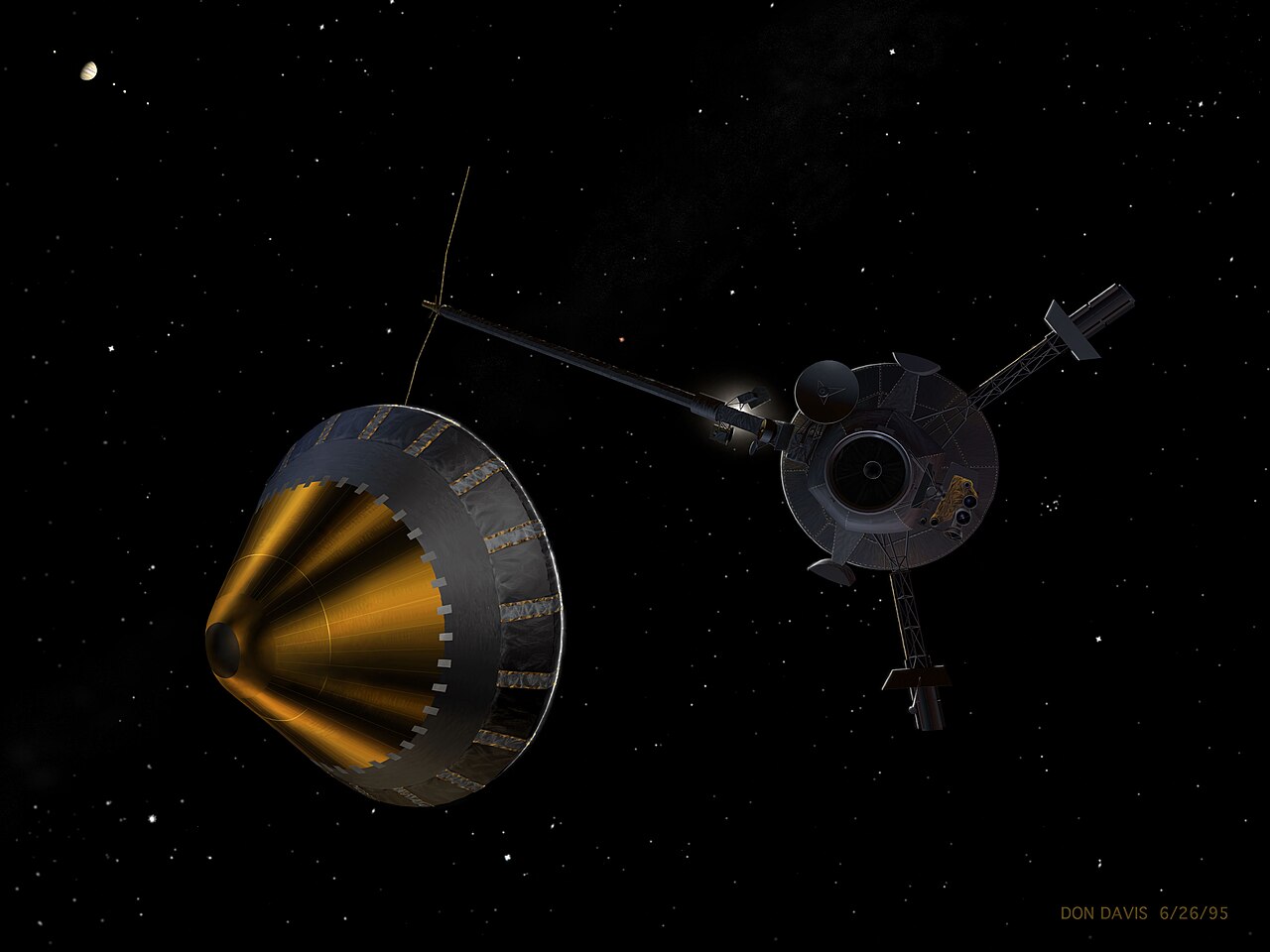

*Via Wikimedia Commons: [Galileo spacecraft leaves the Orbiter](https://commons.wikimedia.org/wiki/File:Galileo_spacecraft_leaves_the_Orbiter.jpg) by Don Davis, public domain.*
*Via Wikimedia Commons: [Galileo spacecraft leaves the Orbiter](https://commons.wikimedia.org/wiki/File:Galileo_spacecraft_leaves_the_Orbiter.jpg) by Don Davis, public domain.*
## Discovery and name
## Discovery and name
NASA says Adrastea was discovered in July 1979 by the Voyager science team, and the discovery listing of NASA's Jet Propulsion Laboratory gives 1979 and the Voyager Science Team, with the provisional designation S/1979 J1.[1][3]
NASA says Adrastea was discovered in July 1979 by the Voyager science team, and the discovery listing of NASA's Jet Propulsion Laboratory gives 1979 and the Voyager Science Team, with the provisional designation S/1979 J1.[1][3]
Adrastea is named for the nymph of Crete who, in the myth, took care of the infant Zeus for his mother Rhea. Rhea entrusted her child to Adrastea to save him from her husband Cronus, who would eat his children to maintain his rule.[1]
Adrastea is named for the nymph of Crete who, in the myth, took care of the infant Zeus for his mother Rhea. Rhea entrusted her child to Adrastea to save him from her husband Cronus, who would eat his children to maintain his rule.[1]
## Sources
## Sources
1. NASA Science. "Adrastea." https://science.nasa.gov/jupiter/jupiter-moons/adrastea/ (read 22 November 2026)
2. NASA NSSDCA. "Jovian Satellite Fact Sheet." https://nssdc.gsfc.nasa.gov/planetary/factsheet/joviansatfact.html (read 22 November 2026)
3. NASA JPL Solar System Dynamics. "Planetary Satellite Discovery Circumstances." https://ssd.jpl.nasa.gov/sats/discovery.html (read 22 November 2026)
