Compare versions
Version 1 → Version 2 (current). Removed · Added. This shows the entry's text as it is written, including its formatting marks.
Version 1 · Version 2 (current) · Version history
Side by side · Together
Version 1Version 2 (current)
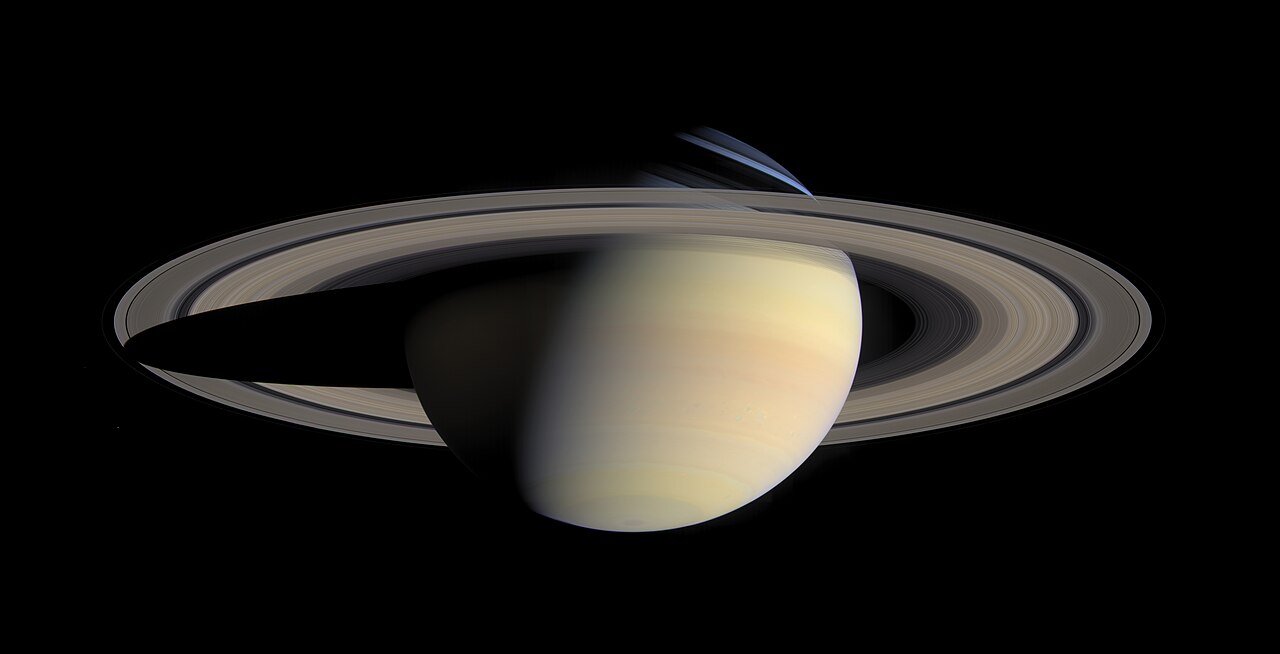
Saturn is the sixth planet from the Sun and the second largest planet in the solar system, a gas giant made mostly of hydrogen and helium and surrounded by the most extensive ring system known.[1][2] It is the farthest planet from Earth that was discovered by the unaided human eye.[1]
Saturn is the sixth planet from the Sun and the second largest planet in the solar system, a gas giant made mostly of hydrogen and helium and surrounded by the most extensive ring system known.[1][2] It is the farthest planet from Earth that was discovered by the unaided human eye.[1]
9 unchanged paragraphs
*Via Wikimedia Commons: [Saturn from Cassini Orbiter (2004-10-06)](https://commons.wikimedia.org/wiki/File:Saturn_from_Cassini_Orbiter_(2004-10-06).jpg) by NASA/JPL/Space Science Institute, public domain.*
*Via Wikimedia Commons: [Saturn from Cassini Orbiter (2004-10-06)](https://commons.wikimedia.org/wiki/File:Saturn_from_Cassini_Orbiter_(2004-10-06).jpg) by NASA/JPL/Space Science Institute, public domain.*
## Size, orbit and day
## Size, orbit and day
Saturn has an equatorial diameter of about 120,500 kilometres (74,897 miles), roughly nine times that of [Earth](https://micwyn.com/t/3024/earth). NASA's comparison: if Earth were the size of a nickel, Saturn would be about as big as a volleyball.[2] NASA's Saturn Fact Sheet gives its mass as 568.32 × 10²⁴ kilograms, about 95 times Earth's, and an equatorial radius of 60,268 kilometres at the 1-bar level, with a flattening of 0.098 because Saturn's rapid spin makes it noticeably oblate.[3]
Saturn has an equatorial diameter of about 120,500 kilometres (74,897 miles), roughly nine times that of [Earth](https://micwyn.com/t/3024/earth). NASA's comparison: if Earth were the size of a nickel, Saturn would be about as big as a volleyball.[2] NASA's Saturn Fact Sheet gives its mass as 568.32 × 10²⁴ kilograms, about 95 times Earth's, and an equatorial radius of 60,268 kilometres at the 1-bar level, with a flattening of 0.098 because Saturn's rapid spin makes it noticeably oblate.[3]
Saturn orbits at an average distance of about 1.4 billion kilometres (886 million miles) from the [Sun](https://micwyn.com/t/3020/sun), which is 9.5 astronomical units, and sunlight takes about 80 minutes to reach it.[2] It completes an orbit in about 29.4 Earth years (10,756 Earth days).[2] A day on Saturn lasts only about 10.7 hours, the second-shortest in the solar system according to NASA.[2] The fact sheet gives 10.656 hours, using a standard reference frame for the planet's rotation.[3] Its axis is tilted 26.73 degrees to its orbit, similar to Earth's tilt of 23.5 degrees, so Saturn has seasons.[2]
Saturn orbits at an average distance of about 1.4 billion kilometres (886 million miles) from the [Sun](https://micwyn.com/t/3020/sun), which is 9.5 astronomical units, and sunlight takes about 80 minutes to reach it.[2] It completes an orbit in about 29.4 Earth years (10,756 Earth days).[2] A day on Saturn lasts only about 10.7 hours, the second-shortest in the solar system according to NASA.[2] The fact sheet gives 10.656 hours, using a standard reference frame for the planet's rotation.[3] Its axis is tilted 26.73 degrees to its orbit, similar to Earth's tilt of 23.5 degrees, so Saturn has seasons.[2]
## Structure
## Structure
Like [Jupiter](https://micwyn.com/t/3029/jupiter), Saturn is mostly hydrogen and helium. NASA describes a dense core of metals such as iron and nickel surrounded by rocky material, enveloped by liquid metallic hydrogen inside a layer of liquid hydrogen, similar to Jupiter's but considerably smaller.[2] The fact sheet's mean density is 687 kilograms per cubic metre; NASA notes that Saturn is the only planet whose average density is less than that of water, so that a bathtub big enough could in principle float it.[2][3] Saturn has no true surface, and NASA says extreme pressures and temperatures deeper down would crush, melt and vaporize any spacecraft that tried to fly into it.[2]
Like [Jupiter](https://micwyn.com/t/3029/jupiter), Saturn is mostly hydrogen and helium. NASA describes a dense core of metals such as iron and nickel surrounded by rocky material, enveloped by liquid metallic hydrogen inside a layer of liquid hydrogen, similar to Jupiter's but considerably smaller.[2] The fact sheet's mean density is 687 kilograms per cubic metre; NASA notes that Saturn is the only planet whose average density is less than that of water, so that a bathtub big enough could in principle float it.[2][3] Saturn has no true surface, and NASA says extreme pressures and temperatures deeper down would crush, melt and vaporize any spacecraft that tried to fly into it.[2]
## Atmosphere and the polar hexagon
## Atmosphere and the polar hexagon
Saturn's clouds appear as faint stripes, jet streams and storms in shades of yellow, brown and gray.[2] The fact sheet gives an atmosphere of about 96.3 percent molecular hydrogen and 3.25 percent helium by volume, with traces of methane, ammonia and ethane, and a temperature of 134 kelvin (−139 °C) at the 1-bar level.[3] NASA's Saturn facts page says winds in the upper atmosphere reach 500 metres per second in the equatorial region, while the fact sheet gives speeds of up to 400 metres per second below 30 degrees latitude, so the two NASA pages differ on the peak wind speed.[2][3]
Saturn's clouds appear as faint stripes, jet streams and storms in shades of yellow, brown and gray.[2] The fact sheet gives an atmosphere of about 96.3 percent molecular hydrogen and 3.25 percent helium by volume, with traces of methane, ammonia and ethane, and a temperature of 134 kelvin (−139 °C) at the 1-bar level.[3] NASA's Saturn facts page says winds in the upper atmosphere reach 500 metres per second in the equatorial region, while the fact sheet gives speeds of up to 400 metres per second below 30 degrees latitude, so the two NASA pages differ on the peak wind speed.[2][3]
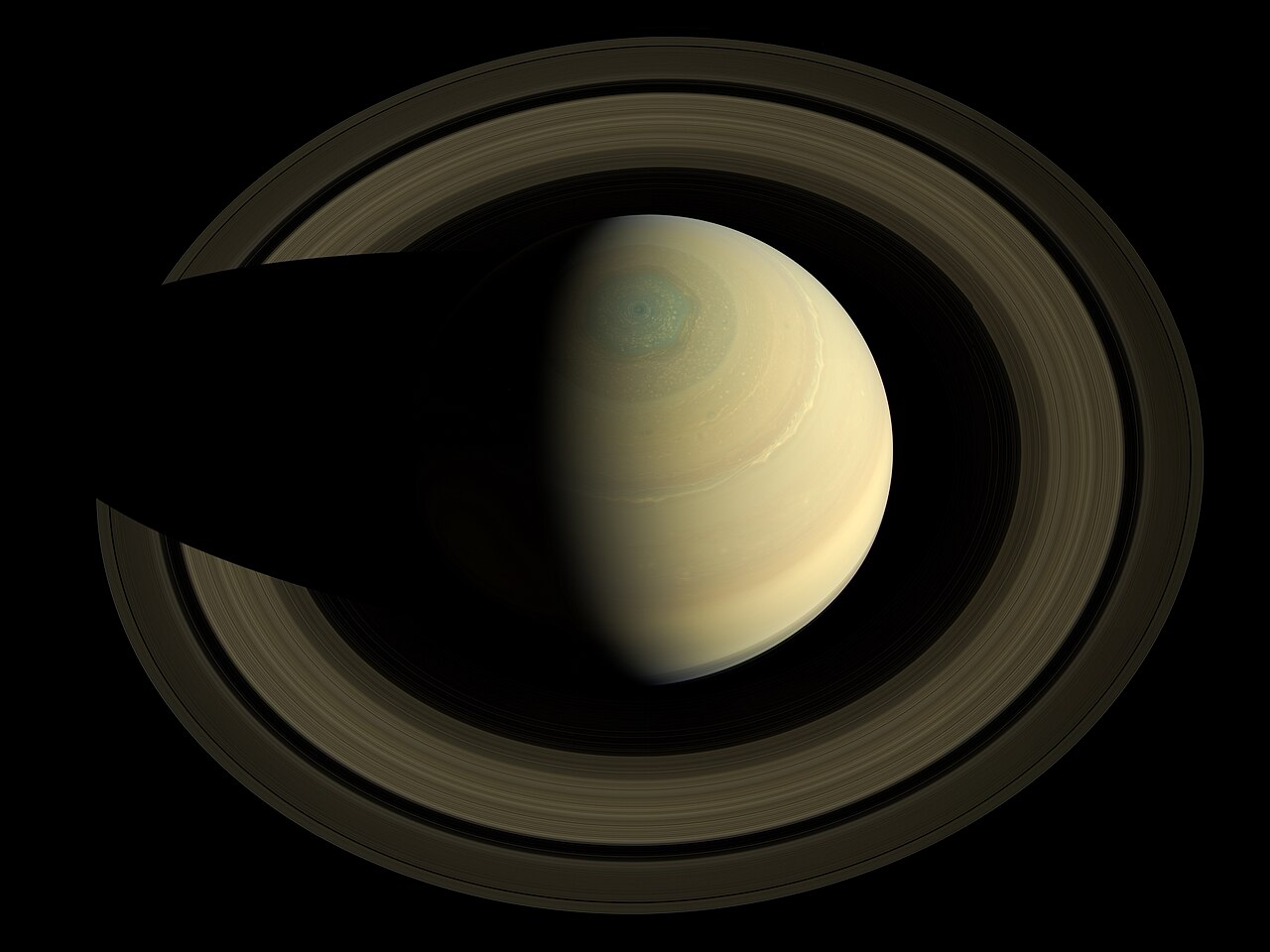
At Saturn's north pole is a six-sided jet stream. This hexagon was first noticed in images taken by the Voyager spacecraft in the early 1980s and later observed more closely by Cassini. It spans about 30,000 kilometres (20,000 miles) and is a wavy jet stream of winds around 322 kilometres per hour, with a large rotating storm at its centre.[2] NASA reports that Hubble observations dating from 2023 revealed a ten-sided wave around Saturn's south pole, according to a research study published in September 2026, the first large regular-sided jet pattern observed in the southern hemisphere.[2]
At Saturn's north pole is a six-sided jet stream. This hexagon was first noticed in images taken by the Voyager spacecraft in the early 1980s and later observed more closely by Cassini. It spans about 30,000 kilometres (20,000 miles) and is a wavy jet stream of winds around 322 kilometres per hour, with a large rotating storm at its centre.[2] NASA reports that Hubble observations dating from 2023 revealed a ten-sided wave around Saturn's south pole, according to a research study published in September 2026, the first large regular-sided jet pattern observed in the southern hemisphere.[2]
7 unchanged paragraphs
*Via Wikimedia Commons: [Top view of the rings of Saturn by Cassini - October 10, 2013](https://commons.wikimedia.org/wiki/File:Top_view_of_the_rings_of_Saturn_by_Cassini_-_October_10,_2013.jpg) by NASA / JPL-Caltech / SSI / Cornell, public domain.*
*Via Wikimedia Commons: [Top view of the rings of Saturn by Cassini - October 10, 2013](https://commons.wikimedia.org/wiki/File:Top_view_of_the_rings_of_Saturn_by_Cassini_-_October_10,_2013.jpg) by NASA / JPL-Caltech / SSI / Cornell, public domain.*
## The rings
## The rings
NASA says Saturn is not the only planet with rings, but none are as spectacular or as complex.[2] The rings are made of billions of small chunks of ice and rock coated with dust and other materials. Most particles range from tiny, dust-sized icy grains to chunks as big as a house, with a few as large as mountains, and NASA says they are thought to be pieces of comets, asteroids or shattered moons that were torn apart by Saturn's gravity before reaching the planet.[2]
NASA says Saturn is not the only planet with rings, but none are as spectacular or as complex.[2] The rings are made of billions of small chunks of ice and rock coated with dust and other materials. Most particles range from tiny, dust-sized icy grains to chunks as big as a house, with a few as large as mountains, and NASA says they are thought to be pieces of comets, asteroids or shattered moons that were torn apart by Saturn's gravity before reaching the planet.[2]
The ring system extends up to about 282,000 kilometres (175,000 miles) from Saturn, yet the vertical height is typically only about 10 metres (30 feet) in the main rings.[2] The rings are named alphabetically in the order they were discovered. The main rings are A, B and C, and the fainter D, E, F and G rings were found more recently. Moving outward from the planet the order is D, C, B, the Cassini Division (a gap 4,700 kilometres wide separating A from B), A, F, G and E, with the very faint Phoebe ring much farther out, in the orbit of the moon Phoebe.[2]
The ring system extends up to about 282,000 kilometres (175,000 miles) from Saturn, yet the vertical height is typically only about 10 metres (30 feet) in the main rings.[2] The rings are named alphabetically in the order they were discovered. The main rings are A, B and C, and the fainter D, E, F and G rings were found more recently. Moving outward from the planet the order is D, C, B, the Cassini Division (a gap 4,700 kilometres wide separating A from B), A, F, G and E, with the very faint Phoebe ring much farther out, in the orbit of the moon Phoebe.[2]
## Moons
## Moons
NASA says Saturn has more confirmed moons than any other planet, ranging from Titan, which is larger than the planet Mercury, to moons as small as a sports arena. The count has risen quickly: NASA's Saturn facts page and the fact sheet list 274 confirmed moons as of March 2025, while NASA's moons page reports 293 as of August 2026.[2][3][4] NASA describes Titan as a moon with methane lakes and a smoggy atmosphere,[2] and Enceladus as a small moon with a global ocean under a thick icy shell, and it calls both high-priority destinations for future missions.[4]
NASA says Saturn has more confirmed moons than any other planet, ranging from Titan, which is larger than the planet Mercury, to moons as small as a sports arena. The count has risen quickly: NASA's Saturn facts page and the fact sheet list 274 confirmed moons as of March 2025, while NASA's moons page reports 293 as of August 2026.[2][3][4] NASA describes Titan as a moon with methane lakes and a smoggy atmosphere,[2] and Enceladus as a small moon with a global ocean under a thick icy shell, and it calls both high-priority destinations for future missions.[4]
NASA's moons list gives discovery dates for the major moons. Titan was found in 1655 by Christiaan Huygens; Rhea, Iapetus, Tethys and Dione by Giovanni Cassini between 1672 and 1684; Mimas and Enceladus by William Herschel in 1789; Hyperion in 1848; and Phoebe in 1898.[4] Smaller moons were found later, including several credited to the Voyager science team in 1980 and a large group found in 2000 by a ground-based team.[4]
NASA's moons list gives discovery dates for the major moons. Titan was found in 1655 by Christiaan Huygens; Rhea, Iapetus, Tethys and Dione by Giovanni Cassini between 1672 and 1684; Mimas and Enceladus by William Herschel in 1789; Hyperion in 1848; and Phoebe in 1898.[4] Smaller moons were found later, including several credited to the Voyager science team in 1980 and a large group found in 2000 by a ground-based team.[4]

7 unchanged paragraphs
*Via Wikimedia Commons: [Saturn's rings in visible light and radio](https://commons.wikimedia.org/wiki/File:Saturn%27s_rings_in_visible_light_and_radio.jpg) by NASA / JPL / Space Science Institute, public domain.*
*Via Wikimedia Commons: [Saturn's rings in visible light and radio](https://commons.wikimedia.org/wiki/File:Saturn%27s_rings_in_visible_light_and_radio.jpg) by NASA / JPL / Space Science Institute, public domain.*
## Exploration
## Exploration
NASA states that four robotic spacecraft have visited Saturn. Pioneer 11 gave the first close look in September 1979, and the twin Voyager 1 and Voyager 2 spacecraft followed with flybys in 1980 and 1981.[1] Cassini arrived in orbit in 2004, the first spacecraft to orbit Saturn, and NASA says it was only then that understanding of Saturn really took shape.[1][5] Cassini launched on 15 October 1997 and ended its mission on 15 September 2017, when operators deliberately plunged it into Saturn so that the moons, particularly Enceladus and Titan, would remain uncontaminated for future exploration.[2][5]
NASA states that four robotic spacecraft have visited Saturn. Pioneer 11 gave the first close look in September 1979, and the twin Voyager 1 and Voyager 2 spacecraft followed with flybys in 1980 and 1981.[1] Cassini arrived in orbit in 2004, the first spacecraft to orbit Saturn, and NASA says it was only then that understanding of Saturn really took shape.[1][5] Cassini launched on 15 October 1997 and ended its mission on 15 September 2017, when operators deliberately plunged it into Saturn so that the moons, particularly Enceladus and Titan, would remain uncontaminated for future exploration.[2][5]
## Formation and life
## Formation and life
According to NASA, Saturn took shape about 4.5 billion years ago as gravity pulled swirling gas and dust together, and it settled into its present position about 4 billion years ago.[2] NASA says the planet itself is most likely too extreme for life, but moons such as Enceladus and Titan, which have internal oceans, could possibly support it.[2] The planet is named for the Roman god of agriculture and wealth, who was also the father of Jupiter.[2] Saturn's discoverer and discovery date are listed as unknown and prehistoric.[3]
According to NASA, Saturn took shape about 4.5 billion years ago as gravity pulled swirling gas and dust together, and it settled into its present position about 4 billion years ago.[2] NASA says the planet itself is most likely too extreme for life, but moons such as Enceladus and Titan, which have internal oceans, could possibly support it.[2] The planet is named for the Roman god of agriculture and wealth, who was also the father of Jupiter.[2] Saturn's discoverer and discovery date are listed as unknown and prehistoric.[3]
## Sources
## Sources
1. NASA Science. "Saturn." https://science.nasa.gov/saturn/ (read 22 November 2026)
2. NASA Science. "Saturn Facts." https://science.nasa.gov/saturn/facts/ (read 22 November 2026)
3. NASA NSSDCA. "Saturn Fact Sheet." https://nssdc.gsfc.nasa.gov/planetary/factsheet/saturnfact.html (read 22 November 2026; last updated 18 March 2025)
4. NASA Science. "Saturn Moons." https://science.nasa.gov/saturn/moons/ (read 22 November 2026)
5. NASA Science. "Cassini-Huygens." https://science.nasa.gov/mission/cassini/ (read 22 November 2026)
