Compare versions
Version 1 → Version 2 (current). Removed · Added. This shows the entry's text as it is written, including its formatting marks.
Version 1 · Version 2 (current) · Version history
Side by side · Together
Version 1Version 2 (current)
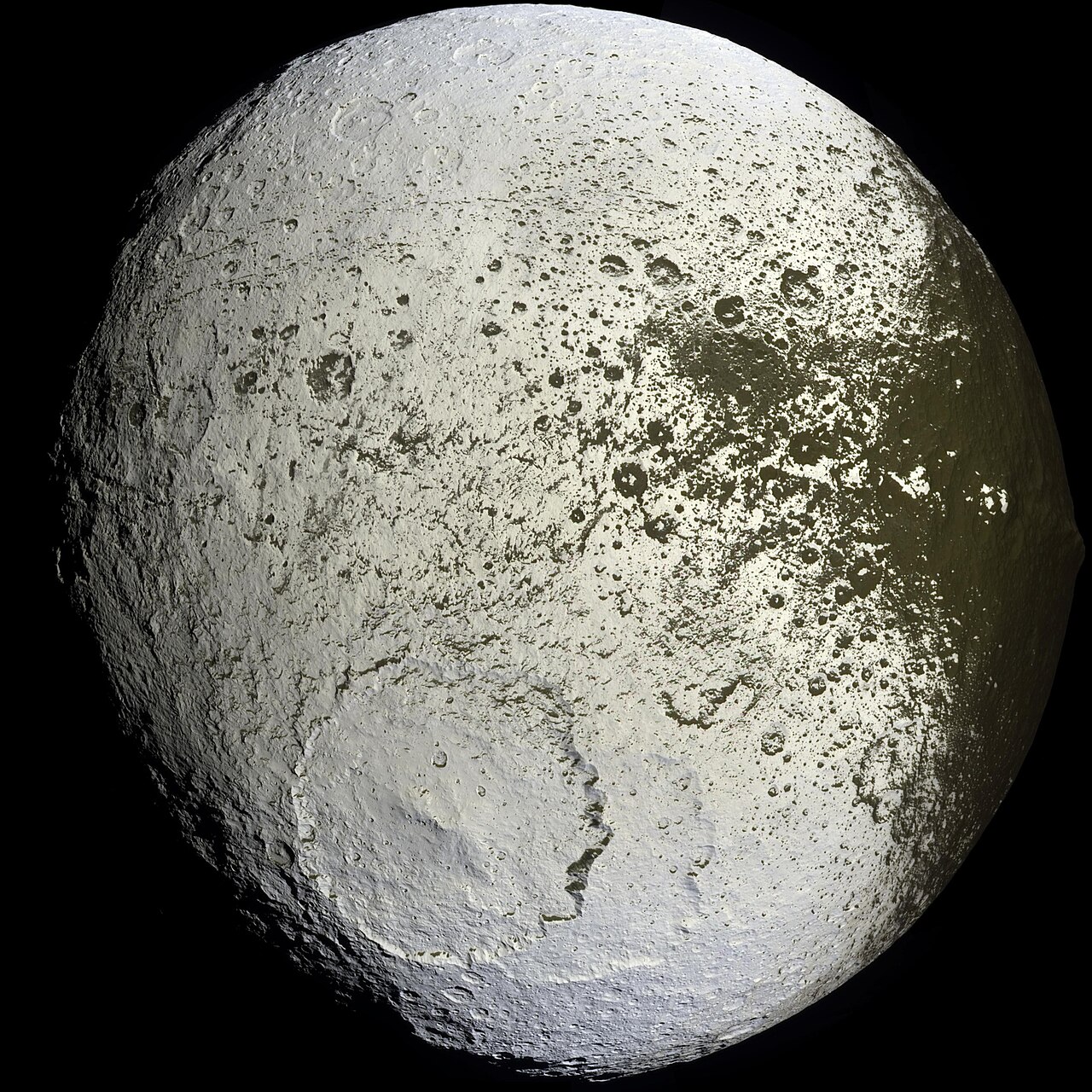
Iapetus is Saturn's third largest moon, known for having one hemisphere as dark as coal and the other much brighter, and for a ridge of mountains running around its equator.[1] It was discovered by Giovanni Cassini on 25 October 1671.[1]
Iapetus is Saturn's third largest moon, known for having one hemisphere as dark as coal and the other much brighter, and for a ridge of mountains running around its equator.[1] It was discovered by Giovanni Cassini on 25 October 1671.[1]
7 unchanged paragraphs
*Via Wikimedia Commons: [Iapetus as seen by the Cassini probe - 20071008 (cropped)](https://commons.wikimedia.org/wiki/File:Iapetus_as_seen_by_the_Cassini_probe_-_20071008_(cropped).jpg) by NASA/JPL/Space Science Institute, public domain.*
*Via Wikimedia Commons: [Iapetus as seen by the Cassini probe - 20071008 (cropped)](https://commons.wikimedia.org/wiki/File:Iapetus_as_seen_by_the_Cassini_probe_-_20071008_(cropped).jpg) by NASA/JPL/Space Science Institute, public domain.*
## Size and orbit
## Size and orbit
NASA gives Iapetus a mean radius of 736 kilometres (457 miles) and a density about 1.2 times that of liquid water, and says it has been suggested that Iapetus, like [Rhea](https://micwyn.com/t/3052/rhea), is three quarters ice and one quarter rock.[1] NASA's Saturnian Satellite Fact Sheet lists radii along three axes of 746 × 746 × 712 kilometres, a mass of 18.1 × 10²⁰ kilograms and a mean density of 1,090 kilograms per cubic metre, so the two NASA sources differ slightly on density.[2]
NASA gives Iapetus a mean radius of 736 kilometres (457 miles) and a density about 1.2 times that of liquid water, and says it has been suggested that Iapetus, like [Rhea](https://micwyn.com/t/3052/rhea), is three quarters ice and one quarter rock.[1] NASA's Saturnian Satellite Fact Sheet lists radii along three axes of 746 × 746 × 712 kilometres, a mass of 18.1 × 10²⁰ kilograms and a mean density of 1,090 kilograms per cubic metre, so the two NASA sources differ slightly on density.[2]
Iapetus orbits [Saturn](https://micwyn.com/t/3050/saturn) at about 3.56 million kilometres (2.21 million miles), much farther out than Rhea or [Titan](https://micwyn.com/t/3051/titan).[1][2] The fact sheet gives a period of 79.33 days, an inclination of 14.72 degrees and an eccentricity of 0.0283, with synchronous rotation.[2] NASA says Saturn has tidally locked Iapetus, so it always shows the same face to the planet. Because of its distant, inclined orbit, Iapetus is the only large moon from which there is a good view of Saturn's rings.[1] NASA also says Iapetus is in resonance with Titan, so that the two speed up and slow down as they pass each other, though Iapetus is affected far more because its diameter is less than a third of Titan's.[1]
Iapetus orbits [Saturn](https://micwyn.com/t/3050/saturn) at about 3.56 million kilometres (2.21 million miles), much farther out than Rhea or [Titan](https://micwyn.com/t/3051/titan).[1][2] The fact sheet gives a period of 79.33 days, an inclination of 14.72 degrees and an eccentricity of 0.0283, with synchronous rotation.[2] NASA says Saturn has tidally locked Iapetus, so it always shows the same face to the planet. Because of its distant, inclined orbit, Iapetus is the only large moon from which there is a good view of Saturn's rings.[1] NASA also says Iapetus is in resonance with Titan, so that the two speed up and slow down as they pass each other, though Iapetus is affected far more because its diameter is less than a third of Titan's.[1]
Its great distance from Saturn's tidal forces, from most other moons and from ring particles has probably spared its surface from melting episodes that smoothed some moons closer to Saturn.[1]
Its great distance from Saturn's tidal forces, from most other moons and from ring particles has probably spared its surface from melting episodes that smoothed some moons closer to Saturn.[1]
## Two-toned surface
## Two-toned surface
NASA calls Iapetus the "yin and yang" of Saturn's moons. Its leading hemisphere has an albedo of 0.03 to 0.05 with a slight reddish tinge, as dark as coal, and its trailing hemisphere is much brighter at 0.5 to 0.6.[1] The fact sheet lists albedos of 0.05 and 0.5 for the two sides.[2] To astronomers Iapetus appeared only as a dot that brightened and faded over its orbit, and NASA says Cassini noted in 1671 that he could see it only on the west side of Saturn and correctly concluded that one side was much darker than the other and that the moon was locked to Saturn. The Voyager 1 and 2 encounters in 1980 and 1981 confirmed this with images of the two hemispheres.[1]
NASA calls Iapetus the "yin and yang" of Saturn's moons. Its leading hemisphere has an albedo of 0.03 to 0.05 with a slight reddish tinge, as dark as coal, and its trailing hemisphere is much brighter at 0.5 to 0.6.[1] The fact sheet lists albedos of 0.05 and 0.5 for the two sides.[2] To astronomers Iapetus appeared only as a dot that brightened and faded over its orbit, and NASA says Cassini noted in 1671 that he could see it only on the west side of Saturn and correctly concluded that one side was much darker than the other and that the moon was locked to Saturn. The Voyager 1 and 2 encounters in 1980 and 1981 confirmed this with images of the two hemispheres.[1]
4 unchanged paragraphs
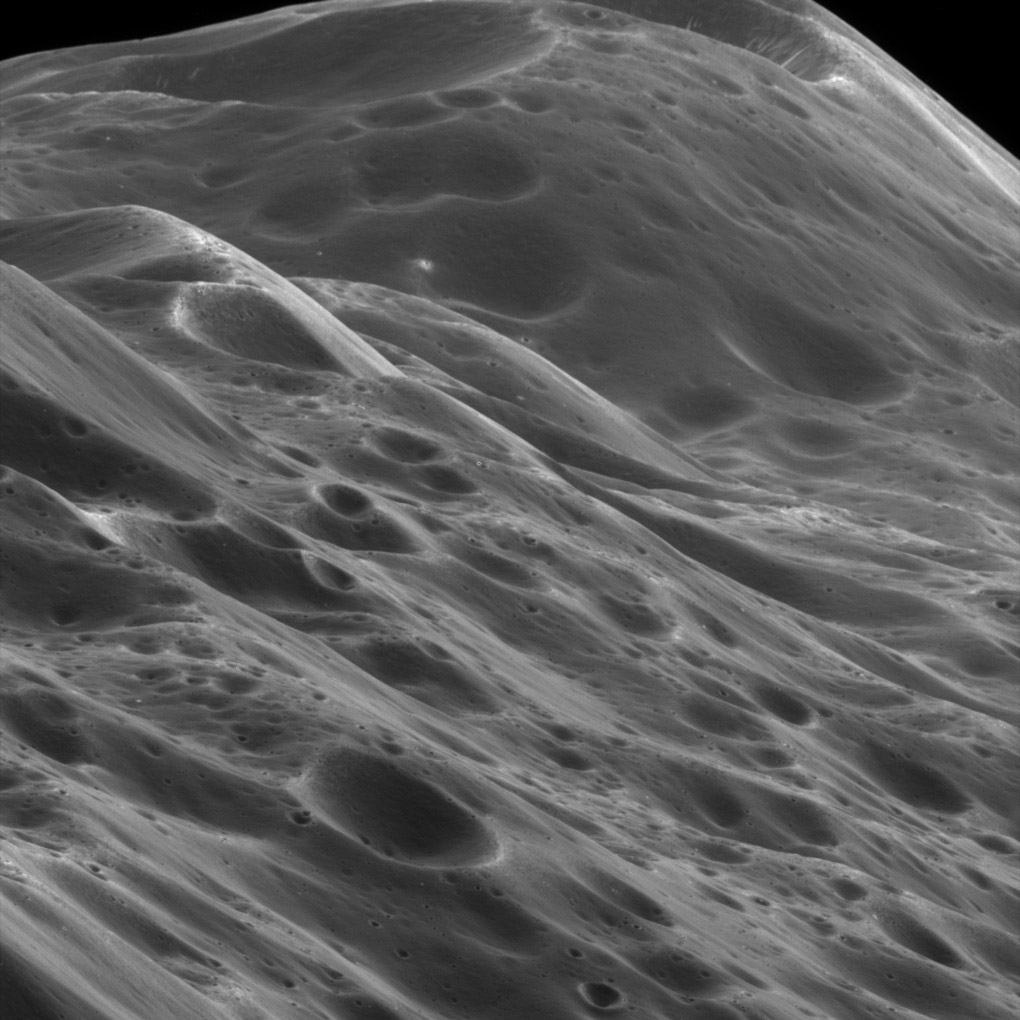
*Via Wikimedia Commons: [Iapetus mountains Larger](https://commons.wikimedia.org/wiki/File:Iapetus_mountains_Larger.jpg) by NASA/JPL/Space Science Institute, public domain.*
*Via Wikimedia Commons: [Iapetus mountains Larger](https://commons.wikimedia.org/wiki/File:Iapetus_mountains_Larger.jpg) by NASA/JPL/Space Science Institute, public domain.*
NASA lists three explanations for the dark hemisphere. One is that Iapetus sweeps up dark particles from the more distant moon Phoebe; NASA says that if so, the dark surface should be steadily renewed, since few fresh bright craters are seen in the dark terrain. Another is ice volcanism that brought dark material to the surface, possibly hydrocarbons darkened by chemical reactions caused by sunlight.[1] A third is thermal segregation: NASA says the September 2007 Cassini flyby showed it to be probably the process most responsible. Iapetus rotates very slowly, more than 79 days per turn, so its daily temperature cycle is very long. The dark material absorbs more heat, which makes its icy components sublime and migrate to colder regions, leaving the dark material darker and the nearby bright, cold regions brighter. NASA adds that a small influx of dark material from an external source may have started this process.[1]
NASA lists three explanations for the dark hemisphere. One is that Iapetus sweeps up dark particles from the more distant moon Phoebe; NASA says that if so, the dark surface should be steadily renewed, since few fresh bright craters are seen in the dark terrain. Another is ice volcanism that brought dark material to the surface, possibly hydrocarbons darkened by chemical reactions caused by sunlight.[1] A third is thermal segregation: NASA says the September 2007 Cassini flyby showed it to be probably the process most responsible. Iapetus rotates very slowly, more than 79 days per turn, so its daily temperature cycle is very long. The dark material absorbs more heat, which makes its icy components sublime and migrate to colder regions, leaving the dark material darker and the nearby bright, cold regions brighter. NASA adds that a small influx of dark material from an external source may have started this process.[1]
## The equatorial ridge
## The equatorial ridge
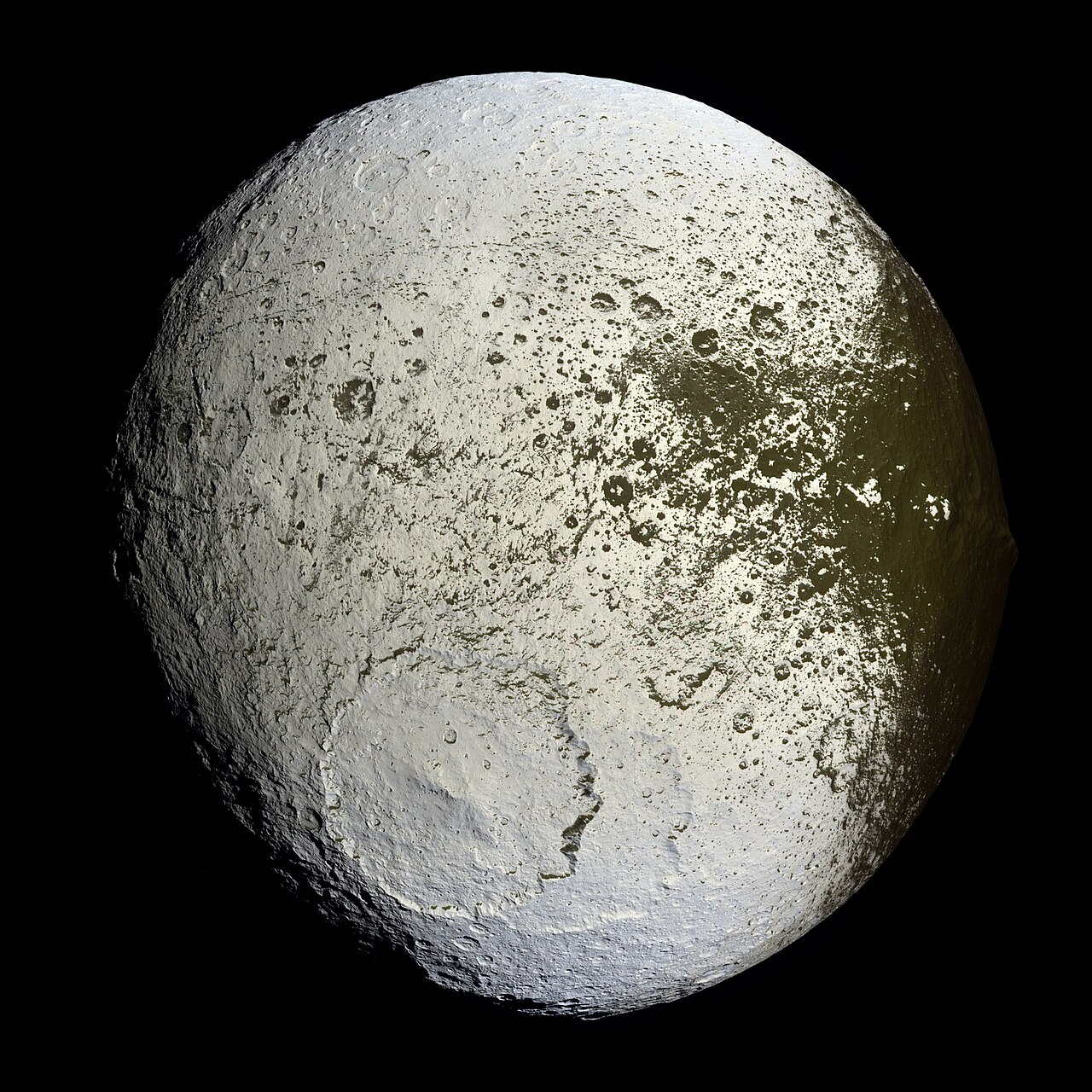
The second most notable feature, according to NASA, is an "equatorial ridge", a chain of mountains about 10 kilometres (6 miles) high around the moon's equator. On the side away from Saturn the ridge breaks up into distinct, partly bright mountains first seen by the Voyager spacecraft and informally called the Voyager Mountains.[1] NASA gives two ideas for the ridge: that it formed when Iapetus rotated much faster than it does now, or that it consists of material left from the collapse of a ring.[1]
The second most notable feature, according to NASA, is an "equatorial ridge", a chain of mountains about 10 kilometres (6 miles) high around the moon's equator. On the side away from Saturn the ridge breaks up into distinct, partly bright mountains first seen by the Voyager spacecraft and informally called the Voyager Mountains.[1] NASA gives two ideas for the ridge: that it formed when Iapetus rotated much faster than it does now, or that it consists of material left from the collapse of a ring.[1]
6 unchanged paragraphs
*Via Wikimedia Commons: [Iapetus as seen by the Cassini probe - 20071008](https://commons.wikimedia.org/wiki/File:Iapetus_as_seen_by_the_Cassini_probe_-_20071008.jpg) by NASA / JPL / Space Science Institute, public domain.*
*Via Wikimedia Commons: [Iapetus as seen by the Cassini probe - 20071008](https://commons.wikimedia.org/wiki/File:Iapetus_as_seen_by_the_Cassini_probe_-_20071008.jpg) by NASA / JPL / Space Science Institute, public domain.*
## Discovery and name
## Discovery and name
Cassini discovered Iapetus on 25 October 1671, and NASA's moons list gives 1671 for the discovery.[1][3] John Herschel suggested naming Saturn's moons for the brothers and sisters of Kronos, the Greek equivalent of Saturn. Iapetus was a Titan, a son of Uranus and Gaia, brother of Kronos and father of Atlas and Prometheus, and NASA says the ancient Greeks regarded him as the father of the human race because of Prometheus.[1]
Cassini discovered Iapetus on 25 October 1671, and NASA's moons list gives 1671 for the discovery.[1][3] John Herschel suggested naming Saturn's moons for the brothers and sisters of Kronos, the Greek equivalent of Saturn. Iapetus was a Titan, a son of Uranus and Gaia, brother of Kronos and father of Atlas and Prometheus, and NASA says the ancient Greeks regarded him as the father of the human race because of Prometheus.[1]
Cassini called Iapetus one of the four Sidera Lodoicea, the Stars of Louis, after King Louis XIV, together with Tethys, Dione and Rhea. It was first numbered Saturn V and became Saturn VIII after more moons were found. Features on Iapetus generally take their names from the French epic poem "The Song of Roland".[1]
Cassini called Iapetus one of the four Sidera Lodoicea, the Stars of Louis, after King Louis XIV, together with Tethys, Dione and Rhea. It was first numbered Saturn V and became Saturn VIII after more moons were found. Features on Iapetus generally take their names from the French epic poem "The Song of Roland".[1]
## Sources
## Sources
1. NASA Science. "Iapetus." https://science.nasa.gov/saturn/moons/iapetus/ (read 22 November 2026)
2. NASA NSSDCA. "Saturnian Satellite Fact Sheet." https://nssdc.gsfc.nasa.gov/planetary/factsheet/saturniansatfact.html (read 22 November 2026)
3. NASA Science. "Saturn Moons." https://science.nasa.gov/saturn/moons/ (read 22 November 2026)
