Compare versions
Version 1 → Version 2 (current). Removed · Added. This shows the entry's text as it is written, including its formatting marks.
Version 1 · Version 2 (current) · Version history
Side by side · Together
Version 1Version 2 (current)
Dione is a mid-sized moon of Saturn, about 562 kilometres in mean radius, an icy world with a dense core that orbits Saturn about as far out as the Moon orbits Earth.[1] It was discovered by Giovanni Cassini on 21 March 1684.[1]
Dione is a mid-sized moon of Saturn, about 562 kilometres in mean radius, an icy world with a dense core that orbits Saturn about as far out as the Moon orbits Earth.[1] It was discovered by Giovanni Cassini on 21 March 1684.[1]

11 unchanged paragraphs
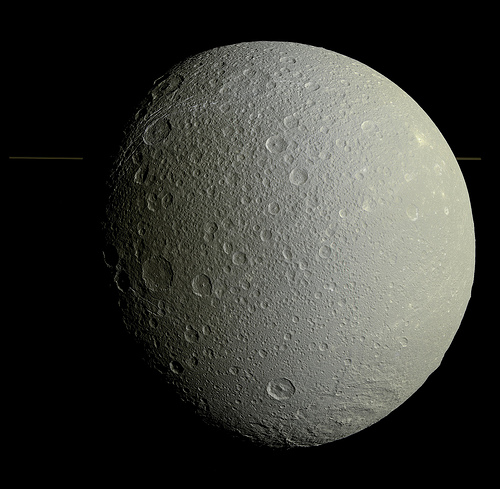
*Via Wikimedia Commons: [Saturn's moon Dione by Cassini in color](https://commons.wikimedia.org/wiki/File:Saturn%27s_moon_Dione_by_Cassini_in_color.jpg) by US Government, public domain.*
*Via Wikimedia Commons: [Saturn's moon Dione by Cassini in color](https://commons.wikimedia.org/wiki/File:Saturn%27s_moon_Dione_by_Cassini_in_color.jpg) by US Government, public domain.*
## Size and orbit
## Size and orbit
NASA gives Dione a mean radius of 349 miles (562 kilometres) and an orbit of 2.7 days at a distance of 377,400 kilometres from [Saturn](https://micwyn.com/t/3050/saturn), which NASA notes is roughly the distance at which the Moon orbits Earth.[1] NASA's Saturnian Satellite Fact Sheet lists radii along three axes of 563 × 561 × 560 kilometres, a mass of 11.0 × 10²⁰ kilograms, a mean density of 1,480 kilograms per cubic metre and an albedo of 0.7.[2] It gives a semi-major axis of 377.40 thousand kilometres, a period of 2.7369 days, an inclination of 0.02 degrees and an eccentricity of 0.0022, with synchronous rotation.[2]
NASA gives Dione a mean radius of 349 miles (562 kilometres) and an orbit of 2.7 days at a distance of 377,400 kilometres from [Saturn](https://micwyn.com/t/3050/saturn), which NASA notes is roughly the distance at which the Moon orbits Earth.[1] NASA's Saturnian Satellite Fact Sheet lists radii along three axes of 563 × 561 × 560 kilometres, a mass of 11.0 × 10²⁰ kilograms, a mean density of 1,480 kilograms per cubic metre and an albedo of 0.7.[2] It gives a semi-major axis of 377.40 thousand kilometres, a period of 2.7369 days, an inclination of 0.02 degrees and an eccentricity of 0.0022, with synchronous rotation.[2]
Dione's density, 1.48 times that of liquid water, suggests to NASA that about a third of the moon is a dense core, probably silicate rock, with the rest ice. At its average temperature of about −186 °C ice is very hard and behaves like rock.[1] Dione is tidally locked, so one side always faces Saturn.[1]
Dione's density, 1.48 times that of liquid water, suggests to NASA that about a third of the moon is a dense core, probably silicate rock, with the rest ice. At its average temperature of about −186 °C ice is very hard and behaves like rock.[1] Dione is tidally locked, so one side always faces Saturn.[1]
## Surface
## Surface
NASA describes heavily cratered terrain, with craters as large as 100 kilometres across, as well as moderately cratered plains, lightly cratered plains and fractured areas. The most heavily cratered areas are on the trailing hemisphere, which is the reverse of what would be expected, since a moon's leading hemisphere should collect more impacts. NASA says it has been theorized that a more recent impact spun Dione around, and that bodies as small as those that made 35-kilometre craters could have done it, but that the fact that Dione seems to have turned by exactly 180 degrees is a mystery.[1]
NASA describes heavily cratered terrain, with craters as large as 100 kilometres across, as well as moderately cratered plains, lightly cratered plains and fractured areas. The most heavily cratered areas are on the trailing hemisphere, which is the reverse of what would be expected, since a moon's leading hemisphere should collect more impacts. NASA says it has been theorized that a more recent impact spun Dione around, and that bodies as small as those that made 35-kilometre craters could have done it, but that the fact that Dione seems to have turned by exactly 180 degrees is a mystery.[1]
The fractured areas appeared in Voyager images as bright, thin, wispy lines tens to hundreds of miles long that often cut across plains and craters. Cassini flybys starting in 2005 showed the "wisps" to be bright canyon walls of ice, some several hundred metres high, probably caused by subsidence cracking. The walls are bright because darker material falls off them and exposes fresh water ice. NASA says these cliffs suggest Dione had tectonic activity in the past and could be a mature phase of the "tiger stripes" on Enceladus.[1] See [Rhea](https://micwyn.com/t/3052/rhea), which NASA says has similar features.
The fractured areas appeared in Voyager images as bright, thin, wispy lines tens to hundreds of miles long that often cut across plains and craters. Cassini flybys starting in 2005 showed the "wisps" to be bright canyon walls of ice, some several hundred metres high, probably caused by subsidence cracking. The walls are bright because darker material falls off them and exposes fresh water ice. NASA says these cliffs suggest Dione had tectonic activity in the past and could be a mature phase of the "tiger stripes" on Enceladus.[1] See [Rhea](https://micwyn.com/t/3052/rhea), which NASA says has similar features.
NASA adds that very fine ice powder from Saturn's E ring constantly bombards Dione, and that the dust in the E ring ultimately comes from Enceladus, which has prominent geyser activity.[1]
NASA adds that very fine ice powder from Saturn's E ring constantly bombards Dione, and that the dust in the E ring ultimately comes from Enceladus, which has prominent geyser activity.[1]
## Companions and resonances
## Companions and resonances
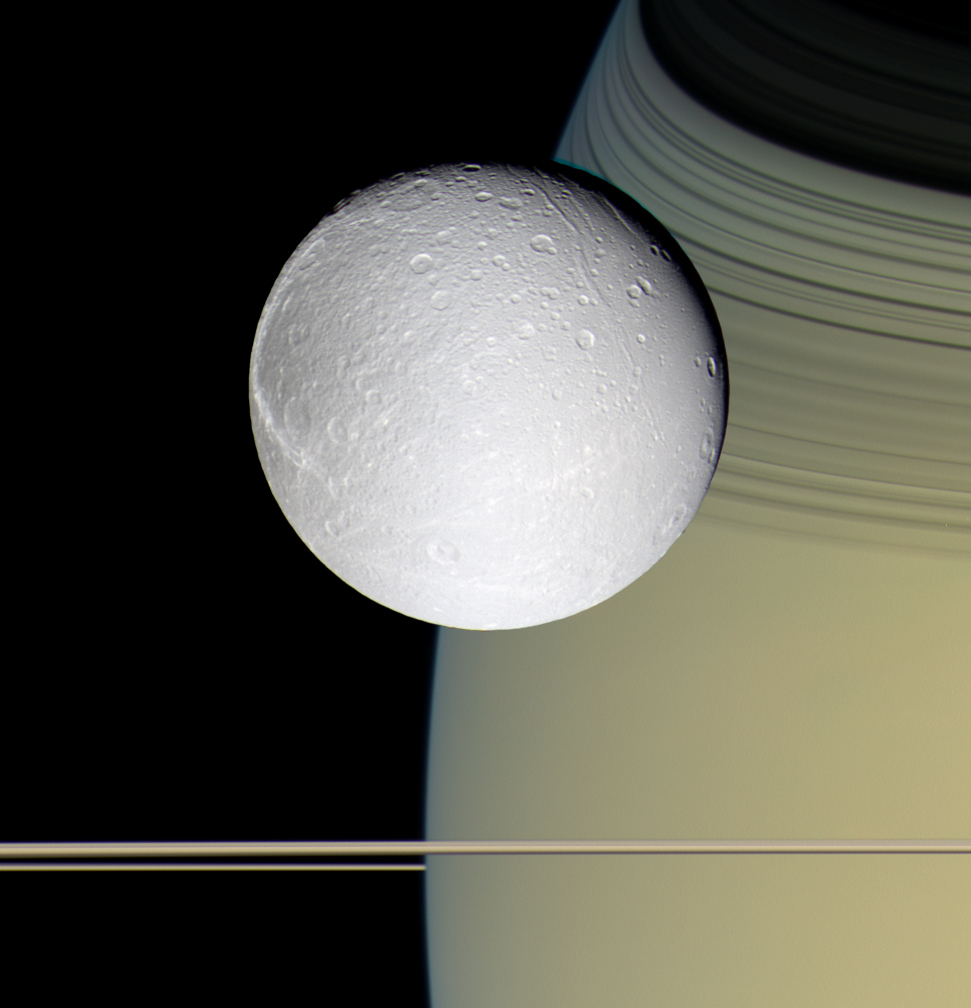
NASA says Dione has gravitationally locked two much smaller moons at the points 60 degrees ahead of and behind it in its orbit: Helene leads Dione by 60 degrees and Polydeuces trails it by 60 degrees. These positions are also called the Lagrangian points L4 and L5, after calculations made by the French astronomer Joseph-Louis Lagrange in 1772.[1]
NASA says Dione has gravitationally locked two much smaller moons at the points 60 degrees ahead of and behind it in its orbit: Helene leads Dione by 60 degrees and Polydeuces trails it by 60 degrees. These positions are also called the Lagrangian points L4 and L5, after calculations made by the French astronomer Joseph-Louis Lagrange in 1772.[1]
Dione is also in resonance with two nearby moons, Mimas and Enceladus, which speed up slightly as they approach one another and slow down as they draw apart. NASA says Dione keeps Enceladus locked at a period exactly half its own.[1]
Dione is also in resonance with two nearby moons, Mimas and Enceladus, which speed up slightly as they approach one another and slow down as they draw apart. NASA says Dione keeps Enceladus locked at a period exactly half its own.[1]
6 unchanged paragraphs
*Via Wikimedia Commons: [Dione and Saturn](https://commons.wikimedia.org/wiki/File:Dione_and_Saturn.jpg) by NASA / Jet Propulsion Laboratory / Space Science Institute, public domain.*
*Via Wikimedia Commons: [Dione and Saturn](https://commons.wikimedia.org/wiki/File:Dione_and_Saturn.jpg) by NASA / Jet Propulsion Laboratory / Space Science Institute, public domain.*
## Discovery and name
## Discovery and name
Giovanni Cassini discovered Dione on 21 March 1684.[1] Cassini referred to Dione as one of the four Sidera Lodoicea, the Stars of Louis, after King Louis XIV, together with Iapetus, Tethys and Rhea. Other astronomers numbered the moons by distance from Saturn, so Dione was Saturn IV. John Herschel suggested naming Saturn's moons for the brothers and sisters of Kronos, the Greek equivalent of Saturn. Features on Dione generally take their names from Virgil's "Aeneid".[1]
Giovanni Cassini discovered Dione on 21 March 1684.[1] Cassini referred to Dione as one of the four Sidera Lodoicea, the Stars of Louis, after King Louis XIV, together with Iapetus, Tethys and Rhea. Other astronomers numbered the moons by distance from Saturn, so Dione was Saturn IV. John Herschel suggested naming Saturn's moons for the brothers and sisters of Kronos, the Greek equivalent of Saturn. Features on Dione generally take their names from Virgil's "Aeneid".[1]
Dione is named for the Greek goddess, or Titan, Dione, who by some accounts was the daughter of Tethys and Oceanus and whom Homer described as the mother of Aphrodite.[1]
Dione is named for the Greek goddess, or Titan, Dione, who by some accounts was the daughter of Tethys and Oceanus and whom Homer described as the mother of Aphrodite.[1]
## Sources
## Sources
1. NASA Science. "Dione." https://science.nasa.gov/saturn/moons/dione/ (read 22 November 2026)
2. NASA NSSDCA. "Saturnian Satellite Fact Sheet." https://nssdc.gsfc.nasa.gov/planetary/factsheet/saturniansatfact.html (read 22 November 2026)
1. NASA Science. "Dione." https://science.nasa.gov/saturn/moons/dione/ (read 22 November 2026)
2. NASA NSSDCA. "Saturnian Satellite Fact Sheet." https://nssdc.gsfc.nasa.gov/planetary/factsheet/saturniansatfact.html (read 22 November 2026)
