Compare versions
Version 1 → Version 2 (current). Removed · Added. This shows the entry's text as it is written, including its formatting marks.
Version 1 · Version 2 (current) · Version history
Side by side · Together
Enceladus is a small, icy moon of Saturn, about 500 kilometres across, that sprays water vapour and ice particles into space from fractures near its south pole.[1] NASA says the spray comes from a global subsurface ocean and that scientists have found in it most of the chemical ingredients needed for life.[1]
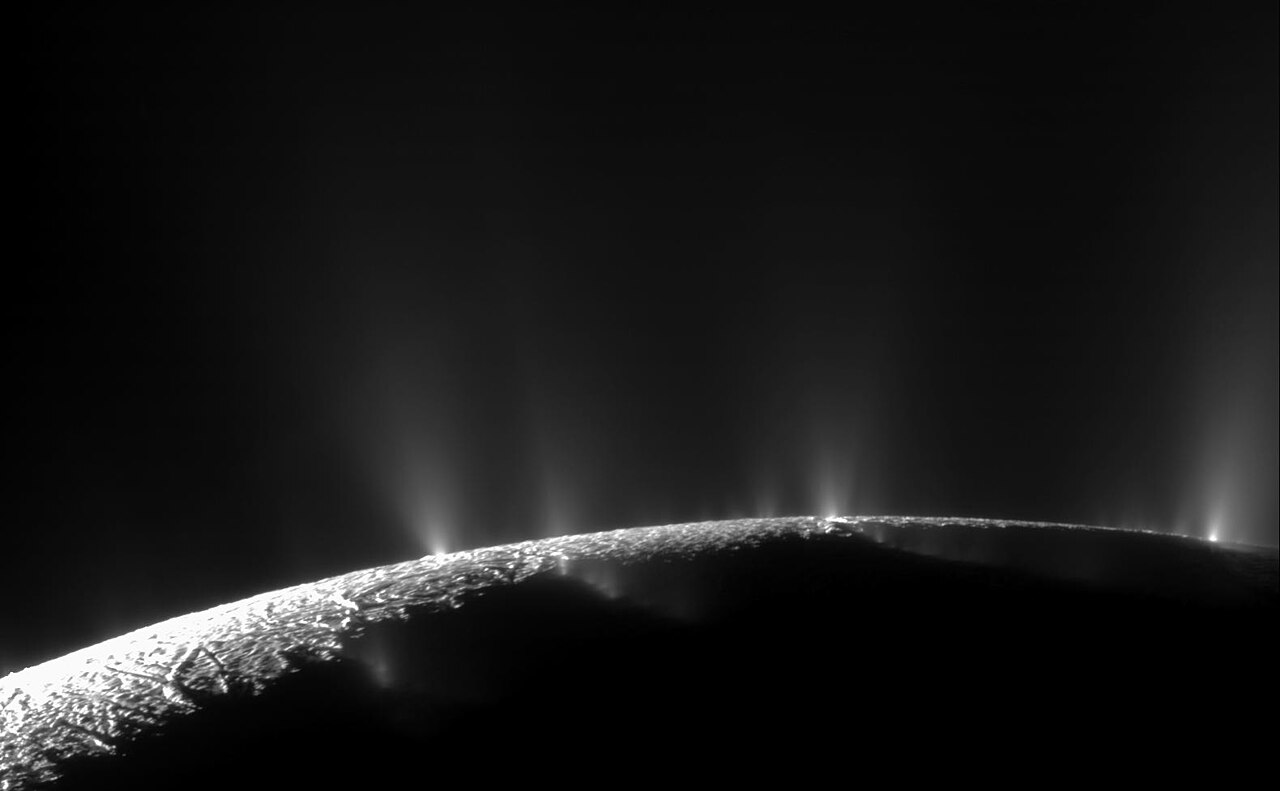Enceladus, seen against the dark sky in a black-and-white spacecraft image.](/m/2026/11/g8fv5uxCcusHVlpP.jpg)
*Via Wikimedia Commons: [Dramatic plumes, both large and small, spray water ice out from many l](https://commons.wikimedia.org/wiki/File:Dramatic_plumes,_both_large_and_small,_spray_water_ice_out_from_many_locations_along_the_famed_tiger_stripes_near_the_south_pole_of_Saturn%E2%80%99s_moon_Enceladus_in_this_image_released_on_Feb_23_(newly-found-organics-in-enceladus-plumes).jpg) by NASA/JPL-Caltech/Space Science Institute, public domain.*
## Size and orbit
NASA describes Enceladus as about as wide as Arizona, only about 500 kilometres (310 miles) across.[1] NASA's Saturnian Satellite Fact Sheet lists radii along three axes of 257 × 251 × 248 kilometres, a mass of 1.08 × 10²⁰ kilograms and a mean density of 1,610 kilograms per cubic metre.[2] It also gives a visual geometric albedo of 1.0, and NASA calls Enceladus the most reflective body in the solar system, with the whitest surface.[1][2] Because it reflects so much sunlight, its surface is extremely cold, about −201 °C.[1]
Enceladus orbits [Saturn](https://micwyn.com/t/3050/saturn) at about 238,000 kilometres (148,000 miles), between the orbits of Mimas and [Tethys](https://micwyn.com/t/3055/tethys), and completes an orbit every 32.9 hours inside the densest part of Saturn's E ring.[1] The fact sheet gives a semi-major axis of 238.02 thousand kilometres, a period of 1.3702 days (about 32.9 hours), an inclination of 0.00 degrees and an eccentricity of 0.0045, with synchronous rotation, so one face always points toward Saturn.[1][2]
NASA says Enceladus is in an orbital resonance with [Dione](https://micwyn.com/t/3054/dione): it orbits Saturn twice for every one orbit of Dione. Dione's gravity stretches Enceladus's orbit into an ellipse, so the moon is sometimes closer to and sometimes farther from Saturn, which causes tidal heating inside it.[1]
## Surface
Voyager images in the 1980s showed that although the moon is small, its icy surface is remarkably smooth in places and bright white all over, and NASA says that for decades scientists did not know why.[1] Parts of Enceladus have craters up to 35 kilometres across, while other regions have few, indicating major resurfacing in the geologically recent past. The south polar region is almost entirely free of impact craters, is littered with house-sized ice boulders and is carved by tectonic patterns unique to that region.[1]
## Geysers and the E ring
NASA says Cassini discovered in 2005 that icy water particles and gas gush from the moon's surface at about 400 metres per second (800 miles per hour). The eruptions appear continuous and create a halo of fine ice dust around Enceladus that supplies Saturn's E ring.[1] Only a small fraction of the material ends up in the ring, and most falls back as snow, which helps keep the moon bright white.[1]
The jets come from relatively warm fractures in the crust that scientists informally call the "tiger stripes". The plume's gases include water vapour, carbon dioxide, methane, perhaps a little ammonia and either carbon monoxide or nitrogen, along with salts and silica, and NASA says the density of organic materials in the plume was about 20 times what scientists expected.[1]
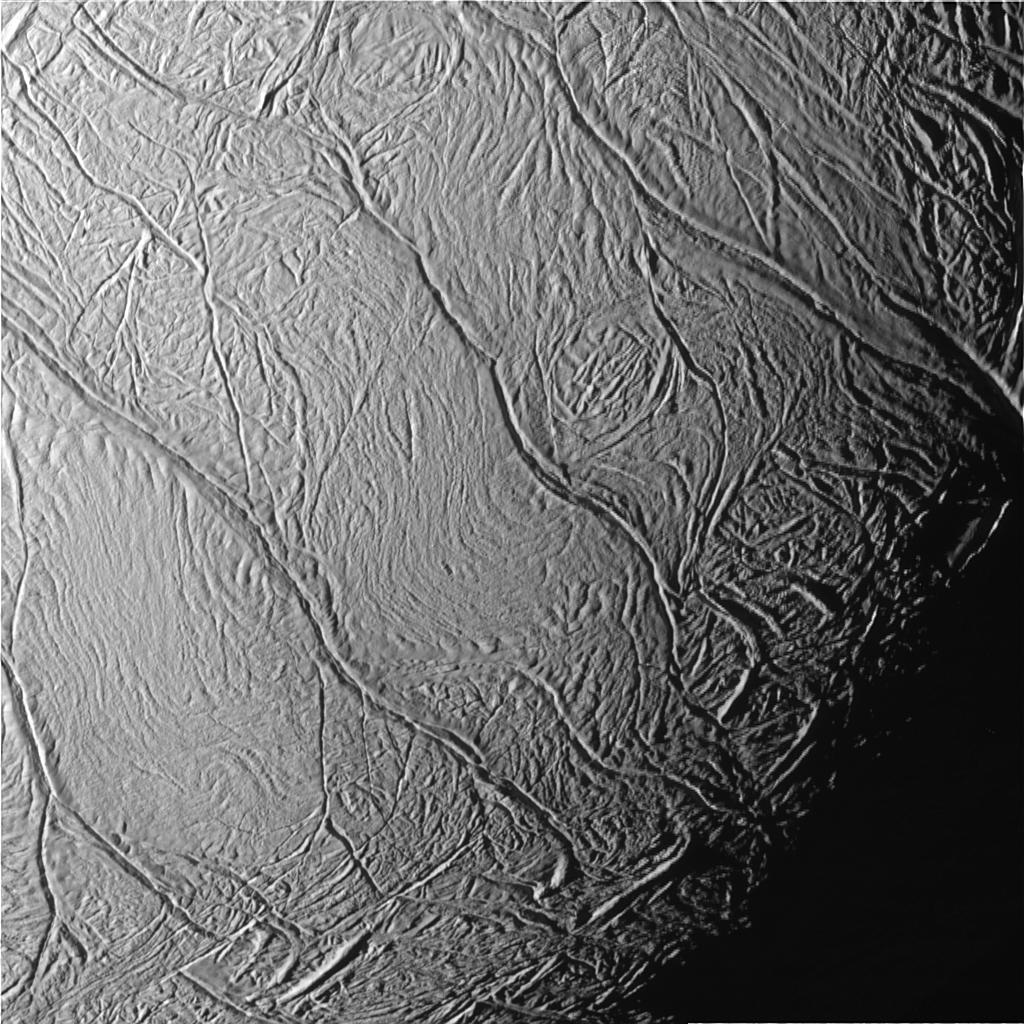and ridged icy surface on Enceladus in a black-and-white spacecraft image; the region shown is not identified here.](/m/2026/11/Zc1IA_qQJxEgSYe5.jpg)
*Via Wikimedia Commons: [Enceladus Tiger Stripes Up Close PIA06247](https://commons.wikimedia.org/wiki/File:Enceladus_Tiger_Stripes_Up_Close_PIA06247.jpg) by NASA/JPL/Space Science Institute, public domain.*
## An ocean under the ice
From gravity measurements and the size of the moon's slight wobble as it orbits, scientists determined that a global ocean inside the moon supplies the jets. NASA says the ice shell may be as thin as 1 to 5 kilometres at the south pole, with an average global thickness thought to be about 20 to 25 kilometres.[1] Because the ocean supplies the jets and the jets produce the E ring, NASA notes, studying material in the E ring is a way to study the ocean. The ring contains peculiar nanograins of silica, which NASA says can only be generated where liquid water and rock interact at temperatures above about 90 °C, evidence that points to hydrothermal vents deep beneath the ice, like those on Earth's ocean floor.[1]
## Ingredients for life
NASA reports that analysis of Enceladus's ice grains found sodium, potassium, chlorine and carbonate compounds, and that computer modelling suggests the ocean is moderately alkaline, all conditions that favour habitability.[3] In June 2023 an international team led by Frank Postberg of the Freie Universität Berlin published a study in the journal Nature that found phosphorus, the least abundant of the elements essential for life, in salt-rich ice grains from Enceladus, using data from Cassini's Cosmic Dust Analyzer. Laboratory experiments indicated that the ocean holds phosphorus, in phosphate forms, at concentrations at least 100 times those of Earth's oceans. NASA's account calls it the first time this element has been found in an ocean beyond Earth.[3]
NASA's article quotes a co-investigator, Christopher Glein, stressing that life has not been found on Enceladus or anywhere else beyond Earth. Having the ingredients is necessary but may not be sufficient, and whether life could have originated in its ocean remains an open question.[3] NASA's moon page describes Enceladus as a promising lead in the search for worlds where life could exist, with its global ocean, unique chemistry and internal heat.[1]
## Discovery and name
British astronomer William Herschel spotted Enceladus on 28 August 1789.[1] It is named for the giant Enceladus of Greek mythology. Herschel's son John Herschel suggested the name in 1847 in a publication that proposed names for the first seven Saturnian moons then known, chosen because Saturn, known in Greek mythology as Cronus, was the leader of the Titans.[1]
## Sources
1. NASA Science. "Enceladus." https://science.nasa.gov/saturn/moons/enceladus/ (read 22 November 2026)
2. NASA NSSDCA. "Saturnian Satellite Fact Sheet." https://nssdc.gsfc.nasa.gov/planetary/factsheet/saturniansatfact.html (read 22 November 2026)
3. NASA / Jet Propulsion Laboratory. "NASA Cassini Data Reveals Building Block for Life in Enceladus' Ocean." 14 June 2023. https://www.nasa.gov/solar-system/nasa-cassini-data-reveals-building-block-for-life-in-enceladus-ocean (read 22 November 2026)
