Compare versions
Version 1 → Version 2 (current). Removed · Added. This shows the entry's text as it is written, including its formatting marks.
Version 1 · Version 2 (current) · Version history
Side by side · Together
Mimas is the smallest and innermost of Saturn's major moons, a heavily cratered ball of ice about 394 kilometres across, best known for its giant Herschel Crater.[1] It was discovered on 17 September 1789 by the English astronomer William Herschel with his 40-foot reflector telescope.[1]
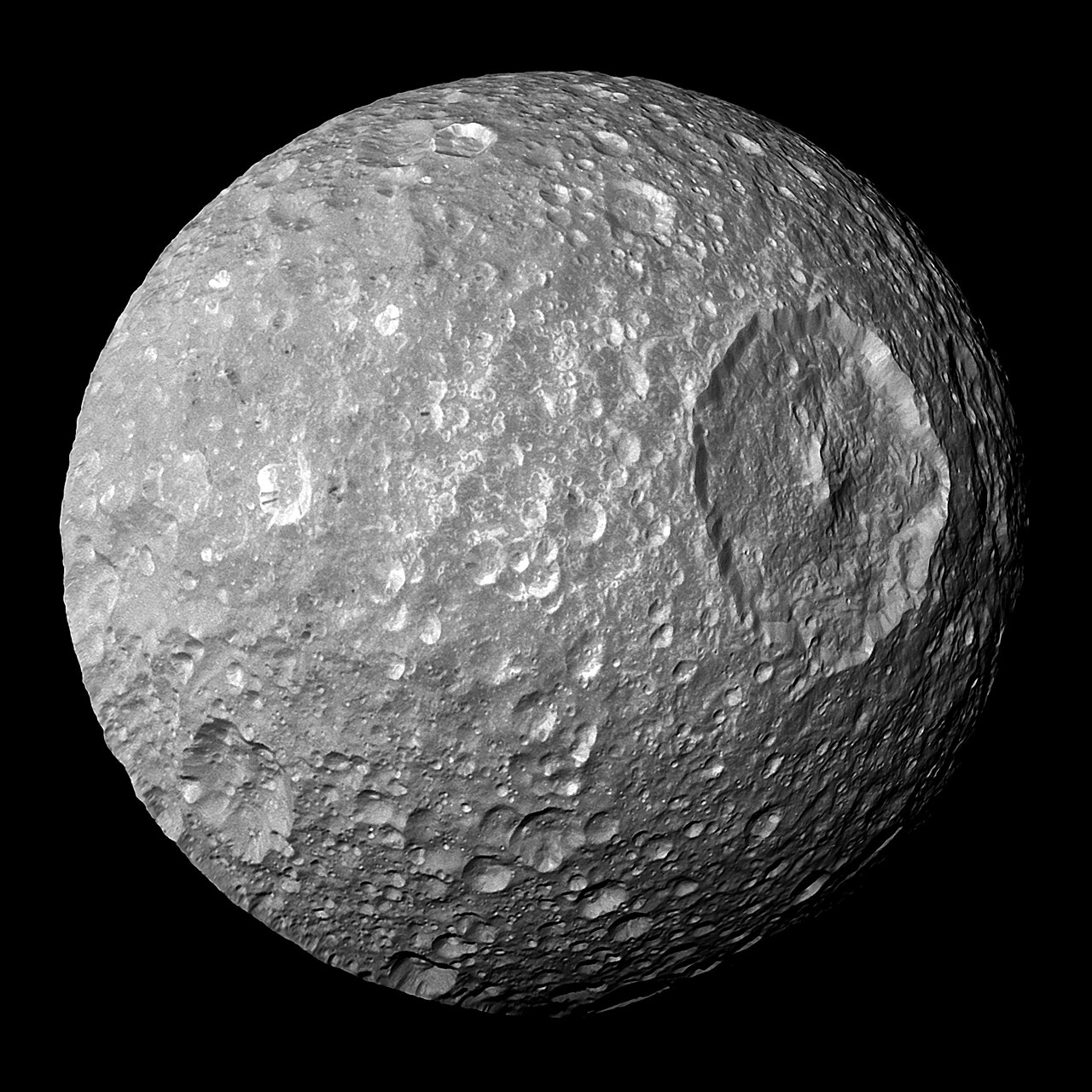Crater at right.](/m/2026/11/FW40-qrWFVGT_PzC.jpg)
*Via Wikimedia Commons: [Mimas Cassini](https://commons.wikimedia.org/wiki/File:Mimas_Cassini.jpg) by NASA / JPL-Caltech / Space Science Institute, public domain.*
## Size and orbit
NASA gives Mimas a mean diameter of about 394 kilometres (245 miles). It is not quite big enough to hold a round shape and is somewhat ovoid, with dimensions NASA lists as 207 × 197 × 191 kilometres.[1] NASA's Saturnian Satellite Fact Sheet lists radii along three axes of 208 × 197 × 191 kilometres, which matches a mean diameter near 394 kilometres only if the figures are radii, so NASA's page uses the same numbers with a different label.[1][2] The fact sheet gives a mass of 0.379 × 10²⁰ kilograms, a mean density of 1,150 kilograms per cubic metre and an albedo of 0.6.[2] NASA says the low density suggests Mimas consists almost entirely of water ice, the only substance ever detected on it.[1]
Mimas orbits [Saturn](https://micwyn.com/t/3050/saturn) at a mean distance of just over 186,000 kilometres (115,000 miles) and takes 22 hours and 36 minutes to complete an orbit.[1] The fact sheet gives a semi-major axis of 185.52 thousand kilometres, a period of 0.9424 days, an inclination of 1.53 degrees and an eccentricity of 0.0202.[2] NASA says Mimas keeps the same face toward Saturn, like the Moon with Earth.[1] A 2024 study found that Mimas's orientation also oscillates slightly, a motion called libration, discussed below.[3]
## Herschel Crater and the surface
NASA says most of the surface is saturated with impact craters, with some more than 40 kilometres across, while the craters near the south pole are generally 20 kilometres or less across, which suggests some melting or resurfacing there later than elsewhere on the moon.[1]
Mimas's most distinguishing feature is the giant crater Herschel, named for the moon's discoverer. NASA gives it as 130 kilometres across, one third of the moon's diameter, with outer walls about 5 kilometres high and a central peak about 6 kilometres high, and says it makes Mimas look like the Death Star from "Star Wars".[1] NASA says the impact probably came close to breaking the moon apart, and that shock waves from it may have caused the fractures, called chasmata, on the opposite side.[1]
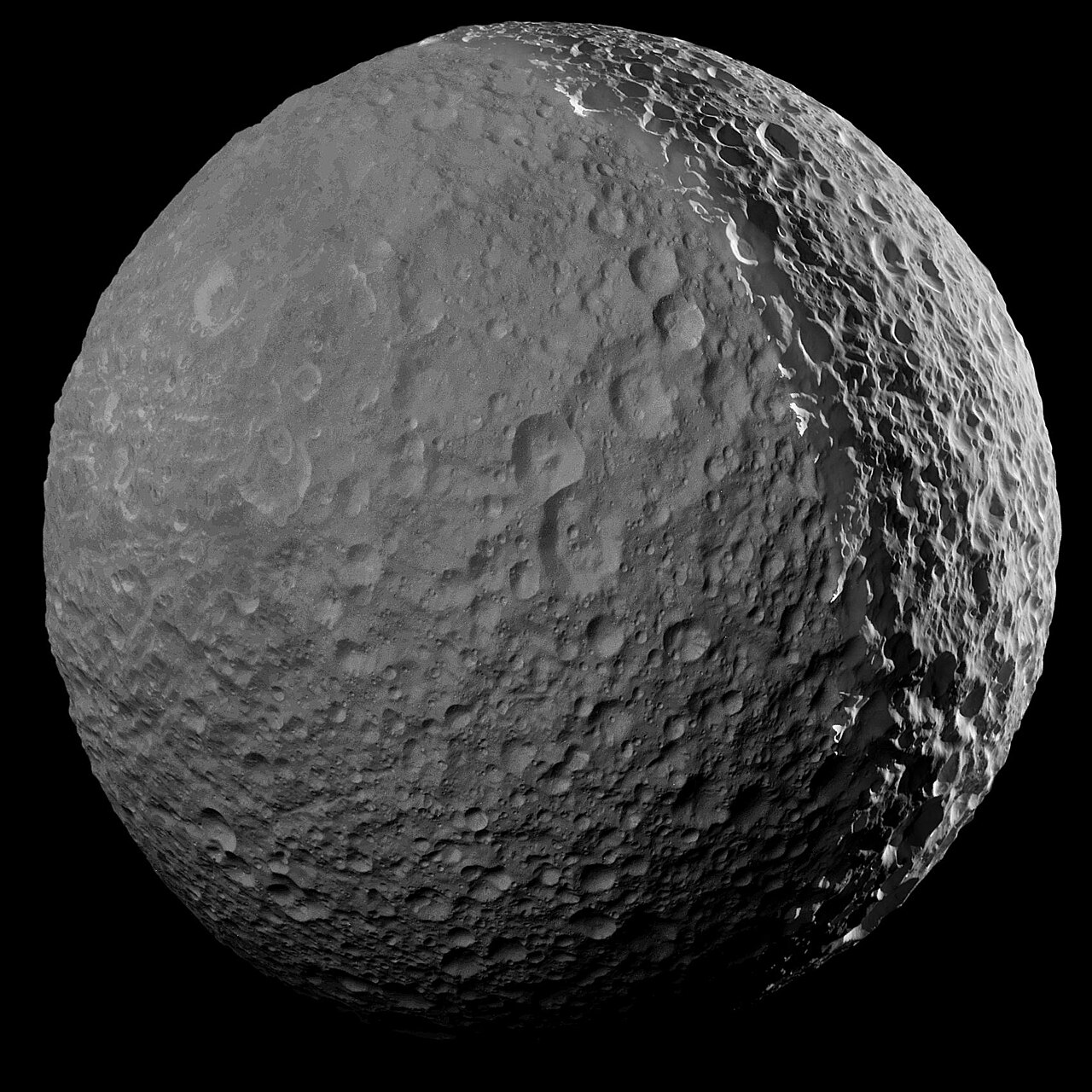Mimas in black and white, showing its densely cratered surface.](/m/2026/11/nDGuopDgOwA8UYrl.jpg)
*Via Wikimedia Commons: [Mimas final approach by Cassini](https://commons.wikimedia.org/wiki/File:Mimas_final_approach_by_Cassini.jpg) by NASA / JPL, public domain.*
## Frozen solid, or an ocean?
NASA's moon page says Mimas appears to be frozen solid, and calls this puzzling: Mimas is closer to Saturn and has a more eccentric orbit than [Enceladus](https://micwyn.com/t/3056/enceladus), which should give it more tidal heating, yet Enceladus has water geysers while Mimas has one of the most heavily cratered surfaces in the solar system. NASA says this paradox prompted the "Mimas Test", by which any theory that explains the partly thawed water of Enceladus must also explain the entirely frozen water of Mimas.[1]
A 2024 study changed that picture. Reported by the Observatoire de Paris and by the American Geophysical Union's news service Eos, a team led by Valéry Lainey of the Observatoire de Paris reanalysed Cassini data, with Hubble data added, and published in the journal Nature on 8 February 2024 that tiny features of Mimas's orbit can be explained only if the moon has a global ocean of liquid water beneath its ice.[3][4] Combined with direct libration measurements, the team estimated the ice shell at 20 to 30 kilometres thick, comparable to Enceladus's.[3][4] The team's modelling dated the ocean's origin to only 5 to 15 million years ago, which they say explains why the surface shows no sign of activity, and the same team had first suggested an ocean in 2014.[3] An outside researcher quoted by Eos had expected the frozen model to be correct, and Eos describes the result as likely, not proven.[4] This entry therefore gives the 2024 study's conclusion and does not claim the matter is closed; NASA's moon page, as read on 22 November 2026, still describes Mimas as frozen solid.
## Discovery and name
Herschel discovered Mimas on 17 September 1789.[1] Ground-based astronomers could see it as little more than a dot until the Voyager 1 and 2 spacecraft imaged it in 1980, and the Cassini spacecraft later made several close approaches and returned detailed images.[1]
The mythological Mimas was a giant killed by Mars in the war between the Titans and the gods of Olympus. John Herschel, son of the discoverer, named the moon and explained his choice of names for the first seven of Saturn's moons by writing, "As Saturn devoured his children, his family could not be assembled round him, so that the choice lay among his brothers and sisters, the Titans and Titanesses."[1] Astronomers also call Mimas Saturn I, because it is the closest of the major moons to Saturn.[1]
## Sources
1. NASA Science. "Mimas." https://science.nasa.gov/saturn/moons/mimas/ (read 22 November 2026)
2. NASA NSSDCA. "Saturnian Satellite Fact Sheet." https://nssdc.gsfc.nasa.gov/planetary/factsheet/saturniansatfact.html (read 22 November 2026)
3. Observatoire de Paris – PSL. "Presence of a 'young' ocean under the Mimas ice sheet." 7 February 2024. https://observatoiredeparis.psl.eu/presence-of-a-young-ocean.html?lang=en (read 22 November 2026)
4. Cartier, Kimberly M. S. "That's No Moon; It's an Ocean World." Eos, 7 February 2024. https://eos.org/articles/thats-no-moon-its-an-ocean-world (read 22 November 2026)
