Compare versions
Version 1 → Version 2 (current). Removed · Added. This shows the entry's text as it is written, including its formatting marks.
Version 1 · Version 2 (current) · Version history
Side by side · Together
Version 1Version 2 (current)
Phoebe is a dark, roughly spherical moon of Saturn, about 106 kilometres in mean radius, that orbits the planet backwards at a great distance and is thought to be a captured object from the outer solar system.[1] It was discovered in August 1898 by the American astronomer William Pickering.[1]
Phoebe is a dark, roughly spherical moon of Saturn, about 106 kilometres in mean radius, that orbits the planet backwards at a great distance and is thought to be a captured object from the outer solar system.[1] It was discovered in August 1898 by the American astronomer William Pickering.[1]
7 unchanged paragraphs
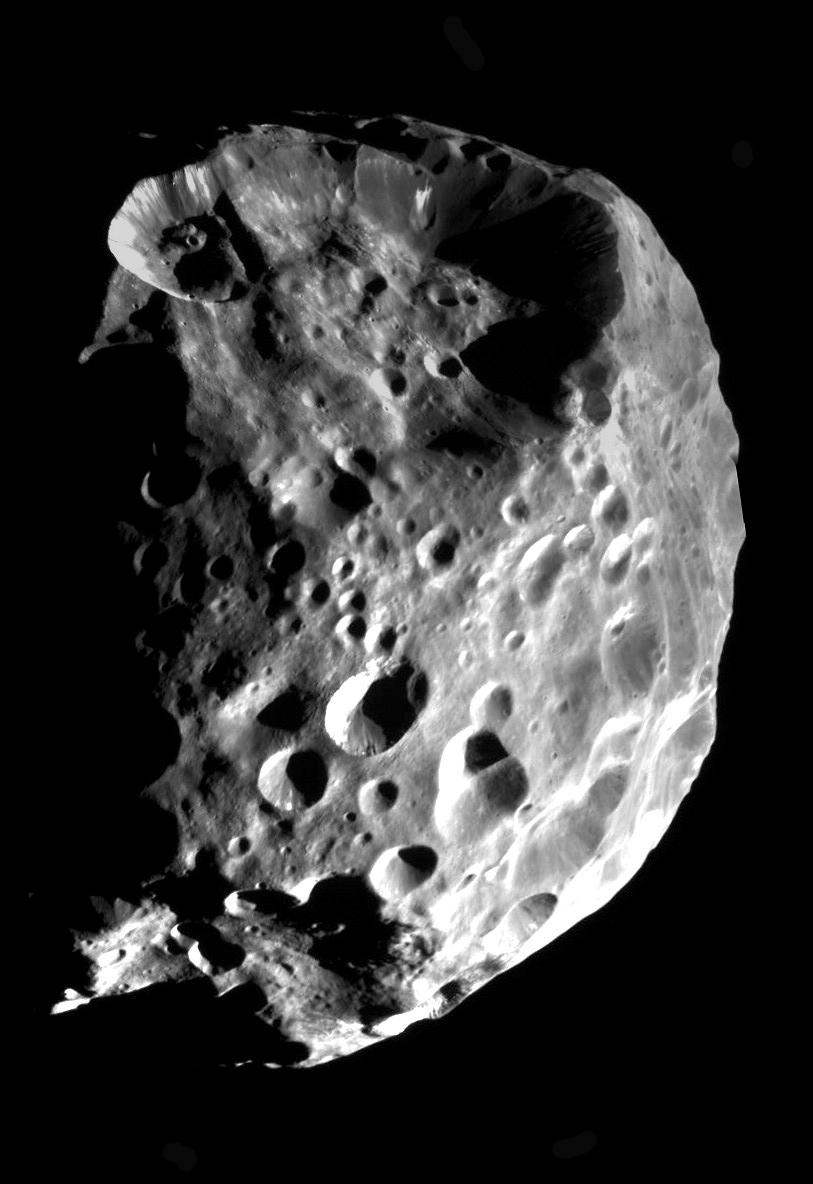
*Via Wikimedia Commons: [Phoebe cassini](https://commons.wikimedia.org/wiki/File:Phoebe_cassini.jpg) by NASA/JPL/Space Science Institute, public domain.*
*Via Wikimedia Commons: [Phoebe cassini](https://commons.wikimedia.org/wiki/File:Phoebe_cassini.jpg) by NASA/JPL/Space Science Institute, public domain.*
## Size and orbit
## Size and orbit
NASA gives Phoebe a mean radius of about 106.5 kilometres (66.2 miles), roughly one-sixteenth the radius of Earth's Moon, and calls it roughly spherical.[1] NASA's Saturnian Satellite Fact Sheet lists radii along three axes of 109 × 109 × 102 kilometres, a mass of 0.083 × 10²⁰ kilograms, a mean density of 1,640 kilograms per cubic metre and an albedo of 0.08.[2]
NASA gives Phoebe a mean radius of about 106.5 kilometres (66.2 miles), roughly one-sixteenth the radius of Earth's Moon, and calls it roughly spherical.[1] NASA's Saturnian Satellite Fact Sheet lists radii along three axes of 109 × 109 × 102 kilometres, a mass of 0.083 × 10²⁰ kilograms, a mean density of 1,640 kilograms per cubic metre and an albedo of 0.08.[2]
Phoebe orbits [Saturn](https://micwyn.com/t/3050/saturn) at about 12.95 million kilometres (8 million miles), almost four times as far as its nearest neighbour among the major moons, [Iapetus](https://micwyn.com/t/3053/iapetus).[1] The fact sheet gives a semi-major axis of 12,944 thousand kilometres, a retrograde period of 548 days, an inclination of 174.8 degrees and an eccentricity of 0.164.[2] NASA says Phoebe rotates every nine hours and completes an orbit in about 18 Earth months, on an irregular, elliptical, retrograde orbit inclined about 175 degrees to Saturn's equator, so it goes around Saturn in the opposite direction from most other moons and most objects in the solar system.[1] NASA says Phoebe and Iapetus are the only major Saturnian moons that do not orbit close to the plane of Saturn's equator.[1]
Phoebe orbits [Saturn](https://micwyn.com/t/3050/saturn) at about 12.95 million kilometres (8 million miles), almost four times as far as its nearest neighbour among the major moons, [Iapetus](https://micwyn.com/t/3053/iapetus).[1] The fact sheet gives a semi-major axis of 12,944 thousand kilometres, a retrograde period of 548 days, an inclination of 174.8 degrees and an eccentricity of 0.164.[2] NASA says Phoebe rotates every nine hours and completes an orbit in about 18 Earth months, on an irregular, elliptical, retrograde orbit inclined about 175 degrees to Saturn's equator, so it goes around Saturn in the opposite direction from most other moons and most objects in the solar system.[1] NASA says Phoebe and Iapetus are the only major Saturnian moons that do not orbit close to the plane of Saturn's equator.[1]
## A captured object
## A captured object
NASA says Phoebe is very dark, reflecting only about 6 percent of the sunlight it receives, whereas the fact sheet gives an albedo of 0.08, so the two NASA sources differ slightly.[1][2] NASA says its darkness and its irregular, retrograde orbit suggest Phoebe is most likely a captured object, a body trapped by the gravity of a much larger one, and that the darkness in particular suggests it comes from the outer solar system, where there is plenty of dark material.[1]
NASA says Phoebe is very dark, reflecting only about 6 percent of the sunlight it receives, whereas the fact sheet gives an albedo of 0.08, so the two NASA sources differ slightly.[1][2] NASA says its darkness and its irregular, retrograde orbit suggest Phoebe is most likely a captured object, a body trapped by the gravity of a much larger one, and that the darkness in particular suggests it comes from the outer solar system, where there is plenty of dark material.[1]
Some scientists think Phoebe could be a captured Centaur. NASA describes Centaurs as small bodies found between the asteroid belt and the Kuiper Belt, thought to be Kuiper Belt objects that migrated inward and considered a kind of intermediate type, neither an asteroid nor a Kuiper Belt object.[1] NASA says Centaurs are believed to be primordial, dating from the formation of the solar system, and that because Phoebe is small it might never have heated enough to change its chemical composition, which raises the scientific value of studying it.[1]
Some scientists think Phoebe could be a captured Centaur. NASA describes Centaurs as small bodies found between the asteroid belt and the Kuiper Belt, thought to be Kuiper Belt objects that migrated inward and considered a kind of intermediate type, neither an asteroid nor a Kuiper Belt object.[1] NASA says Centaurs are believed to be primordial, dating from the formation of the solar system, and that because Phoebe is small it might never have heated enough to change its chemical composition, which raises the scientific value of studying it.[1]
9 unchanged paragraphs
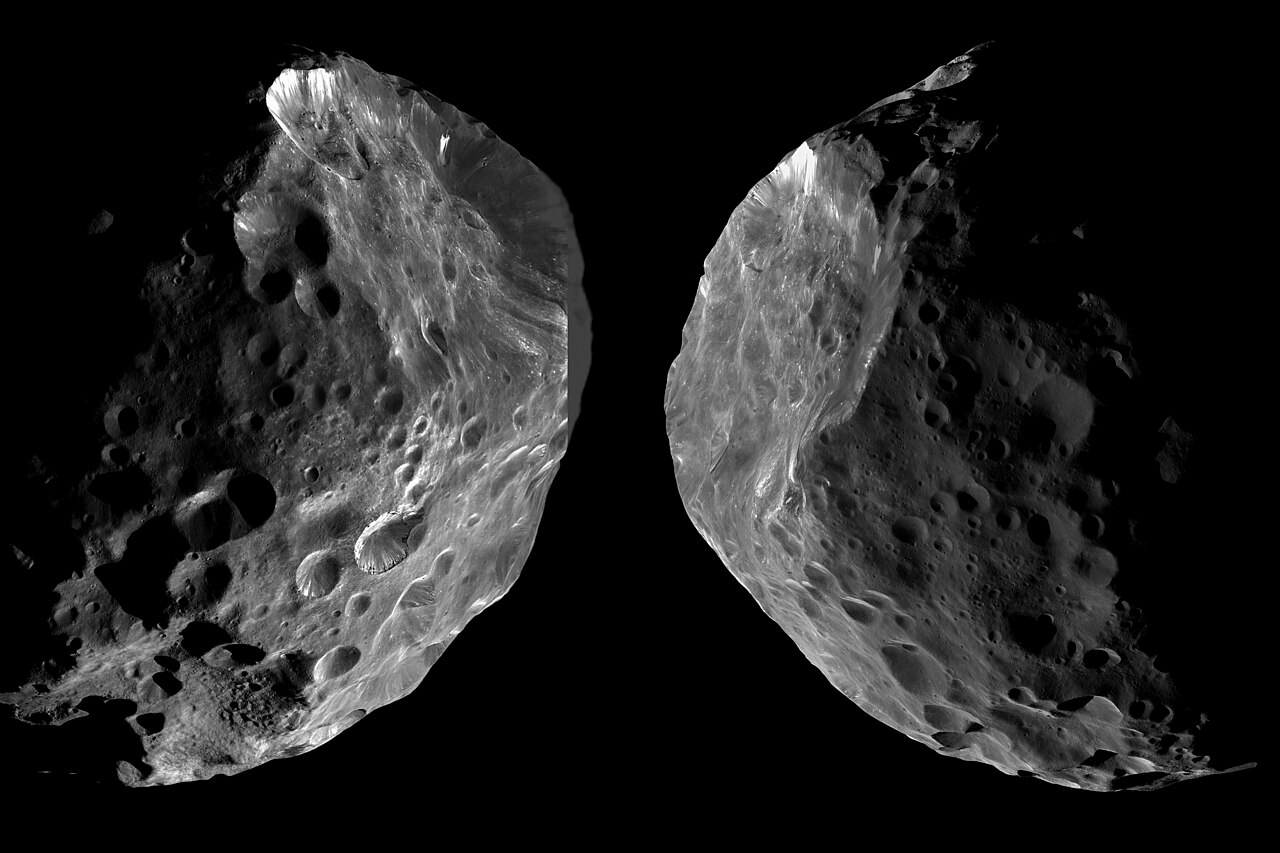
*Via Wikimedia Commons: [Phoebe arrival and departure mosaics](https://commons.wikimedia.org/wiki/File:Phoebe_arrival_and_departure_mosaics.jpg) by NASA / JPL-Caltech / Space Science Institute, public domain.*
*Via Wikimedia Commons: [Phoebe arrival and departure mosaics](https://commons.wikimedia.org/wiki/File:Phoebe_arrival_and_departure_mosaics.jpg) by NASA / JPL-Caltech / Space Science Institute, public domain.*
## Cassini's flyby and the Phoebe ring
## Cassini's flyby and the Phoebe ring
NASA says Phoebe was the first target Cassini encountered on arrival in the Saturn system in 2004, because Cassini's trajectory and arrival time were chosen to permit the flyby, and that it is therefore unusually well studied for an irregular moon of its size.[1] NASA's image caption for the mosaic of two images dates the flyby to 11 June 2004.[1]
NASA says Phoebe was the first target Cassini encountered on arrival in the Saturn system in 2004, because Cassini's trajectory and arrival time were chosen to permit the flyby, and that it is therefore unusually well studied for an irregular moon of its size.[1] NASA's image caption for the mosaic of two images dates the flyby to 11 June 2004.[1]
NASA's Saturn page lists a very faint "Phoebe ring" much farther out than Saturn's main rings, in the orbit of Phoebe.[3] NASA's Iapetus page also says Iapetus may be sweeping up dark particles from the more distant moon Phoebe, which is one of three explanations it gives for Iapetus's dark hemisphere; see [Iapetus](https://micwyn.com/t/3053/iapetus) for the others, including thermal segregation, which NASA says is probably the most responsible.[4]
NASA's Saturn page lists a very faint "Phoebe ring" much farther out than Saturn's main rings, in the orbit of Phoebe.[3] NASA's Iapetus page also says Iapetus may be sweeping up dark particles from the more distant moon Phoebe, which is one of three explanations it gives for Iapetus's dark hemisphere; see [Iapetus](https://micwyn.com/t/3053/iapetus) for the others, including thermal segregation, which NASA says is probably the most responsible.[4]
## Discovery and name
## Discovery and name
NASA says Phoebe was discovered in August 1898 by William Pickering, and its moons list gives 1898.[1][5] NASA notes that Saturn's moons were originally named for Greco-Roman Titans and their descendants, but as many new moons were found, names were drawn from other mythologies, including Gallic, Inuit and Norse.[1]
NASA says Phoebe was discovered in August 1898 by William Pickering, and its moons list gives 1898.[1][5] NASA notes that Saturn's moons were originally named for Greco-Roman Titans and their descendants, but as many new moons were found, names were drawn from other mythologies, including Gallic, Inuit and Norse.[1]
Phoebe is another name for the goddess the Greeks called Artemis and the Romans called Diana, the youthful goddess of the Moon, forests, wild animals and hunting, who was sworn to chastity and independence, never married and was closely identified with her brother Apollo.[1]
Phoebe is another name for the goddess the Greeks called Artemis and the Romans called Diana, the youthful goddess of the Moon, forests, wild animals and hunting, who was sworn to chastity and independence, never married and was closely identified with her brother Apollo.[1]
## Sources
## Sources
1. NASA Science. "Phoebe." https://science.nasa.gov/saturn/moons/phoebe/ (read 22 November 2026)
2. NASA NSSDCA. "Saturnian Satellite Fact Sheet." https://nssdc.gsfc.nasa.gov/planetary/factsheet/saturniansatfact.html (read 22 November 2026)
3. NASA Science. "Saturn Facts." https://science.nasa.gov/saturn/facts/ (read 22 November 2026)
4. NASA Science. "Iapetus." https://science.nasa.gov/saturn/moons/iapetus/ (read 22 November 2026)
5. NASA Science. "Saturn Moons." https://science.nasa.gov/saturn/moons/ (read 22 November 2026)
