Version 3
Nov 23, 2026. Compare with the current version · Version history
Prometheus is a small, potato-shaped moon of Saturn, about 43 kilometres in mean radius, that orbits just inside the planet's narrow F ring and acts as one of the ring's "shepherd" moons.[1] It was discovered in October 1980 by the Voyager 1 science team.[1]
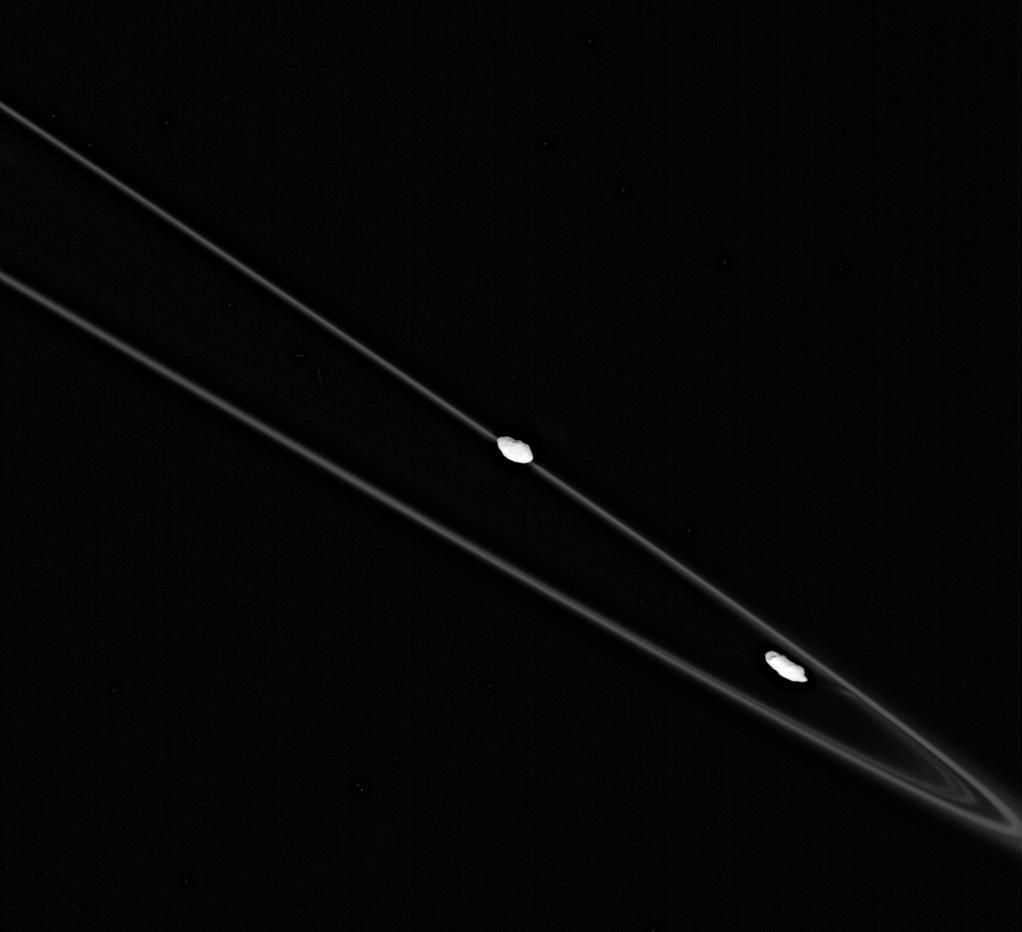
Via Wikimedia Commons: Prometheus und Pandora by NASA/JPL/Space Science Institute, public domain.
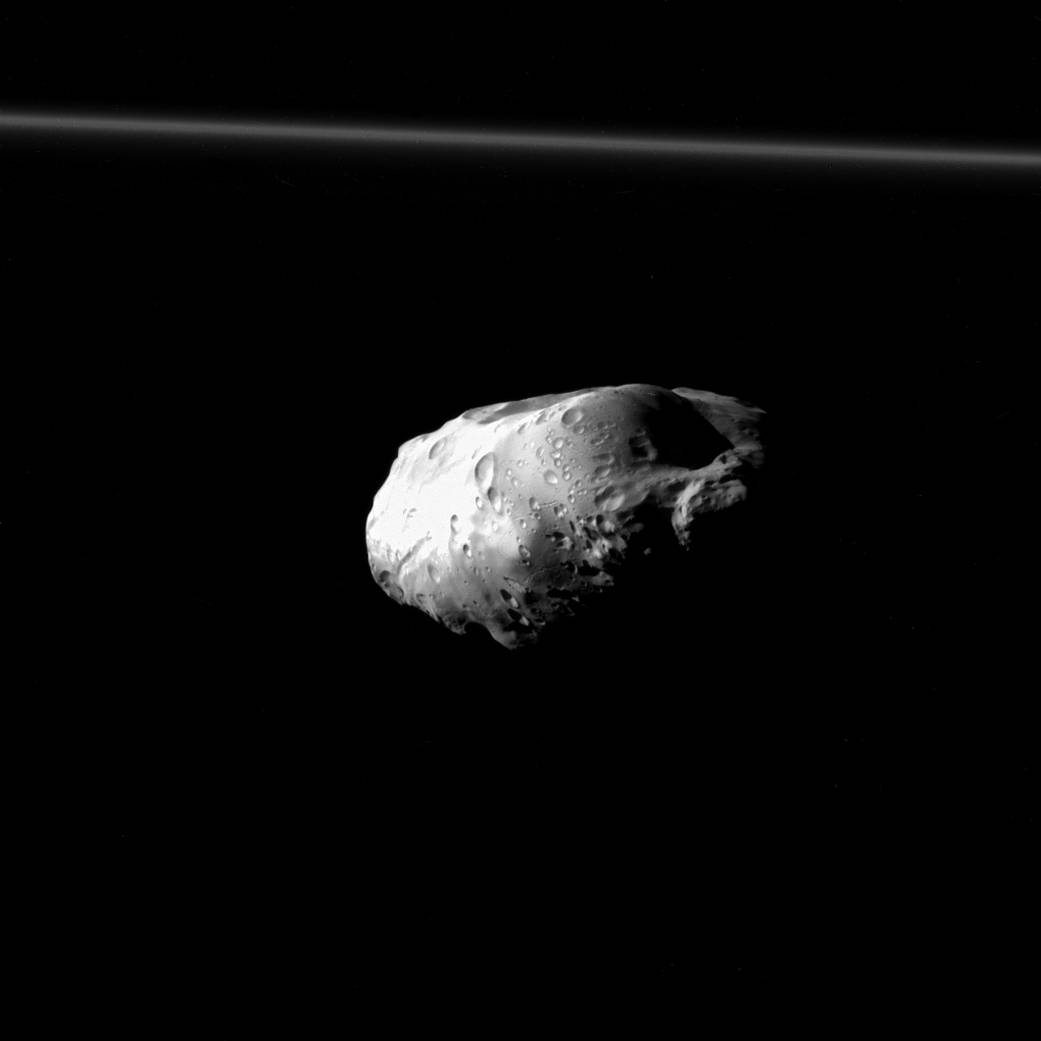
Via Wikimedia Commons: Prometheus moon by Cassini on 2015-12-06 by NASA/JPL-Caltech/Space Science Institute, public domain.
Size and orbit
NASA gives Prometheus a mean radius of about 43.1 kilometres (26.8 miles).[1] NASA's Saturnian Satellite Fact Sheet lists radii along three axes of 68 × 40 × 30 kilometres, a mass of 0.0016 × 10²⁰ kilograms, a mean density of 480 kilograms per cubic metre and an albedo of 0.5.[2] The page and the fact sheet agree on the size, since the fact sheet's axes work out to a mean radius of about 43 kilometres.[1][2]
Prometheus orbits Saturn at about 139,000 kilometres (87,000 miles) and takes 14.7 hours to go around the planet.[1] The fact sheet gives a semi-major axis of 139.353 thousand kilometres, a period of 0.6130 days and an eccentricity of 0.00204, and lists an inclination of 0.0 degrees at the precision it gives, so the orbit is nearly circular and lies in the plane of Saturn's equator.[2] NASA says Prometheus is extremely irregular in shape, with a low estimated density that suggests it is probably a porous, icy body.[1]
A shepherd of the F ring
NASA says Prometheus acts as a shepherding moon, constraining the extent of the inner edge of Saturn's F ring.[1] The neighbouring moon Pandora works on the ring from the outside: NASA's Pandora page says it tends to disrupt the F ring, while Prometheus helps keep the primary ring in place.[3]
Surface
NASA reports visible craters up to 20 kilometres in diameter, but says Prometheus is much less cratered than its nearby neighbours Pandora, Janus and Epimetheus.[1] An image caption on NASA's page gives its size as 86 kilometres (53 miles) across in a view from a moderately close Cassini flyby on 6 December 2015, which shows details of its pockmarked surface.[1]
Discovery and name
NASA says the Voyager 1 science team discovered Prometheus in October 1980, and the fact sheet lists its original designation as S/1980 S27.[1][2] NASA notes that Saturn's moons were first named for Greco-Roman Titans and their descendants, and that as many more moons were found, names were drawn from other mythologies, including Gallic, Inuit and Norse.[1]
Prometheus is named for the son of the Titan Iapetus and brother of Atlas and Epimetheus, best known in Greek mythology for stealing fire from the gods and giving it to humanity.[1]
Sources
- NASA Science. "Prometheus." science.nasa.gov/saturn/moons/prometheus/ (read 22 November 2026)
- NASA NSSDCA. "Saturnian Satellite Fact Sheet." nssdc.gsfc.nasa.gov/planetary/factsheet/saturniansatfact.html (read 22 November 2026)
- NASA Science. "Pandora." science.nasa.gov/saturn/moons/pandora/ (read 22 November 2026)
