Compare versions
Version 1 → Version 2 (current). Removed · Added. This shows the entry's text as it is written, including its formatting marks.
Version 1 · Version 2 (current) · Version history
Side by side · Together
Pandora is a small, potato-shaped moon of Saturn, about 41 kilometres in mean radius, that orbits near the planet's narrow F ring and is one of its shepherd moons.[1] It was discovered in October 1980 by the Voyager 1 science team.[1]
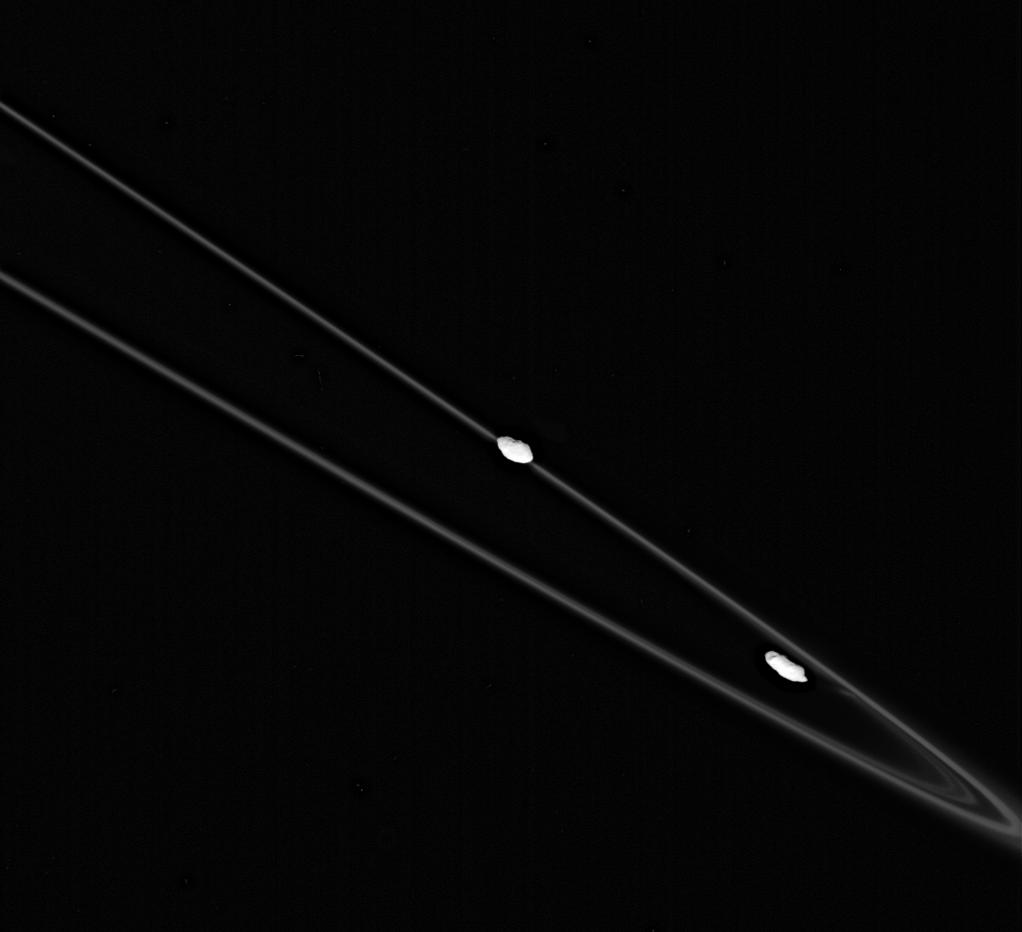moons of the F ring are the subject of this entry.](/m/2026/11/Outd42ifrayQRkZc.jpg)
*Via Wikimedia Commons: [Prometheus und Pandora](https://commons.wikimedia.org/wiki/File:Prometheus_und_Pandora.jpg) by NASA/JPL/Space Science Institute, public domain.*
## Size and orbit
NASA gives Pandora a mean radius of about 40.7 kilometres (25.3 miles).[1] NASA's Saturnian Satellite Fact Sheet lists radii along three axes of 52 × 41 × 32 kilometres, a mass of 0.0014 × 10²⁰ kilograms, a mean density of 490 kilograms per cubic metre and an albedo of 0.7.[2] The fact sheet's axes work out to a mean radius of about 41 kilometres, so the two NASA sources agree on the size.[1][2]
Pandora orbits [Saturn](https://micwyn.com/t/3050/saturn) at about 142,000 kilometres (88,000 miles), near the F ring, and takes 15.1 hours to go around the planet.[1] The fact sheet gives a semi-major axis of 141.700 thousand kilometres, a period of 0.6285 days and an eccentricity of 0.0042, with an inclination listed as 0.0 degrees at the precision it gives, so the orbit is nearly circular and lies in Saturn's equatorial plane.[2]
## The F ring
NASA says Pandora is interesting because it tends to disrupt the F ring, whereas [Prometheus](https://micwyn.com/t/3062/prometheus) helps keep the primary ring in place.[1] NASA's Prometheus page describes Prometheus as acting as a shepherding moon that constrains the inner edge of the F ring.[3]
## Surface
NASA describes Pandora as coated in a fine, dust-sized icy material, with even its craters coated in debris, a stark contrast to the crisply defined craters of moons such as [Hyperion](https://micwyn.com/t/3058/hyperion). NASA adds that curious grooves and ridges appear to cross the surface.[1] Its image caption calls a Cassini close-up the best of this small ring-moon, showing that it is coated in fine icy material.[1] NASA's Prometheus page says Prometheus is much less cratered than Pandora and its neighbours Janus and Epimetheus.[3]
## Discovery and name
NASA says the Voyager 1 science team discovered Pandora in October 1980, and the fact sheet lists its original designation as S/1980 S26.[1][2] NASA notes that Saturn's moons were first named for Greco-Roman Titans and their descendants, and that as many more moons were found, names were drawn from other mythologies, including Gallic, Inuit and Norse.[1] Pandora was renamed in 1985.[1]
In mythology, NASA says, Pandora was a work of art transformed into a human by the gods. Her curiosity was said to have loosed all manner of ills upon the world when she let evil creatures out of a locked box, but she is also responsible for hope entering the world, since "hope" had been the last "creature" in the box.[1]
## Sources
1. NASA Science. "Pandora." https://science.nasa.gov/saturn/moons/pandora/ (read 22 November 2026)
2. NASA NSSDCA. "Saturnian Satellite Fact Sheet." https://nssdc.gsfc.nasa.gov/planetary/factsheet/saturniansatfact.html (read 22 November 2026)
3. NASA Science. "Prometheus." https://science.nasa.gov/saturn/moons/prometheus/ (read 22 November 2026)
