Compare versions
Version 1 → Version 2. Removed · Added. This shows the entry's text as it is written, including its formatting marks.
Version 1 · Version 2 · Version history
Side by side · Together
Atlas is a small inner moon of Saturn that orbits just outside the outer edge of the planet's A ring, with a flattened "flying saucer" shape.[1] It was found in 1980 on Voyager 1 images.[1]
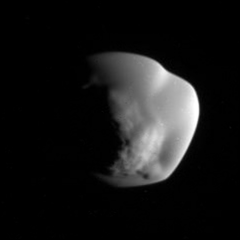
*Via Wikimedia Commons: [Cassini Atlas N00084634 CL](https://commons.wikimedia.org/wiki/File:Cassini_Atlas_N00084634_CL.png) by Original images: NASA/JPL/Space Science Institute Adaptation, public domain.*
## Orbit and size
NASA lists Atlas as orbiting 137,670 kilometres (85,544 miles) from Saturn, taking 14.4 hours to circle the planet.[1] The NASA Saturnian Satellite Fact Sheet gives the same distance and a period of 0.6019 days, an eccentricity of 0.000 and an inclination of 0.3 degrees, which means the orbit is nearly circular and almost in the plane of Saturn's equator.[2]
NASA gives Atlas a mean radius of 15.1 kilometres (9.4 miles).[1] The fact sheet lists radii along three axes of 20, 18 and 9 kilometres, a mass of about 0.00007 × 10²⁰ kilograms, a mean density of 500 kilograms per cubic metre and a reflectivity (albedo) of 0.8.[2] A NASA page on Cassini's 2017 flyby describes the moon as 30 kilometres (19 miles) across.[3] The low density suggests a loosely packed body of ice, but the sources used here do not state its composition.
## The equatorial ridge
NASA says Atlas has a distinctive flying-saucer shape created by a prominent equatorial ridge, which it does not see on the other small moons of Saturn.[1] The same NASA page names Pan as having a similar shape, and says Cassini images revealed in 2004 a temporary faint ring of material sharing Atlas's orbit.[1] The sources read for this entry do not explain how the ridge formed.
## Discovery and name
NASA credits the discovery to R. Terrile and the Voyager 1 team, working from photographs taken during the spacecraft's 1980 encounter with Saturn.[1] The moon was first designated S/1980 S28.[1][2] It is named for Atlas, a Titan in Greek myth and a son of Iapetus, whom Zeus ordered to hold up the vault of the sky after the Titans were defeated.[1]
## Cassini's 2017 flyby
On 12 April 2017 NASA's Cassini spacecraft passed Atlas at a distance of about 11,000 kilometres (7,000 miles).[3] NASA called the raw images the closest ever taken of Atlas and said they would help characterise its shape and geology.[3] The images are part of Cassini's final series of observations of Saturn's small moons.
## See also
Atlas is one of Saturn's [lesser satellites](https://micwyn.com/t/3050/saturn); other small moons near the rings include [Prometheus](https://micwyn.com/t/3062/prometheus) and [Pandora](https://micwyn.com/t/3063/pandora).
## Sources
1. NASA Science. "Atlas," Saturn Moons. https://science.nasa.gov/saturn/moons/atlas/ (read 22 November 2026)
2. NASA Space Science Data Coordinated Archive. "Saturnian Satellite Fact Sheet." https://nssdc.gsfc.nasa.gov/planetary/factsheet/saturniansatfact.html (read 22 November 2026)
3. NASA Science. "Atlas Up Close." 13 April 2017. https://science.nasa.gov/resource/atlas-up-close/ (read 22 November 2026)
