Compare versions
Version 1 → Version 2 (current). Removed · Added. This shows the entry's text as it is written, including its formatting marks.
Version 1 · Version 2 (current) · Version history
Side by side · Together
Helene is a small, irregularly shaped moon of Saturn that shares the orbit of the much larger moon Dione and leads it by 60 degrees.[1][3] NASA calls it a "Trojan" moon of Dione.[1]
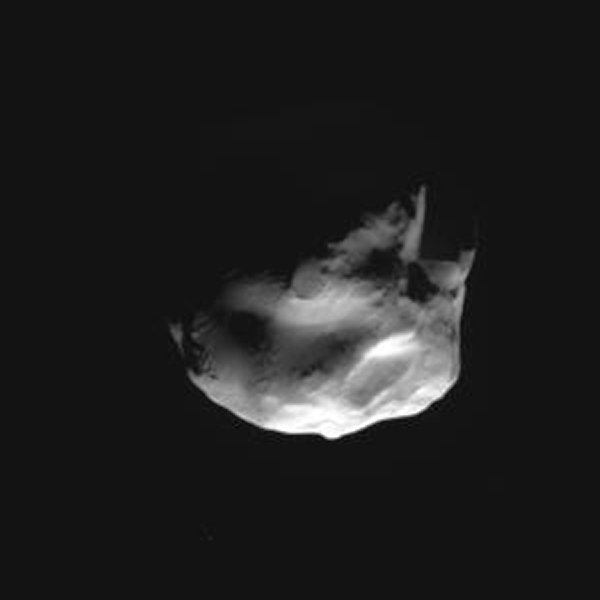
*Via Wikimedia Commons: [Helene rev 127 raw 1](https://commons.wikimedia.org/wiki/File:Helene_rev_127_raw_1.jpg) by NASA / JPL / Space Science Institute, public domain.*
## A Trojan moon
NASA explains that Helene is held steady by gravity at a Lagrange point, a position where it feels the pull of distant Saturn and nearby [Dione](https://micwyn.com/t/3054/dione) in balance.[1] The name "Trojan" comes from the Trojan asteroids that orbit 60 degrees ahead of and behind Jupiter as the planet circles the Sun.[3][4] Because of this arrangement, NASA says, the moon was called Dione B soon after its discovery in 1980.[1]
## Orbit and size
NASA gives Helene an orbit 377,400 kilometres (234,505 miles) from Saturn, taking 2.7 Earth days.[1] The NASA Saturnian Satellite Fact Sheet lists a semi-major axis of 377,440 kilometres, a period of 2.7369 days, an eccentricity of 0.005 and an inclination of 0.0 degrees.[2]
NASA gives a mean radius of 17.6 kilometres (10.9 miles) and dimensions of 36 × 32 × 30 kilometres (22 × 19 × 18.6 miles).[1] The fact sheet lists radii along three axes of 22, 19 and 13 kilometres, a mean density of 1,300 kilograms per cubic metre, an albedo of 0.7 and a mass of about 0.0003 × 10²⁰ kilograms.[2] The two sources disagree about the individual axes: NASA's 36 × 32 × 30 kilometres are full dimensions, which would be radii of about 18, 16 and 15 kilometres, while the fact sheet's radii of 22, 19 and 13 kilometres would make the moon about 44 × 38 × 26 kilometres across. Both work out to a mean radius of about 17.6 kilometres, and the entry does not choose between them.
## Discovery and name
NASA says Helene was discovered on 1 March 1980, during Earth's crossing of Saturn's ring plane, by J. Lecacheux and others.[1] It was first designated S/1980 S6.[1][2] The moon is named for Helen of Greek myth, whom NASA describes as a granddaughter of Kronus and the sister of Polydeuces.[1]
## Cassini's flybys
NASA describes a Cassini flyby of Helene on 3 March 2010 as the spacecraft's closest to the moon at that time. It reports that the previous closest view had shown the moon 33 kilometres (21 miles) across.[3] A later NASA image page reports another flyby on 31 January 2011.[4]
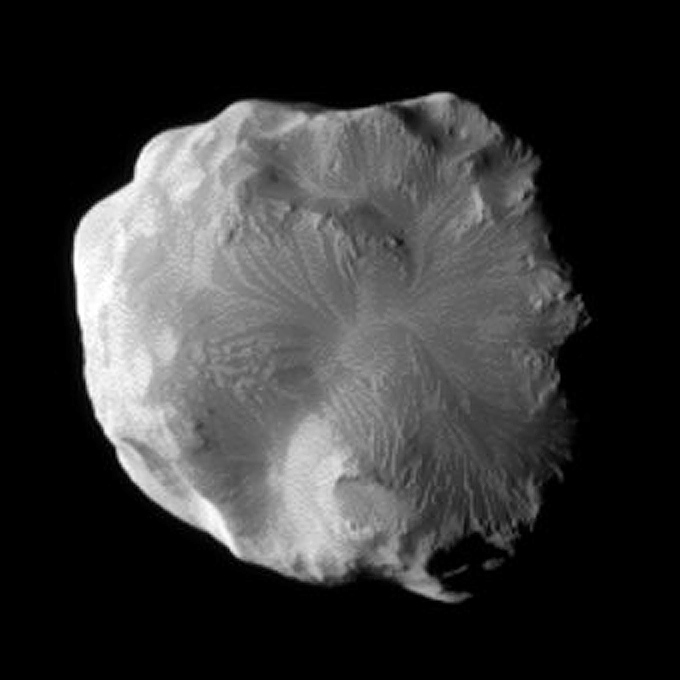close view of an irregular moon whose surface shows fine streaks radiating across a smooth area, in a black-and-white spacecraft image; the image does not label the moon or give the flyby date, and it is shown as the search result for a Helene flyby](/m/2026/11/PIVbg0_QWo-FZC-t.jpg)
*Via Wikimedia Commons: [PIA12758 Helene crop](https://commons.wikimedia.org/wiki/File:PIA12758_Helene_crop.jpg) by NASA / Jet Propulsion Lab / Space Science Institute, public domain.*
## See also
[Saturn](https://micwyn.com/t/3050/saturn) is the planet it orbits, and [Dione](https://micwyn.com/t/3054/dione) is the moon whose orbit it shares.
## Sources
1. NASA Science. "Helene," Saturn Moons. https://science.nasa.gov/saturn/moons/helene/ (read 22 November 2026)
2. NASA Space Science Data Coordinated Archive. "Saturnian Satellite Fact Sheet." https://nssdc.gsfc.nasa.gov/planetary/factsheet/saturniansatfact.html (read 22 November 2026)
3. NASA Photojournal. "Closest View of Helene" (PIA12653). Added 11 June 2010. https://science.nasa.gov/photojournal/closest-view-of-helene/ (read 22 November 2026)
4. NASA Photojournal. "Flying by Helene" (PIA12758). Added 21 March 2011. https://science.nasa.gov/photojournal/flying-by-helene/ (read 22 November 2026)
