Compare versions
Version 1 → Version 2 (current). Removed · Added. This shows the entry's text as it is written, including its formatting marks.
Version 1 · Version 2 (current) · Version history
Side by side · Together
Version 1Version 2 (current)
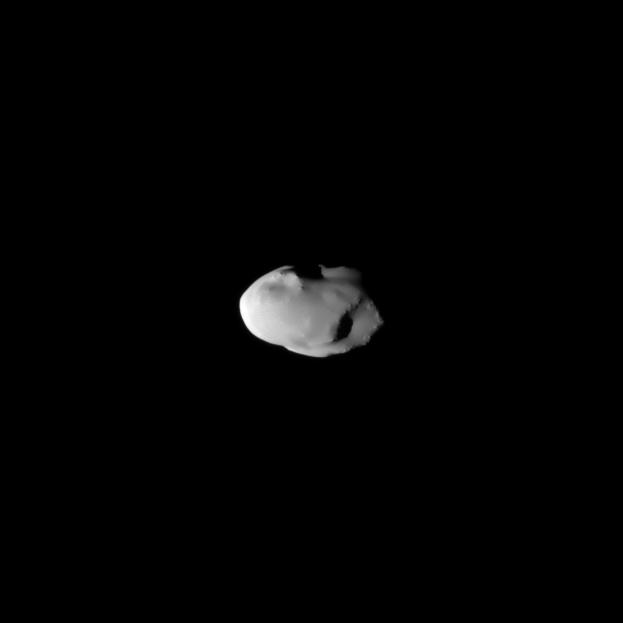
Telesto is a small moon of Saturn that shares the orbit of the larger moon Tethys, circling about 60 degrees ahead of it.[1] NASA calls it a "Tethys Trojan" and the "leading Trojan" of a three-moon group.[1]
Telesto is a small moon of Saturn that shares the orbit of the larger moon Tethys, circling about 60 degrees ahead of it.[1] NASA calls it a "Tethys Trojan" and the "leading Trojan" of a three-moon group.[1]
12 unchanged paragraphs
*Via Wikimedia Commons: [Saturn's moon Telesto (PIA12704)](https://commons.wikimedia.org/wiki/File:Saturn%27s_moon_Telesto_(PIA12704).jpg) by NASA/JPL/Cassini, public domain.*
*Via Wikimedia Commons: [Saturn's moon Telesto (PIA12704)](https://commons.wikimedia.org/wiki/File:Saturn%27s_moon_Telesto_(PIA12704).jpg) by NASA/JPL/Cassini, public domain.*
## A Tethys Trojan
## A Tethys Trojan
According to NASA, Telesto and Calypso both travel in the orbit of [Tethys](https://micwyn.com/t/3055/tethys). Telesto is about 60 degrees ahead of Tethys and Calypso about 60 degrees behind, which is why Telesto is the "leading" Trojan.[1] The name comes from the Trojan asteroids that orbit 60 degrees ahead of and behind Jupiter.[5]
According to NASA, Telesto and Calypso both travel in the orbit of [Tethys](https://micwyn.com/t/3055/tethys). Telesto is about 60 degrees ahead of Tethys and Calypso about 60 degrees behind, which is why Telesto is the "leading" Trojan.[1] The name comes from the Trojan asteroids that orbit 60 degrees ahead of and behind Jupiter.[5]
## Orbit and size
## Orbit and size
NASA puts Telesto about 295,000 kilometres (183,000 miles) from Saturn, taking 45.3 hours to complete an orbit.[1] The NASA Saturnian Satellite Fact Sheet lists a semi-major axis of 294,720 kilometres, a period of 1.8878 days (45.3 hours), an eccentricity of 0.001 and an inclination of 1.158 degrees.[2]
NASA puts Telesto about 295,000 kilometres (183,000 miles) from Saturn, taking 45.3 hours to complete an orbit.[1] The NASA Saturnian Satellite Fact Sheet lists a semi-major axis of 294,720 kilometres, a period of 1.8878 days (45.3 hours), an eccentricity of 0.001 and an inclination of 1.158 degrees.[2]
NASA gives a mean radius of 12.4 kilometres (7.7 miles).[1] The fact sheet lists radii along three axes of 16, 12 and 10 kilometres, a mean density of 1,000 kilograms per cubic metre, an albedo of 1.0 and a mass of about 0.00007 × 10²⁰ kilograms.[2] Cassini image captions from NASA describe the moon as 24 kilometres (15 miles) across.[3][4]
NASA gives a mean radius of 12.4 kilometres (7.7 miles).[1] The fact sheet lists radii along three axes of 16, 12 and 10 kilometres, a mean density of 1,000 kilograms per cubic metre, an albedo of 1.0 and a mass of about 0.00007 × 10²⁰ kilograms.[2] Cassini image captions from NASA describe the moon as 24 kilometres (15 miles) across.[3][4]
## A smooth surface
## A smooth surface
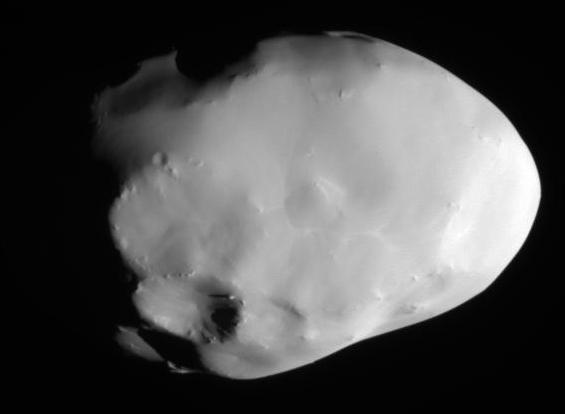
NASA says Telesto appears to have a smooth, icy surface, without the intense cratering seen on many of Saturn's other moons.[1] A NASA caption for a Cassini image from October 2005 says the moon appears to be mantled in fine, icy material, although a few craters and some outcrops or large boulders are visible.[3] A second NASA caption says the smooth surface suggests that, like [Pandora](https://micwyn.com/t/3063/pandora), Telesto is covered with a mantle of fine, dust-sized icy material. NASA adds that a false-color map built from Cassini images shows regional color differences whose origin "is not yet understood", and which may come from subtle differences in composition or grain size.[4]
NASA says Telesto appears to have a smooth, icy surface, without the intense cratering seen on many of Saturn's other moons.[1] A NASA caption for a Cassini image from October 2005 says the moon appears to be mantled in fine, icy material, although a few craters and some outcrops or large boulders are visible.[3] A second NASA caption says the smooth surface suggests that, like [Pandora](https://micwyn.com/t/3063/pandora), Telesto is covered with a mantle of fine, dust-sized icy material. NASA adds that a false-color map built from Cassini images shows regional color differences whose origin "is not yet understood", and which may come from subtle differences in composition or grain size.[4]
## Discovery and name
## Discovery and name
NASA credits the discovery to Brad Smith, Harold Reitsema, Stephen Larson and John Fountain, who used ground-based observations in 1980.[1] NASA's Telesto page gives the original designation as S/1981 S13, while the fact sheet lists S/1980 S13; the sources read do not explain the difference, and the entry does not choose between them.[1][2] Telesto is named for a daughter of the Titans Oceanus and Tethys in Greek mythology.[1]
NASA credits the discovery to Brad Smith, Harold Reitsema, Stephen Larson and John Fountain, who used ground-based observations in 1980.[1] NASA's Telesto page gives the original designation as S/1981 S13, while the fact sheet lists S/1980 S13; the sources read do not explain the difference, and the entry does not choose between them.[1][2] Telesto is named for a daughter of the Titans Oceanus and Tethys in Greek mythology.[1]
## Cassini views
## Cassini views
NASA describes a close pass in October 2005 and gives the date of one image as 11 October 2005, taken from about 14,500 kilometres (9,000 miles) at a scale of 86 metres per pixel.[3] Another image dated 25 December 2005 was taken from about 20,000 kilometres (12,000 miles) at 118 metres per pixel.[4]
NASA describes a close pass in October 2005 and gives the date of one image as 11 October 2005, taken from about 14,500 kilometres (9,000 miles) at a scale of 86 metres per pixel.[3] Another image dated 25 December 2005 was taken from about 20,000 kilometres (12,000 miles) at 118 metres per pixel.[4]
3 unchanged paragraphs
*Via Wikimedia Commons: [Telesto cassini closeup](https://commons.wikimedia.org/wiki/File:Telesto_cassini_closeup.jpg) by 최준최우, public domain.*
*Via Wikimedia Commons: [Telesto cassini closeup](https://commons.wikimedia.org/wiki/File:Telesto_cassini_closeup.jpg) by 최준최우, public domain.*
## See also
## See also
[Saturn](https://micwyn.com/t/3050/saturn) is the planet it orbits; [Helene](https://micwyn.com/t/3070/helene-moon) is a Trojan moon of Dione.
[Saturn](https://micwyn.com/t/3050/saturn) is the planet it orbits; [Helene](https://micwyn.com/t/3070/helene-moon) is a Trojan moon of Dione.
3 unchanged paragraphs
*Via Wikimedia Commons: [Telesto N1507754980 2 crop](https://commons.wikimedia.org/wiki/File:Telesto_N1507754980_2_crop.png) by NASA/JPL-Caltech/SSI, public domain.*
*Via Wikimedia Commons: [Telesto N1507754980 2 crop](https://commons.wikimedia.org/wiki/File:Telesto_N1507754980_2_crop.png) by NASA/JPL-Caltech/SSI, public domain.*
## Sources
## Sources
1. NASA Science. "Telesto," Saturn Moons. https://science.nasa.gov/saturn/moons/telesto/ (read 22 November 2026)
2. NASA Space Science Data Coordinated Archive. "Saturnian Satellite Fact Sheet." https://nssdc.gsfc.nasa.gov/planetary/factsheet/saturniansatfact.html (read 22 November 2026)
3. NASA Photojournal. "Smooth Surface of Telesto" (PIA07702). https://science.nasa.gov/photojournal/smooth-surface-of-telesto/ (read 22 November 2026)
4. NASA Photojournal. "A Closer Look at Telesto (False Color)." https://science.nasa.gov/photojournal/a-closer-look-at-telesto-false-color/ (read 22 November 2026)
5. NASA Photojournal. "Closest View of Helene" (PIA12653). https://science.nasa.gov/photojournal/closest-view-of-helene/ (read 22 November 2026; explains the Trojan name)
