Version 1
Nov 23, 2026. Compare with the current version · Version history
Uranus is the seventh planet from the Sun and the third largest planet in the solar system by diameter, about four times wider than Earth.[1][2] It is an ice giant that rotates on its side, tipped nearly 90 degrees to the plane of its orbit.[1][2]
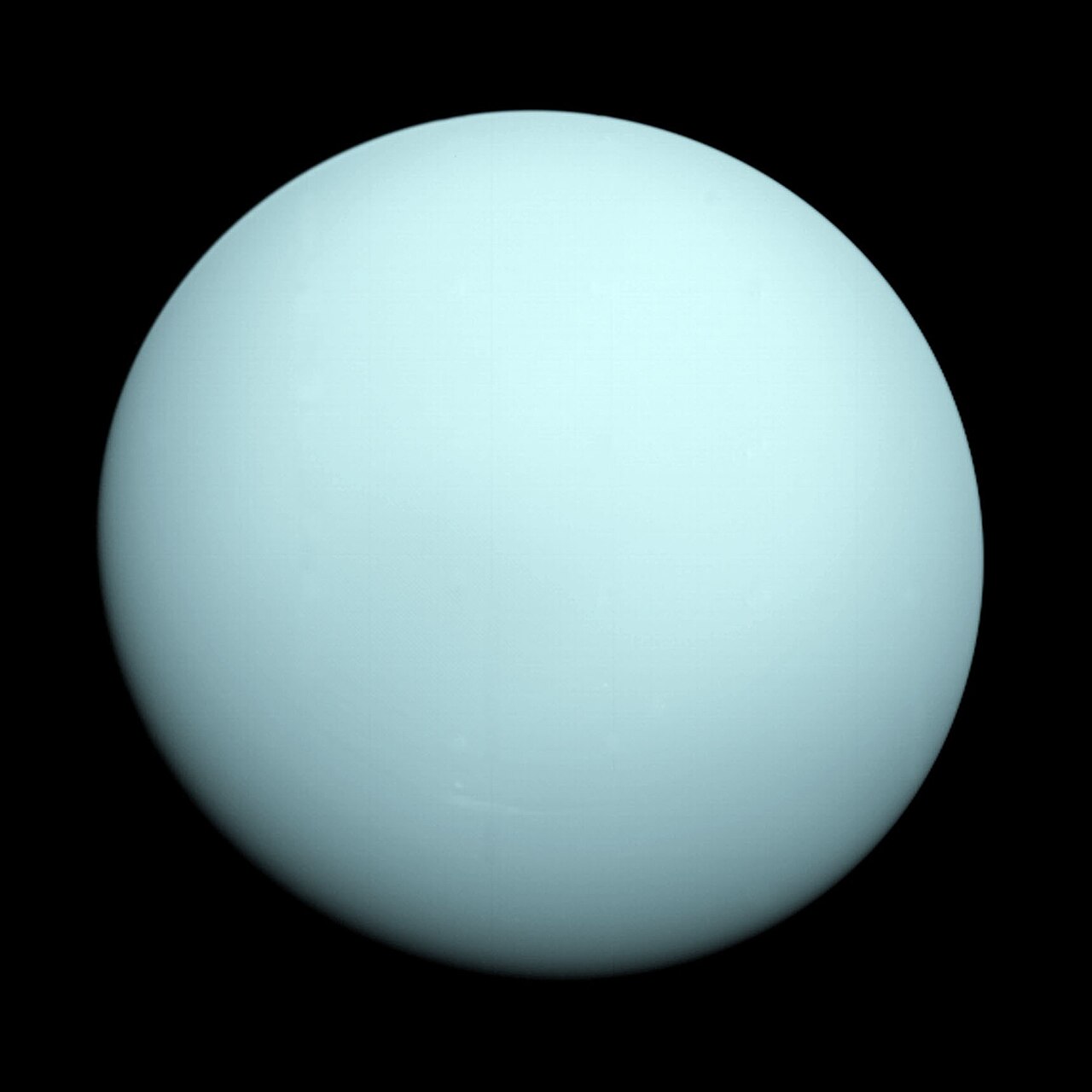
Via Wikimedia Commons: Uranus2 by NASA/JPL-Caltech, public domain.
Size, distance and orbit
NASA gives Uranus an equatorial diameter of 51,118 kilometres (31,763 miles), and an average distance from the Sun of about 2.9 billion kilometres, or about 19 astronomical units.[2] Sunlight takes about 2 hours and 40 minutes to reach it.[2] The NASA fact sheet lists a mass of 86.811 × 10²⁴ kilograms, 14.54 times Earth's, an equatorial radius of 25,559 kilometres at the 1-bar level and a mean density of 1,270 kilograms per cubic metre.[3]
One orbit around the Sun takes about 84 Earth years. NASA's facts page gives 30,687 Earth days and the fact sheet gives a sidereal period of 30,685.4 days; the two figures differ slightly and both are given here.[2][3] A day on Uranus lasts about 17 hours (17.24 hours in the fact sheet).[2][3]
The sideways tilt
Uranus's equator is tilted 97.77 degrees to its orbit, the only planet with an equator nearly at a right angle to its orbit.[2][3] NASA says this may be the result of a collision with an Earth-sized object long ago.[2] Because of the tilt, Uranus has the most extreme seasons in the solar system: for nearly a quarter of each Uranian year, the Sun shines directly over a pole while the other half of the planet is plunged into a 21-year winter of darkness.[2] The planet also rotates in the opposite direction from most planets; Venus is the other planet that does so.[2] NASA reports that Uranus reached equinox in December 2007.[5]
Structure and atmosphere
As an ice giant, Uranus has no true surface.[2] NASA says most of its mass, 80 percent or more, is a hot dense fluid of "icy" materials (water, methane and ammonia) above a small rocky core.[2] It is slightly larger in diameter than Neptune but less massive, and NASA calls it the second least dense planet, after Saturn.[2] The atmosphere is mostly hydrogen and helium with a little methane and traces of water and ammonia; the fact sheet gives 82.5 percent molecular hydrogen, 15.2 percent helium and 2.3 percent methane by volume.[2][3] Methane absorbs red light, which gives Uranus its blue-green color.[2]
NASA gives a minimum atmospheric temperature of 49 kelvin (−224.2 °C) and wind speeds of up to 560 miles per hour (900 kilometres per hour), blowing against the planet's rotation near the equator and with it closer to the poles.[2] The fact sheet lists winds of 0 to 250 metres per second, which is the same top speed.[3] Voyager 2 saw only a few discrete clouds in 1986, while more recent observations show dynamic clouds as the planet approaches equinox.[2]
Magnetic field
NASA describes Uranus's magnetosphere as unusual and irregularly shaped. The magnetic axis is tilted nearly 60 degrees from the rotation axis and offset from the planet's center by one-third of its radius; the fact sheet gives a dipole tilt of 58.6 degrees and an offset of 0.352 Uranian radii.[2][3] As a result the planet's auroras are not aligned with its poles.[2]
Rings and moons
NASA says Uranus has 13 faint rings in two sets: an inner system of nine narrow, dark grey rings, and two outer rings, the innermost reddish and the outer one blue like Saturn's E ring.[2] The rings were discovered on 10 March 1977 when Uranus passed in front of a distant star and observers at the Kuiper Airborne Observatory and the Perth Observatory saw it dim before and after the main event.[5] In December 2005 NASA announced a new pair of rings and two new small moons, Mab and Cupid, found in Hubble images.[5]
The number of moons depends on the source and date. NASA's facts page and the fact sheet give 28.[2][3] NASA's moons page says 29 are officially recognized as of August 2026, and that the most recently discovered was first spotted in November 2023 and carries the designation S/2023 U1, with a literary name still to come.[4] Captions of Webb images on NASA's Uranus page refer to 27 moons, which predates these counts.[1]
Five are major moons: Miranda, Ariel, Umbriel, Titania and Oberon.[1][4] Titania and Oberon were discovered by William Herschel in 1787, Ariel and Umbriel by William Lassell in 1851, and Miranda by Gerard Kuiper in 1948.[4] Voyager 2 found 10 more in 1986.[5] The moons are named for characters in the works of William Shakespeare and Alexander Pope.[2] NASA says the inner moons appear to be roughly half water ice and half rock, and that the outer moons are likely captured asteroids and of unknown composition.[2]
Discovery and name
William Herschel discovered Uranus in 1781 and first thought it a comet or a star.[2] NASA's exploration timeline gives the date as 13 March 1781 and calls it the first new planet discovered since ancient times.[5] The fact sheet gives the same date.[3] Herschel tried unsuccessfully to name it Georgium Sidus after King George III; it was instead named for the Greek god of the sky, as Johann Bode proposed.[2]
Voyager 2 and later observations
Only one spacecraft has visited Uranus. On 24 January 1986 Voyager 2 came within 81,500 kilometres (50,600 miles) of the planet's cloud tops, after a trip of more than 3 billion kilometres lasting nine years, and gathered much of what is known about the planet, its rings and moons in about six hours.[5] The flyby discovered 10 new moons, two new rings and a magnetic field stronger than Saturn's.[5] The rest of what is known comes from the Hubble Space Telescope and large ground-based telescopes.[5] In October 2024 Hubble and New Horizons observed Uranus at the same time, allowing a direct comparison of the planet from two viewpoints.[5]
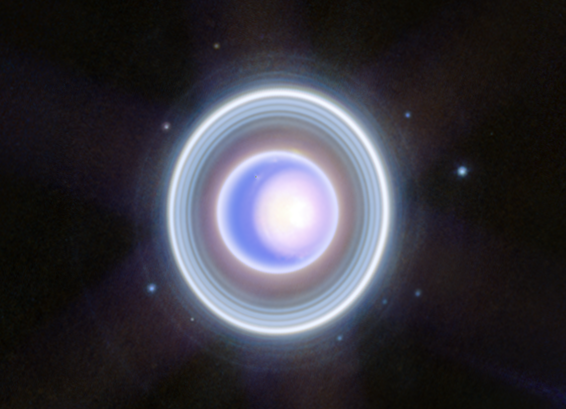
Via Wikimedia Commons: Uranus Close-up (NIRCam image) (2023-150) by Image: NASA, ESA, CSA, STScI, public domain.
A possible orbiter
The 2023–2032 U.S. planetary science decadal survey named a Uranus Orbiter and Probe as the highest-priority strategic mission for that decade.[5][6] A paper accepted in 2026 by a NASA-led team describes a mission still at the concept stage: it considers later launch dates without a Jupiter gravity assist, moves orbit insertion farther from Uranus because of uncertainty about the ring structure, and proposes a lighter orbiter with two radioisotope power generators.[6] The sources read do not give an approved launch date.
See also
For another ringed giant planet, see Saturn. The James Webb Space Telescope has imaged the planet, its rings and several of its moons.[1]
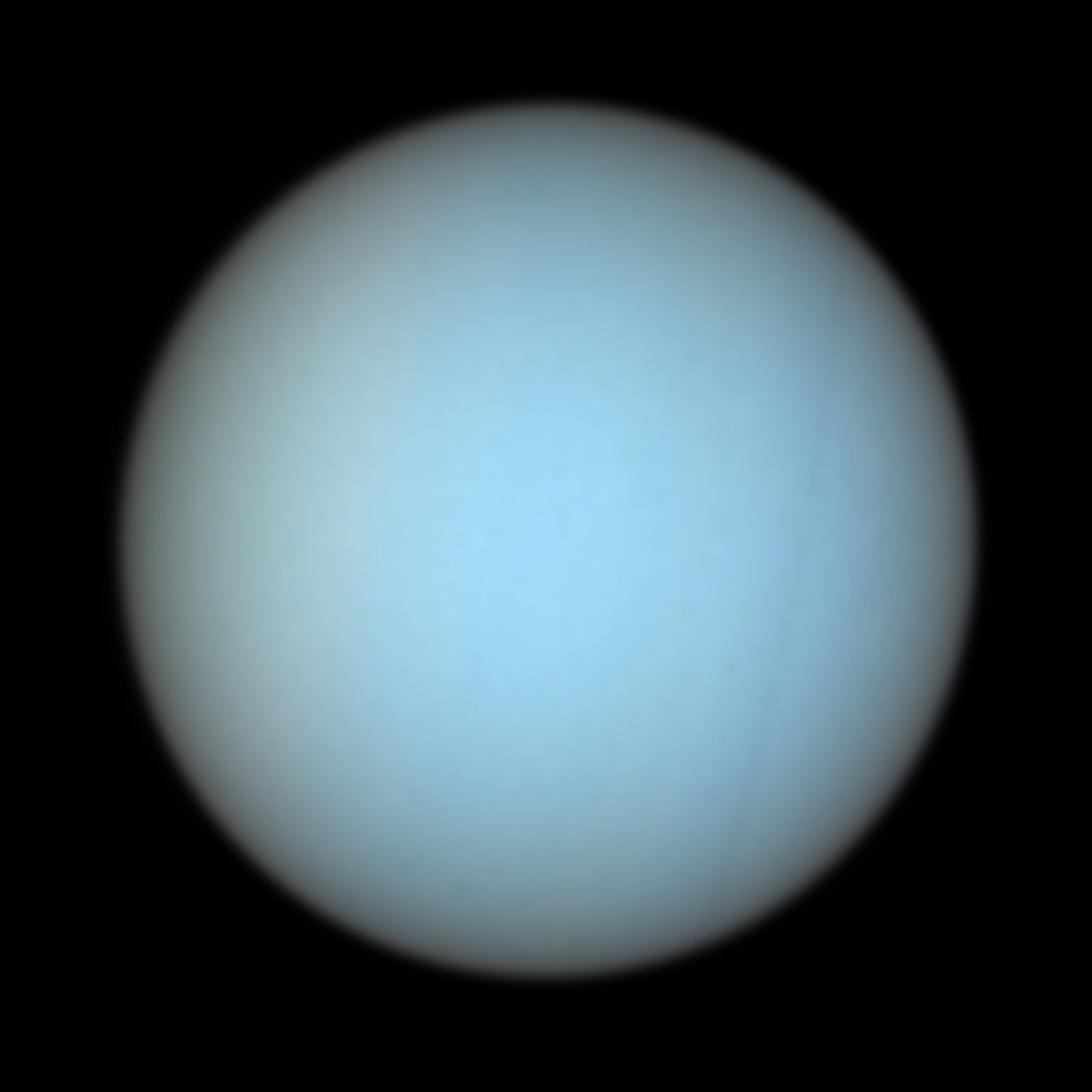
Via Wikimedia Commons: Uranus Hubble by NASA/ESA and Erich Karkoschka, University of Arizona, public domain.
Sources
- NASA Science. "Uranus" (overview). science.nasa.gov/uranus/ (read 22 November 2026)
- NASA Science. "Uranus Facts." science.nasa.gov/uranus/facts/ (read 22 November 2026)
- NASA Space Science Data Coordinated Archive. "Uranus Fact Sheet." Updated 2 October 2024. nssdc.gsfc.nasa.gov/planetary/factsheet/uranusfact.html (read 22 November 2026)
- NASA Science. "Uranus Moons." science.nasa.gov/uranus/moons/ (read 22 November 2026)
- NASA Science. "Uranus: Exploration." science.nasa.gov/uranus/exploration/ (read 22 November 2026)
- Simon, A. A., et al. "Uranus Orbiter and Probe: Mission Challenges and Concept Updates Since the Origins, Worlds, and Life Decadal Survey." NASA Technical Reports Server, document 20260004996 (accepted manuscript, 2026). ntrs.nasa.gov/citations/20260004996 (abstract read 22 November 2026)
