Compare versions
Version 1 → Version 2 (current). Removed · Added. This shows the entry's text as it is written, including its formatting marks.
Version 1 · Version 2 (current) · Version history
Side by side · Together
Version 1Version 2 (current)
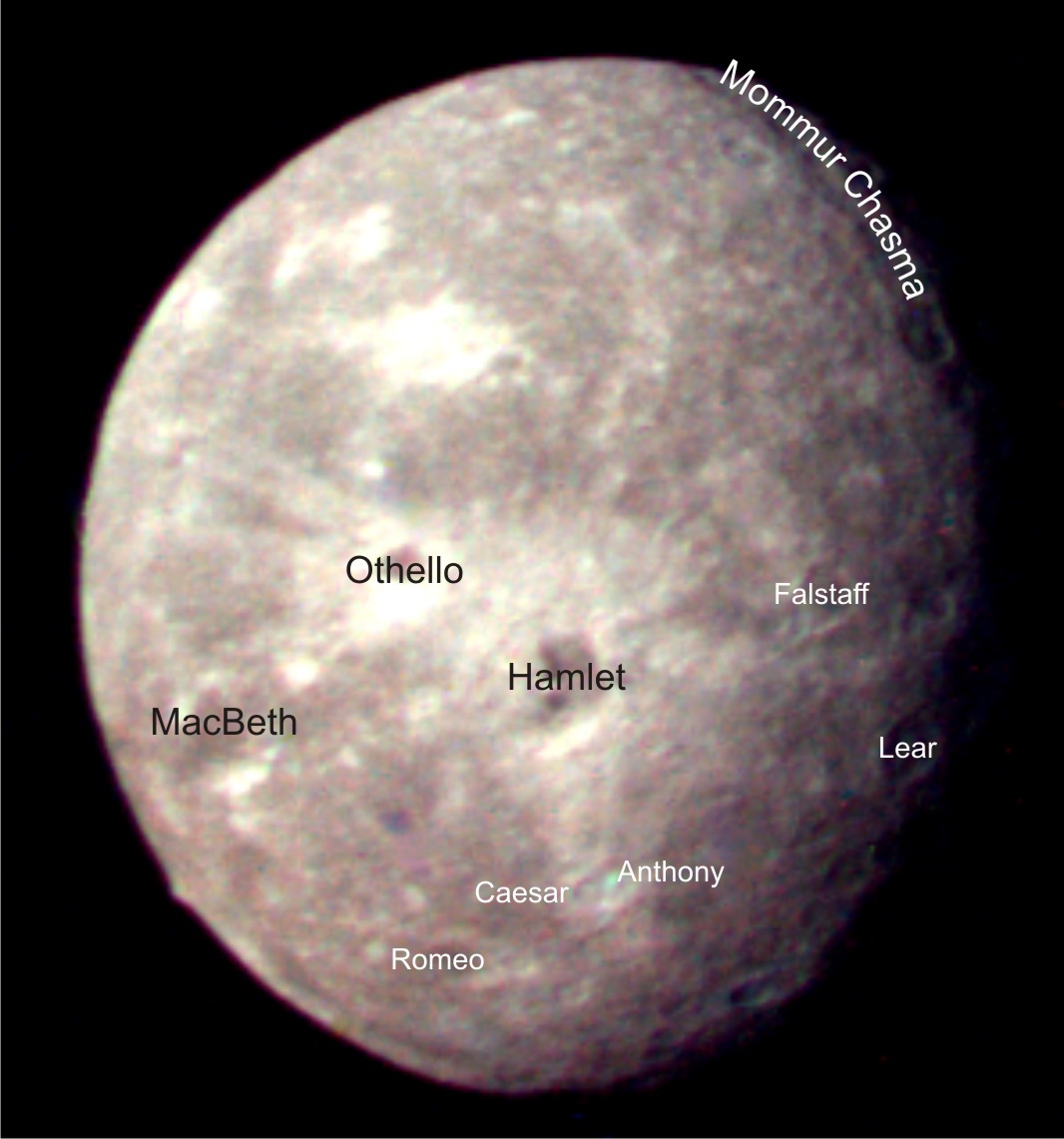
Oberon is the second-largest moon of [Uranus](https://micwyn.com/t/3073/uranus), a heavily cratered world of roughly half ice and half rock.[1] Little was known about it until Voyager 2 passed it in January 1986.[1]
Oberon is the second-largest moon of [Uranus](https://micwyn.com/t/3073/uranus), a heavily cratered world of roughly half ice and half rock.[1] Little was known about it until Voyager 2 passed it in January 1986.[1]
13 unchanged paragraphs
*Via Wikimedia Commons: [Voyager 2 picture of Oberon mod](https://commons.wikimedia.org/wiki/File:Voyager_2_picture_of_Oberon_mod.jpg) by Voyager2pictureofOberon.jpg : NASA Original uploader was Loo, public domain.*
*Via Wikimedia Commons: [Voyager 2 picture of Oberon mod](https://commons.wikimedia.org/wiki/File:Voyager_2_picture_of_Oberon_mod.jpg) by Voyager2pictureofOberon.jpg : NASA Original uploader was Loo, public domain.*
## Orbit and size
## Orbit and size
The NASA Uranian Satellite Fact Sheet lists Oberon at 583,500 kilometres from Uranus, or 22.83 Uranian radii, with an orbital period of 13.463234 days, an inclination of 0.07 degrees and an eccentricity of 0.0014. Its rotation is synchronous, so it always shows the same face to Uranus.[2] The sheet gives a radius of 761.4 kilometres, a mass of 28.8 × 10²⁰ kilograms, a mean density of 1,560 kilograms per cubic metre and a visual geometric albedo of 0.23.[2] Those figures put it just behind [Titania](https://micwyn.com/t/3074/titania-moon), whose radius is 788.9 kilometres on the same sheet.[2]
The NASA Uranian Satellite Fact Sheet lists Oberon at 583,500 kilometres from Uranus, or 22.83 Uranian radii, with an orbital period of 13.463234 days, an inclination of 0.07 degrees and an eccentricity of 0.0014. Its rotation is synchronous, so it always shows the same face to Uranus.[2] The sheet gives a radius of 761.4 kilometres, a mass of 28.8 × 10²⁰ kilograms, a mean density of 1,560 kilograms per cubic metre and a visual geometric albedo of 0.23.[2] Those figures put it just behind [Titania](https://micwyn.com/t/3074/titania-moon), whose radius is 788.9 kilometres on the same sheet.[2]
## Surface and makeup
## Surface and makeup
NASA says Oberon is heavily cratered, similar to Umbriel, and especially so when compared with Ariel, Titania and Miranda. Like all of Uranus's large moons, it is composed of roughly half ice and half rock, and it has at least one large mountain that rises about 6 kilometres off the surface.[1] NASA describes a Voyager 2 image as the best the spacecraft acquired of the moon.[1]
NASA says Oberon is heavily cratered, similar to Umbriel, and especially so when compared with Ariel, Titania and Miranda. Like all of Uranus's large moons, it is composed of roughly half ice and half rock, and it has at least one large mountain that rises about 6 kilometres off the surface.[1] NASA describes a Voyager 2 image as the best the spacecraft acquired of the moon.[1]
## Newer observations
## Newer observations
In June 2025 a team using the Hubble Space Telescope reported on the four largest Uranian moons. They had expected charged particles trapped in Uranus's magnetic field to darken the trailing sides of the moons. They found no sign of that, and found that Oberon and Titania have darker and redder leading hemispheres.[3] The team thinks dust from some of Uranus's irregular outer satellites coats the leading sides of Oberon and Titania, which sweep it up as they orbit. The release adds that the two outer moons would shield the inner moons Ariel and Umbriel from this dust, which is why those moons look similar on both sides. The team also said the finding suggests Uranus's magnetosphere might not interact much with its large moons, and that more work is needed.[3] NASA's Oberon page does not mention this result.
In June 2025 a team using the Hubble Space Telescope reported on the four largest Uranian moons. They had expected charged particles trapped in Uranus's magnetic field to darken the trailing sides of the moons. They found no sign of that, and found that Oberon and Titania have darker and redder leading hemispheres.[3] The team thinks dust from some of Uranus's irregular outer satellites coats the leading sides of Oberon and Titania, which sweep it up as they orbit. The release adds that the two outer moons would shield the inner moons Ariel and Umbriel from this dust, which is why those moons look similar on both sides. The team also said the finding suggests Uranus's magnetosphere might not interact much with its large moons, and that more work is needed.[3] NASA's Oberon page does not mention this result.
## Discovery and name
## Discovery and name
NASA says William Herschel discovered Oberon on 11 January 1787.[1] NASA's moon list gives the year 1787 and credits Herschel with both Oberon and Titania.[4] According to NASA, the name was given in the early 19th century by Herschel's son John, for the king of the fairies in Shakespeare's *A Midsummer Night's Dream*.[1]
NASA says William Herschel discovered Oberon on 11 January 1787.[1] NASA's moon list gives the year 1787 and credits Herschel with both Oberon and Titania.[4] According to NASA, the name was given in the early 19th century by Herschel's son John, for the king of the fairies in Shakespeare's *A Midsummer Night's Dream*.[1]
## See also
## See also
[Uranus](https://micwyn.com/t/3073/uranus) describes the planet and its moon system, and [Titania](https://micwyn.com/t/3074/titania-moon) is the largest of its moons.
[Uranus](https://micwyn.com/t/3073/uranus) describes the planet and its moon system, and [Titania](https://micwyn.com/t/3074/titania-moon) is the largest of its moons.
## Sources
## Sources
1. NASA Science. "Oberon," Uranus Moons. https://science.nasa.gov/uranus/moons/oberon/ (read 22 November 2026)
2. NASA Space Science Data Coordinated Archive. "Uranian Satellite Fact Sheet." Updated 11 March 2023. https://nssdc.gsfc.nasa.gov/planetary/factsheet/uraniansatfact.html (read 22 November 2026)
3. Space Telescope Science Institute. "Moons of Uranus Surprise Scientists in NASA Hubble Study" (release 2025-018). 10 June 2025. https://www.stsci.edu/contents/news-releases/2025/news-2025-018 (read 22 November 2026)
4. NASA Science. "Uranus Moons." https://science.nasa.gov/uranus/moons/ (read 22 November 2026)
