Compare versions
Version 2 → Version 3 (current). Removed · Added. This shows the entry's text as it is written, including its formatting marks.
Version 2 · Version 3 (current) · Version history
Side by side · Together
Version 2Version 3 (current)
12 unchanged paragraphs
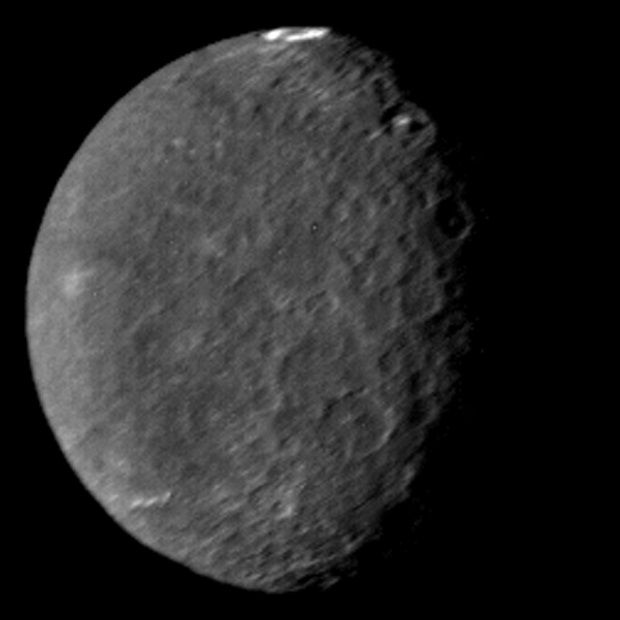
Umbriel is a moon of [Uranus](https://micwyn.com/t/3073/uranus), about 1,200 kilometres across, and NASA calls it the darkest of Uranus's largest moons.[1] Its surface is ancient and cratered, and on its dark surface Voyager 2 imaged a bright ring that is still unexplained.[1]
Umbriel is a moon of [Uranus](https://micwyn.com/t/3073/uranus), about 1,200 kilometres across, and NASA calls it the darkest of Uranus's largest moons.[1] Its surface is ancient and cratered, and on its dark surface Voyager 2 imaged a bright ring that is still unexplained.[1]
## Orbit and size
## Orbit and size
The NASA Uranian Satellite Fact Sheet lists Umbriel at 266,000 kilometres from Uranus, or 10.41 Uranian radii, with an orbital period of 4.144176 days, an inclination of 0.13 degrees and an eccentricity of 0.0039. Its rotation is synchronous, so it always shows the same face to Uranus.[2] The sheet gives a radius of 584.7 kilometres, a mass of 12.2 × 10²⁰ kilograms and a mean density of 1,460 kilograms per cubic metre.[2] NASA's Umbriel page gives a diameter of about 750 miles (1,200 kilometres).[1]
The NASA Uranian Satellite Fact Sheet lists Umbriel at 266,000 kilometres from Uranus, or 10.41 Uranian radii, with an orbital period of 4.144176 days, an inclination of 0.13 degrees and an eccentricity of 0.0039. Its rotation is synchronous, so it always shows the same face to Uranus.[2] The sheet gives a radius of 584.7 kilometres, a mass of 12.2 × 10²⁰ kilograms and a mean density of 1,460 kilograms per cubic metre.[2] NASA's Umbriel page gives a diameter of about 750 miles (1,200 kilometres).[1]
## A dark surface
## A dark surface
NASA says Umbriel reflects only 16 percent of the light that strikes it, similar to the highland areas of Earth's Moon, while other Uranian moons are much brighter. The fact sheet lists a visual geometric albedo of 0.21; the two figures are not necessarily the same measure of reflectivity, and the sources read do not say which each represents.[1][2] NASA calls the process that darkened Umbriel's ancient cratered surface a mystery.[1] NASA's Oberon page says that moon is heavily cratered, similar to Umbriel; see [Oberon](https://micwyn.com/t/3075/oberon-moon) and [Titania](https://micwyn.com/t/3074/titania-moon).[3]
NASA says Umbriel reflects only 16 percent of the light that strikes it, similar to the highland areas of Earth's Moon, while other Uranian moons are much brighter. The fact sheet lists a visual geometric albedo of 0.21; the two figures are not necessarily the same measure of reflectivity, and the sources read do not say which each represents.[1][2] NASA calls the process that darkened Umbriel's ancient cratered surface a mystery.[1] NASA's Oberon page says that moon is heavily cratered, similar to Umbriel; see [Oberon](https://micwyn.com/t/3075/oberon-moon) and [Titania](https://micwyn.com/t/3074/titania-moon).[3]
## The bright ring
## The bright ring
NASA reports that Voyager 2 images from 1986 revealed a curious bright ring about 90 miles (140 kilometres) in diameter on the dark surface. NASA says it is unclear what created the ring, though it may be frost deposits associated with an impact crater.[1] A February 2026 episode of the Planetary Society's *Planetary Radio* describes the feature as a bright ring inside the 131-kilometre-wide Wunda crater, and says Voyager 2's images are the only close-up ones of Umbriel.[4] The two sources describe the size differently: the radio program's 131 kilometres is for the crater, while NASA's 140 kilometres is for the bright ring, and the sources do not reconcile them.
NASA reports that Voyager 2 images from 1986 revealed a curious bright ring about 90 miles (140 kilometres) in diameter on the dark surface. NASA says it is unclear what created the ring, though it may be frost deposits associated with an impact crater.[1] A February 2026 episode of the Planetary Society's *Planetary Radio* describes the feature as a bright ring inside the 131-kilometre-wide Wunda crater, and says Voyager 2's images are the only close-up ones of Umbriel.[4] The two sources describe the size differently: the radio program's 131 kilometres is for the crater, while NASA's 140 kilometres is for the bright ring, and the sources do not reconcile them.
That episode discusses a new study in the *Journal of Geophysical Research: Planets* by Adeene Denton of the Southwest Research Institute and colleagues. Using shock physics simulations, the team reconstructs the impact that formed Wunda crater to determine what Umbriel's interior must have been like at the time, and explores whether impact-triggered cryovolcanism, the eruption of icy material, could explain the bright deposits on the crater floor.[4] Only the episode's description was read for this entry, not the paper, so the study's conclusions are not given here. NASA's Umbriel page does not mention it.
That episode discusses a new study in the *Journal of Geophysical Research: Planets* by Adeene Denton of the Southwest Research Institute and colleagues. Using shock physics simulations, the team reconstructs the impact that formed Wunda crater to determine what Umbriel's interior must have been like at the time, and explores whether impact-triggered cryovolcanism, the eruption of icy material, could explain the bright deposits on the crater floor.[4] Only the episode's description was read for this entry, not the paper, so the study's conclusions are not given here. NASA's Umbriel page does not mention it.
## Discovery and name
## Discovery and name
NASA says the English astronomer William Lassell discovered Umbriel on 24 October 1851.[1] NASA's moon list gives 1851 and lists Lassell as the discoverer of both Umbriel and Ariel.[3] The moon is named for a malevolent spirit in Alexander Pope's 18th-century poem "The Rape of the Lock".[1]
NASA says the English astronomer William Lassell discovered Umbriel on 24 October 1851.[1] NASA's moon list gives 1851 and lists Lassell as the discoverer of both Umbriel and Ariel.[3] The moon is named for a malevolent spirit in Alexander Pope's 18th-century poem "The Rape of the Lock".[1]
## Voyager 2
## Voyager 2
NASA describes a Voyager 2 image of Umbriel's southern hemisphere, showing heavy cratering, taken on 24 January 1986 from a distance of 557,000 kilometres (346,000 miles).[1]
NASA describes a Voyager 2 image of Umbriel's southern hemisphere, showing heavy cratering, taken on 24 January 1986 from a distance of 557,000 kilometres (346,000 miles).[1]
3 unchanged paragraphs
*Via Wikimedia Commons: [PIA00040 Umbrielx2.47](https://commons.wikimedia.org/wiki/File:PIA00040_Umbrielx2.47.jpg) by NASA / Jet Propulsion Lab, public domain.*
*Via Wikimedia Commons: [PIA00040 Umbrielx2.47](https://commons.wikimedia.org/wiki/File:PIA00040_Umbrielx2.47.jpg) by NASA / Jet Propulsion Lab, public domain.*
## Sources
## Sources
1. NASA Science. "Umbriel," Uranus Moons. https://science.nasa.gov/uranus/moons/umbriel/ (read 22 November 2026)
2. NASA Space Science Data Coordinated Archive. "Uranian Satellite Fact Sheet." Updated 11 March 2023. https://nssdc.gsfc.nasa.gov/planetary/factsheet/uraniansatfact.html (read 22 November 2026)
3. NASA Science. "Oberon," Uranus Moons. https://science.nasa.gov/uranus/moons/oberon/ and "Uranus Moons," https://science.nasa.gov/uranus/moons/ (read 22 November 2026)
4. The Planetary Society. "Did an impact trigger cryovolcanism on Umbriel?" *Planetary Radio*, 25 February 2026. https://www.planetary.org/planetary-radio/2026-cryovolcanism-on-umbriel (episode description read 22 November 2026)
