Version 1
Nov 23, 2026. Compare with the current version · Version history
Bianca is one of the small inner moons of Uranus, found in Voyager 2 images in January 1986.[1] NASA says little is known about it beyond its size and orbital characteristics.[1]
Orbit and size
The NASA Uranian Satellite Fact Sheet lists Bianca at 59,200 kilometres from Uranus, or 2.316 Uranian radii, with an orbital period of 0.434579 days (about 10.4 hours), an inclination of 0.19 degrees and an eccentricity of 0.0009. It gives a radius of 27 kilometres and an albedo of 0.07.[2] NASA says neither Bianca's size nor its albedo has been measured directly. By analogy with Belinda and Puck, NASA says its surface probably consists of the dark, unprocessed, carbon-rich material found on the C-class of asteroids.[1] Because the fact sheet's radius is therefore an estimate rather than a measurement, it should be read as approximate.
Neighbours
The inner moons of Uranus lie close together. NASA's Webb team reported in August 2025 that a newly found small moon, S/2025 U1, orbits about 56,000 kilometres (35,000 miles) from Uranus's centre, in the equatorial plane between the orbits of Ophelia and Bianca.[3] A 2026 preprint accepted for publication in Astronomy & Astrophysics studies how that new moon fits into the inner system; its abstract reports a stable orbit for S/2025 U1 over 250,000 years and discusses the dynamical environment around it.[4] The Webb result is described in the Uranus entry. The sources read do not say anything specific about how Bianca itself is affected.
Discovery and name
NASA says Bianca was discovered on 23 January 1986 in images taken by Voyager 2, one of the 10 Uranian satellites found by the Voyager science team.[1] It was first called S/1986 U9. NASA says it was named for the sister of Katharina (Kate) in Shakespeare's The Taming of the Shrew.[1]
See also
Other small inner moons of Uranus include Cordelia, Ophelia and Puck.
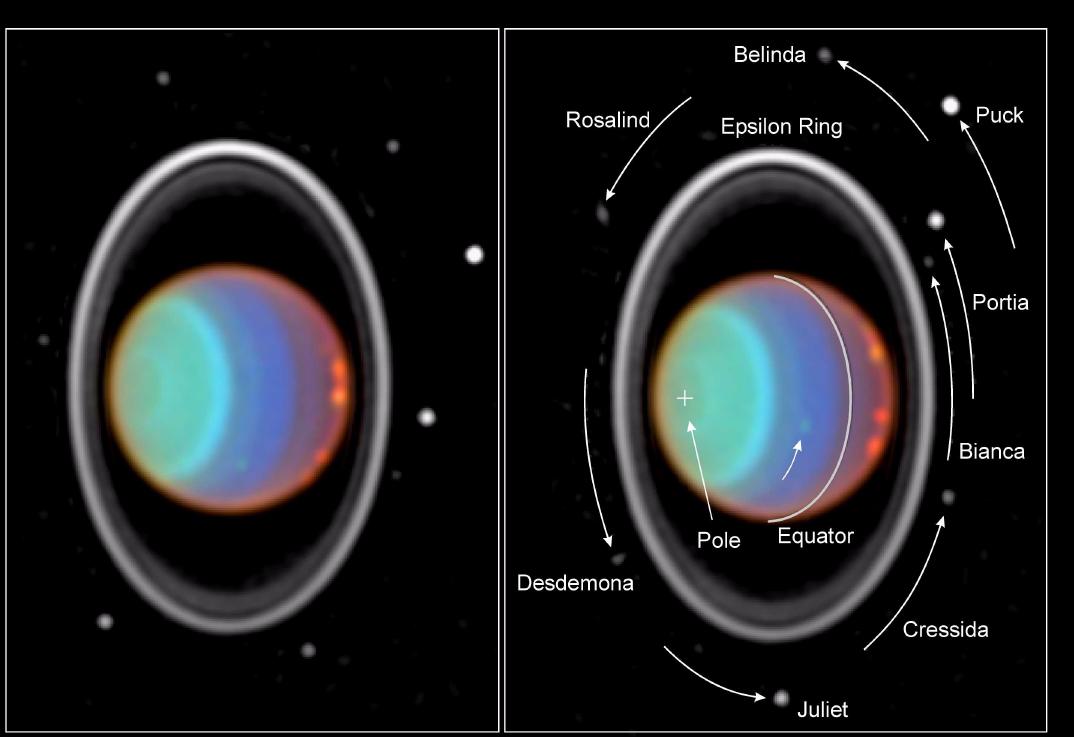
Via Wikimedia Commons: PIA01278 Hubble Tracks Clouds on Uranus by NASA/JPL/STScI, public domain.
Sources
- NASA Science. "Bianca," Uranus Moons. science.nasa.gov/uranus/moons/bianca/ (read 22 November 2026)
- NASA Space Science Data Coordinated Archive. "Uranian Satellite Fact Sheet." Updated 11 March 2023. nssdc.gsfc.nasa.gov/planetary/factsheet/uraniansatfact.html (read 22 November 2026)
- NASA Webb Mission Team. "New Moon Discovered Orbiting Uranus Using NASA's Webb Telescope." 19 August 2025. science.nasa.gov/blogs/webb/2025/08/19/new-moon-discovered-orbiting… (read 22 November 2026)
- Xavier, J., Amarante, A., Giuliatti Winter, S. and Ferreira, A. "Stability Mapping of the New Uranian Moon S/2025 U1 with Updated Masses for Cordelia, Ophelia, and Cressida." arXiv:2608.16078 (accepted to Astronomy & Astrophysics). arxiv.org/abs/2608.16078 (abstract read 22 November 2026)
