Compare versions
Version 2 → Version 3. Removed · Added. This shows the entry's text as it is written, including its formatting marks.
Version 2 · Version 3 · Version history
Side by side · Together
Neptune is the eighth and most distant planet from the Sun, an ice giant about four times wider than Earth.[1] It is the only planet in the solar system not visible to the naked eye, and it was the first planet found by mathematical prediction and not by routine observation of the sky.[1]
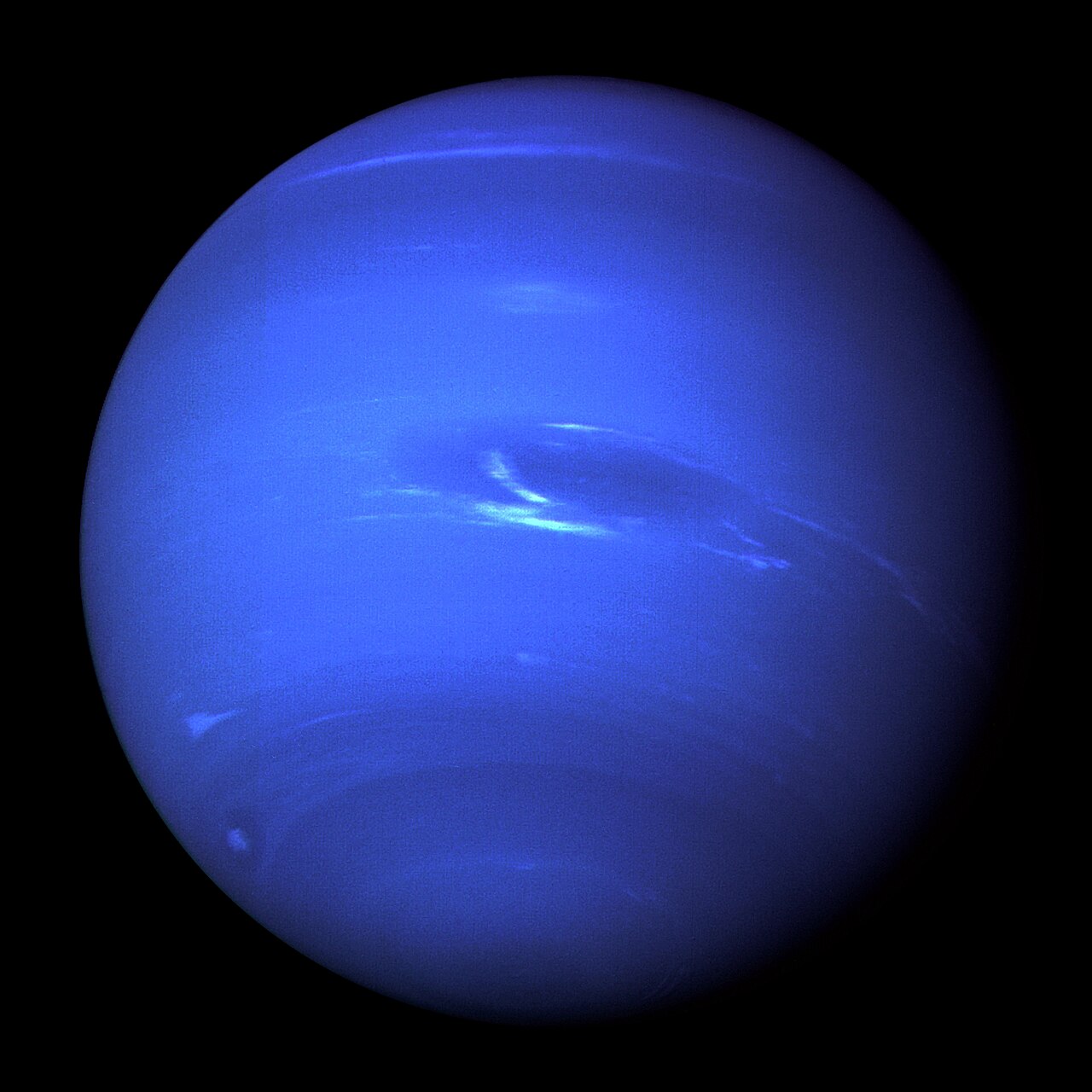
*Via Wikimedia Commons: [Neptune Full](https://commons.wikimedia.org/wiki/File:Neptune_Full.jpg) by NASA, public domain.*
## Size, distance and orbit
NASA gives Neptune an equatorial diameter of 49,528 kilometres (30,775 miles) and an average distance from the Sun of about 4.5 billion kilometres, or 30 astronomical units, so that sunlight takes about 4 hours to arrive.[1] The NASA fact sheet lists a mass of 102.409 × 10²⁴ kilograms, 17.15 times Earth's, an equatorial radius of 24,764 kilometres at the 1-bar level and a mean density of 1,638 kilograms per cubic metre; NASA calls it the densest of the giant planets.[1][3]
A day on Neptune lasts about 16 hours (16.11 hours in the fact sheet), and one orbit around the Sun takes about 165 Earth years, 60,190 days in NASA's facts and 60,189 days in the fact sheet.[1][3] NASA says Neptune completed its first orbit since its 1846 discovery in 2011.[1][4] Its rotation axis is tilted about 28 degrees to its orbit, similar to Earth and Mars, so it has seasons, each lasting more than 40 years.[1]
NASA also notes that Pluto's elliptical orbit sometimes brings it inside Neptune's, most recently from 1979 to 1999, and that the two can never collide because Pluto completes two laps of the Sun for every three that Neptune makes.[1]
## Discovery
NASA says Galileo recorded Neptune as a fixed star in 1612 and 1613.[1][4] More than 200 years later, because Uranus did not travel exactly as expected, the French mathematician Urbain Le Verrier proposed the position and mass of an unknown planet that could cause the deviations, and sent his predictions to Johann Gottfried Galle at the Berlin Observatory, who found Neptune on his first night of searching in 1846.[1] The fact sheet gives the date as 23 September 1846 and credits Galle, based on predictions by John Couch Adams and Le Verrier.[3] Seventeen days later, on 10 October 1846, William Lassell discovered Neptune's largest moon, Triton.[1][2]
## Structure and atmosphere
NASA says Neptune has no solid surface. Most of its mass, 80 percent or more, is a hot, dense fluid of "icy" materials (water, methane and ammonia) above a small rocky core with about Earth's mass. NASA also says scientists think there might be an ocean of super hot water under the cold clouds, kept from boiling away by the pressure.[1] The atmosphere is mostly hydrogen and helium with a little methane; the fact sheet gives 80.0 percent molecular hydrogen, 19.0 percent helium and 1.5 percent methane by volume.[1][3]
Methane absorbs red light and gives Neptune a blue hue. NASA says many Voyager 2 images show Neptune as a much deeper blue because the Voyager team adjusted them to bring out clouds and features, and that researchers who reprocessed the images in 2024 showed that Neptune and Uranus look much more alike than many thought.[1]
NASA calls Neptune the windiest world in the solar system, with winds that can reach more than 1,200 miles per hour (2,000 kilometres per hour); the fact sheet lists wind speeds of 0 to 580 metres per second, about 2,090 kilometres per hour.[1][3] In 1989 Voyager 2 saw a "Great Dark Spot" large enough to contain Earth; NASA says that storm has since disappeared and new ones have appeared elsewhere.[1] NASA's exploration timeline notes that Hubble found a new dark spot in 2016, the first new atmospheric vortex seen in the 21st century.[4]
## Magnetic field and auroras
NASA says Neptune's magnetic axis is tipped about 47 degrees from its rotation axis, and that its field is about 27 times as strong as Earth's.[1] The fact sheet gives a dipole tilt of 46.9 degrees and an offset of 0.485 Neptunian radii.[3]
On 26 March 2025 NASA reported that the James Webb Space Telescope had captured bright auroras on Neptune for the first time. The team found them at the planet's mid-latitudes, not at its poles, which NASA ties to the tilted magnetic axis. They also measured the temperature of the top of Neptune's atmosphere for the first time since Voyager 2 and reported that it had cooled by several hundred degrees, with the 2023 temperature just over half of that in 1989. The team suggests that colder temperature is likely why the auroras went undetected for so long.[5] Astronomers hope to observe Neptune with Webb over a full 11-year solar cycle.[5] The [James Webb Space Telescope](https://micwyn.com/t/3018/james-webb-space-telescope) is described in its own entry.
## Rings
NASA says Neptune has at least five main rings and four prominent ring arcs. From the planet outward the main rings are Galle, Leverrier, Lassell, Arago and Adams. The four arcs, Liberté, Egalité, Fraternité and Courage, lie in the outermost ring, Adams. NASA reports that scientists now think the gravity of the moon Galatea, just inward of that ring, stabilises the arcs, and that the rings are thought to be relatively young and short-lived.[1] NASA's timeline says astronomers found evidence for the rings in 1984, that Voyager 2 confirmed them in 1989, that Keck observations in 2005 showed some arcs had deteriorated, and that Webb's first image of Neptune in 2022 gave the clearest view of the rings in more than 30 years.[4]
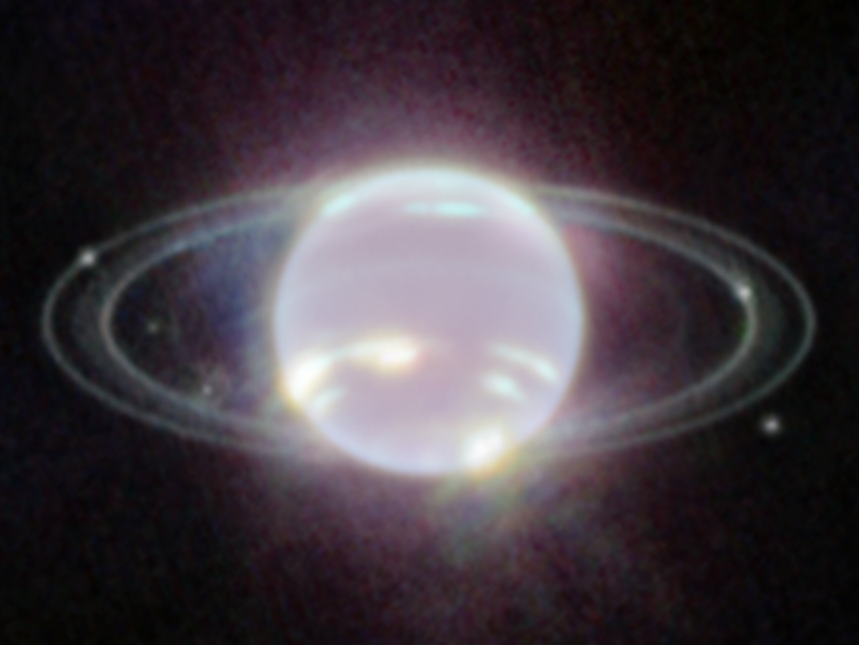
*Via Wikimedia Commons: [New Webb Image Captures Clearest View of Neptune’s Rings in Decades (c](https://commons.wikimedia.org/wiki/File:New_Webb_Image_Captures_Clearest_View_of_Neptune%E2%80%99s_Rings_in_Decades_(cropped).png) by IMAGE: NASA, ESA, CSA, STScI IMAGE PROCESSING: Joseph DePasq, public domain.*
## Moons
NASA's facts page and moons page both say Neptune has 16 known moons, 14 of them named.[1][2] Triton,[Triton](https://micwyn.com/t/3104/triton-moon), the largest, orbits in the opposite direction to the planet's rotation, the only large moon in the solar system to do so, which NASA says suggests it may once have been an independent object that Neptune captured. NASA says Voyager 2 saw geysers on Triton spewing icy material more than 8 kilometres up, and that its thin atmosphere is growing warmer for reasons not yet known.[1] The other named moons are Nereid, Naiad, Thalassa, Despina, Galatea, Larissa, Proteus, Halimede, Psamathe, Sao, Laomedeia, Neso and Hippocamp, named for lesser sea gods and nymphs of Greek mythology.[2] NASA's timeline says four moons (Laomedeia, Neso, Sao and Halimede) were found in 2002, Psamathe in 2003, and a 14th moon, provisionally S/2004 N 1, in 2013.[4] NASA's own page spells the first as "Laomedia".[4]
## Exploration
NASA says Voyager 2 became the first and only spacecraft to visit Neptune, passing about 4,800 kilometres (2,983 miles) above the planet's north pole in 1989 and confirming that it has faint rings.[4] Other information comes from the Hubble and Webb space telescopes and ground-based telescopes.[4] The sources read here do not describe any approved mission to return.
## Sources
1. NASA Science. "Neptune Facts." https://science.nasa.gov/neptune/facts/ (read 22 November 2026)
2. NASA Science. "Neptune Moons." https://science.nasa.gov/neptune/moons/ (read 22 November 2026)
3. NASA Space Science Data Coordinated Archive. "Neptune Fact Sheet." Updated 3 October 2024. https://nssdc.gsfc.nasa.gov/planetary/factsheet/neptunefact.html (read 22 November 2026)
4. NASA Science. "Neptune: Exploration." https://science.nasa.gov/neptune/exploration/ (read 22 November 2026)
5. NASA. "NASA's Webb Captures Neptune's Auroras For First Time." 26 March 2025. https://science.nasa.gov/missions/webb/nasas-webb-captures-neptunes-auroras-for-first-time/ (read 22 November 2026)
