Compare versions
Version 2 → Version 4 (current). Removed · Added. This shows the entry's text as it is written, including its formatting marks.
Version 2 · Version 4 (current) · Version history
Side by side · Together
Version 2Version 4 (current)
13 unchanged paragraphs
Triton is the largest moon of [Neptune](https://micwyn.com/t/3101/neptune), about 2,700 kilometres across, and the only large moon in the solar system that orbits in the opposite direction to its planet's rotation.[1] It is thought to be a captured Kuiper Belt object and is one of the few geologically active moons known.[1]
Triton is the largest moon of [Neptune](https://micwyn.com/t/3101/neptune), about 2,700 kilometres across, and the only large moon in the solar system that orbits in the opposite direction to its planet's rotation.[1] It is thought to be a captured Kuiper Belt object and is one of the few geologically active moons known.[1]
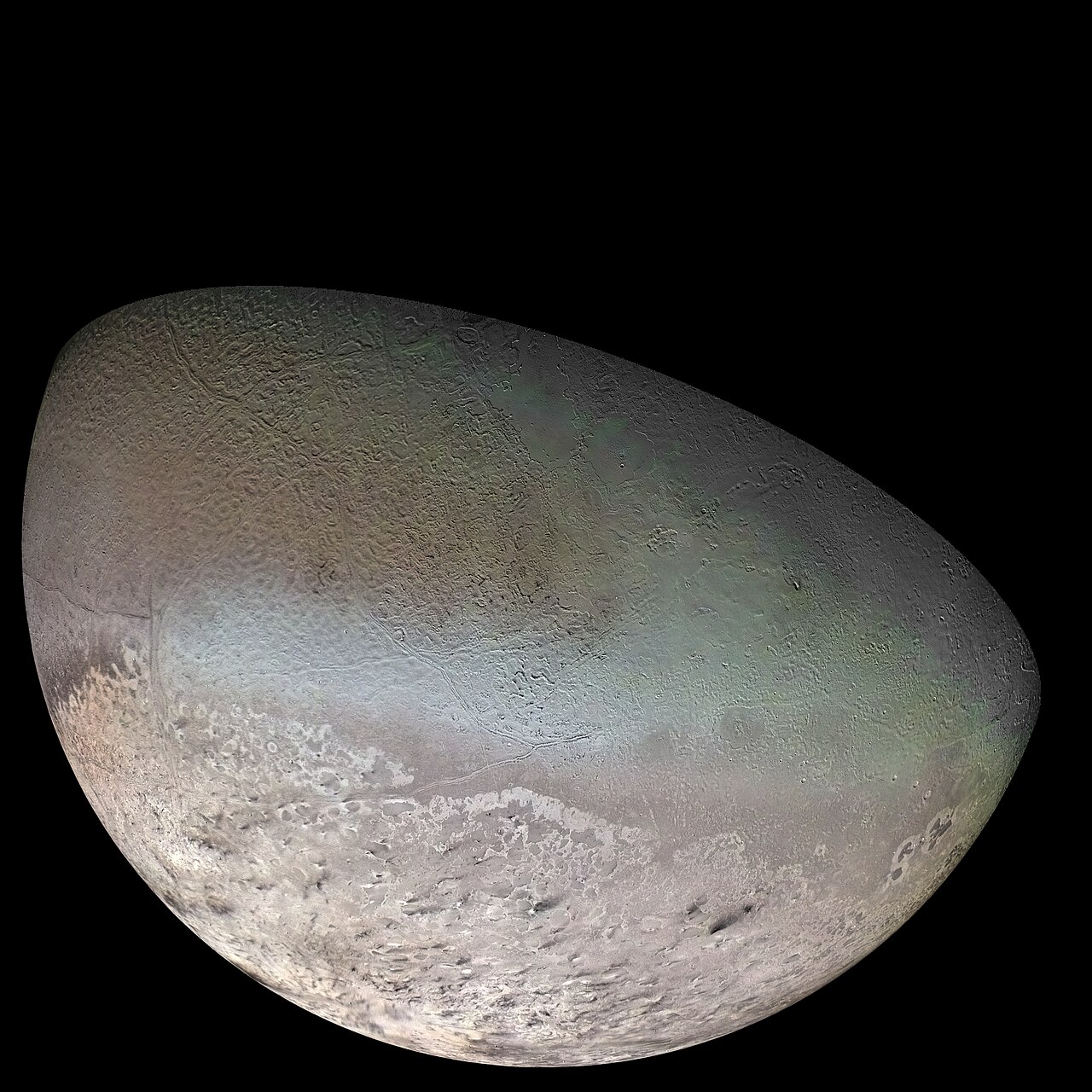

*Via Wikimedia Commons: [Triton moon mosaic Voyager 2 (large)](https://commons.wikimedia.org/wiki/File:Triton_moon_mosaic_Voyager_2_(large).jpg) by NASA / Jet Propulsion Lab / U.S. Geological Survey, public domain.*
*Via Wikimedia Commons: [Triton moon mosaic Voyager 2 (large)](https://commons.wikimedia.org/wiki/File:Triton_moon_mosaic_Voyager_2_(large).jpg) by NASA / Jet Propulsion Lab / U.S. Geological Survey, public domain.*
## Orbit and size
## Orbit and size
The NASA Neptunian Satellite Fact Sheet lists Triton at 354,760 kilometres from Neptune, or 14.328 Neptune radii, with an orbital period of 5.876854 days, retrograde, an inclination of 157.345 degrees and an eccentricity of 0.000016, which makes the orbit almost perfectly circular. Its rotation is synchronous, so one side always faces Neptune.[2] The sheet gives a radius of 1,353.4 kilometres, a mass of 214 × 10²⁰ kilograms, a mean density of 2,050 kilograms per cubic metre and a visual geometric albedo of 0.72.[2] NASA's Triton page gives a diameter of 1,680 miles (2,700 kilometres), a density about twice that of water, and a surface that reflects 70 percent of the sunlight that strikes it.[1]
The NASA Neptunian Satellite Fact Sheet lists Triton at 354,760 kilometres from Neptune, or 14.328 Neptune radii, with an orbital period of 5.876854 days, retrograde, an inclination of 157.345 degrees and an eccentricity of 0.000016, which makes the orbit almost perfectly circular. Its rotation is synchronous, so one side always faces Neptune.[2] The sheet gives a radius of 1,353.4 kilometres, a mass of 214 × 10²⁰ kilograms, a mean density of 2,050 kilograms per cubic metre and a visual geometric albedo of 0.72.[2] NASA's Triton page gives a diameter of 1,680 miles (2,700 kilometres), a density about twice that of water, and a surface that reflects 70 percent of the sunlight that strikes it.[1]
NASA says Triton's density, higher than that of almost any other satellite of an outer planet except Io and Europa, implies that it contains more rock in its interior than the icy satellites of Saturn and Uranus.[1]
NASA says Triton's density, higher than that of almost any other satellite of an outer planet except Io and Europa, implies that it contains more rock in its interior than the icy satellites of Saturn and Uranus.[1]
## A captured moon
## A captured moon
NASA says scientists think Triton is a Kuiper Belt object that Neptune's gravity captured millions of years ago, and that it shares many similarities with Pluto.[1] Its retrograde orbit is the clue: NASA says it suggests Triton may once have been an independent object.[3] NASA adds that, like our Moon, Triton is locked in synchronous rotation, and that because of its unusual orbital inclination both polar regions take turns facing the Sun.[1]
NASA says scientists think Triton is a Kuiper Belt object that Neptune's gravity captured millions of years ago, and that it shares many similarities with Pluto.[1] Its retrograde orbit is the clue: NASA says it suggests Triton may once have been an independent object.[3] NASA adds that, like our Moon, Triton is locked in synchronous rotation, and that because of its unusual orbital inclination both polar regions take turns facing the Sun.[1]
## Surface, atmosphere and geysers
## Surface, atmosphere and geysers
NASA says spacecraft images show a sparsely cratered surface with smooth volcanic plains, mounds and round pits formed by icy lava flows. Triton consists of a crust of frozen nitrogen over an icy mantle believed to cover a core of rock and metal.[1] Its thin atmosphere is mainly nitrogen with a little methane, which NASA says most likely comes from volcanic activity driven by seasonal heating by the Sun.[1] NASA says Triton, Io and Venus are the only bodies besides Earth known to be volcanically active at present.[1]
NASA says spacecraft images show a sparsely cratered surface with smooth volcanic plains, mounds and round pits formed by icy lava flows. Triton consists of a crust of frozen nitrogen over an icy mantle believed to cover a core of rock and metal.[1] Its thin atmosphere is mainly nitrogen with a little methane, which NASA says most likely comes from volcanic activity driven by seasonal heating by the Sun.[1] NASA says Triton, Io and Venus are the only bodies besides Earth known to be volcanically active at present.[1]
Triton is one of the coolest objects in the solar system. Voyager 2, the only spacecraft to fly past Neptune and Triton, measured surface temperatures of −235 °C in 1989 and found active geysers.[1] NASA's Neptune page says the geysers spewed icy material upward more than 8 kilometres, and that Triton's thin atmosphere has been detected from Earth several times since and is growing warmer, for reasons scientists do not yet know.[3]
Triton is one of the coolest objects in the solar system. Voyager 2, the only spacecraft to fly past Neptune and Triton, measured surface temperatures of −235 °C in 1989 and found active geysers.[1] NASA's Neptune page says the geysers spewed icy material upward more than 8 kilometres, and that Triton's thin atmosphere has been detected from Earth several times since and is growing warmer, for reasons scientists do not yet know.[3]
## Newer work
## Newer work
A paper published in August 2026 in a Springer Nature journal, by Lana Tilke, Kevin Trinh and Joseph O'Rourke, argues that Triton's capture and orbital circularisation may have caused intense heating, leading to a metallic core. Using thermal evolution models, they say Triton may have an active dynamo today, a magnetic field of the order of 1 microtesla at its surface, as Ganymede does. The abstract calls Triton one of the highest-priority candidate ocean worlds for exploration, says strong dynamo fields would complicate attempts to characterise a subsurface ocean with magnetometry on a single flyby, and says a dedicated mission to the Neptune system would allow better measurements.[4] This is a model-based argument, not a detection, and the abstract states that confirmation would be needed.
A paper published in August 2026 in a Springer Nature journal, by Lana Tilke, Kevin Trinh and Joseph O'Rourke, argues that Triton's capture and orbital circularisation may have caused intense heating, leading to a metallic core. Using thermal evolution models, they say Triton may have an active dynamo today, a magnetic field of the order of 1 microtesla at its surface, as Ganymede does. The abstract calls Triton one of the highest-priority candidate ocean worlds for exploration, says strong dynamo fields would complicate attempts to characterise a subsurface ocean with magnetometry on a single flyby, and says a dedicated mission to the Neptune system would allow better measurements.[4] This is a model-based argument, not a detection, and the abstract states that confirmation would be needed.
On 29 July 2026 a team led by Ryleigh Davis, then of Caltech and now at the University of California, San Diego, published a study in *Science Advances* that, according to a secondary report in *EarthSky*, found that Neptune's inner moons likely formed from the remnants of a former family of moons that Triton's capture destroyed. The report says Webb observations of Larissa, Galatea and Proteus found magnesium-rich clays on Larissa and Galatea and in the rings, but not on Proteus, and that Davis said that if Neptune once had a system of moons like Uranus's, Triton's capture would have destroyed it. The *EarthSky* report also says the process might have left Nereid as a sole survivor.[5] The original paper was not read for this entry.
On 29 July 2026 a team led by Ryleigh Davis, then of Caltech and now at the University of California, San Diego, published a study in *Science Advances* that, according to a secondary report in *EarthSky*, found that Neptune's inner moons likely formed from the remnants of a former family of moons that Triton's capture destroyed. The report says Webb observations of Larissa, Galatea and Proteus found magnesium-rich clays on Larissa and Galatea and in the rings, but not on Proteus, and that Davis said that if Neptune once had a system of moons like Uranus's, Triton's capture would have destroyed it. The *EarthSky* report also says the process might have left [Nereid](https://micwyn.com/t/3106/nereid-moon) as a sole survivor.[5] Caltech's own release of the same date, described in the [Proteus](https://micwyn.com/t/3105/proteus-moon) entry, gives the same account, saying the findings point to an original moon system demolished when Triton was likely captured.[6] The original paper was not read for this entry.
9 unchanged paragraphs
## Discovery and name
## Discovery and name
NASA says the British astronomer William Lassell discovered Triton on 10 October 1846, just 17 days after Neptune itself was found.[1] Lassell was a grand amateur astronomer who financed his telescopes with a fortune made in the brewery business.[3] NASA says Triton is named for the son of Poseidon, and that until the discovery of Nereid in 1949 it was commonly called simply "the satellite of Neptune".[1]
NASA says the British astronomer William Lassell discovered Triton on 10 October 1846, just 17 days after Neptune itself was found.[1] Lassell was a grand amateur astronomer who financed his telescopes with a fortune made in the brewery business.[3] NASA says Triton is named for the son of Poseidon, and that until the discovery of Nereid in 1949 it was commonly called simply "the satellite of Neptune".[1]
## Counting Neptune's moons
## Counting Neptune's moons
NASA's Triton page calls it the largest of Neptune's 13 moons, while NASA's Neptune pages say Neptune has 16 known moons.[1][3] The satellite fact sheet lists 16, including two with provisional designations, S/2002 N5 and S/2021 N1.[2] The Triton page's count appears to be out of date.
NASA's Triton page calls it the largest of Neptune's 13 moons, while NASA's Neptune pages say Neptune has 16 known moons.[1][3] The satellite fact sheet lists 16, including two with provisional designations, S/2002 N5 and S/2021 N1.[2] The Triton page's count appears to be out of date.
## See also
## See also
[Neptune](https://micwyn.com/t/3101/neptune) describes the planet, its rings and moons.
[Neptune](https://micwyn.com/t/3101/neptune) describes the planet, its rings and moons.
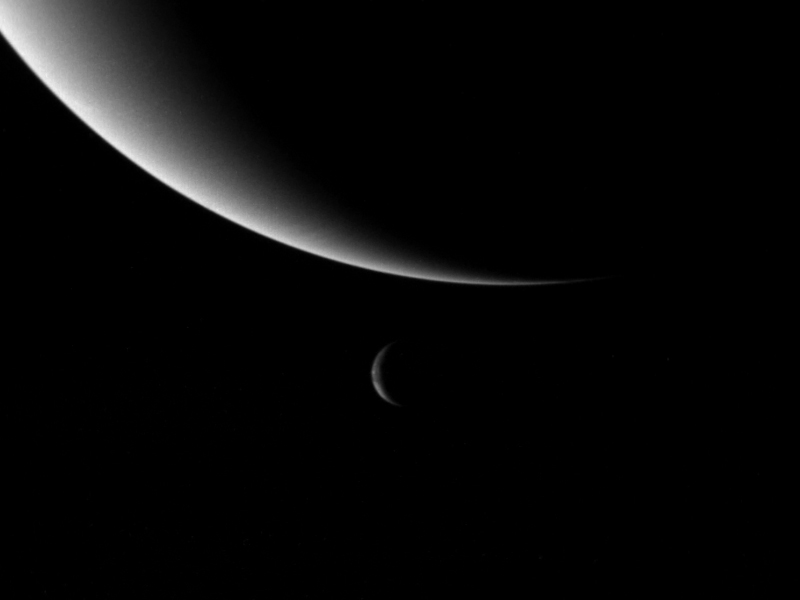

*Via Wikimedia Commons: [Voyager 2 Neptune and Triton](https://commons.wikimedia.org/wiki/File:Voyager_2_Neptune_and_Triton.jpg) by NASA / Jet Propulsion Lab, public domain.*
*Via Wikimedia Commons: [Voyager 2 Neptune and Triton](https://commons.wikimedia.org/wiki/File:Voyager_2_Neptune_and_Triton.jpg) by NASA / Jet Propulsion Lab, public domain.*
## Sources
## Sources
1. NASA Science. "Triton," Neptune Moons. https://science.nasa.gov/neptune/moons/triton/ (read 22 November 2026)
2. NASA Space Science Data Coordinated Archive. "Neptunian Satellite Fact Sheet." Updated 11 March 2024. https://nssdc.gsfc.nasa.gov/planetary/factsheet/neptuniansatfact.html (read 22 November 2026)
3. NASA Science. "Neptune Moons" and "Neptune Facts." https://science.nasa.gov/neptune/moons/ and https://science.nasa.gov/neptune/facts/ (read 22 November 2026)
4. Tilke, L. J., Trinh, K. T. and O'Rourke, J. G. "A modern dynamo at Triton as a consequence of its capture by Neptune." Published August 2026. CaltechAUTHORS record (metadata only). https://authors.library.caltech.edu/records/c8ztd-sg938 (abstract read 22 November 2026)
5. EarthSky. "Were Neptune's inner moons born from an ancient cataclysm?" https://earthsky.org/space/neptunes-inner-moons-triton-james-webb-space-telescope/ (read 22 November 2026; a secondary report on Davis et al., *Science Advances*, 29 July 2026)
6. Caltech. "Neptune's inner moons may be shattered remains of ancient icy worlds." 29 July 2026. https://www.caltech.edu/about/news/neptunes-inner-moons-may-be-shattered-remains-of-ancient-icy-worlds (read 22 November 2026)
