Version 2
Nov 23, 2026. Compare with the current version · Version history
Proteus is one of Neptune's largest moons, though not as large as Triton: an irregularly shaped, heavily cratered and very dark body found by Voyager 2 in 1989.[1] NASA says it has an odd box-like shape and would become a sphere with only a little more mass.[1]
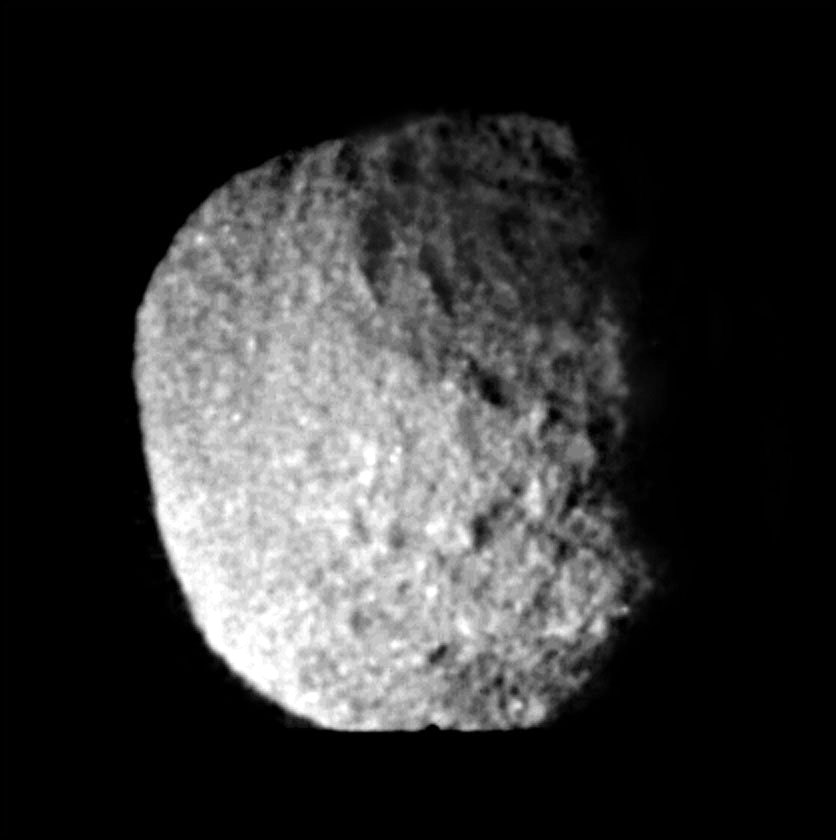
Via Wikimedia Commons: Proteus (Voyager 2) by Voyager 2, NASA, public domain.
Orbit and size
The NASA Neptunian Satellite Fact Sheet lists Proteus at 117,647 kilometres from Neptune, or 4.751 Neptune radii, with an orbital period of 1.122315 days (about 27 hours), an inclination of 0.04 degrees and an eccentricity of 0.0004.[2] It gives radii along three axes of 220, 208 and 202 kilometres, a mass of 0.5 × 10²⁰ kilograms and a visual geometric albedo of 0.10.[2] NASA says Proteus circles Neptune in the same direction as the planet rotates and stays close to its equatorial plane.[1]
A very dark body
NASA says Proteus is irregularly shaped and heavily cratered but shows no sign of geological modification, and that it is one of the darkest objects in the solar system, reflecting only 6 percent of the sunlight that hits it, like Saturn's moon Phoebe.[1] The fact sheet's albedo of 0.10 is different from NASA's 6 percent, and the sources read do not say why; the two numbers may not measure the same thing.[1][2]
Webb and a shattered moon system
On 29 July 2026 Caltech announced results from a Webb Space Telescope study, led by Ryleigh Davis, of Neptune's rings and three of its small inner moons, Larissa, Galatea and Proteus, published in Science Advances.[3] The release says the moons' composition is unique among outer solar system bodies. It says the findings point to an original moon system of Neptune that was demolished when Triton was likely captured, and that remnants then came together to form the inner moons seen today.[3]
According to the release, magnesium-rich clay minerals called phyllosilicates were found in the spectra of Larissa, Galatea and the rings, which form only in the presence of liquid water, yet no water ice was indicated on any of the three moons or the rings. The clays were not present on Proteus, the largest of the three, which the team says suggests it may have reaccreted from a different region of the debris disk or been heated afterwards in a way that destroyed any clay. The team also found that all three moons share a hydrated mineral that it could not identify, which Davis said does not match anything in the team's spectral libraries.[3] Davis said that only about 1 percent of the material might have stayed in the system if Triton smashed up large original moons.[3] A report in EarthSky adds that the researchers consider a destroyed system of ancient moons the most likely explanation, with a less likely alternative being that a single Pluto-sized Kuiper Belt object was shredded by Neptune.[4] The original paper was not read for this entry.
Discovery and name
NASA says Voyager 2 discovered Proteus in 1989, which is unusual because the smaller moon Nereid was found 33 years earlier with an Earth-based telescope. NASA says Proteus was most likely overlooked because it is so dark and so far away.[1] The Caltech release says Voyager 2 discovered six new moons in 1989, five of them tiny ones orbiting just outside the main rings, and names Larissa, Galatea and Proteus among them.[3] Proteus was originally designated S/1989 N 1.[1] It is named for the shape-changing sea god of Greek mythology.[1] NASA's Proteus page describes a Voyager 2 image taken from 870,000 kilometres (540,000 miles) at a resolution of 8 kilometres per pixel.[1]
See also
Neptune describes the planet, its rings and moons, and Triton is its largest moon.
Sources
- NASA Science. "Proteus," Neptune Moons. science.nasa.gov/neptune/moons/proteus/ (read 22 November 2026)
- NASA Space Science Data Coordinated Archive. "Neptunian Satellite Fact Sheet." Updated 11 March 2024. nssdc.gsfc.nasa.gov/planetary/factsheet/neptuniansatfact.html (read 22 November 2026)
- Caltech. "Neptune's inner moons may be shattered remains of ancient icy worlds." 29 July 2026. caltech.edu/about/news/neptunes-inner-moons-may-be-shattered-remain… (read 22 November 2026)
- EarthSky. "Were Neptune's inner moons born from an ancient cataclysm?" earthsky.org/space/neptunes-inner-moons-triton-james-webb-space-tel… (read 22 November 2026)
