Version 2
Nov 23, 2026. Compare with the current version · Version history
Pluto is a dwarf planet in the Kuiper Belt, about 2,377 kilometres across, discovered in 1930 and long counted as the solar system's ninth planet before the International Astronomical Union reclassified it in 2006.[1] NASA's New Horizons spacecraft flew past it in 2015, the only visit so far.[1][2]
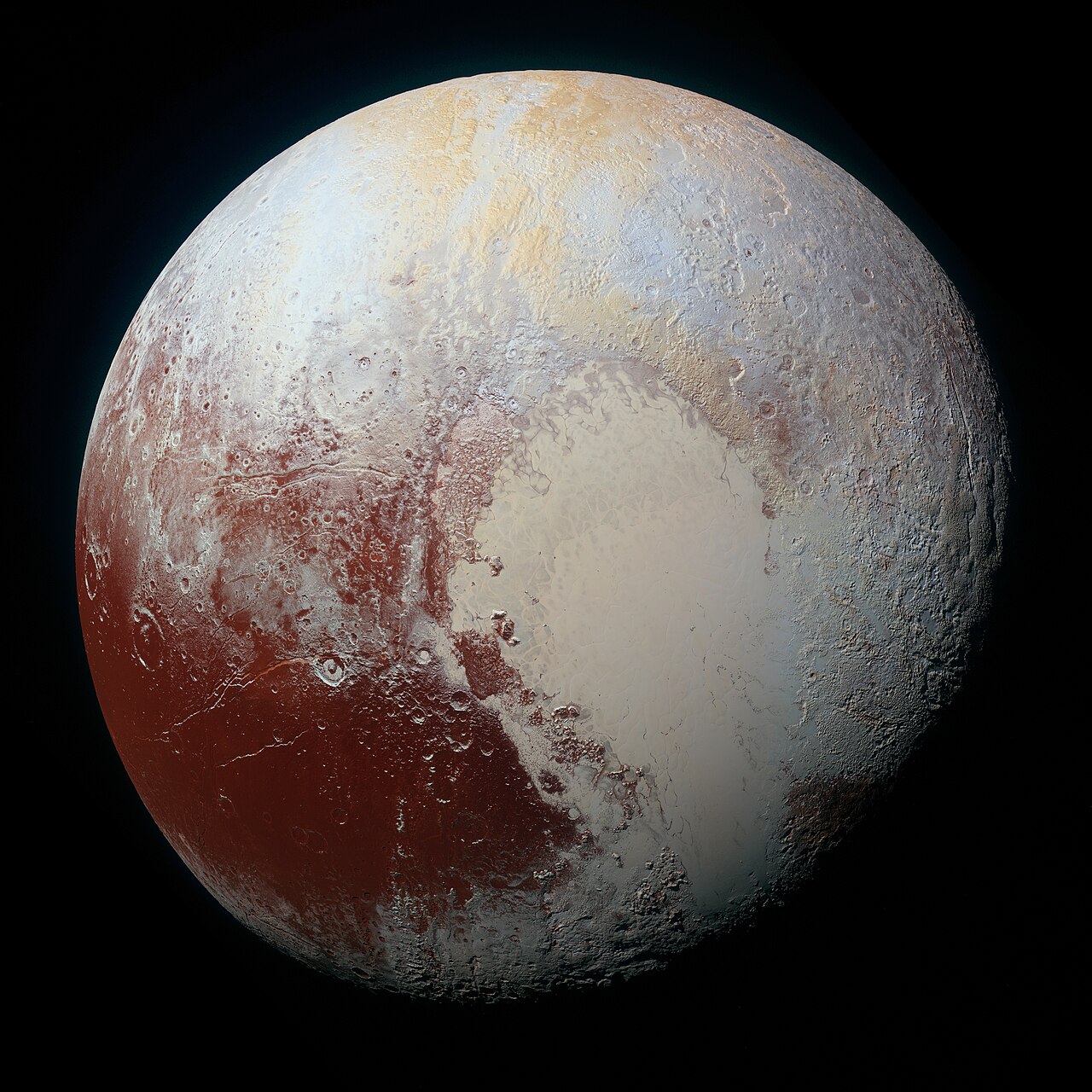
Via Wikimedia Commons: Pluto-01 Stern 03 Pluto Color TXT by NASA / Johns Hopkins University Applied Physics Laboratory /, public domain.
Size, distance and orbit
NASA gives Pluto an equatorial diameter of about 1,477 miles (2,377 kilometres), about one-fifth of Earth's width, and an average distance from the Sun of about 5.9 billion kilometres, or 39 astronomical units, so that sunlight takes about 5.5 hours to arrive.[1] The NASA fact sheet lists a radius of 1,188 kilometres, a mass of 0.01303 × 10²⁴ kilograms, a mean density of 1,854 kilograms per cubic metre and a surface gravity of 0.62 metres per second squared, about 6 percent of Earth's.[3] NASA says Pluto's mass is about one-sixth that of Earth's Moon and its diameter about two-thirds.[1]
Pluto's oval orbit takes 248 years, bringing it as far as 49.3 astronomical units from the Sun and as close as 30, and is tilted to the plane of the planets; the fact sheet gives an inclination of 17.16 degrees and an eccentricity of 0.2444.[1][3] NASA says that from 1979 to 1999 Pluto was near perihelion, closer to the Sun than Neptune was.[1] A day on Pluto is about 153 hours. NASA says Pluto's axis is tilted 57 degrees and that it rotates retrograde, east to west, like Venus and Uranus; the fact sheet gives an obliquity of 119.51 degrees and an inclination of the equator of 57.47 degrees, which describe the same orientation in two ways.[1][3]
Discovery and name
The fact sheet credits Clyde Tombaugh with Pluto's discovery on 18 February 1930.[3] NASA says it was named by Venetia Burney, an 11-year-old girl in Oxford, England, who suggested the name over breakfast on 14 March 1930, the day her grandfather announced the discovery of the ninth planet; her grandfather forwarded the name to Lowell Observatory, where it was chosen.[1] NASA says Pluto is the Roman god of the underworld, equivalent to the Greek Hades.[1]
Reclassification
NASA says the discovery of similar worlds deeper in the Kuiper Belt led the International Astronomical Union to reclassify Pluto as a dwarf planet in 2006. It quotes the resolution's definition of a dwarf planet as an object in orbit around the Sun that is large enough to pull itself into a nearly round shape but has not cleared its orbit of debris, and says Pluto falls into that category because it lies in the trans-Neptunian region where other objects might cross its orbit.[1]
Surface and interior
NASA says Pluto's surface has mountains, valleys, plains and craters, with temperatures as cold as −226 to −240 °C, and that its tallest mountains, blocks of water ice sometimes coated with frozen methane, rise 2 to 3 kilometres. It reports troughs and valleys up to 600 kilometres long and craters up to 260 kilometres across, some showing erosion and filling, which it says suggests tectonic forces are slowly resurfacing Pluto, and plains of frozen nitrogen with no craters that show convection structures.[1] NASA says Pluto probably has a rocky core surrounded by a mantle of water ice, coated with methane and nitrogen frost, and that some think there could be an ocean deep inside.[1]
On 5 August 2026 Southwest Research Institute reported a study in the Planetary Science Journal, led by Alan Stern, principal investigator of New Horizons, of New Horizons images of the northern part of Sputnik Planitia, the large heart-shaped nitrogen glacier. It says dark linear and diffuse features there appear to have been occasionally and temporarily wetted by a liquid, most likely liquid nitrogen, rising through cracks from below. The release calls this the first evidence of liquid recently flowing on Pluto, says computer models show nitrogen ice at the base of the glacier can melt, and says the surface of Sputnik Planitia is probably less than one million years old. It also says liquid nitrogen rain is physically impossible at Pluto.[5] This is a model-supported interpretation of images, not a direct observation of liquid, and the release notes that half of Pluto remains unmapped at high resolution.[5]
Atmosphere
NASA says Pluto's thin atmosphere, mainly nitrogen with some methane and carbon monoxide, expands as Pluto nears the Sun and collapses as it moves away, rather like a comet's, and that much of it may freeze and fall as snow on the surface during the part of the year when Pluto is far from the Sun.[1] The fact sheet gives a surface pressure of about 13 microbar, a composition of 99 percent nitrogen, 0.5 percent methane and 0.05 percent carbon monoxide, and a surface temperature of 24 to 38 kelvin.[3]
EarthSky reports on a study in the Planetary Science Journal, published on 31 July 2026 and led by Amanda Sickafoose of the Planetary Science Institute, that used 10 stellar occultations since 2017 to find that Pluto's atmospheric pressure stayed constant from the 2015 flyby into 2021, and then fell by 16 percent between mid-2021 and July 2023. The report says Pluto was closest to the Sun on 5 September 1989, and that the team may have seen the first signs of the atmosphere's eventual collapse as Pluto recedes into colder regions.[6] The original paper was not read for this entry.
Moons
NASA says Pluto has five known moons: Charon, Nix, Hydra, Kerberos and Styx.[1] Charon is about half Pluto's size, making it the largest known moon relative to its parent planet in the solar system, and orbits at a distance of 19,640 kilometres; its orbit of 153 hours matches Pluto's rotation, so Charon hovers over the same spot on Pluto.[1] NASA says Pluto and Charon are often called a double planet, and that the four smaller moons are less than 160 kilometres across, irregularly shaped and not tidally locked.[1] NASA says the moon system might have formed by a collision between Pluto and another similar-sized body early in the solar system's history.[1] The fact sheet lists Charon's mean distance as 19,596 kilometres and its radius as 606 kilometres.[3] NASA says there are no known rings around Pluto.[1] The moons are named for figures of the underworld, and NASA gives the first discovery date for a Pluto moon as 22 June 1978, for Charon.[4]
Exploration
NASA says New Horizons was the first and so far only mission to explore Pluto and the first to explore the Kuiper Belt, the region beyond the giant planets, and that it flew past Pluto on 14 July 2015.[1][2] NASA's image of Pluto's "heart" was taken on 13 July 2015 from 768,000 kilometres.[1]
See also
Neptune is the planet whose orbit Pluto crosses; NASA says Pluto can never collide with it because Pluto completes two laps of the Sun for every three Neptune makes. Triton is described by NASA as a captured Kuiper Belt object with many similarities to Pluto. Nereid is discussed in a 2026 Webb study that noted faint spectral similarities to Charon.
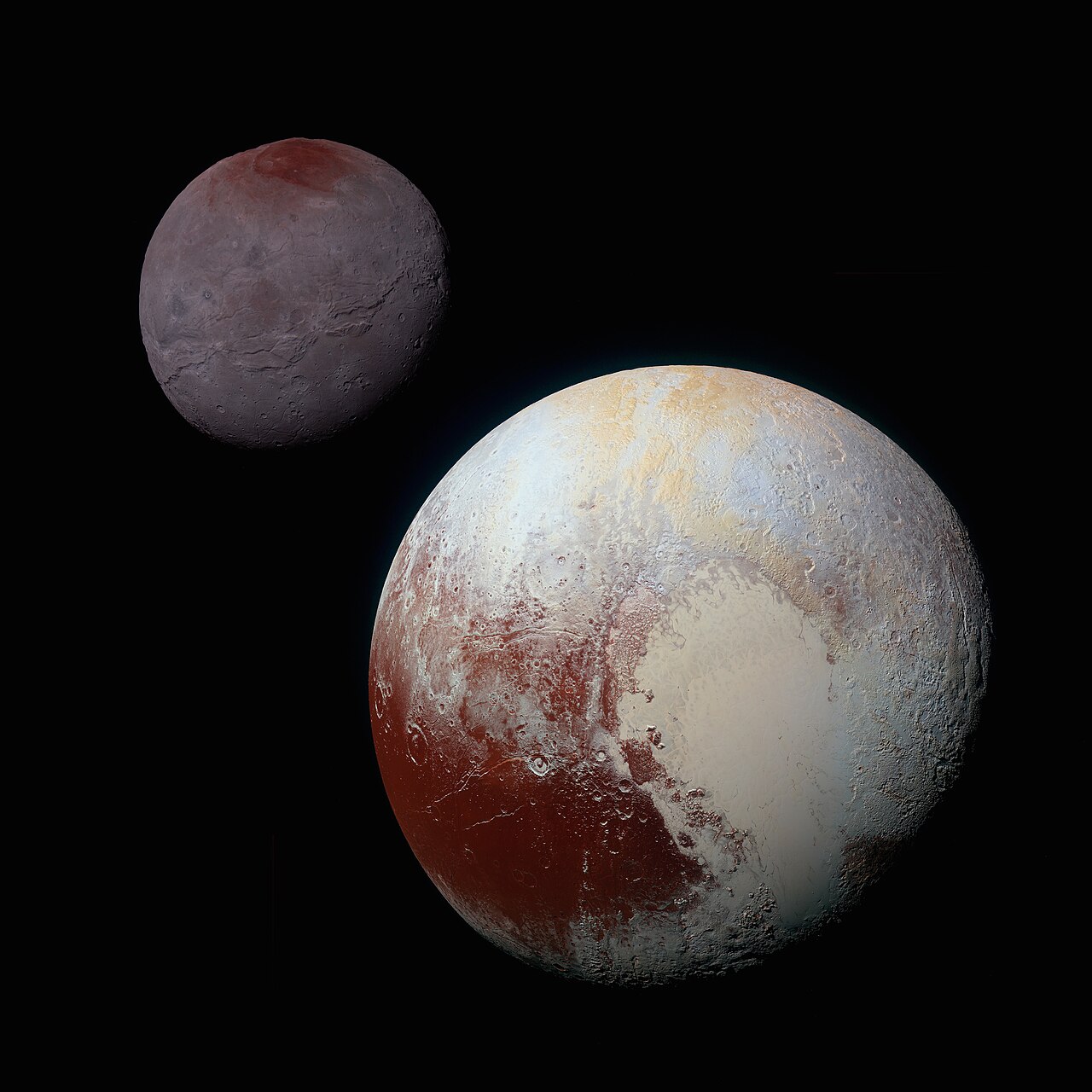
Via Wikimedia Commons: Pluto-Charon-v2-10-1-15 by NASA / Johns Hopkins University Applied Physics Laboratory /, public domain.

Via Wikimedia Commons: Pluto’s Blue Sky by NASA/JHUAPL/SwRI, public domain.
Sources
- NASA Science. "Pluto Facts." science.nasa.gov/dwarf-planets/pluto/facts/ (read 23 November 2026)
- NASA Science. "Pluto." science.nasa.gov/dwarf-planets/pluto/ (read 23 November 2026)
- NASA Space Science Data Coordinated Archive. "Pluto Fact Sheet." nssdc.gsfc.nasa.gov/planetary/factsheet/plutofact.html (read 23 November 2026)
- NASA Science. "Pluto Moons." science.nasa.gov/dwarf-planets/pluto/moons/ (read 23 November 2026)
- Southwest Research Institute. "SwRI study finds evidence of liquid recently flowing on Pluto's surface." 5 August 2026. swri.org/node/12948511 (read 23 November 2026)
- EarthSky. "Pluto's atmosphere is thinning toward a collapse." earthsky.org/space/plutos-atmosphere-thinning-as-predicted/ (read 23 November 2026; a secondary report on Sickafoose et al., Planetary Science Journal, 31 July 2026)
