Compare versions
Version 1 → Version 5 (current). Removed · Added. This shows the entry's text as it is written, including its formatting marks.
Version 1 · Version 5 (current) · Version history
Side by side · Together
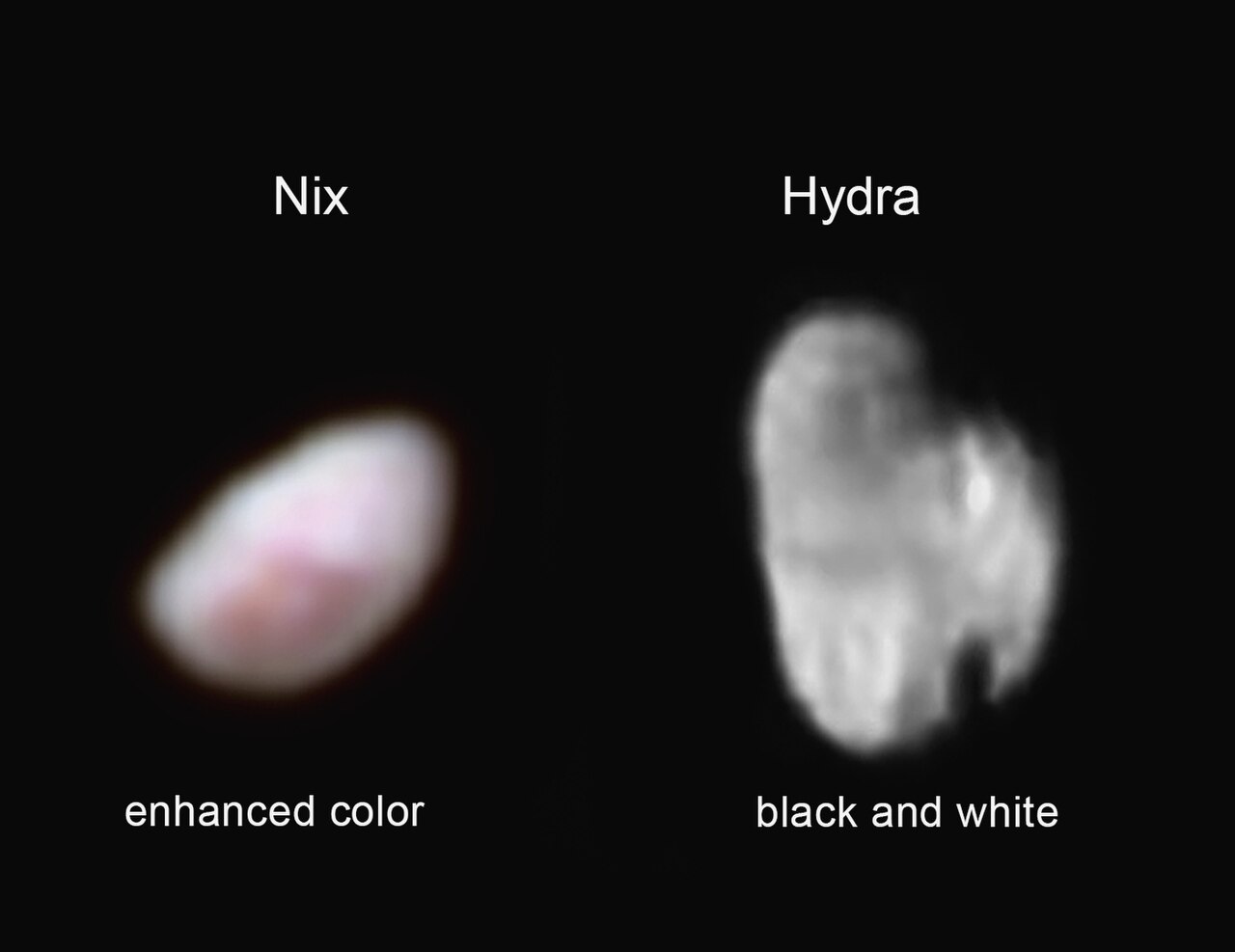
Nix is the inner of the two small moons found orbiting [Pluto](https://micwyn.com/t/3136/pluto) in 2005 and is one of the moons that, according to Hubble data, tumbles chaotically as it orbits.[1][3] NASA's New Horizons spacecraft imaged it in 2015.[1]
## Orbit and size
The NASA Pluto Fact Sheet gives Nix a semi-major axis of 48,690 kilometres,kilometres (the sheet says its orbital values are barycentric, measured from the centre of Plutomass andof Charon'sthe sharedPluto orbit,system), an orbital period of 24.85 days, a mean diameter given as 48.4 × 33.8 × 31.4 kilometres and a geometric albedo of 0.56.[2] NASA's Nix page says Nix and Hydra are roughly 5,000 times fainter than Pluto, about two to three times as far from Pluto as the large moon [Charon](https://micwyn.com/t/3137/charon-moon), and roughly 20 to 70 miles (32 to 113 kilometres) wide.[1] The fact sheet's figures for Nix lie within that range.[2]
## Chaotic tumbling
NASA's Hubble team reported in June 2015, in a study to be published in *Nature* by Mark Showalter of the SETI Institute and Douglas Hamilton of the University of Maryland, that Nix and Hydra wobble unpredictably. The moons are embedded in a gravitational field that shifts constantly because Pluto and Charon whirl about their common centre of gravity, and the effect is strengthened by the moons' football-like, rather than spherical, shapes. The researchers analysed Hubble images of Pluto from 2005 to 2012, comparing unpredictable changes in the moons' brightness with models of spinning bodies in complex gravitational fields.[3] NASA says scientists believed it likely that Kerberos and Styx are in a similar situation.[3] The same report says three of Pluto's moons are locked in an orbital resonance, a precise ratio between their orbital periods, and says Hubble data showed Kerberos to be as dark as a charcoal briquette while the other moons are as bright as sand.[3] New Horizons images later showed [Kerberos](https://micwyn.com/t/3140/kerberos-moon) to be small and bright, about as reflective as the other small moons, so that early darkness estimate was wrong.
The fact sheet lists a rotation period of 1.83 days for Nix, but the 2015 finding means such a single figure cannot describe a steady spin.[2][3] TheA sources2016 readpaper doin not*Science* sayon whatthe New Horizons'Horizons laterobservations imagesof showedPluto's small moons, whose abstract is posted on arXiv, reports that all four small moons rotate much faster than synchronously, with rotational poles clustered nearly at right angles to the common pole directions of Pluto and Charon, and that crater densities on Nix and Hydra imply surface ages of at least about Nix's4 rotation.billion years.[4] It gives an equivalent spherical diameter of about 40 kilometres for Nix, says all four moons are highly elongated with axis ratios of about 2, and reports albedos of about 50 to 90 percent, suggestive of water-ice surfaces.[4] The moons' formation is described as following the collision that produced the Pluto–Charon pair, and [Hydra](https://micwyn.com/t/3139/hydra-moon) is described in its own entry.[4]
## What New Horizons saw
NASA says one of the best New Horizons images of Nix shows a reddish spot, shown in enhanced colour by the Ralph instrument, which has attracted the interest of mission scientists.[1] The sources read give no explanation for it.
## Discovery and name
NASA says Hal Weaver and a large team of astronomers discovered Nix in June 2005 using the Hubble Space Telescope.[1] They were so small and faint that scientists combined a short exposure of Pluto and Charon with a long exposure of Nix and Hydra to show them all together.[1] NASA's 2015 Hubble report says Hubble discovered Nix and Hydra in 2005, Kerberos in 2011 and Styx in 2012, during a search for objects that could be hazards to New Horizons.[3] Nix is named for the Greek goddess of darkness and night and mother of Charon.[1]
## See also
[Pluto](https://micwyn.com/t/3136/pluto) describes the dwarf planet and its five moons, and [Charon](https://micwyn.com/t/3137/charon-moon) is the largest.
## Sources
1. NASA Science. "Nix," Pluto Moons. https://science.nasa.gov/dwarf-planets/pluto/moons/nix/ (read 23 November 2026)
2. NASA Space Science Data Coordinated Archive. "Pluto Fact Sheet." https://nssdc.gsfc.nasa.gov/planetary/factsheet/plutofact.html (read 23 November 2026)
3. NASA Science. "NASA's Hubble Finds Pluto's Moons Tumbling in Absolute Chaos." 3 June 2015. https://science.nasa.gov/missions/hubble/nasas-hubble-finds-plutos-moons-tumbling-in-absolute-chaos/ (read 23 November 2026)
4. Weaver, H. A., et al. "The Small Satellites of Pluto as Observed by New Horizons." *Science* 351, aae0030 (2016); arXiv:1604.05366. https://arxiv.org/abs/1604.05366 (abstract read 23 November 2026)
