Compare versions
Version 1 → Version 4 (current). Removed · Added. This shows the entry's text as it is written, including its formatting marks.
Version 1 · Version 4 (current) · Version history
Side by side · Together
Version 1Version 4 (current)
10 unchanged paragraphs
Hydra is the outer of the two small moons discovered orbiting [Pluto](https://micwyn.com/t/3136/pluto) in 2005, and the outermost of Pluto's five moons, with a surface of nearly pristine water ice.[1][2][3] It is an irregular, elongated body about 40 kilometres across by volume.[4]
Hydra is the outer of the two small moons discovered orbiting [Pluto](https://micwyn.com/t/3136/pluto) in 2005, and the outermost of Pluto's five moons, with a surface of nearly pristine water ice.[1][2][3] It is an irregular, elongated body about 40 kilometres across by volume.[4]
## Orbit and size
## Orbit and size
The NASA Pluto Fact Sheet gives Hydra a semi-major axis of 64,721 kilometres, measured as barycentric orbital values from the centre of mass of the Pluto system, an orbital period of 38.20 days, a mean diameter given as 62.0 × 36.5 × 29.3 kilometres, a rotation period of 0.43 days and a geometric albedo of 0.83.[2] NASA's Hydra page says Nix and Hydra are roughly 5,000 times fainter than Pluto, two to three times as far from Pluto as [Charon](https://micwyn.com/t/3137/charon-moon), and roughly 20 to 70 miles (32 to 113 kilometres) wide.[1] A 2016 paper in *Science* on the New Horizons observations of Pluto's small moons, whose abstract is posted on arXiv, gives equivalent spherical diameters of about 40 kilometres for Hydra and [Nix](https://micwyn.com/t/3138/nix-moon) and says all four small moons are highly elongated, with maximum to minimum axis ratios of about 2.[4] The fact sheet's three dimensions give a mean near 40 kilometres, consistent with that figure.[2][4]
The NASA Pluto Fact Sheet gives Hydra a semi-major axis of 64,721 kilometres, measured as barycentric orbital values from the centre of mass of the Pluto system, an orbital period of 38.20 days, a mean diameter given as 62.0 × 36.5 × 29.3 kilometres, a rotation period of 0.43 days and a geometric albedo of 0.83.[2] NASA's Hydra page says Nix and Hydra are roughly 5,000 times fainter than Pluto, two to three times as far from Pluto as [Charon](https://micwyn.com/t/3137/charon-moon), and roughly 20 to 70 miles (32 to 113 kilometres) wide.[1] A 2016 paper in *Science* on the New Horizons observations of Pluto's small moons, whose abstract is posted on arXiv, gives equivalent spherical diameters of about 40 kilometres for Hydra and [Nix](https://micwyn.com/t/3138/nix-moon) and says all four small moons are highly elongated, with maximum to minimum axis ratios of about 2.[4] The fact sheet's three dimensions give a mean near 40 kilometres, consistent with that figure.[2][4]
## A surface of water ice
## A surface of water ice
NASA says that infrared spectra gathered by New Horizons' Ralph/LEISA instrument on 14 July 2015 from 240,000 kilometres show that Hydra's surface is dominated by nearly pristine crystalline water ice, with a broad absorption from 1.50 to 1.60 micrometres and a narrower feature at 1.65 micrometres.[3] NASA says the spectrum resembles that of Charon but with even deeper water-ice bands, which suggests larger ice grains or more reflection at certain angles. It adds that Hydra is thought to have formed in an icy debris disk produced when water-rich mantles were stripped from the two bodies that collided to form the Pluto–Charon binary about 4 billion years ago, and that Hydra's deep water bands and high reflectance imply relatively little contamination by dark material of the kind that has accumulated on Charon's surface.[3] One theory NASA gives is that micrometeorite impacts continually refresh Hydra's surface by blasting off contaminants, which would have been ineffective on Charon because its much stronger gravity retains the debris.[3] The 2016 paper reports albedos of about 50 to 90 percent for all four small moons, suggesting water-ice surfaces, and surface ages of at least about 4 billion years for Nix and Hydra from crater densities.[4]
NASA says that infrared spectra gathered by New Horizons' Ralph/LEISA instrument on 14 July 2015 from 240,000 kilometres show that Hydra's surface is dominated by nearly pristine crystalline water ice, with a broad absorption from 1.50 to 1.60 micrometres and a narrower feature at 1.65 micrometres.[3] NASA says the spectrum resembles that of Charon but with even deeper water-ice bands, which suggests larger ice grains or more reflection at certain angles. It adds that Hydra is thought to have formed in an icy debris disk produced when water-rich mantles were stripped from the two bodies that collided to form the Pluto–Charon binary about 4 billion years ago, and that Hydra's deep water bands and high reflectance imply relatively little contamination by dark material of the kind that has accumulated on Charon's surface.[3] One theory NASA gives is that micrometeorite impacts continually refresh Hydra's surface by blasting off contaminants, which would have been ineffective on Charon because its much stronger gravity retains the debris.[3] The 2016 paper reports albedos of about 50 to 90 percent for all four small moons, suggesting water-ice surfaces, and surface ages of at least about 4 billion years for Nix and Hydra from crater densities.[4]
## Spin and tumbling
## Spin and tumbling
The 2016 paper says the small moons rotate much faster than synchronously, with rotational poles clustered nearly at right angles to the common pole directions of Pluto and Charon, and that its results reinforce the idea that the small moons formed after the collision that produced the Pluto–Charon pair.[4] NASA's Hubble team reported in 2015 that Hydra and Nix wobble unpredictably in the shifting gravity of Pluto and Charon.[5] The Nix entry describes this in more detail.
The 2016 paper says the small moons rotate much faster than synchronously, with rotational poles clustered nearly at right angles to the common pole directions of Pluto and Charon, and that its results reinforce the idea that the small moons formed after the collision that produced the Pluto–Charon pair.[4] NASA's Hubble team reported in 2015 that Hydra and Nix wobble unpredictably in the shifting gravity of Pluto and Charon.[5] The Nix entry describes this in more detail.
## Discovery and name
## Discovery and name
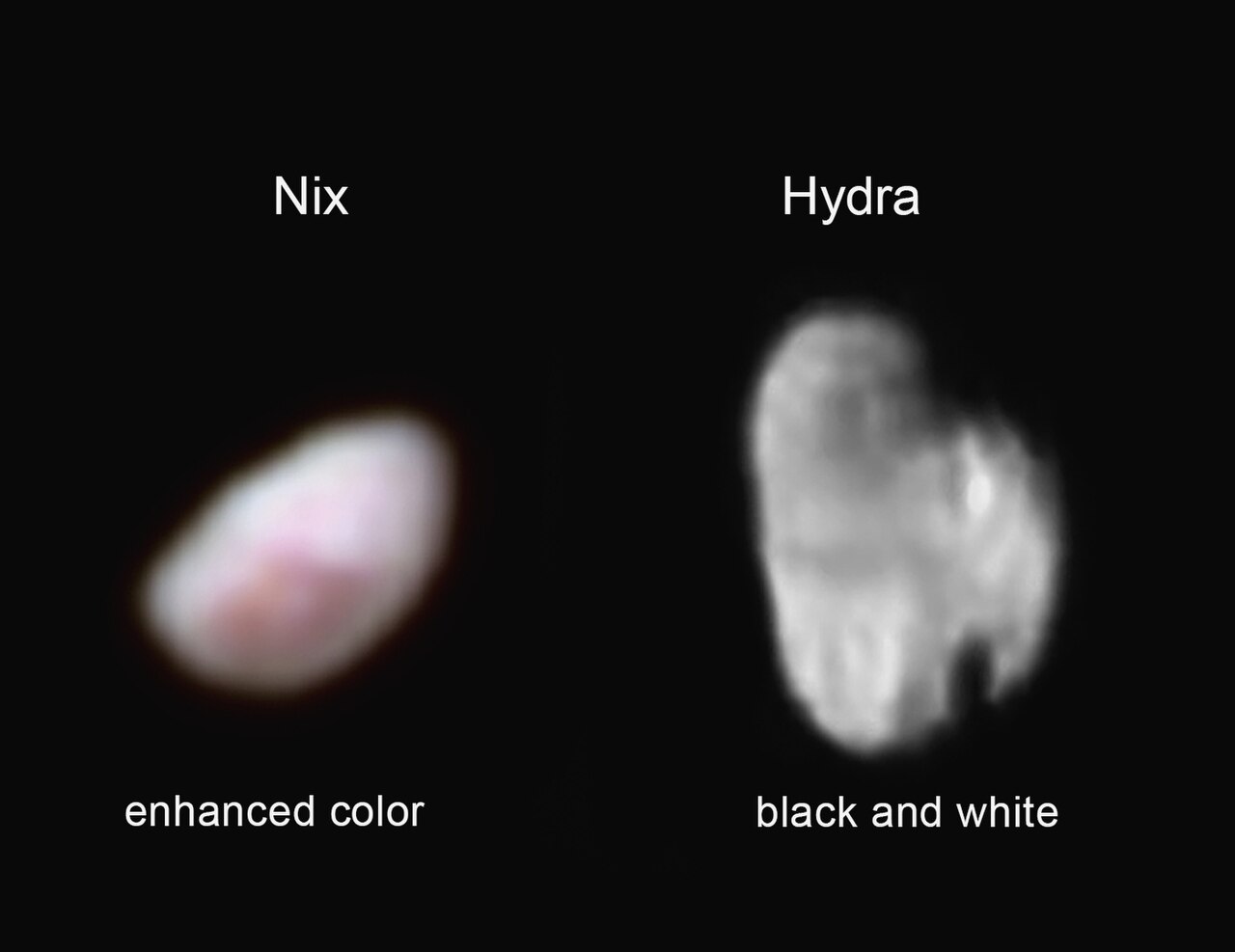
NASA says Hal Weaver and a large team of astronomers discovered Hydra in June 2005 using the Hubble Space Telescope, and that the moons were so faint that scientists combined a short exposure of Pluto and Charon with a long exposure of Nix and Hydra to show them together.[1] NASA says Hydra is named for the nine-headed serpent that Hercules fought in Greek and Roman mythology.[1] NASA describes a black-and-white New Horizons LORRI image of Hydra taken on 14 July 2015 from about 231,000 kilometres.[1]
NASA says Hal Weaver and a large team of astronomers discovered Hydra in June 2005 using the Hubble Space Telescope, and that the moons were so faint that scientists combined a short exposure of Pluto and Charon with a long exposure of Nix and Hydra to show them together.[1] NASA says Hydra is named for the nine-headed serpent that Hercules fought in Greek and Roman mythology.[1] NASA describes a black-and-white New Horizons LORRI image of Hydra taken on 14 July 2015 from about 231,000 kilometres.[1]
## See also
## See also
[Pluto](https://micwyn.com/t/3136/pluto) describes the dwarf planet and its five moons. The other small moons are [Nix](https://micwyn.com/t/3138/nix-moon), Kerberos and Styx.
[Pluto](https://micwyn.com/t/3136/pluto) describes the dwarf planet and its five moons. The other small moons are [Nix](https://micwyn.com/t/3138/nix-moon), [Kerberos](https://micwyn.com/t/3140/kerberos-moon) and [Styx](https://micwyn.com/t/3141/styx-moon).
3 unchanged paragraphs
*Via Wikimedia Commons: [NH-PlutoMoons-Nix-Hydra-20150714](https://commons.wikimedia.org/wiki/File:NH-PlutoMoons-Nix-Hydra-20150714.jpg) by NASA/JHUAPL/SWRI, public domain.*
*Via Wikimedia Commons: [NH-PlutoMoons-Nix-Hydra-20150714](https://commons.wikimedia.org/wiki/File:NH-PlutoMoons-Nix-Hydra-20150714.jpg) by NASA/JHUAPL/SWRI, public domain.*
## Sources
## Sources
1. NASA Science. "Hydra," Pluto Moons. https://science.nasa.gov/dwarf-planets/pluto/moons/hydra/ (read 23 November 2026)
2. NASA Space Science Data Coordinated Archive. "Pluto Fact Sheet." https://nssdc.gsfc.nasa.gov/planetary/factsheet/plutofact.html (read 23 November 2026)
3. NASA Photojournal. "Icy Hydra" (PIA20581). Added 6 May 2016. https://science.nasa.gov/photojournal/icy-hydra/ (read 23 November 2026)
4. Weaver, H. A., et al. "The Small Satellites of Pluto as Observed by New Horizons." *Science* 351, aae0030 (2016); arXiv:1604.05366. https://arxiv.org/abs/1604.05366 (abstract read 23 November 2026)
5. NASA Science. "NASA's Hubble Finds Pluto's Moons Tumbling in Absolute Chaos." 3 June 2015. https://science.nasa.gov/missions/hubble/nasas-hubble-finds-plutos-moons-tumbling-in-absolute-chaos/ (read 23 November 2026)
