Version 2
Nov 23, 2026. Compare with the current version · Version history
Eris is one of the largest dwarf planets, about the size of Pluto but three times farther from the Sun, found in 2005 in data taken in 2003.[1] Its discovery helped trigger the debate that led the International Astronomical Union in 2006 to define "planet" and reclassify Pluto.[1]
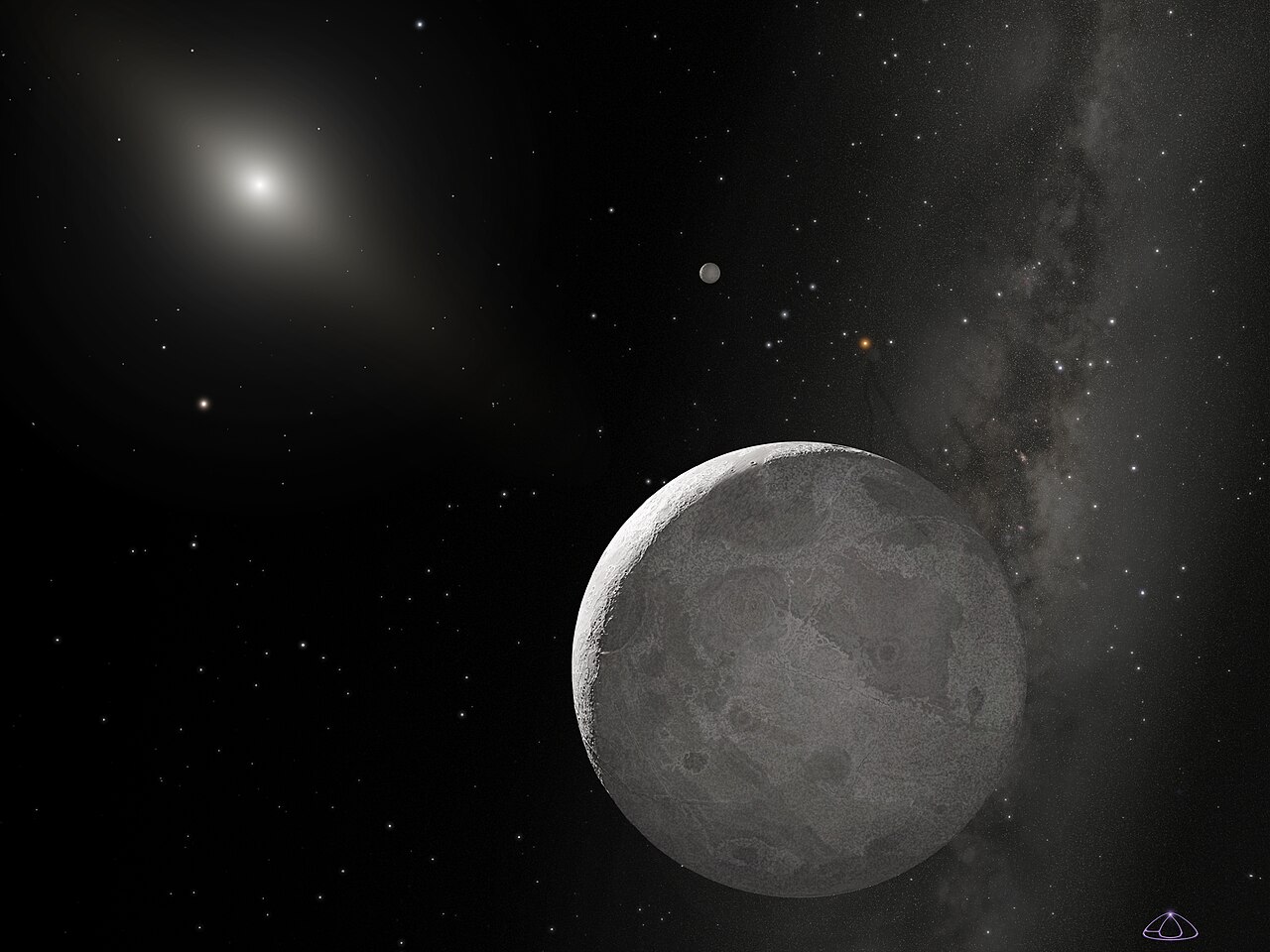
Via Wikimedia Commons: 2006-16-a-full-1- by NASA, ESA, and A. Schaller (for STScI), CC BY 4.0.
Size, distance and orbit
NASA gives Eris an equatorial diameter of about 1,500 miles (2,400 kilometres), roughly one-fifth of Earth's width, and an average distance from the Sun of about 6.3 billion miles (10 billion kilometres), or 68 astronomical units, so that sunlight takes more than nine hours to arrive.[1] It takes 557 Earth years to orbit the Sun, on an orbit well out of the plane of the planets, and completes one rotation every 25.9 hours.[1] NASA's Hubble team reported in 2007 that Hubble observations in 2006 showed Eris to be slightly larger than Pluto.[2] An Astronomy magazine report says Eris is about 30 miles smaller in diameter than Pluto, and that the next-largest object in the Kuiper Belt, Makemake, is smaller by more than 500 miles.[5]
Mass and density
NASA's 2007 report said Hubble and the Keck Observatory measured Eris's mass from the orbital motion of its moon Dysnomia, giving 1.27 times the mass of Pluto, and that Michael Brown of Caltech and colleagues calculated a density of 2.3 grams per cubic centimetre, similar to Pluto's and Triton's and implying a significant rocky component.[2] A 2020 study of Hubble observations by Bryan Holler and colleagues, whose abstract is posted on arXiv, found Dysnomia's orbital period to be 15.785899 days and revised the system density to 2.43 ± 0.05 grams per cubic centimetre, a decrease of about 4 percent from the earlier 2.52 ± 0.05.[4] The two figures, 2.3 and 2.43, describe slightly different quantities, Eris's density in 2007 and the density of the Eris–Dysnomia system in 2020, and the sources do not say how they relate.
Discovery and name
NASA says Eris was discovered on 5 January 2005 from data obtained on 21 October 2003 during a Palomar Observatory survey, by Mike Brown of Caltech, Chad Trujillo of the Gemini Observatory and David Rabinowitz of Yale University.[1] The discovery team announced it on 8 January 2005 as a Pluto-sized world billions of miles beyond Neptune, nicknamed "Xena" for a television character, and in September 2005 announced a moon, nicknamed "Gabriella".[1] On 26 August 2006 the International Astronomical Union voted to change the definition of a planet, reclassifying Pluto as a dwarf planet and reducing the number of planets to eight, with Eris and the asteroid Ceres also classed as dwarf planets.[1] On 14 September 2006 the union announced the name Eris, after the Greek goddess of discord, and named its moon Dysnomia, for the demon goddess of lawlessness and daughter of Eris.[1] It was originally designated 2003 UB313.[1] See Pluto for the reclassification.
Surface and atmosphere
NASA says Eris's surface temperature varies from about −217 °C to −243 °C, that it is often so far from the Sun that its atmosphere collapses and freezes onto the surface as snow, and that the atmosphere thaws as it approaches the Sun. NASA's page says Eris "most likely has a rocky surface similar to Pluto", and says little is known about its internal structure.[1]
Webb Space Telescope observations reported by William Grundy and colleagues, in a paper posted on arXiv, show a different surface composition: the abstract says Eris and Makemake have high-albedo surfaces rich in methane ice, and that there is evidence for nitrogen ice on Eris. It measured the ratio of deuterium to hydrogen in the methane at (2.5 ± 0.5) × 10⁻⁴ for Eris, much lower than in comet 67P's presumably primordial methane and similar to that in water in many comets, which the authors say suggests the hydrogen in the methane came from water and points to geochemical processes in past or even ongoing hot environments in their deep interiors. They say possible explanations include geologically recent outgassing or processes that refresh the surface methane.[3] This is an interpretation of spectra, not a direct observation of activity, and NASA's page does not mention it.
Interior
Astronomy magazine reports on a Science Advances study in which Francis Nimmo of the University of California, Santa Cruz and colleagues used Dysnomia's orbit and the tidal locking of Eris to Dysnomia to infer that Eris is unusually "squishy", which they say needs a clean boundary between a rocky core and an icy mantle that was once relatively warm. The report says the model suggests Eris contains much more rock than Pluto, with a layer of warm, convecting ice near the core.[5] This is a model-based inference, reported here through a magazine summary, and the paper itself was not read.
See also
Pluto is about the same size, and NASA says Dysnomia plays a role in determining how comparable the two are.[1] Dysnomia is described in its own entry.
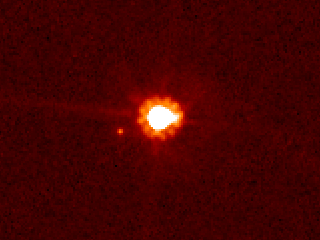
Via Wikimedia Commons: Eris and Dysnomia (captured by the Hubble Space Telescope) - landscape by NASA, ESA, and M. Brown (California Institute of Technology), public domain.
Sources
- NASA Science. "Eris." science.nasa.gov/dwarf-planets/eris/ (read 23 November 2026)
- NASA Hubble Mission Team. "Astronomers Measure Mass of Largest Dwarf Planet." 14 June 2007. science.nasa.gov/missions/hubble/astronomers-measure-mass-of-larges… (read 23 November 2026)
- Grundy, W. M., et al. "Measurement of D/H and 13C/12C Ratios in Methane Ice on Eris and Makemake: Evidence for Internal Activity." arXiv:2309.05085 (Icarus). arxiv.org/abs/2309.05085 (abstract read 23 November 2026; the 2,326-kilometre diameter comes from search-result summaries of this paper and was not seen on the abstract page)
- Holler, B. J., Grundy, W. M., Buie, M. W. and Noll, K. S. "The Eris/Dysnomia system I: The orbit of Dysnomia." arXiv:2009.13733 (29 September 2020). arxiv.org/abs/2009.13733 (abstract read 23 November 2026)
- Astronomy. "A moon helps to uncover strange solar system body Eris." 2026. astronomy.com/science/a-moon-helps-to-uncover-strange-solar-system-… (read 23 November 2026)
