Version 2 (current)
Nov 23, 2026. Version history
Makemake is a dwarf planet in the Kuiper Belt, about 1,430 kilometres across, the second-brightest object in the Kuiper Belt as seen from Earth after Pluto.[1] A 2025 Webb Space Telescope study reported methane gas above its surface, only the second trans-Neptunian object after Pluto with confirmed gas.[2][3]
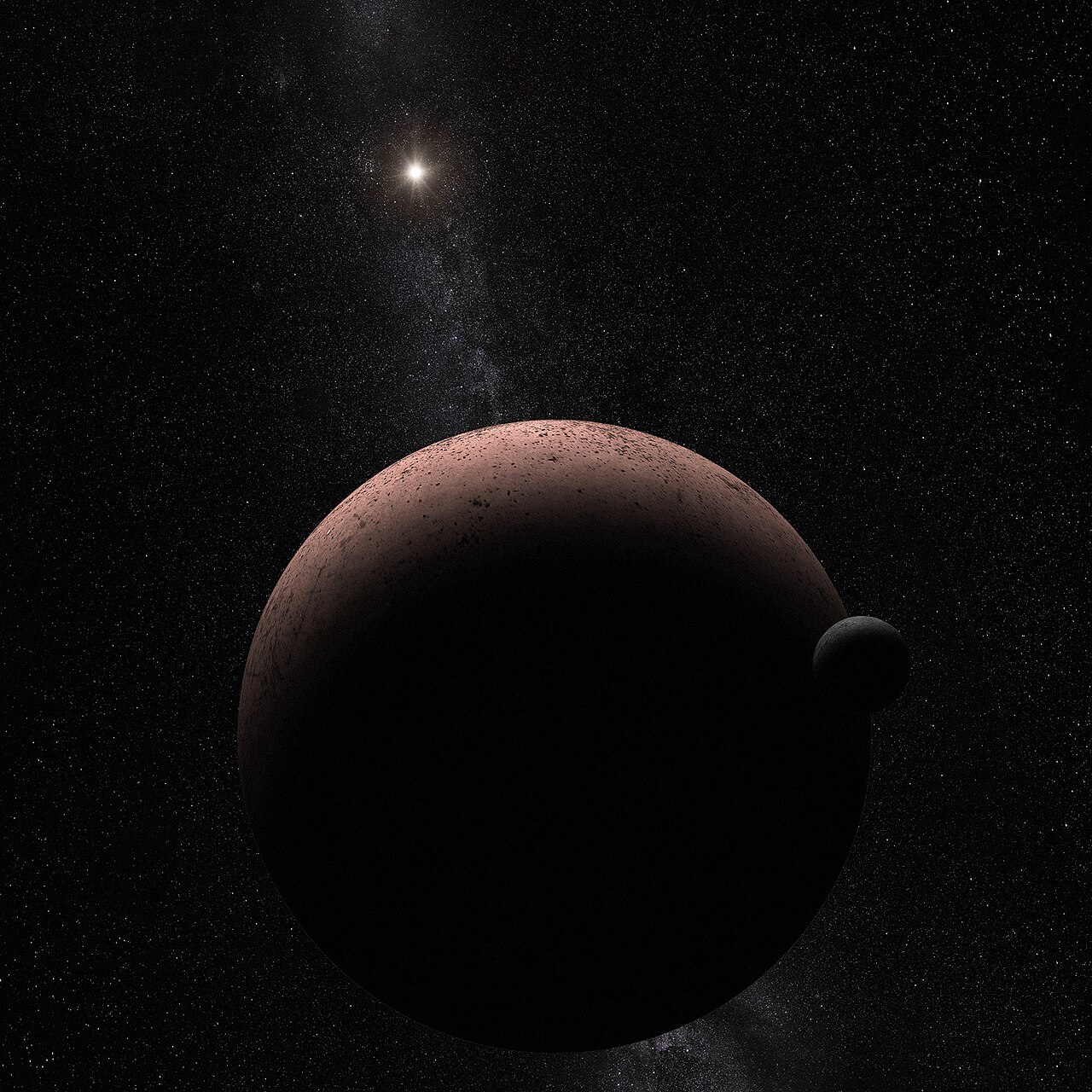
Via Wikimedia Commons: Makemake and Its Moon (Artist's Concept) by NASA, ESA, and A. Parker and M. Buie (Southwest Research Ins, CC BY 4.0.
Size, distance and orbit
NASA gives Makemake a diameter of about 888 miles (1,430 kilometres), an average distance from the Sun of about 6.8 billion kilometres, or 45.8 astronomical units, so that sunlight takes about 6 hours 20 minutes to arrive, a 305-year orbit and a rotation period of about 22.5 hours.[1] NASA's page also calls Makemake "slightly smaller than Pluto", which does not match its own diameter: Pluto's is about 2,377 kilometres on NASA's Pluto page, and a Southwest Research Institute release describes Makemake as two-thirds the size of Pluto.[1][3] An Astronomy magazine report, in a piece about Eris, says Makemake is smaller than Pluto by more than 500 miles.[4]
Discovery and name
NASA says Makemake was first observed in March 2005 by Michael Brown, Chad Trujillo and David Rabinowitz at Palomar Observatory in California. Its unofficial codename was "Easterbunny", in Brown's words "in honor of the fact that it was discovered just a few days past Easter", and its provisional name was 2005 FY9.[1] It is named for the Rapanui god of fertility.[1] NASA says Makemake's discovery, together with that of Eris, prompted the International Astronomical Union to reconsider the definition of a planet and create the group of dwarf planets.[1]
Its moon
NASA says Makemake has one provisional moon, S/2015 (136472) 1, nicknamed MK 2, which a Hubble image shows from observations in April 2015. NASA says it is more than 1,300 times fainter than Makemake, was seen about 13,000 miles from the dwarf planet, and has an estimated radius of about 50 miles (80 kilometres).[1] The introduction of NASA's page says that in 2016 Hubble spotted a small, dark moon orbiting Makemake, so the page gives both 2015 and 2016, and does not explain the difference.[1]
Surface
NASA says Makemake appears reddish-brown, like Pluto, that frozen methane and ethane have been detected on its surface, and that pellets of frozen methane up to a centimetre across may lie on it.[1] A paper by William Grundy and colleagues using Webb observations of Eris and Makemake, whose abstract is posted on arXiv, says both have high-albedo surfaces rich in methane ice, measures a ratio of deuterium to hydrogen in Makemake's methane of (2.9 ± 0.6) × 10⁻⁴, and argues that the similarity to the ratio in water suggests the hydrogen in the methane came from water through geochemical processes in past or even ongoing hot environments in the deep interior.[5]
Methane gas
On 9 September 2025 Southwest Research Institute announced a Webb study led by Silvia Protopapa, "JWST Detection of Hydrocarbon Ices and Methane Gas on Makemake", slated for the Astrophysical Journal Letters.[3] The abstract reports a chemically complex surface of methane, deuterated methane and possibly methanol, with acetylene and ethane aggregates, suggesting methane breakdown by light is ongoing or recent. It gives a deuterium-to-hydrogen ratio in methane ice of (3.98 ± 0.34) × 10⁻⁴, consistent within two sigma with earlier estimates.[2] The Grundy abstract gives (2.9 ± 0.6) × 10⁻⁴ for the same ratio.[5] The authors report the first detection of methane fluorescence, sunlight absorbed and re-emitted by gas molecules.[2][3]
They explore two scenarios, and say neither fully reproduces the data. In one, an expanding coma, possibly from a localised plume, would have a gas production rate of 0.2 to 1.6 × 10²⁸ molecules per second at about 35 kelvin. In the other, a gravitationally bound atmosphere would have a gas temperature near 40 kelvin and a surface pressure of about 10 picobar, consistent with earlier stellar occultation limits and with an atmosphere in equilibrium with surface methane ice.[2] The release adds that 10 picobar is about a million times more tenuous than Pluto's atmosphere, and that plume-like release would need a few hundred kilograms per second, comparable to the water plumes of Saturn's moon Enceladus.[3] The authors say telling the scenarios apart needs higher spectral resolution and better signal-to-noise observations, and that the findings challenge the traditional view of Makemake as a quiescent, frozen body.[2] NASA's Makemake page says only that the dwarf planet may develop a very thin atmosphere, most likely nitrogen, near perihelion, and does not mention the 2025 detection.[1]
See also
Pluto and Eris are the other large trans-Neptunian dwarf planets with entries here; Haumea is a fourth.
Sources
- NASA Science. "Makemake." science.nasa.gov/dwarf-planets/makemake/ (read 23 November 2026)
- Protopapa, S., Wong, I., Lellouch, E., et al. "JWST Detection of Hydrocarbon Ices and Methane Gas on Makemake." arXiv:2509.06772 (2025; to appear in The Astrophysical Journal Letters). arxiv.org/abs/2509.06772 (abstract read 23 November 2026)
- Southwest Research Institute. "SwRI-led team discovers methane gas on Makemake." 9 September 2025. swri.org/node/12821431 (read 23 November 2026)
- Astronomy. "A moon helps to uncover strange solar system body Eris." 2026. astronomy.com/science/a-moon-helps-to-uncover-strange-solar-system-… (read 23 November 2026)
- Grundy, W. M., et al. "Measurement of D/H and 13C/12C Ratios in Methane Ice on Eris and Makemake: Evidence for Internal Activity." arXiv:2309.05085. arxiv.org/abs/2309.05085 (abstract read 23 November 2026)
