Compare versions
Version 1 → Version 2. Removed · Added. This shows the entry's text as it is written, including its formatting marks.
Version 1 · Version 2 · Version history
Side by side · Together
Ceres is the largest object in the main asteroid belt between Mars and Jupiter and the only dwarf planet in the inner solar system.[1] It was the first asteroid-belt body discovered, by Giuseppe Piazzi in 1801, and in 2015 NASA's Dawn spacecraft made it the first dwarf planet visited by a spacecraft.[1][2]
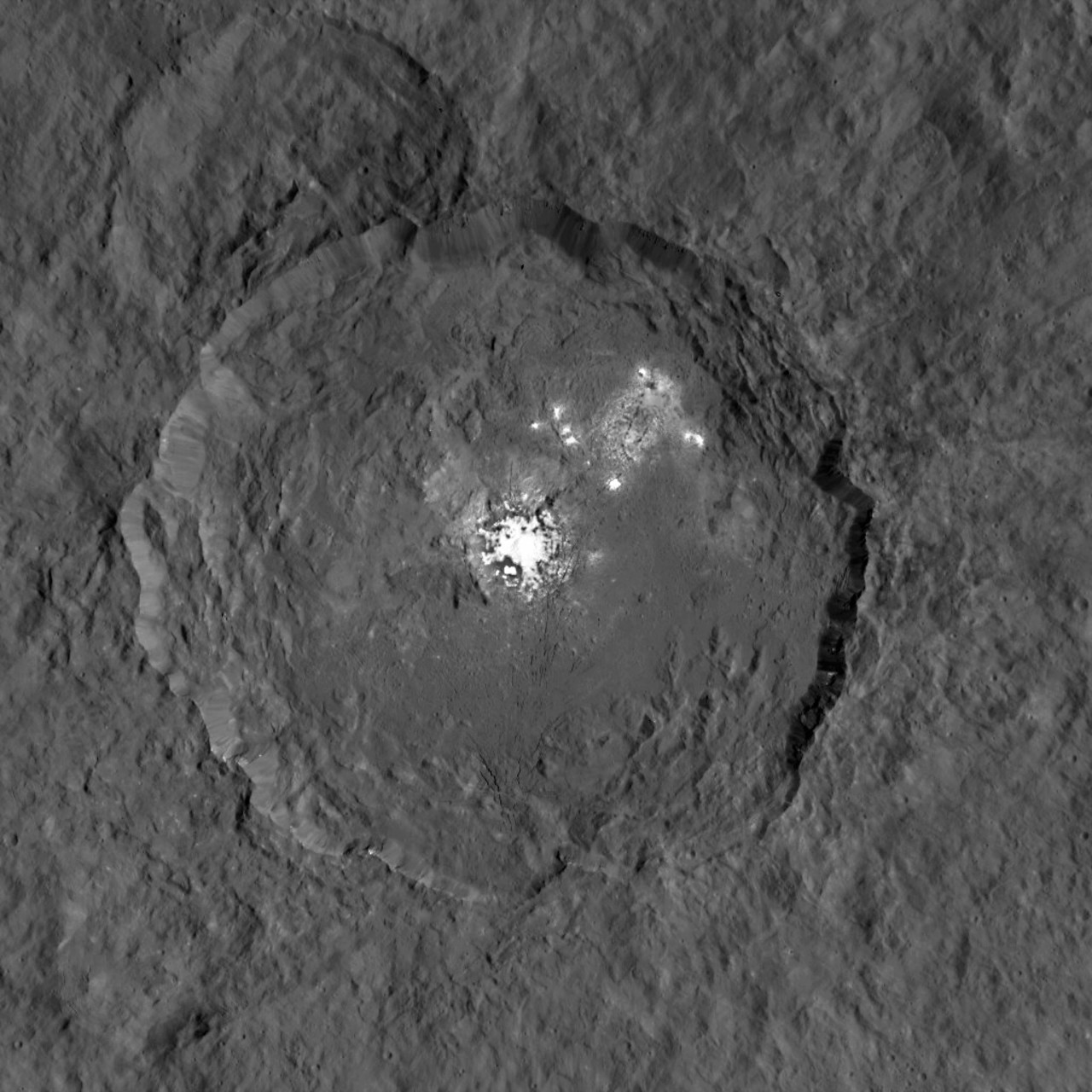
*Via Wikimedia Commons: [The bright spots on Ceres imaged by the dawn spacecraft (eso1609b)](https://commons.wikimedia.org/wiki/File:The_bright_spots_on_Ceres_imaged_by_the_dawn_spacecraft_(eso1609b).jpg) by NASA/JPL-Caltech/UCLA/MPS/DLR/IDA, public domain.*
## Size, distance and orbit
NASA gives Ceres a radius of 296 miles (476 kilometres), about one-thirteenth of Earth's, and an average distance from the Sun of about 413 million kilometres, or 2.8 astronomical units, so that sunlight takes 22 minutes to arrive.[1] A University of California, Berkeley release of 2020 gives its diameter as about 940 kilometres (585 miles), consistent with NASA's radius.[4] Ceres orbits the Sun in 1,682 Earth days, or 4.6 years, and rotates every 9 hours; its axis is tilted just 4 degrees, so it has no real seasons.[1] NASA says Ceres makes up about 25 percent of the asteroid belt's total mass, while Pluto is still 14 times more massive than Ceres.[1] NASA says Ceres has no moons and no rings.[1]
## Discovery and reclassification
NASA says Piazzi spotted Ceres in 1801 while searching for a star and called it a planet; John Herschel coined the term "asteroid" in 1802, and by 1863 Ceres was widely accepted as an asteroid.[2] NASA says Ceres is so much bigger and so different from its rocky neighbours that scientists classified it as a dwarf planet in 2006.[1][2] Ceres is named for the Roman goddess of corn and harvests, from which the word "cereal" comes.[1] The [Pluto](https://micwyn.com/t/3136/pluto) and [Eris](https://micwyn.com/t/3142/eris-dwarf-planet) entries describe the same 2006 reclassification.
## The Dawn mission
NASA says Dawn launched on 27 September 2007 and went into orbit around Ceres on 6 March 2015, about four months before New Horizons flew past Pluto on 14 July 2015, making Ceres the first dwarf planet to be orbited by a spacecraft.[2][3] The Berkeley release says Dawn used up its fuel in October 2018, remains parked in a long-term orbit around Ceres, and in 2017 and 2018 flew as low as about 35 kilometres above the surface to capture high-resolution images and map the gravity field.[4]
## Interior and surface
NASA says Ceres is more like the terrestrial planets than its asteroid neighbours but much less dense, probably has a solid core and a mantle of water ice, may be up to 25 percent water, and has a rocky, dusty crust with large deposits of salts such as magnesium sulfate rather than table salt.[1] It is covered in countless small, young craters, none larger than 175 miles (280 kilometres) across, which NASA calls surprising and suggests may reflect ice or salt just below the surface or past hydrothermal activity such as ice volcanoes erasing larger ones.[1] NASA says there are permanently shadowed "cold traps" in some craters where water ice might survive for long periods, and that Ceres has a very thin atmosphere with evidence of water vapour.[1]
*Physics Today* reports that Dawn found at least 10 percent of Ceres's surface material to be iron and carbon, with the rest ammonium clays and magnesium carbonates, which on Earth form when rock is altered by liquid water containing carbon dioxide, and which the article says suggests Ceres harboured liquid water with dissolved carbon and nitrogen. It also describes a very bright spot about 15 kilometres across at the centre of Occator crater, with few craters, indicating an age of millions of years at most, and a volcano-like mountain named Ahuna Mons, perhaps made of frozen cryolava.[5]
## Salty water beneath Occator
Berkeley News of 10 August 2020 reported papers in *Nature Astronomy*, *Nature Geoscience* and *Nature Communications* based on Dawn data. An analysis led by Carol Raymond of the Jet Propulsion Laboratory used low-altitude gravity data from 2018 flyovers of the 92-kilometre Occator crater to conclude that a low-density region beneath it is consistent with a briny slush reservoir of water and salts.[4] The release says the impact that made Occator about 20 million years ago likely fractured the crust, letting fractures tap deeper brine reservoirs, and that bright salt deposits on the crater floor, previously found to be sodium carbonates, appear to have erupted within the last 2 million years, too recently to come from melt generated by the impact.[4] It says the brines may still be percolating to the surface and that Ceres once harboured a global subsurface ocean that likely froze long ago.[4] This is an interpretation of spacecraft data, and NASA's Ceres page does not describe it.
## Potential for life
NASA says Ceres is one of the few places in the solar system where scientists would like to search for possible signs of life, because it has water, and that any life would likely be very small microbes, though there may be signs it harboured life in the past.[1] The sources read do not report any detection of life or of present-day habitable conditions.
## See also
[Pluto](https://micwyn.com/t/3136/pluto), [Eris](https://micwyn.com/t/3142/eris-dwarf-planet), [Haumea](https://micwyn.com/t/3144/haumea) and [Makemake](https://micwyn.com/t/3149/makemake) are the other dwarf planets recognised by the International Astronomical Union, all in the outer solar system.
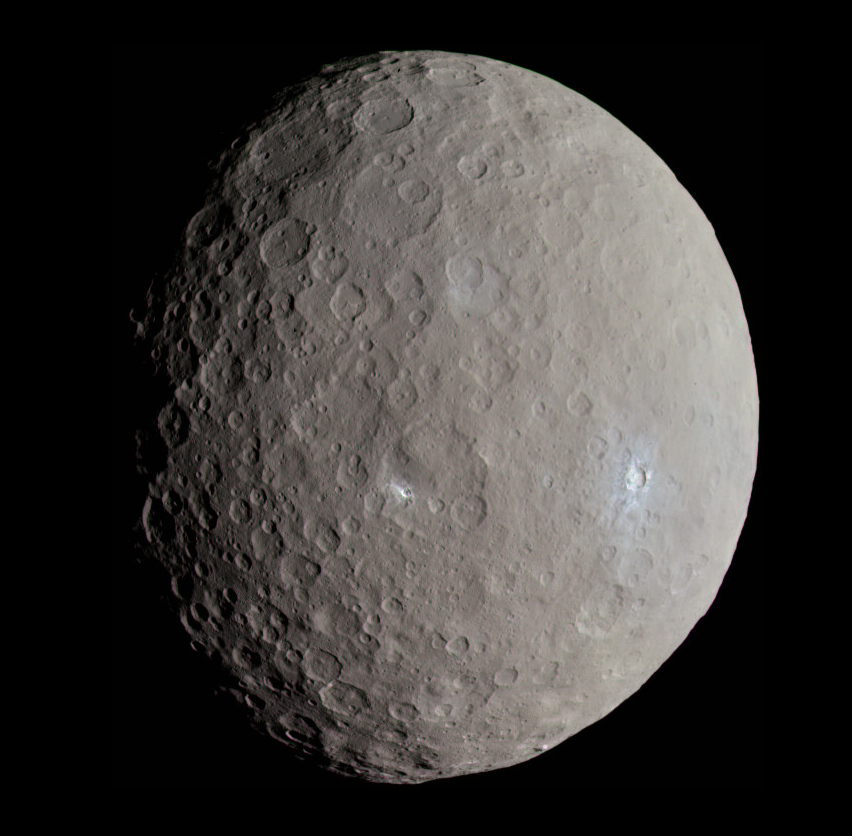heavily cratered, grey, nearly round world seen in natural colour against black, with two small bright patches on its lower right half; the image itself does not give the mission or date, though it matches NASA's and Physics Today's descriptions of Dawn's views of Ceres and its bright spots](/m/2026/11/AKd-MbfI6NWpW5--.jpg)
*Via Wikimedia Commons: [Ceres - RC3 - Haulani Crater (22381131691) (cropped)](https://commons.wikimedia.org/wiki/File:Ceres_-_RC3_-_Haulani_Crater_(22381131691)_(cropped).jpg) by Justin Cowart, public domain.*
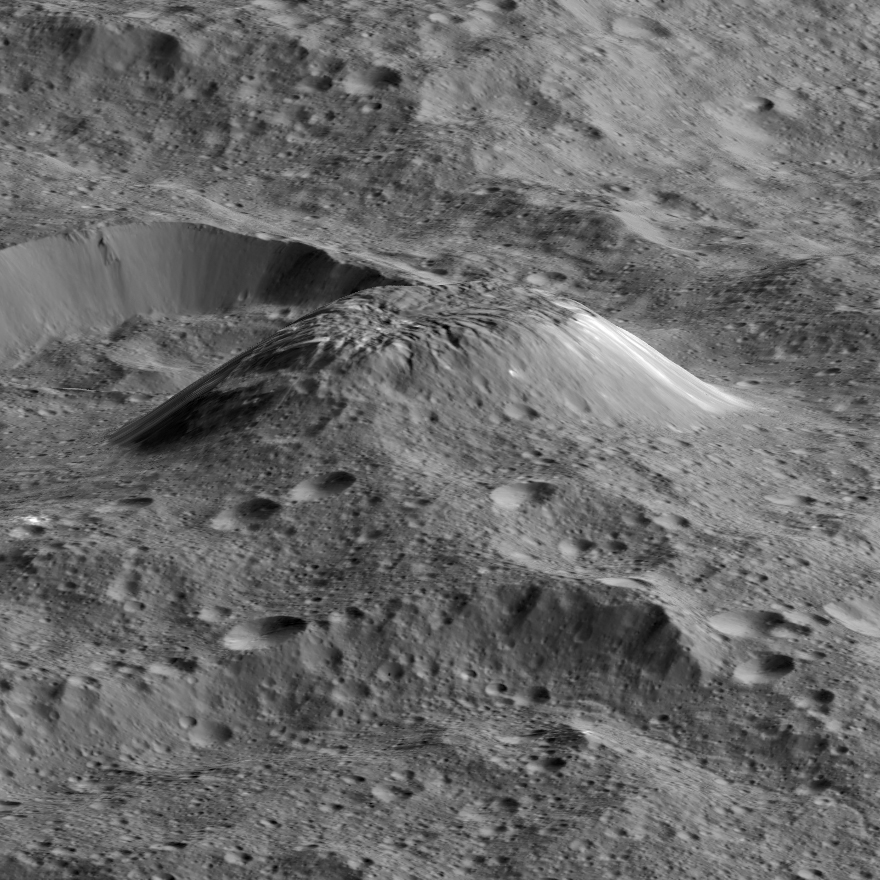
*Via Wikimedia Commons: [PIA20349 crop - Ceres' Ahuna Mons side view](https://commons.wikimedia.org/wiki/File:PIA20349_crop_-_Ceres%27_Ahuna_Mons_side_view.jpg) by NASA / JPL-Caltech / UCLA / Max Planck Institute for Solar S, public domain.*
## Sources
1. NASA Science. "Ceres Facts." https://science.nasa.gov/dwarf-planets/ceres/facts/ (read 23 November 2026)
2. NASA Science. "Ceres Exploration." https://science.nasa.gov/dwarf-planets/ceres/exploration/ (read 23 November 2026)
3. NASA Science. "Ceres." https://science.nasa.gov/dwarf-planets/ceres/ (read 23 November 2026)
4. Berkeley News. "Dwarf planet Ceres has reservoirs of salty water." 10 August 2020. https://news.berkeley.edu/2020/08/10/dwarf-planet-ceres-has-reservoirs-of-salty-water/ (read 23 November 2026)
5. Physics Today. "Ceres, a window into how planets could harbor life." https://physicstoday.aip.org/quick-study/ceres-a-window-into-how-planets-could-harbor-life (read 23 November 2026)
