Compare versions
Version 5 → Version 11 (current). Removed · Added. This shows the entry's text as it is written, including its formatting marks.
Version 5 · Version 11 (current) · Version history
Side by side · Together
Version 5Version 11 (current)
The solar system is the [Sun](https://micwyn.com/t/3020/sun) and everything bound to it: eight planets, five officially named [dwarf planets](https://micwyn.com/t/3153/dwarf-planet), hundreds of [moons](https://micwyn.com/t/3154/natural-satellite), and thousands of asteroids and comets.[1] NASA says it formed about 4.6 billion years ago from a collapsing cloud of interstellar gas and dust.[1]
The solar system is the [Sun](https://micwyn.com/t/3020/sun) and everything bound to it: eight planets, five officially named [dwarf planets](https://micwyn.com/t/3153/dwarf-planet), hundreds of [moons](https://micwyn.com/t/3154/natural-satellite), and thousands of [asteroids](https://micwyn.com/t/3159/asteroid) and comets.[1] NASA says it formed about 4.6 billion years ago from a collapsing cloud of interstellar gas and dust.[1]
9 unchanged paragraphs
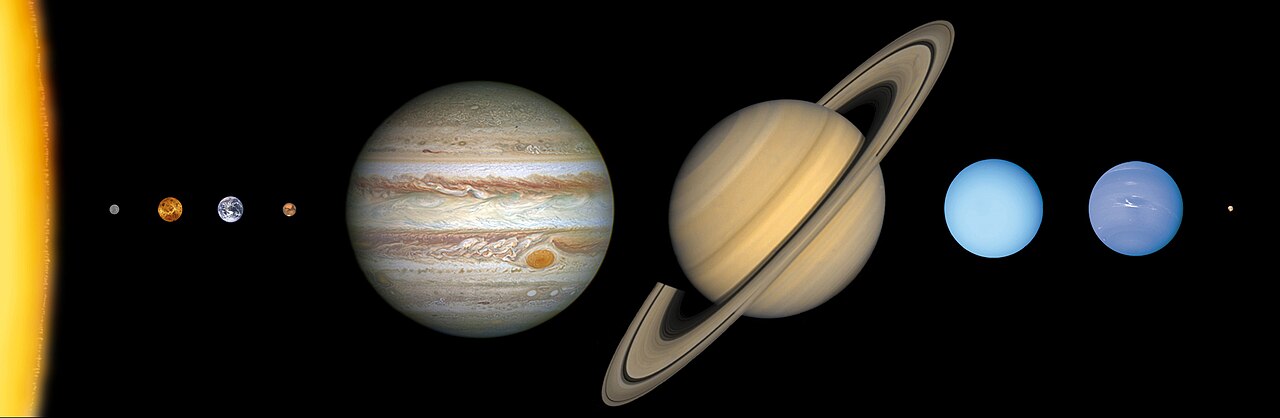

*Via Wikimedia Commons: [Solar system scale v2](https://commons.wikimedia.org/wiki/File:Solar_system_scale_v2.jpg) by Lunar and Planetary Laboratory Mercury image: NASA/JHUAPL Ve, public domain.*
*Via Wikimedia Commons: [Solar system scale v2](https://commons.wikimedia.org/wiki/File:Solar_system_scale_v2.jpg) by Lunar and Planetary Laboratory Mercury image: NASA/JHUAPL Ve, public domain.*
## What it contains
## What it contains
NASA lists the Sun, eight planets, five officially named dwarf planets, hundreds of moons, and thousands of asteroids and comets.[1] The eight [planets](https://micwyn.com/t/3152/planet) are [Mercury](https://micwyn.com/t/3021/mercury-planet), [Venus](https://micwyn.com/t/3022/venus), [Earth](https://micwyn.com/t/3024/earth), [Mars](https://micwyn.com/t/3026/mars), [Jupiter](https://micwyn.com/t/3029/jupiter), [Saturn](https://micwyn.com/t/3050/saturn), [Uranus](https://micwyn.com/t/3073/uranus) and [Neptune](https://micwyn.com/t/3101/neptune). The five named dwarf planets are [Ceres](https://micwyn.com/t/3150/ceres), [Pluto](https://micwyn.com/t/3136/pluto), [Haumea](https://micwyn.com/t/3144/haumea), [Makemake](https://micwyn.com/t/3149/makemake) and [Eris](https://micwyn.com/t/3142/eris-dwarf-planet).[1][3] Earth's [Moon](https://micwyn.com/t/3025/moon) is the best known of its moons.[1]
NASA lists the Sun, eight planets, five officially named dwarf planets, hundreds of moons, and thousands of asteroids and comets.[1] The eight [planets](https://micwyn.com/t/3152/planet) are [Mercury](https://micwyn.com/t/3021/mercury-planet), [Venus](https://micwyn.com/t/3022/venus), [Earth](https://micwyn.com/t/3024/earth), [Mars](https://micwyn.com/t/3026/mars), [Jupiter](https://micwyn.com/t/3029/jupiter), [Saturn](https://micwyn.com/t/3050/saturn), [Uranus](https://micwyn.com/t/3073/uranus) and [Neptune](https://micwyn.com/t/3101/neptune). The five named dwarf planets are [Ceres](https://micwyn.com/t/3150/ceres), [Pluto](https://micwyn.com/t/3136/pluto), [Haumea](https://micwyn.com/t/3144/haumea), [Makemake](https://micwyn.com/t/3149/makemake) and [Eris](https://micwyn.com/t/3142/eris-dwarf-planet).[1][3] Earth's [Moon](https://micwyn.com/t/3025/moon) is the best known of its moons.[1]
## Where it sits
## Where it sits
NASA says the solar system lies in the Milky Way, a barred spiral galaxy, in a small partial arm called the Orion Arm or Orion Spur between the Sagittarius and Perseus arms. It orbits the centre of the galaxy at about 515,000 miles per hour (828,000 kilometres per hour) and takes about 230 million years to complete one orbit.[1] NASA's light-day page gives the nearest large galaxy, the [Andromeda Galaxy](https://micwyn.com/t/3019/andromeda-galaxy), as about 2.5 million light-years from the Milky Way.[2]
NASA says the solar system lies in the Milky Way, a barred spiral galaxy, in a small partial arm called the Orion Arm or Orion Spur between the Sagittarius and Perseus arms. It orbits the centre of the galaxy at about 515,000 miles per hour (828,000 kilometres per hour) and takes about 230 million years to complete one orbit.[1] NASA's light-day page gives the nearest large galaxy, the [Andromeda Galaxy](https://micwyn.com/t/3019/andromeda-galaxy), as about 2.5 million light-years from the Milky Way.[2]
## The name
## The name
NASA says the planetary system is called the solar system because "solar" describes things related to our star, from the Latin word for Sun, "solis".[1]
NASA says the planetary system is called the solar system because "solar" describes things related to our star, from the Latin word for Sun, "solis".[1]
## How far it extends
## How far it extends
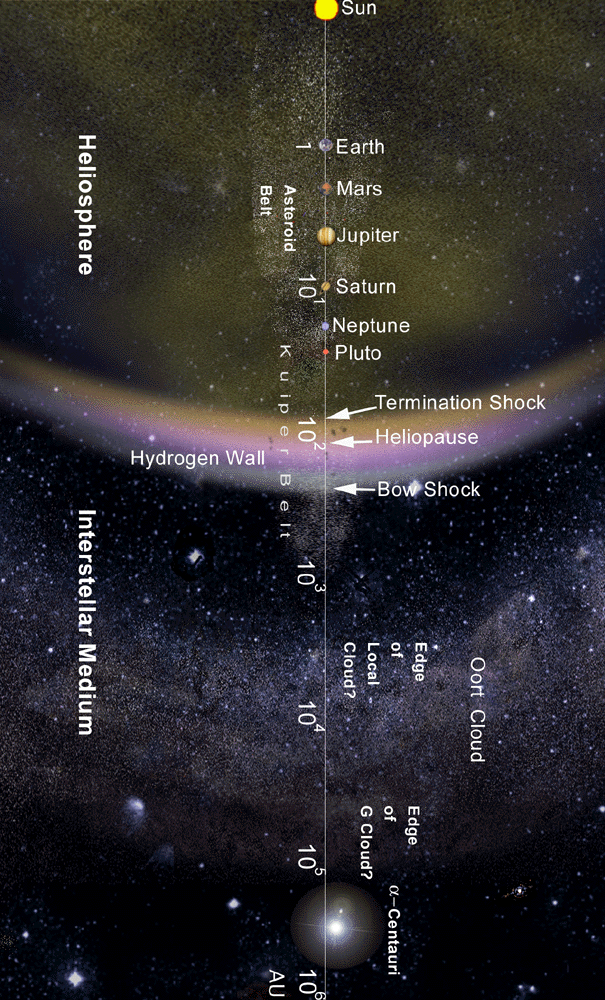
NASA says the solar system extends much farther than the planets. It includes the Kuiper Belt past Neptune's orbit, a ring of icy bodies almost all smaller than the best-known Kuiper Belt object, Pluto. Beyond the Kuiper Belt's fringes is the Oort Cloud, a giant spherical shell that has never been directly observed but is predicted from mathematical models and observations of comets believed to come from it. NASA says it is made of icy debris, some pieces bigger than mountains, orbiting as far as 1.6 light-years away, in a shell from 5,000 to 100,000 astronomical units, and that it marks the boundary of the Sun's gravitational influence.[1] An astronomical unit is the distance from the Sun to Earth, about 93 million miles or 150 million kilometres.[1]
NASA says the solar system extends much farther than the planets. It includes the [Kuiper Belt](https://micwyn.com/t/3165/kuiper-belt) past Neptune's orbit, a ring of icy bodies almost all smaller than the best-known Kuiper Belt object, Pluto. Beyond the Kuiper Belt's fringes is the Oort Cloud, a giant spherical shell that has never been directly observed but is predicted from mathematical models and observations of comets believed to come from it. NASA says it is made of icy debris, some pieces bigger than mountains, orbiting as far as 1.6 light-years away, in a shell from 5,000 to 100,000 astronomical units, and that it marks the boundary of the Sun's gravitational influence.[1] An astronomical unit is the distance from the Sun to Earth, about 93 million miles or 150 million kilometres.[1]
5 unchanged paragraphs
The Sun's heliosphere does not extend quite as far. NASA describes it as the bubble created by the solar wind, a stream of electrically charged gas blowing outward from the Sun, and says the boundary where the solar wind is abruptly slowed by pressure from interstellar gas, the termination shock, lies between 80 and 100 astronomical units.[1] NASA says Voyager 1 crossed the termination shock in 2004 and Voyager 2 in 2007, that Voyager 1 went interstellar in 2012 and Voyager 2 in 2018, and that it will be many thousands of years before they exit the Oort Cloud.[1]
The Sun's heliosphere does not extend quite as far. NASA describes it as the bubble created by the solar wind, a stream of electrically charged gas blowing outward from the Sun, and says the boundary where the solar wind is abruptly slowed by pressure from interstellar gas, the termination shock, lies between 80 and 100 astronomical units.[1] NASA says Voyager 1 crossed the termination shock in 2004 and Voyager 2 in 2007, that Voyager 1 went interstellar in 2012 and Voyager 2 in 2018, and that it will be many thousands of years before they exit the Oort Cloud.[1]
On 18 November 2026 NASA reported that Voyager 1, in flight since 1977, had reached a distance of one light-day from Earth, about 16 billion miles (26 billion kilometres), at 5:16:07 a.m. Eastern time, after 49 years, two months and 11 days. NASA says Voyager 2 is on pace to reach the same distance in November 2035, and that a radio signal now takes a full day to reach Voyager 1.[2][4]
On 18 November 2026 NASA reported that Voyager 1, in flight since 1977, had reached a distance of one light-day from Earth, about 16 billion miles (26 billion kilometres), at 5:16:07 a.m. Eastern time, after 49 years, two months and 11 days. NASA says Voyager 2 is on pace to reach the same distance in November 2035, and that a radio signal now takes a full day to reach Voyager 1.[2][4]
## Moons
## Moons
NASA says that, besides Earth's Moon, the solar system has hundreds of moons orbiting planets, dwarf planets and asteroids, that Mercury and Venus are the only planets with none, though Venus has a quasi-satellite officially named Zoozve, and that Jupiter and Saturn lead the moon counts. It notes that Pluto, smaller than our Moon, has five moons, including Charon, large enough to make Pluto wobble.[1] The entries for [Jupiter](https://micwyn.com/t/3029/jupiter), [Saturn](https://micwyn.com/t/3050/saturn), [Uranus](https://micwyn.com/t/3073/uranus), [Neptune](https://micwyn.com/t/3101/neptune) and [Pluto](https://micwyn.com/t/3136/pluto) list the moons described on this site.
NASA says that, besides Earth's Moon, the solar system has hundreds of moons orbiting planets, dwarf planets and asteroids, that Mercury and Venus are the only planets with none, though Venus has a quasi-satellite officially named Zoozve, and that Jupiter and Saturn lead the moon counts. It notes that Pluto, smaller than our Moon, has five moons, including Charon, large enough to make Pluto wobble.[1] The entries for [Jupiter](https://micwyn.com/t/3029/jupiter), [Saturn](https://micwyn.com/t/3050/saturn), [Uranus](https://micwyn.com/t/3073/uranus), [Neptune](https://micwyn.com/t/3101/neptune) and [Pluto](https://micwyn.com/t/3136/pluto) list the moons described on this site.
## How it formed
## How it formed
NASA says the cloud of gas and dust that became the solar system collapsed, possibly because of the shockwave from a nearby exploding star, forming a spinning, swirling disk called the solar nebula. At the centre, gravity pulled in so much material that hydrogen atoms began to combine into helium, releasing enormous energy and creating the Sun, which came to hold more than 99 percent of the available matter.[1] Matter farther out clumped together, with clumps colliding to form larger objects, some big enough for gravity to make them spherical, becoming planets, dwarf planets and large moons. In other places planets did not form: NASA says the asteroid belt is made of bits and pieces of the early solar system that never came together into a planet, and that other leftovers became asteroids, comets, meteoroids and small irregular moons.[1] NASA's pages for [Uranus](https://micwyn.com/t/3073/uranus) and [Neptune](https://micwyn.com/t/3101/neptune) give an age of about 4.5 billion years for the formation of those planets, while its solar system page gives 4.6 billion for the system as a whole, and the sources do not explain the difference.
NASA says the cloud of gas and dust that became the solar system collapsed, possibly because of the shockwave from a nearby exploding star, forming a spinning, swirling disk called the solar nebula. At the centre, gravity pulled in so much material that hydrogen atoms began to combine into helium, releasing enormous energy and creating the Sun, which came to hold more than 99 percent of the available matter.[1] Matter farther out clumped together, with clumps colliding to form larger objects, some big enough for gravity to make them spherical, becoming planets, dwarf planets and large moons. In other places planets did not form: NASA says the [asteroid belt](https://micwyn.com/t/3158/asteroid-belt) is made of bits and pieces of the early solar system that never came together into a planet, and that other leftovers became asteroids, comets, meteoroids and small irregular moons.[1] NASA's pages for [Uranus](https://micwyn.com/t/3073/uranus) and [Neptune](https://micwyn.com/t/3101/neptune) give an age of about 4.5 billion years for the formation of those planets, while its solar system page gives 4.6 billion for the system as a whole, and the sources do not explain the difference.
## Structure
## Structure
NASA says the order of the planets follows from how the system formed. Near the Sun, only rocky material could withstand the heat of the young solar system, so the four inner planets, Mercury, Venus, Earth and Mars, are terrestrial planets, small with solid, rocky surfaces. Materials familiar as ice, liquid or gas settled in the outer regions, where gravity gathered them into the gas giants Jupiter and Saturn and the ice giants Uranus and Neptune.[1]
NASA says the order of the planets follows from how the system formed. Near the Sun, only rocky material could withstand the heat of the young solar system, so the four inner planets, Mercury, Venus, Earth and Mars, are [terrestrial planets](https://micwyn.com/t/3155/terrestrial-planet), small with solid, rocky surfaces. Materials familiar as ice, liquid or gas settled in the outer regions, where gravity gathered them into the [gas giants](https://micwyn.com/t/3156/gas-giant) Jupiter and Saturn and the [ice giants](https://micwyn.com/t/3157/ice-giant) Uranus and Neptune.[1]
8 unchanged paragraphs
## Life
## Life
NASA says that so far life is known only on Earth, and that it is searching for life on other worlds in the solar system and beyond.[1]
NASA says that so far life is known only on Earth, and that it is searching for life on other worlds in the solar system and beyond.[1]
## See also
## See also
The [Sun](https://micwyn.com/t/3020/sun) is the central star, the [James Webb Space Telescope](https://micwyn.com/t/3018/james-webb-space-telescope) observes many solar system bodies, and [Ceres](https://micwyn.com/t/3150/ceres) is the largest object in the asteroid belt.
The [Sun](https://micwyn.com/t/3020/sun) is the central star, the [James Webb Space Telescope](https://micwyn.com/t/3018/james-webb-space-telescope) observes many solar system bodies, and [Ceres](https://micwyn.com/t/3150/ceres) is the largest object in the asteroid belt.

*Via Wikimedia Commons: [Solarmap](https://commons.wikimedia.org/wiki/File:Solarmap.png), public domain.*
*Via Wikimedia Commons: [Solarmap](https://commons.wikimedia.org/wiki/File:Solarmap.png), public domain.*
## Sources
## Sources
1. NASA Science. "Solar System Facts." https://science.nasa.gov/solar-system/facts/ (read 23 November 2026)
2. NASA Science. "Voyager 1: What Is a Light-Day." https://science.nasa.gov/mission/voyager/voyager-1/voyager-1-what-is-a-light-day/ (read 23 November 2026)
3. NASA Science. "Ceres Facts" and "Pluto Facts." https://science.nasa.gov/dwarf-planets/ceres/facts/ and https://science.nasa.gov/dwarf-planets/pluto/facts/ (read 23 November 2026)
4. NASA Scientific Visualization Studio. "How Far Away Is Voyager 1? One Light-Day, Explained." 12 November 2026. https://svs.gsfc.nasa.gov/15120 (read 23 November 2026)
