Compare versions
Version 1 → Version 2 (current). Removed · Added. This shows the entry's text as it is written, including its formatting marks.
Version 1 · Version 2 (current) · Version history
Side by side · Together
A natural satellite, or moon, is a naturally formed body that orbits a planet, a dwarf planet or a smaller body.[1] NASA says there were 461 officially recognised moons orbiting planets, including the dwarf planet Pluto, as of October 2026, and hundreds more confirmed around asteroids, other dwarf planets and trans-Neptunian objects.[2]
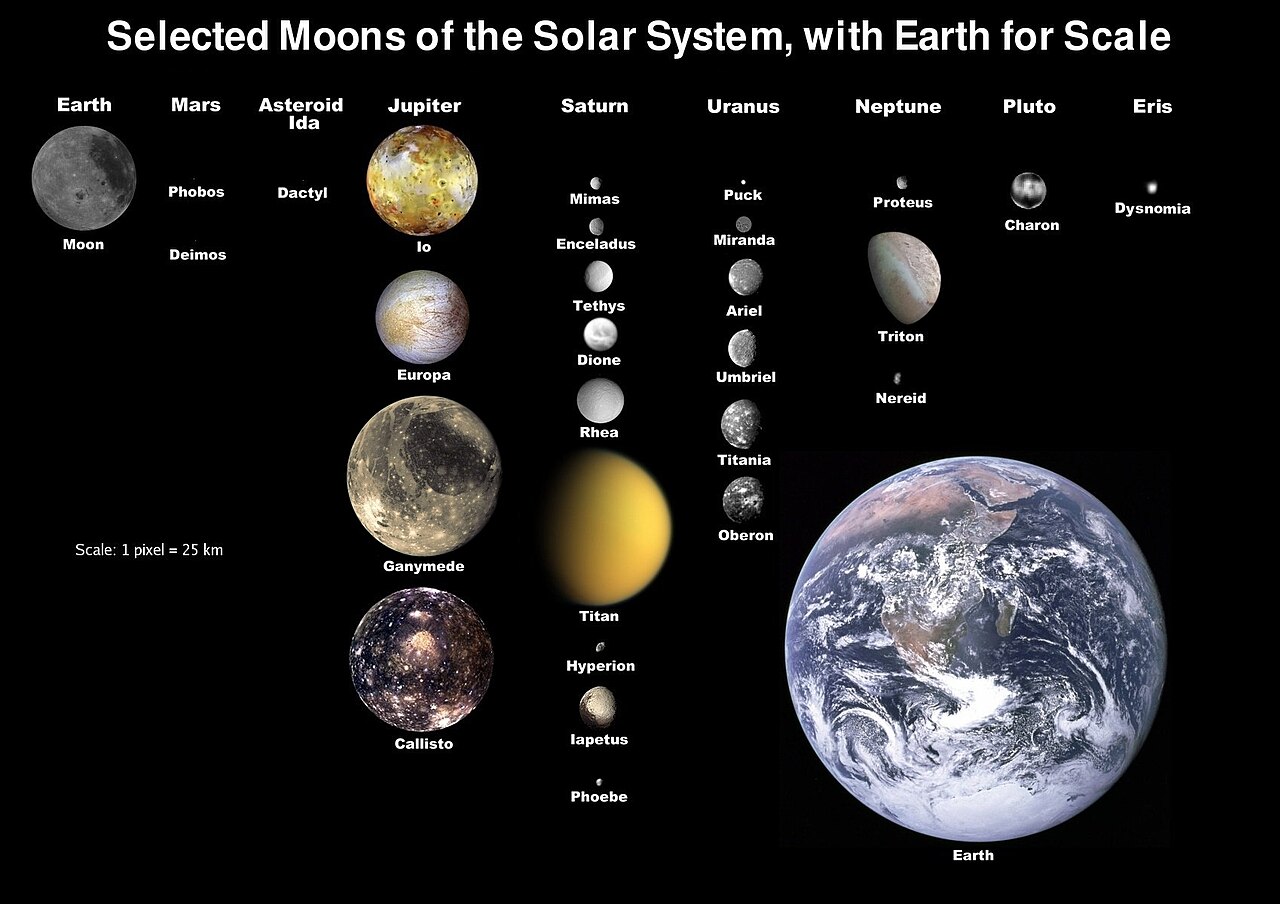chart titled 'Selected Moons of the Solar System, with Earth for Scale', with columns for Earth, Mars, the asteroid Ida, Jupiter, Saturn, Uranus, Neptune, Pluto and Eris listing their moons as labelled spheres, including the Moon, Phobos, Deimos, Dactyl, Io, Europa, Ganymede, Callisto, Titan, Triton, Charon and Dysnomia, with a large Earth at lower right and a scale note of 1 pixel = 25 km; the image carries no credit](/m/2026/11/qpiP6OKufTfCHo0b.jpg)
*Via Wikimedia Commons: [Moons of solar system v7](https://commons.wikimedia.org/wiki/File:Moons_of_solar_system_v7.jpg) by Originally uploaded from NASA by Bricktop ; edited by Deuar, public domain.*
## What counts as a moon
NASA says moons, also called natural satellites, come in many shapes, sizes and types, are generally solid bodies, and in a few cases have atmospheres.[1][2] Most planetary moons probably formed out of the discs of gas and dust circulating around the planets in the early solar system.[2] NASA notes that the chunks of ice and rock in Saturn's rings, and the particles in the rings of the other outer planets, are not considered moons, though distinct moons or moonlets are embedded in the rings, and that some of these, shepherd moons, help keep the rings in line.[2]
## How many there are
The counts on NASA's separate pages are as follows, and they add up to 461, the October 2026 total on its moons page, although the pages are dated differently.[2][3][4][5]
- [Earth](https://micwyn.com/t/3024/earth) has one, the [Moon](https://micwyn.com/t/3025/moon).[2]
- [Mars](https://micwyn.com/t/3026/mars) has two small moons, [Phobos](https://micwyn.com/t/3027/phobos) and [Deimos](https://micwyn.com/t/3028/deimos).[1][2]
- [Jupiter](https://micwyn.com/t/3029/jupiter) has 115 officially recognised by the International Astronomical Union, though NASA says the number does not capture the complexity of a system with thousands of small objects in orbit.[3]
- [Saturn](https://micwyn.com/t/3050/saturn) has 293 confirmed moons as of August 2026, far more than any other planet.[4]
- [Uranus](https://micwyn.com/t/3073/uranus) has 29 officially recognised as of August 2026 on NASA's Uranus Moons page.[5]
- [Neptune](https://micwyn.com/t/3101/neptune) has 16 known moons.[2]
- [Pluto](https://micwyn.com/t/3136/pluto) has five.[2]
Mercury and Venus have none, though NASA says Venus has a quasi-satellite officially named Zoozve.[6] NASA says other dwarf planets also have moons: Ceres has none, Haumea has two, Makemake has one provisional moon and Eris has one.[2]
## Moons of the inner solar system
NASA says Earth's Moon probably formed when a Mars-sized body collided with Earth about 4.5 billion years ago and tossed material into orbit, which accumulated into the Moon.[2] It describes Mars's two moons as lumpy, dark, on nearly circular orbits near the plane of the planet's equator, with Phobos slowly drawing closer to Mars and possibly crashing into it in 40 or 50 million years or being broken apart by its gravity and forming a thin ring.[2]
## Moons of the giant planets
NASA says Jupiter's four largest moons, [Io](https://micwyn.com/t/3030/io), [Europa](https://micwyn.com/t/3031/europa), [Ganymede](https://micwyn.com/t/3032/ganymede) and [Callisto](https://micwyn.com/t/3033/callisto), were the first moons discovered beyond Earth, that Ganymede is the largest moon in the solar system, that Europa is an ocean moon and Io is volcanic, and that many of Jupiter's outer moons have highly elliptical orbits and travel backwards, opposite to the planet's spin.[2] Saturn, Uranus and Neptune also have irregular moons that orbit far from their planets.[2] Saturn has two ocean moons, [Enceladus](https://micwyn.com/t/3056/enceladus) and [Titan](https://micwyn.com/t/3051/titan), both with subsurface oceans, and Titan, the second-largest moon in the solar system, is the only moon with a thick atmosphere and also has surface seas of ethane and methane.[2] Of Uranus, NASA says the inner moons appear to be about half water ice and half rock, and that [Miranda](https://micwyn.com/t/3078/miranda-moon) is the most unusual, with a chopped-up appearance showing impact scars.[2] NASA says Neptune's moon [Triton](https://micwyn.com/t/3104/triton-moon) is as big as Pluto and orbits backwards compared with Neptune's rotation.[2]
## Moons of dwarf planets and small bodies
NASA says Pluto's largest moon, [Charon](https://micwyn.com/t/3137/charon-moon), is about half Pluto's size and, like Earth's Moon, may have formed from debris after an early collision, and that Hubble found four more small moons, [Nix](https://micwyn.com/t/3138/nix-moon), [Hydra](https://micwyn.com/t/3139/hydra-moon), [Kerberos](https://micwyn.com/t/3140/kerberos-moon) and [Styx](https://micwyn.com/t/3141/styx-moon).[2] Haumea's two moons are [Hi'iaka](https://micwyn.com/t/3147/hi-iaka-moon) and [Namaka](https://micwyn.com/t/3148/namaka-moon), and Eris's is [Dysnomia](https://micwyn.com/t/3143/dysnomia-moon).[2] NASA says scientists did not know whether asteroids could hold moons until the Galileo spacecraft flew past the asteroid Ida in 1993 and revealed a tiny moon, later named Dactyl, and that astronomers have since confirmed hundreds of moons orbiting asteroids and trans-Neptunian objects.[2]
## Names
NASA says every moon discovered in the modern era gets a number first and the most significant ones get an official name, that most are named for mythological characters from many cultures, and that newer moons at Saturn are named for Norse mythology, such as the giant Bergelmir.[2] Uranus is the exception, with moons named for characters in the plays of William Shakespeare, such as Ophelia and Puck, and in poems by Alexander Pope, such as Belinda and Ariel.[2]
## See also
The [Solar System](https://micwyn.com/t/3151/solar-system) entry puts the moons in context, and the [Planet](https://micwyn.com/t/3152/planet) and [Dwarf planet](https://micwyn.com/t/3153/dwarf-planet) entries describe the bodies they orbit.
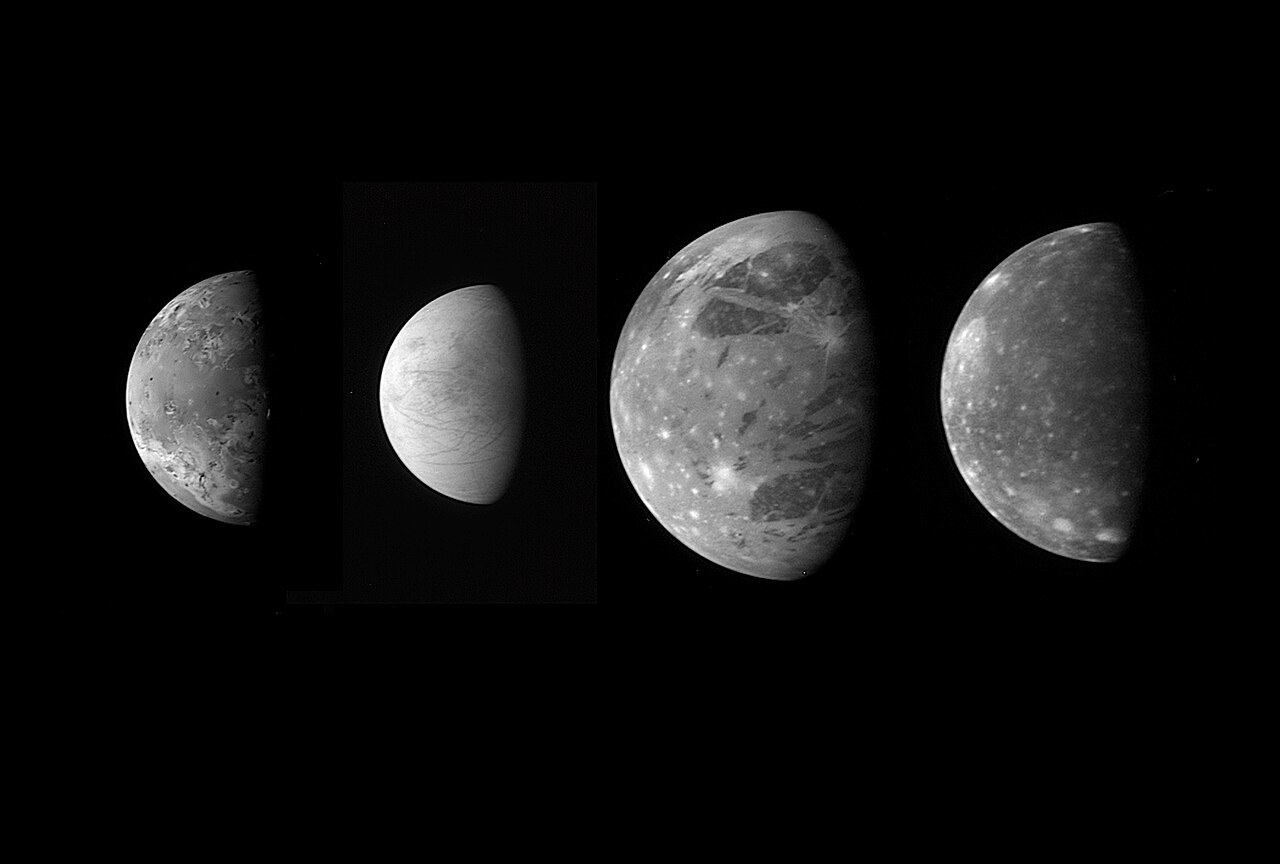half-lit moons in a row in black and white, from left a mottled one, a pale one crossed by thin lines, a larger one with dark patches and bright spots, and a darker one with many bright spots; it matches NASA's description of a montage of Jupiter's four large moons, Io, Europa, Ganymede and Callisto, from New Horizons in 2007, though the image itself carries no labels or credit](/m/2026/11/HZhAg_wHqMmx1ecb.jpg)
*Via Wikimedia Commons: [Jupiter's Moons - Family Portrait 050107 09](https://commons.wikimedia.org/wiki/File:Jupiter%27s_Moons_-_Family_Portrait_050107_09.jpg) by NASA/Johns Hopkins University Applied Physics Laboratory/Sou, public domain.*
## Sources
1. NASA Science. "Moons of Our Solar System." https://science.nasa.gov/solar-system/moons/ (read 23 November 2026)
2. NASA Science. "Moons: Facts." https://science.nasa.gov/solar-system/moons/facts/ (read 23 November 2026)
3. NASA Science. "Jupiter Moons." https://science.nasa.gov/jupiter/moons/ (read 23 November 2026)
4. NASA Science. "Saturn Moons." https://science.nasa.gov/saturn/moons/ (read 23 November 2026)
5. NASA Science. "Uranus Moons." https://science.nasa.gov/uranus/moons/ (read 22 November 2026)
6. NASA Science. "Solar System Facts." https://science.nasa.gov/solar-system/facts/ (read 23 November 2026)
