Version 2
Nov 23, 2026. Compare with the current version · Version history
A gas giant is a large planet made mostly of hydrogen and helium, with no solid surface, only swirling gases and liquids above a dense core.[1][2] The solar system has two, Jupiter and Saturn.[3]
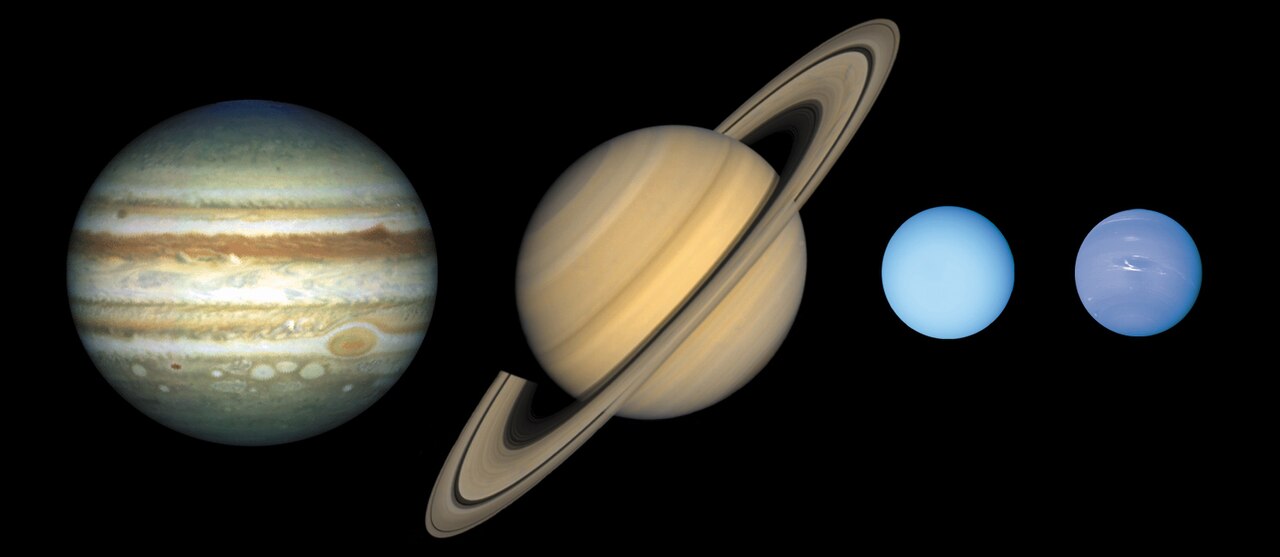
Via Wikimedia Commons: Gas planet size comparisons by Solar System Exploration, NASA, public domain.
What a gas giant is
NASA's exoplanet page defines a gas giant as a large planet mostly composed of helium and hydrogen, with no hard surface and instead swirling gases above a solid core.[1] NASA's solar system page says that, in the outer solar system, materials familiar to us as ice, liquid or gas settled far from the young Sun and were pulled together by gravity, which is where the gas giants Jupiter and Saturn and the ice giants Uranus and Neptune are found.[3] NASA's planets page says the giant planets don't have hard surfaces but swirling gases above a core.[4] See Planet and Solar System.
Jupiter
NASA gives Jupiter a radius of 69,911 kilometres, 11 times Earth's width, an average distance from the Sun of 778 million kilometres, or 5.2 astronomical units, and says its composition is similar to the Sun's, mostly hydrogen and helium.[5] Deep in the atmosphere, NASA says, the pressure compresses hydrogen into a liquid, giving Jupiter the largest ocean in the solar system, an ocean of hydrogen and not water, and at depths perhaps halfway to the centre electrons are squeezed off the hydrogen atoms, making the liquid electrically conducting like metal, with its fast rotation thought to drive a dynamo that generates the powerful magnetic field.[5] It says Jupiter has no true surface, and that a spacecraft would be crushed, melted and vaporised by the pressures and temperatures deep inside.[5] NASA describes likely cloud layers of ammonia ice, ammonium hydrosulfide crystals and water, a rotation of once every 10 hours that creates strong jet streams separating dark belts from bright zones, and a Great Red Spot storm bigger than Earth that has raged for hundreds of years.[5] See the Jupiter entry.
Saturn
NASA gives Saturn an equatorial diameter of about 120,500 kilometres, nine times Earth's width, and an average distance from the Sun of 1.4 billion kilometres, or 9.5 astronomical units, and says it is made mostly of hydrogen and helium like Jupiter, with a dense core of iron and nickel surrounded by rocky material, enveloped by liquid metallic hydrogen inside a layer of liquid hydrogen.[6] NASA says Saturn is the only planet in the solar system with an average density less than water, so that it could float in a bathtub if one existed that large.[6] It has no true surface, winds reaching 500 metres per second at the equator, and a six-sided jet stream at its north pole about 30,000 kilometres across.[6] See the Saturn entry.
The other giants
NASA's older spaceflight primer says Uranus and Neptune are composed primarily of rock and various ices, with extensive atmospheres of hydrogen and a little helium making up about 15 percent of each planet's mass, and calls the gas giants collectively "Jovian planets".[7] NASA now calls Uranus and Neptune ice giants.[4] See Uranus and Neptune.
Gas giants around other stars
NASA says gas giant exoplanets can be much larger than Jupiter and much closer to their stars than anything in the solar system, and that gas giants near their stars are often called "hot Jupiters", gas giants like Jupiter orbiting so closely that their temperatures reach thousands of degrees, some circling in as few as 18 hours.[1] NASA says hot Jupiters were among the first exoplanet types found because their tight orbits cause a measurable wobble in their stars, and that their existence raises the question of whether they form close to their stars or farther away and migrate inward, with the youngest known, HIP 67522 b, found in 2020 about 490 light-years away, about 10 times Earth's diameter and orbiting its star every seven days.[1] NASA says the first planet found around a Sun-like star, in 1995, was the gas giant 51 Pegasi b.[1] The discovery of more than 5,600 exoplanets over about 25 years changed understanding that had been based on the eight planets of the solar system.[1]
See also
The Natural satellite entry describes the many moons of the gas giants, and the Terrestrial planet entry describes the rocky planets near the Sun.
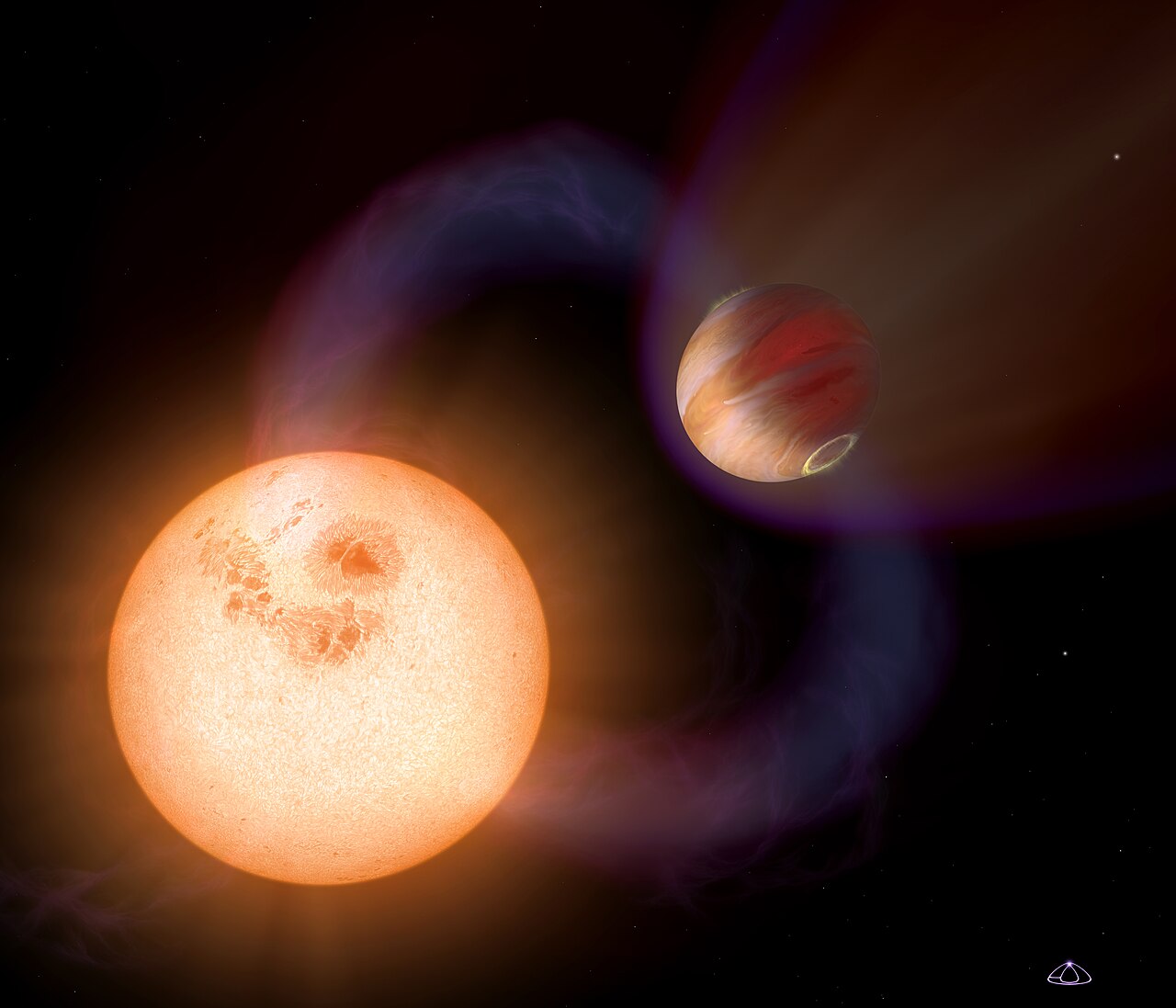
Via Wikimedia Commons: Artist's impression of an ultra-short-period planet by NASA, ESA and A. Schaller, CC BY 4.0.
Sources
- NASA Science. "Gas Giant" (exoplanets). science.nasa.gov/exoplanets/gas-giant/ (read 23 November 2026)
- NASA Science. "Jupiter Facts" and "Saturn Facts." science.nasa.gov/jupiter/facts/ and science.nasa.gov/saturn/facts/ (read 23 November 2026)
- NASA Science. "Solar System Facts." science.nasa.gov/solar-system/facts/ (read 23 November 2026)
- NASA Science. "Planets." science.nasa.gov/solar-system/planets/ (read 23 November 2026)
- NASA Science. "Jupiter Facts." science.nasa.gov/jupiter/facts/ (read 23 November 2026)
- NASA Science. "Saturn Facts." science.nasa.gov/saturn/facts/ (read 23 November 2026)
- NASA Science. "Basics of Space Flight, Chapter 1: The Solar System." science.nasa.gov/learn/basics-of-space-flight/chapter1-2/ (read 23 November 2026; page dates from about 2016)
