Compare versions
Version 2 → Version 4 (current). Removed · Added. This shows the entry's text as it is written, including its formatting marks.
Version 2 · Version 4 (current) · Version history
Side by side · Together
Version 2Version 4 (current)
The asteroid belt is the region between the orbits of [Mars](https://micwyn.com/t/3026/mars) and [Jupiter](https://micwyn.com/t/3029/jupiter) where most known asteroids orbit the Sun.[1][2] NASA says the belt is estimated to hold between 1.1 and 1.9 million asteroids larger than 1 kilometre across, and millions of smaller ones.[1]
The asteroid belt is the region between the orbits of [Mars](https://micwyn.com/t/3026/mars) and [Jupiter](https://micwyn.com/t/3029/jupiter) where most known asteroids orbit the Sun.[1][2] NASA says the belt is estimated to hold between 1.1 and 1.9 million asteroids larger than 1 kilometre across, and millions of smaller ones.[1]
## Where it is and what is in it
## Where it is and what is in it
NASA says most asteroids orbit the Sun between Mars and Jupiter in the main asteroid belt, generally on orbits that are not very elongated.[1] The largest object in the belt is the dwarf planet [Ceres](https://micwyn.com/t/3150/ceres), which NASA says is the largest object in the asteroid belt and makes up about 25 percent of the belt's total mass.[3] NASA gives the largest asteroid as Vesta, about 530 kilometres in diameter, with asteroids ranging down to under 10 metres across.[1] NASA says the total mass of all the asteroids combined is less than that of Earth's Moon.[1] See the [Asteroid](https://micwyn.com/t/3159/asteroid) entry.
NASA says most asteroids orbit the Sun between Mars and Jupiter in the main asteroid belt, generally on orbits that are not very elongated.[1] The largest object in the belt is the dwarf planet [Ceres](https://micwyn.com/t/3150/ceres), which NASA says is the largest object in the asteroid belt and makes up about 25 percent of the belt's total mass.[3] NASA gives the largest [asteroid](https://micwyn.com/t/3159/asteroid) as Vesta, about 530 kilometres in diameter, with asteroids ranging down to under 10 metres across.[1] NASA says the total mass of all the asteroids combined is less than that of Earth's Moon.[1] See the [Asteroid](https://micwyn.com/t/3159/asteroid) entry.
5 unchanged paragraphs
## Why it never became a planet
## Why it never became a planet
NASA says that early in the history of the solar system, the gravity of newly formed Jupiter brought an end to the formation of planetary bodies in this region and caused the small bodies to collide with one another, fragmenting them into the asteroids seen today.[1] NASA's solar system page says the asteroid belt is made of bits and pieces of the early solar system that could never quite come together into a planet.[4] NASA's Ceres page describes Ceres as an "embryonic planet" that began to form but whose growth Jupiter's strong gravity stopped.[3] See the [Solar System](https://micwyn.com/t/3151/solar-system) entry.
NASA says that early in the history of the solar system, the gravity of newly formed Jupiter brought an end to the formation of planetary bodies in this region and caused the small bodies to collide with one another, fragmenting them into the asteroids seen today.[1] NASA's solar system page says the asteroid belt is made of bits and pieces of the early solar system that could never quite come together into a planet.[4] NASA's Ceres page describes Ceres as an "embryonic planet" that began to form but whose growth Jupiter's strong gravity stopped.[3] See the [Solar System](https://micwyn.com/t/3151/solar-system) entry.
## What the asteroids are made of
## What the asteroids are made of
NASA says asteroids fall into three broad composition classes, C-, S- and M-type. The C-types are the most common, probably clay and silicate rocks, dark in appearance, and among the most ancient objects in the solar system. S-types are silicate materials with nickel-iron, and M-types are metallic. NASA says the compositional differences are related to how far from the Sun the asteroids formed, and that some warmed enough after formation to partly melt, with iron sinking to the centre and basaltic lava forced to the surface.[1]
NASA says asteroids fall into three broad composition classes, C-, S- and M-type. The C-types are the most common, probably clay and silicate rocks, dark in appearance, and among the most ancient objects in the solar system. S-types are silicate materials with nickel-iron, and M-types are metallic. NASA says the compositional differences are related to how far from the Sun the asteroids formed, and that some warmed enough after formation to partly melt, with iron sinking to the centre and basaltic lava forced to the surface.[1]
## Leaving the belt
## Leaving the belt
NASA says Jupiter's massive gravity, and occasional close encounters with Mars or other objects, can change asteroid orbits, knocking asteroids out of the main belt and hurling them across the orbits of the other planets, and that stray asteroids and fragments have struck Earth and the other planets in the past, playing a major role in the geological history of the planets and the evolution of life on Earth.[1] NASA says some asteroids and comets are nudged by the gravity of planets into Earth's neighbourhood and become near-Earth objects, whose closest approach to the Sun is less than 1.3 times Earth's distance from it.[1]
NASA says Jupiter's massive gravity, and occasional close encounters with Mars or other objects, can change asteroid orbits, knocking asteroids out of the main belt and hurling them across the orbits of the other planets, and that stray asteroids and fragments have struck Earth and the other planets in the past, playing a major role in the geological history of the planets and the evolution of life on Earth.[1] NASA says some asteroids and comets are nudged by the gravity of planets into Earth's neighbourhood and become [near-Earth objects](https://micwyn.com/t/3161/near-earth-object), whose closest approach to the Sun is less than 1.3 times Earth's distance from it.[1]
10 unchanged paragraphs
## Visited by Dawn
## Visited by Dawn
*Physics Today* says NASA's Dawn mission, launched in 2007, studied Vesta in 2011 and 2012 and arrived at Ceres in 2015, and describes the pair as two very different protoplanets in the belt.[5] NASA says Dawn went into orbit around Ceres on 6 March 2015, the first spacecraft to orbit a dwarf planet.[3]
*Physics Today* says NASA's Dawn mission, launched in 2007, studied Vesta in 2011 and 2012 and arrived at Ceres in 2015, and describes the pair as two very different protoplanets in the belt.[5] NASA says Dawn went into orbit around Ceres on 6 March 2015, the first spacecraft to orbit a dwarf planet.[3]
## Moons of asteroids
## Moons of asteroids
NASA says more than 150 asteroids are known to have small companion moons, some two, and that there are also binary asteroids and triple systems, and that scientists did not know asteroids could hold moons until Galileo flew past Ida in 1993 and found Dactyl.[1][6] See the [Natural satellite](https://micwyn.com/t/3154/natural-satellite) entry.
NASA says more than 150 asteroids are known to have small companion moons, some two, and that there are also binary asteroids and triple systems, and that scientists did not know asteroids could hold moons until Galileo flew past Ida in 1993 and found Dactyl.[1][6] See the [Natural satellite](https://micwyn.com/t/3154/natural-satellite) entry.
## See also
## See also
The [Dwarf planet](https://micwyn.com/t/3153/dwarf-planet) entry describes Ceres's category and the [Planet](https://micwyn.com/t/3152/planet) entry the definition that separates them from asteroids. The [Terrestrial planet](https://micwyn.com/t/3155/terrestrial-planet) and [Gas giant](https://micwyn.com/t/3156/gas-giant) entries describe the planets on either side of the belt.
The [Dwarf planet](https://micwyn.com/t/3153/dwarf-planet) entry describes Ceres's category and the [Planet](https://micwyn.com/t/3152/planet) entry the definition that separates them from asteroids. The [Terrestrial planet](https://micwyn.com/t/3155/terrestrial-planet) and [Gas giant](https://micwyn.com/t/3156/gas-giant) entries describe the planets on either side of the belt.
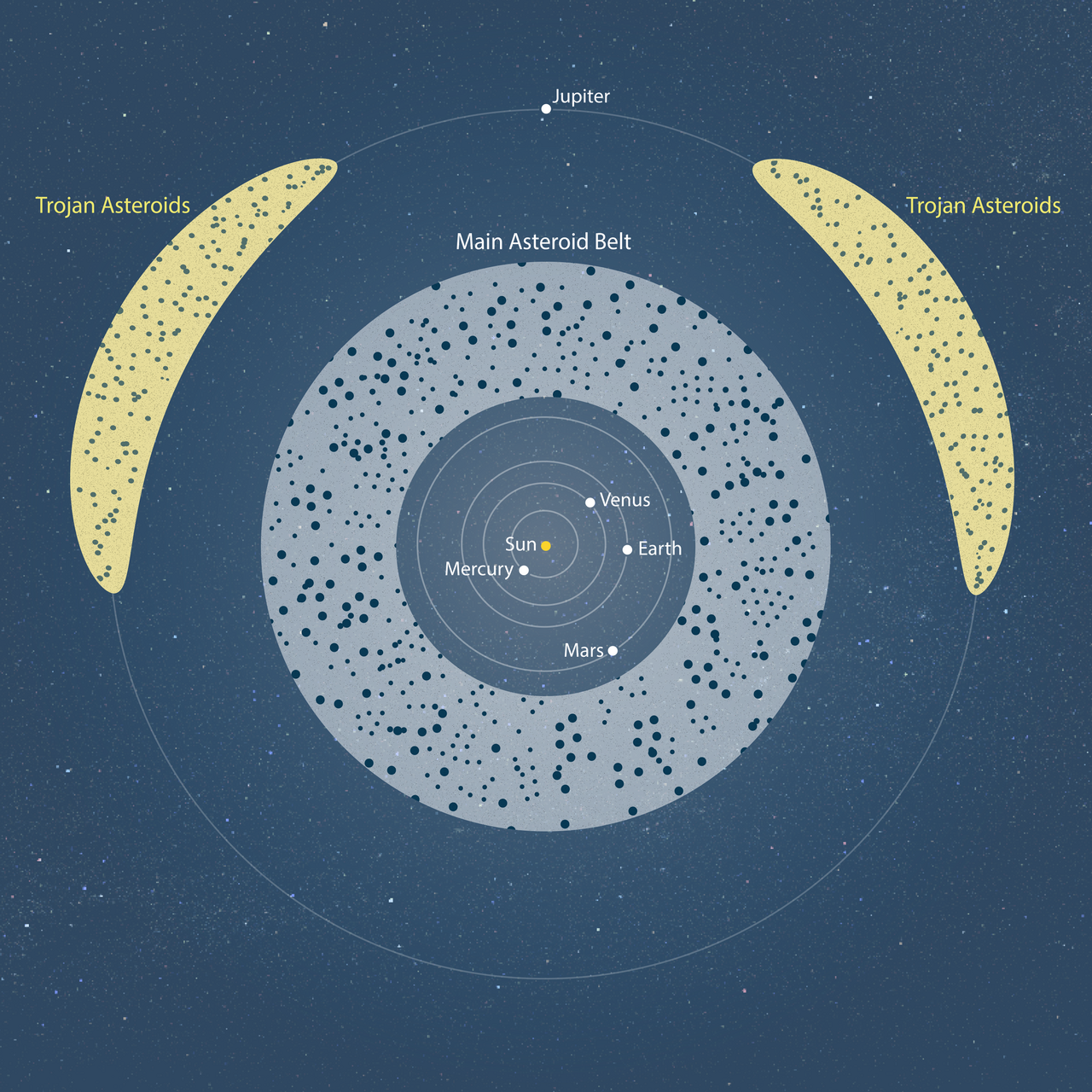

*Via Wikimedia Commons: [Asteroid Belts (Illustration) (2020-25-4663-Image)](https://commons.wikimedia.org/wiki/File:Asteroid_Belts_(Illustration)_(2020-25-4663-Image).png) by IMAGE: NASA, ESA, Joseph Olmsted (STScI), public domain.*
*Via Wikimedia Commons: [Asteroid Belts (Illustration) (2020-25-4663-Image)](https://commons.wikimedia.org/wiki/File:Asteroid_Belts_(Illustration)_(2020-25-4663-Image).png) by IMAGE: NASA, ESA, Joseph Olmsted (STScI), public domain.*
## Sources
## Sources
1. NASA Science. "Asteroid Facts." https://science.nasa.gov/solar-system/asteroids/facts/ (read 23 November 2026)
2. NASA Science. "Asteroid Belt." https://science.nasa.gov/solar-system/asteroid-belt/ (read 23 November 2026)
3. NASA Science. "Ceres Facts." https://science.nasa.gov/dwarf-planets/ceres/facts/ (read 23 November 2026)
4. NASA Science. "Solar System Facts." https://science.nasa.gov/solar-system/facts/ (read 23 November 2026)
5. Physics Today. "Ceres, a window into how planets could harbor life." https://physicstoday.aip.org/quick-study/ceres-a-window-into-how-planets-could-harbor-life (read 23 November 2026)
6. NASA Science. "Moons: Facts." https://science.nasa.gov/solar-system/moons/facts/ (read 23 November 2026)
